
Knowledge · Kitchen and use
Parasites in fish
Wild fish can carry many different parasites. Only some of them also make people ill, especially if the fish is eaten raw or not cooked through. A freezer thermometer shows whether your freezer gets cold enough.
Which parasites affect people
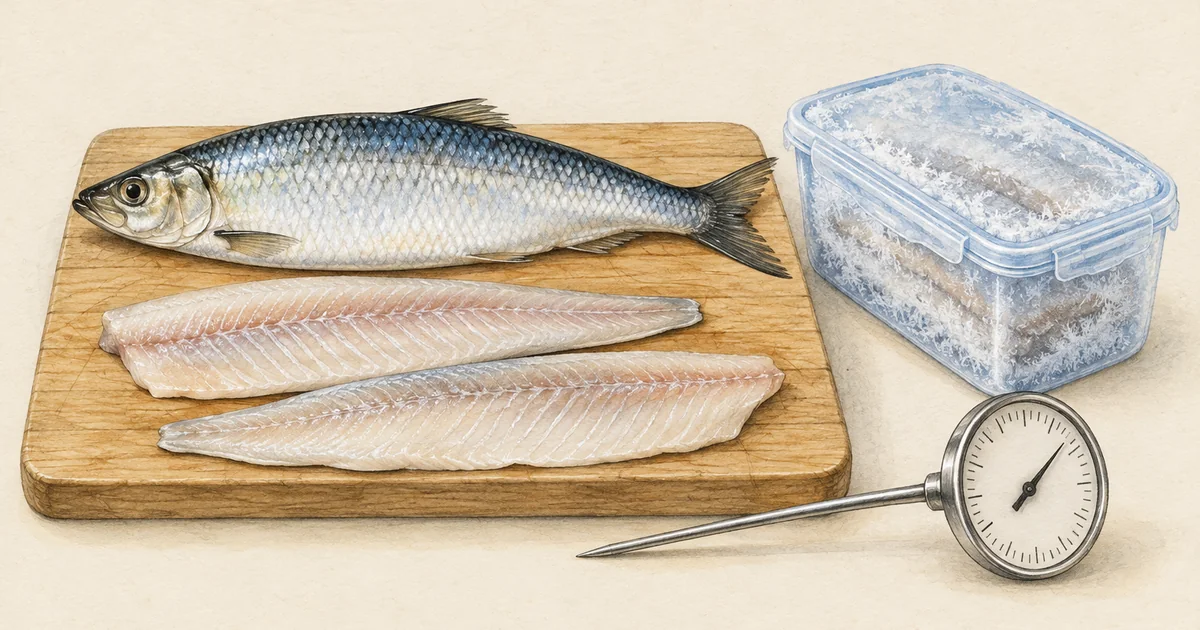
Parasites infest a host and feed on it. The German Federal Institute for Risk Assessment (Bundesinstitut für Risikobewertung, BfR) distinguishes ectoparasites, which live on the outside, for example on the skin, from endoparasites on the inside. Endoparasites can get into people through food and cause illness (BfR).
Fish can be infested by very different parasites. Some of them can cause illness in people too, above all those from wild-caught fish. What matters is whether they are eaten alive: according to current knowledge, dead stages pose no health risk to healthy people, writes the Lower Saxony state office LAVES.
The EU bases its rules on an opinion of the food authority EFSA. According to it, all wild-caught sea and freshwater fish must be expected to carry viable parasites dangerous to humans if they are to be eaten raw or almost raw (Regulation (EU) No 1276/2011). According to the Bavarian state office LGL, illnesses caused by worms from food have become very rare in Germany.
Roundworms in sea fish
In sea fish the most important parasites are the larvae of roundworms (nematodes). The adult worms live in marine mammals, and their larvae reach the fish through intermediate hosts. Mainly Anisakis simplex and Pseudoterranova occur (LGL). All sea fish can be infested (BZfE), including herring, mackerel, cod and coley.
The larvae are transparent and, according to LAVES, up to about 3,5 centimetres long. A photo from the office shows a coiled larva in a monkfish fillet. They grow in the body cavity and in the muscle (Lexikon der Biologie). So you can find them in the belly cavity when gutting and in the flesh when filleting.
The EU hygiene regulation requires businesses to gut fish as soon as possible after the catch, where technically possible, and to remove the viscera quickly (Regulation (EC) No 853/2004). Along with the viscera you also remove the larvae that sit in the belly cavity (see Gutting fish). Businesses also check for parasites, for example on light tables that shine through the fillet. This works with pale flesh such as that of cod-like fish, but not with dark flesh (LAVES). When filleting, hold a pale fillet up to the light and cut out any visible worms.
According to LAVES, larvae eaten alive can cause illness, above all of the gut. The federal health portal names stomach pain, diarrhoea, nausea and vomiting for anisakiasis (gesund.bund.de). There is also a risk of allergy: according to EFSA, Anisakis is the only parasite in fish products that can cause allergic reactions, according to LAVES also through dead larvae.
Fish tapeworm in freshwater fish
The fish tapeworm (Diphyllobothrium latum) can pass from freshwater fish to people. Its larvae are taken up first by a small crustacean, then by a fish such as the perch, in whose liver or muscle they grow. They accumulate in predatory fish such as the pike. The adult worm lives in the gut of fish-eating mammals and of humans (Lexikon der Biologie).
You can catch it from raw fish. According to the health portal, possible consequences are stomach pain, diarrhoea and, after some time, a vitamin B12 deficiency; some people affected have no symptoms (gesund.bund.de). For freshwater fish that is to be eaten raw, LAVES gives at least one week at minus 20 degrees Celsius, for sea fish at least 24 hours (LAVES).
What you see on the outside and when gutting
These parasites stand out on freshwater fish. The descriptions come from specialist encyclopedias and from the fish health service and concern the fish, not human health.
- Fish leech: round, greenish to brownish with pale spots, sucks on silver fish, pike and perch. Length according to Lexikon der Biologie two to five centimetres, according to Fischgesundheitsdienst Bayern up to three. Pinpoint bleeding appears where they have sucked.
- Carp louse: a flat crustacean of six to seven millimetres, easy to see on the pale belly side. It pierces the skin, sucks blood and changes host (Fischgesundheitsdienst Bayern, Lexikon der Biologie).
- Black spot disease: black dots in the skin and muscle, above all in cyprinids such as roach and bream. They are encysted larvae of a fluke, around which the fish deposits dark pigment. The adult worm lives in fish-eating birds (Wikipedia).
- Ligula tapeworm: larva of the tapeworm Ligula intestinalis, up to one metre long in the body cavity of freshwater fish, above all cyprinids. The adult lives in gulls and other water birds (Lexikon der Biologie, Wikipedia).
- Thorny-headed worms: mostly white intestinal worms that fasten to the gut wall with a hooked proboscis (Lexikon der Biologie).
That does not mean a fish infested in this way still belongs in the kitchen. For trade, LAVES says: fish or fillets that are clearly infested with parasites are unfit for consumption and must not be sold. If in doubt, ask the fish health service (Fischgesundheitsdienst).
Heating and freezing: the figures from the authorities
Heat and cold kill parasites. The values differ depending on the source:
| Where | Heating | Freezing |
|---|---|---|
| EU regulation, for businesses | 60 °C at the core, at least 1 minute | −20 °C at least 24 h or −35 °C at least 15 h |
| EFSA, for Anisakis | over 60 °C, at least 1 minute | −15 °C 96 h, −20 °C 24 h or −35 °C 15 h |
| BfR | 70 °C, 2 minutes at every point | suitable “under certain conditions” |
| LAVES | cook through | −20 °C: sea fish 24 h, freshwater fish 1 week |
| BVL | cook until opaque | “a few days” at −20 °C |
| AGES, Austria | 70 °C | −20 °C, 24 h |
The EU values apply to businesses and not to flukes. The temperature must be reached throughout the fish, so the time only starts running when the core is also that cold or that hot.
Check your freezer: BfR assumes minus 18 degrees Celsius in the home (BfR: Korrektes Kühlen). But the 24 hours apply at minus 20 degrees. At minus 15 degrees EFSA gives at least 96 hours. A freezer thermometer shows what your appliance can do.
Smoking, salting, curing and raw fish
Freezing and heating are, according to EFSA (2024), still the most effective methods of killing parasites. For marinated, salted and otherwise treated fish products, the EU regulation requires freezing if the treatment does not kill the parasites.
The Austrian agency AGES advises freezing fish before putting it in salt or marinade. That applies to gravlax as well as to pickled herring. According to its account, cold-smoked fish needs the same cold treatment if the core does not exceed 60 degrees during smoking. Matjes is frozen after maturing, also to kill parasites (BZfE). More under Smoking fish.
LAVES advises against eating raw fish you have caught yourself if it has not been frozen through sufficiently. BfR does not recommend raw fish at all for small children, pregnant women and people with a weakened immune system. Pregnant women and people with weakened immunity should, as a precaution because of listeria, also avoid smoked and cured fish unless it is cooked through.
Reporting suspicious fish
You report heavy infestation, ulcers or a fish kill first to the water manager, that is, the club or leaseholder. Depending on the federal state (Bundesland), examination is carried out by the fish health service, by a state office or through the veterinary office. In Lower Saxony LAVES handles this diagnostics including parasites, in Bavaria the fish health service at the Tiergesundheitsdienst. Worms in fish you have bought are a matter for the retailer and food inspection.
Not a substitute for a doctor: This text does not replace medical advice. Anyone who gets stomach pain, diarrhoea or vomiting after raw or undercooked fish should have it checked by a doctor and say what they ate.
Frequently asked questions
Is a fish with roundworms still edible?
According to LAVES, dead larvae pose no health risk to healthy people. So only fish that is cooked through or sufficiently frozen is safe. You still cut out any visible worms. According to LAVES, allergies to Anisakis can also arise from dead larvae.
How long must fish you have caught yourself go in the freezer for sushi?
According to LAVES, sea fish at least 24 hours at minus 20 degrees Celsius, freshwater fish at least one week. BVL speaks of a few days. If your appliance does not reach minus 20 degrees, the 24 hours do not apply.
Do farmed fish have parasites too?
Many do not. According to the limited data of EFSA (2024), farmed Atlantic salmon, rainbow trout, carp and wels catfish, for example, are free of parasites that infest humans. Such parasites were found in sea bass, bluefin tuna, cod and tench from sea pens or flow-through ponds.
Related
- Gutting fish: the belly cut step by step
- Filleting and boning fish: the three cuts
- Storage and hygiene: cold chain and thawing
- Smoking fish: hot and cold smoke
- Scaling and skinning fish: the preparation for filleting
- Stunning and killing fish: the step before gutting
- Fish diet: what fish eat
Sources
- Bundesinstitut für Risikobewertung: Parasiten in Lebensmitteln, Lebensmittelinfektionen im Privathaushalt, Korrektes Kühlen (70 °C, Risikogruppen, Tiefgefrieren)
- Landesamt LAVES Niedersachsen: Parasiten in Fischen, Sushi selber machen, Untersuchung von Fischen (Larven, Gefrierzeiten, Rohverzehr, Diagnostik)
- Landesamt LGL Bayern: Fish, Erkrankungen durch Parasiten (Nematoden, Seltenheit)
- Europäische Union: Verordnung (EU) Nr. 1276/2011, Verordnung (EG) Nr. 853/2004 (Gefrieren, Erhitzen, Ausnehmen)
- EFSA: Parasiten bei Fisch (2010), Zuchtfische (2024)
- BVL: Hygienischer Umgang mit Fisch; AGES: Fisch (Garen, Einfrieren, Einlegen)
- Bundesgesundheitsministerium, gesund.bund.de: Anisakiasis, Diphyllobothriose (Beschwerden)
- Bundeszentrum für Ernährung: Gesundheit und Umwelt, Vom Fang in den Handel (Seefische, Matjes)
- Spektrum, Lexikon der Biologie: Anisakis, Diphyllobothrium, Ligula, Piscicolidae, Fischläuse, Acanthocephala (Lebensweise)
- Fischgesundheitsdienst Bayern: Krankheiten in der Karpfenteichwirtschaft (Karpfenlaus, Fischegel)
- Wikipedia: Posthodiplostomum cuticola, Riemenwurm (nur Lebensweise, keine Gesundheitsangaben)
Text AI-assisted, drawing AI-generated. Sources opened and checked in October 2026; no graphics taken from the sources.
All details are guidelines and given without guarantee. The text is no substitute for medical advice; the advice of the authorities and of food inspection is what counts.