
Knowledge · Tackle
Floats: Shapes, carrying capacity and use
A float holds the bait at a fixed depth and signals the bite on the surface. Which shape suits depends on water, wind and bait: slim on a lake, stocky on a river, large and with high carrying capacity for baitfish. This page explains the parts, shapes and the carrying-capacity figure.
Build: antenna, body, stem and eye
Most floats have three parts. At the top sits the antenna, the thin, coloured stem you see at the water. Below it lies the body, which provides the buoyancy. At the bottom comes the stem, a thin rod of wire or carbon fibre, on which the attachment sits in many models. Once balanced, only the antenna sticks out of the water, according to the tackle guide of the Fischereiverein Löningen (fig. 1).
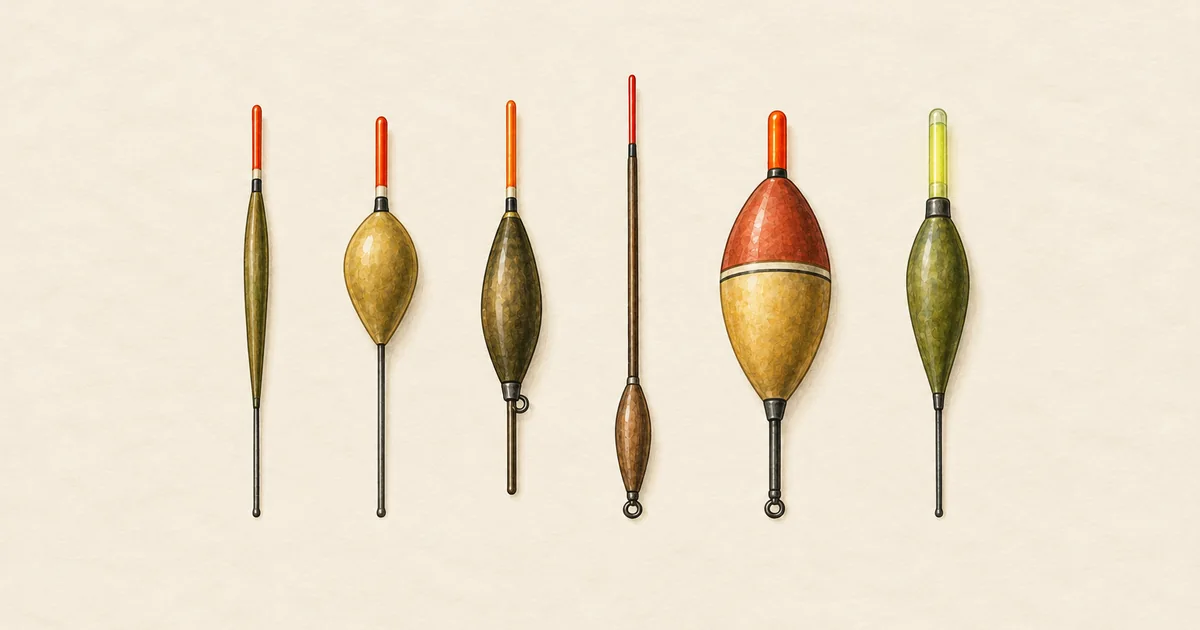
Manufacturers today mostly make the body from balsa or rigid foam (Fischereiverein Löningen). In the Bavarian exam catalogue, rigid foam is the float material with the greatest buoyancy, compared with hardwood and softwood. For the stem there are two materials: wire is heavy, so the float sits better in the water, especially when the surface is moving. In return it bends more easily, and the rig tangles more often in the cast. Carbon fibre springs back to its starting position and suits fine floats.
Not every float has all the parts. The stick float, a slim peg, traditionally of balsa, for slow-flowing rivers, manages entirely without stem and antenna.
Attachment: top and bottom, or bottom only
The classic fixed float sits on the line at the top and bottom; anglers attached it this way centuries ago. On some models rubber rings hold the line to the outside of the body, on others three pieces of silicone tube on the stem join the float to the line. To adjust it, you slide the whole float. It cannot manage more than a rod length of depth, says the tackle guide of the Landesfischereiverband Baden-Württemberg.
The waggler hangs on the line by just one eye at the lower end. This way the line runs under water, where the wind hardly catches it (Rute & Rolle). How to distribute the weight and sink the line is covered under Waggler rig.
The sliding float glides on the line until a stopper holds it. With it you can reach any depth. The exam catalogue of Saxony-Anhalt names it for spots where the fishing depth clearly exceeds the rod length. The line runs through one or two eyes (Fischereiverein Löningen) or through a channel in the body. According to Rute & Rolle, this internal guide needs enough lead for the line to slip through reliably, and so belongs more to heavy fishing. The build is shown by the float rig, and the stoppers are introduced in Stoppers, beads and shrink tube.
Shape by water, current and wind
There is no single float for every situation, writes the Fischereiverein Löningen. In still water it should be slim, in a river compact, and in wind and waves a low centre of gravity helps. The Landesfischereiverband Baden-Württemberg names long, slim floats for lakes and short ones in drop or ball shape for flowing waters.
For pole fishing four shapes are enough:
- Inverted carrot, thickest at the top: still water.
- Onion shape: strong wind or great depth on a lake, plus slow-flowing water.
- Egg or ball: stronger current.
- Lollipop float, flat as a disc: very fast water.
Each shape reacts slightly differently to a bite: some show lift bites less well, and with a float whose antenna is too thick, timid bites stay invisible. That is why Blinker advises sticking to these four shapes and carrying them in several carrying capacities. The line has to suit too: light floats are hard to cast on line that is too thick, and sometimes impossible in wind. What the line still holds after the knot is shown by the line calculator.
Bellied river floats, called loafers in English, stay up even in wild water and drift along evenly. How hard it gets in the current is shown by an example: in very fast current a 40 gram lollipop was too light for one pole angler, so he switched to 50 grams.
| Shape | Attachment | Use |
|---|---|---|
| Pole float | fixed, top and bottom | pole fishing, depth up to rod length |
| Stick float | fixed, top and bottom | slow-flowing rivers |
| Lollipop float | fixed, tubes on the stem | very strong current |
| Sliding float | eye or internal guide, stopper | deeper than the rod is long |
| Waggler | bottom eye only | lake, wind, long casts |
| Glow-stick float | depending on the model | Dusk and night |
| Pike float | eye at the bottom, stopper | baitfish for pike |
Carrying capacity: what the number means
The number on the float gives the lead in grams that it carries (Landesfischereiverband Baden-Württemberg). With that amount it stands upright and only the antenna shows. Whatever buoyancy is left over, the fish has to overcome when it bites. The exam catalogue of Saxony-Anhalt therefore demands as little buoyancy as possible. Blinker advises the lightest float possible: one of 2 grams shows bites much better than one of 6 grams.
Guide values from the Zusammenfassung Gerätekunde of the Fischereiverein Löningen: for roach in still water about 1 gram, in a river more depending on the current, for carp 2 to 5 grams, with a dead baitfish for pike 10 to 20 grams. Which shot together make up your carrying capacity is worked out by Float shotting.
Shotting: where the weight goes
The weight goes on the main line, not on the hooklength. How you distribute it depends on shape and water. The float shotting tool calculates four patterns based on specialist articles:
| Pattern | Float | Use |
|---|---|---|
| string of shot | slim carrot | still water |
| olive with half the carrying capacity, string below | onion shape | windy or deep lake, slow water |
| string, from the heaviest shot under the float getting lighter towards the hooklength | Stick float | slow to medium-paced water |
| single-point shotting with olive or ball | round float, lollipop | Flowing waters |
Together the shot add up to at most the carrying capacity. According to the conversion table from Angling Times, British shot sizes weigh: BB 0,4 g, AAA 0,8 g, No. 6 0,1 g and No. 8 0,06 g. On pre-weighted floats two numbers are printed on the body: with 10 + 3, 10 g are already in the float and 3 g belong on the line.
The sliding float needs weight so that the line runs quickly through the eye. The minimum is one gram per metre of water depth, as long as there is no strong undertow. At three metres of depth that is around 3 g.
Lead: Split shot is mostly made of lead. The EU has restricted lead in fishing tackle with Regulation (EU) 2026/2501, which applies from 3 December 2026. It concerns the sale of fishing tackle containing 1 per cent lead or more, not recreational angling with lead. When which lead may no longer be sold is set out on the page Fishing weights. Substitutes have a different density: lead comes to 11,3 g/cm³, iron to 7,9 and tungsten to 19,3. A lead-free shot of the same weight is therefore larger or smaller; go by the grams on the packet.
Wind, distance and current
In wind and at distance the waggler shows its strength. Its body sits low, the centre of gravity lies far below the surface, and high waves pass evenly over the small tip. The long, fine antenna offers surface drift little resistance, as long as the line lies under water.
With a straight waggler the bait stays steady in wind, says Angling Times. Without wind, a waggler with a tip insert shows timid bites better. Pre-weighted waggler fly ahead on the cast and pull the small shot behind them. In a deep canal with a slight current, though, the bait sinks slowly on a 10 + 3 waggler: by the time the 3 g on the line have it on the bottom, the float has drifted several metres. That is what the Zoomer is for.
So that the wind does not push a bow into the line, you sink it: dip the rod tip in by about 20 cm, tighten with a few turns of the handle and pull the rod out sideways with a jerk. More on this at the waggler rig.
In a river the surface current pulls the float faster than the undercurrent. If you work the bait stop-and-go, the hook is flushed into faster water; you set the rig up as described under float rig.
Reading bite patterns on the float
The float shows only what happens at the lowest shot and the bait:
- Tilting and trembling: anglers report that the float tilts to the side, trembles and stands again, then jerks follow and it moves off. When it moves off purposefully, the angler strikes.
- Lift bite: the fish lifts the lowest shot, the antenna rises out of the water like an asparagus spear, and the float can even lie flat on the water. Because only the weight is moved, the fish feels hardly any resistance.
- Wave rhythm disturbed: with a waggler in wind the waves run evenly over the tip; when the rhythm is interrupted, it is time to strike.
- Nothing to see, bait sucked clean: the float carries too much or has an antenna that is too thick.
- Float dips or tumbles below the surface: in a river it is set too deep. Set it shallower until it travels its course smoothly.
Special forms: glow stick, pike and sbirolino
Glow-stick float for the night
For dusk and night there are floats into which a glow stick is pushed, a light rod that glows once snapped. Some night floats also work with a battery and LED (Fischereiverein Löningen). For eel in still water, glow-stick floats of 3 to 6 grams are usual, rarely over 10 grams (Blinker).
Bright yellow or green glow sticks suit water more than 2 metres deep. Between half a metre and one metre they can disturb fish; there you use red or blue light. More on the glow sticks under Glow sticks, on procedure and rules under Night fishing. How to retrofit an ordinary float is explained further down under Accessories.
Pike float for baitfish
There are several shapes for baitfish for pike. The slim pencil float runs on the line by an eye at the lower end, limited upwards by stopper and bead. For dead baitfish you set it 30 centimetres over-deep, so deeper than the water is, and straighten it by tightening the line. The dart float carries a sail on top, stays easy to see even in waves and carries up to 30 grams. The sail float is left to drift over large waters in strong wind. Anyone who wants the baitfish to dance on the waves uses floats of 50 grams carrying capacity for this.
Keep an eye on the floats: If a pike takes the bait unnoticed, it can swallow the hooks so deeply that they cannot be removed without fatally injuring it. The rig is shown by the baitfish rig, the bite-proof leader by the Pike leader.
Sbirolino: float as casting weight
The sbirolino, called a bombarda in Italy, consists of a body and a tube through which the line runs. When trolling at a trout lake it serves only as a casting weight and does not show bites. How to fish it is covered under the sbirolino rig.
Accessories: adapters, float rubbers and light
A few small parts decide how quickly you can change your set-up at the water. With an adapter or float rubbers you swap the float while hook, weight and depth stay where they are. With a holder or a rubber band, your day float becomes a night float in the evening.
Float adapter: changing floats without cutting the line
The float adapter sits on the main line, and the float is simply plugged into it by its base. Blinker describes it as an aid for swapping the float quickly without cutting the line. Two rubber stoppers hold the adapter in place and with it the set depth. If the wind picks up, you pull the float out and push in a heavier one in a single movement. Fisch & Fang uses a silicone attachment with a swivel on the waggler and fixes the depth with two silicone stoppers, or three or four for heavier floats. There are also systems with a snap swivel into which the float is simply clipped. According to Blinker, bulbous river floats are also better attached via an adapter than threaded onto the line.
For the sliding float there are attachments that take the place of the eye. Fisch & Fang names two advantages: the float can be swapped at any time, and the bore is so narrow that even a stopper knot of 0,22 mm mono stops it. Such a small knot runs smoothly through the rod rings. According to the same source, long-range wagglers can weigh up to 40 grams. For them there are attachments with a brass tube through which the line runs. If one of the tubes splits, the float still stays on the rig. How stoppers and beads work together is explained under Stoppers, beads and shrink tube, the swivels themselves under Swivels, snaps and split rings.
Some floats have interchangeable antennae. Then you only swap the tip and leave everything else as it is. According to Fisch & Fang, a bright yellow is often easier to see than orange on dark water, and black against the light. Blinker lists antennae in red, yellow and black.
Float rubbers on the fixed float
Float rubbers are short rings or pieces of silicone tubing that hold a fixed float on the line. According to Blinker there are usually two on a stick float: a larger one under the tip and a smaller one further down the stem. Three are better. If one becomes brittle and splits, the others hold and you do not have to rig up again. The same rubbers let you quickly swap the float for a larger or smaller model.
According to Blinker, long peacock-quill floats soon break if only two rubbers hold them; they need three. Push the two outer ones right to the ends. If one end of the float sticks out freely, the rig is more likely to tangle in the cast. On a pole float with three pieces of tubing on the stem, Fisch & Fang sets the top one a little away from the body. The float then slides more easily when you adjust it, and the line does not cut into the body. The bottom piece may be a little longer and overhang at the bottom, so nothing catches there.
Glow-stick holder and light float
You do not necessarily need a dedicated glow-stick float. For the match rod there are wagglers whose tip takes a glow stick (Blinker). Other floats have interchangeable tips that you swap for a small light at dusk. If there is no holder at all, you tie the light to the antenna with a rubber band. It does not look pretty, but it holds, reports Blinker. If a silicone tube holds the line at the top of the float, it belongs at the upper end of the glow stick: then nothing sticks out, and the rig does not flip over in the cast (Fig. 3).
The dipping float (Tunkpose) is different. When dipping, you use it to hold the bait in place in strong current. It stays completely above the water, about 10 centimetres above the surface, and the bite shows as a jerk. According to Blinker, the glow stick goes on the stem here, not on the antenna. In shallow water Blinker advises blue glow sticks or darkening the light slightly with a waterproof marker. The fish then notice it less, while at short range the float stays clearly visible to you.
Before you use a battery-powered light float, check the state law. In Bavaria the implementing regulation for the fisheries act prohibits fishing using electric light sources (§ 15 Abs. 1 Nr. 1 AVBayFiG, as of November 2026). What that means for a light float is something to clarify with your club or the fisheries authority (Fischereibehörde); in other federal states the rules are set out in state law and in the fishing permit (Erlaubnisschein). Colours, glow time, disposal and dealing with leaked liquid are explained on the page Glow sticks.
Common mistakes
- Too much carrying capacity: If the maggots are sucked dry when you reel in and the float showed nothing, it was probably too buoyant.
- Wrong shape: The slim lake float on a river, or a float without a low centre of gravity in wind. The wrong float at the wrong time is among the most common mistakes in pole fishing.
- Accepting the printed figure unchecked: With floats made of peacock quill the carrying capacity varies markedly. Work up to the antenna with small shot.
- Fine wire eye on a heavy float: On larger floats it can tear out in the cast, strike or fight; an internal guide cannot (Fisch & Fang).
- Putting the weight on the hooklength: it belongs on the main line; the hooklength stays free.
- Line too thick for a light float: it is hard to cast, and sometimes impossible in wind.
- Glaring glow stick in the shallows: If the fish feel disturbed, they often just push the float about and do not take the bait.
Frequently asked questions
What does the number on the float mean?
The lead in grams that the float carries until only the antenna shows. The suitable shot are given by Float shotting.
Fixed float or sliding float?
A fixed float is enough down to roughly the length of the rod. If the water is deeper than the rod is long, the Bavarian exam catalogue also recommends the sliding float (Durchlaufschwimmer), that is, with a stopper.
Which float helps in wind on a lake?
One with a low centre of gravity, such as the onion shape or a waggler. On the waggler the buoyancy body sits in the lower third, describes Fisch & Fang, and the line runs under water.
How much buoyancy does a sliding float need in deep water?
As a rule of thumb, one gram per metre of depth, as long as there is no strong undertow. That is a minimum; it can be a little more so that the line slides through the eye.
How can I tell a bite on the float?
It trembles, tilts, moves off, dives or rises out of the water on a lift bite. With a waggler in wind, the disturbed rhythm of the waves over the tip is the sign.
Related
- Float rig: build with stopper, bead and shot
- Float shotting: shot matched to the carrying capacity
- Float rod: match, Bolognese and pole
- Fishing weights: shot, olives and other shapes
- Plummet: measure the depth before setting
- Waggler rig: sinking the line and distributing the weight
- Float fishing: the method at a glance
- Line calculator: what thin hooklengths can still carry after the knot
Sources
- Fischereiverein Löningen: Gerätekunde (PDF) (Werkstoff, Form nach Gewässer und Wind, Antenne, Leuchtposen, feste Pose und Laufpose) und Zusammenfassung Gerätekunde (PDF) (Tragkraft für Rotauge, Karpfen, Hecht)
- Landesfischereiverband Baden-Württemberg: Gerätekunde (PDF) (Formen für See und Fluss, feste und laufende Pose, Zahl auf der Pose)
- LfL Bayern: Prüfungsfragen zur Fischerprüfung 2023/2024 (PDF) (Hartschaum, Durchlaufschwimmer) und Sachsen-Anhalt: Fragenkatalog zur Fischerprüfung (PDF) (Auftrieb, Laufpose)
- Blinker: Fehler beim Stippangeln (vier Formen, falsche Pose), Posenangeln leicht gemacht (leichte Pose, Flussposen, Adapter an der Flusspose, Ersatzgummi, Wechselantennen), Draht- oder Carbonkiel?, Die Stick-Pose (ohne Kiel und Antenne), Lutscher unter Strom (50 Gramm, Schläuche am Kiel)
- Blinker: Hechtpose (Formen, Befestigung, Übertiefe, Tragkraft, Warnung), Aal im Stillwasser (Knicklichtpose 3 bis 6 Gramm), 10 Mythen beim Nachtangeln (Knicklicht und Wassertiefe), Posen zum Forellenangeln (schwankende Tragkraft, drei Posengummis an der Feder), Sbirolino (Aufbau, Name)
- Rute & Rolle: Die Laufpose (Gummiringe, Laufposen-Typen, Innenführung, Waggler)
- Fisch & Fang: Pfiffiges zum Posenfischen (Schläuche am Kiel und ihr Sitz, Drahtöse, Adapter mit Wirbel, Einhänger für Lauf- und Weitwurfposen, Wechselantennen), Wer erfand den Waggler? (Auftriebskörper im unteren Drittel), Zielfisch Forelle (Sbirolino als Wurfgewicht)
- Angling Times: Winter silvers on the waggler (gerader Waggler und Spitzeneinsatz) und Shot conversion guide (Gewicht der Schrote, Tabelle als Grafik)
- Blinker: Waggler und Zoomer (vorgebleite Waggler, Angabe 10 + 3), Brassen angeln (ein Gramm je Meter Tiefe, Schnur versenken), Posenangeln in sanfter Strömung (Oberflächenströmung, Dippen, Silikongummis an der Stickpose) und Bleifrei angeln (Dichte von Blei, Eisen, Wolfram)
- Fisch & Fang: Zielfisch Brassen (Schwerpunkt des Wagglers, Hebebiss, Wellenrhythmus)
- Blinker (Zubehör): Insiderwissen zum Angeln im März (Posenadapter), Gummiband beim Angeln verwenden (Knicklicht an der Antenne), Wenig Sonne, viel Brassen (Knicklicht-Waggler, Tunkpose), Aalangeln im Frühjahr (Wechselspitzen), Zander: Mobil mit Pose und Köfi (Schlauch am oberen Ende), Aal auf Nahdistanz (Licht abdunkeln)
- Freistaat Bayern: Verordnung zur Ausführung des Bayerischen Fischereigesetzes (§ 15, elektrische Lichtquellen)
- EUR-Lex: Verordnung (EU) 2026/2501 der Kommission vom 12. November 2026, Blei in bestimmtem Fischereigerät und Berichtigung vom 17. November 2026 (Verkauf statt Verwendung, Grenze 1 Prozent)
Text AI-assisted, drawings AI-generated. Sources opened and checked in November 2026, no graphics taken from the sources.
All figures are guide values without guarantee. Which float suits depends on water, current, wind and bait; you check the carrying capacity best in the water.