
Knowledge · Rigs & setups
Waggler rig
The waggler is a long, slim float attached to the line only at its bottom end. This lets you sink the line below the surface, where the wind hardly reaches it.
What you need
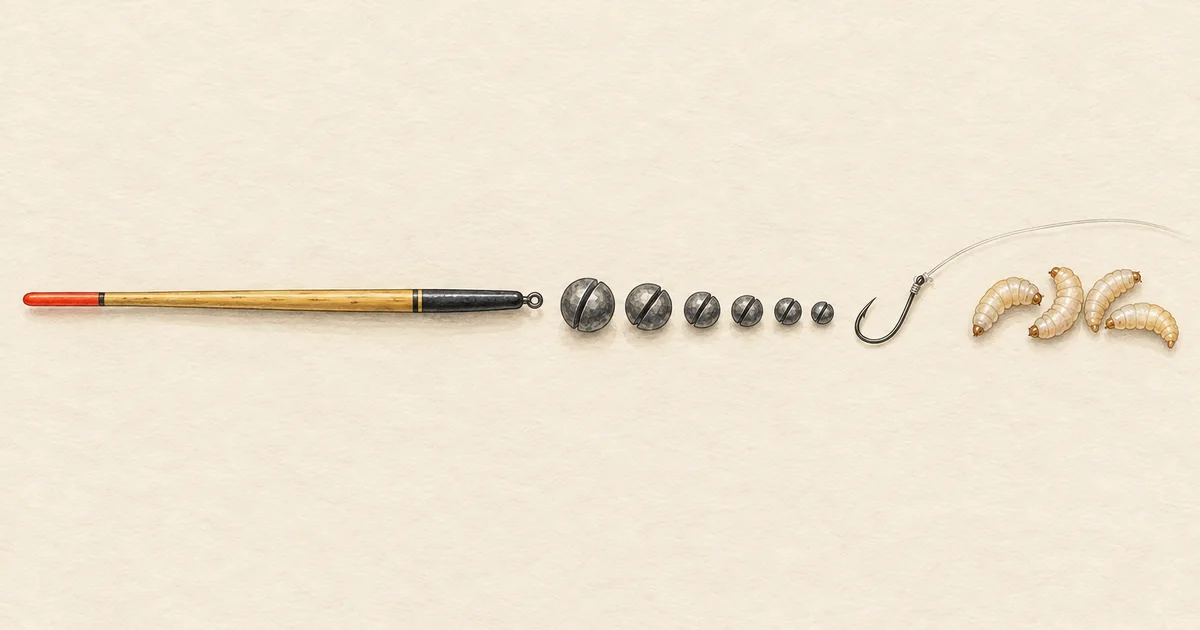
- a match rod with a fixed-spool reel, the sources give 3 to 4.20 metres
- monofilament main line, in the sources around 0.16 millimetres
- a waggler; its carrying capacity, the weight it carries, is usually printed on the float
- a float adapter or small snap swivel
- split shot, small slotted lead balls to pinch on: two larger ones and several of sizes No. 6 to No. 8
- a small swivel, a finer hooklength and a hook, for example 0.12 millimetres and size 16 in Rute & Rolle
- a plummet
As bait the sources mainly name maggots, casters (maggot pupae) and sweetcorn, see Maggots and larvae and Sweetcorn and particles.
Set-up: attached to the line at the bottom only
For centuries the float was attached at the top and bottom with float rings (Fisch & Fang). The line then leaves it at the tip, above the water. The waggler has only one eyelet at the lower end. From there the line goes to the rod and can be laid under water, as the section on sinking the line shows. According to Rute & Rolle, this keeps it out of the wind.
Two larger shot are pinched on at the eyelet, one on each side. They hold the float and form the main weight. Below them come a few small shot, a small swivel and the hooklength, the short, finer piece of line with the hook (Fig. 1).
Because the body sits deep in the water, high waves run over the small tip and the waggler stands steady, says Fisch & Fang. A long, fine antenna also offers little resistance to surface drift, the water the wind pushes ahead of it (Fisch & Fang).
Straight, with body, pre-weighted
| Shape | How to recognise it | Use according to the sources |
|---|---|---|
| straight waggler | slim all the way, often made of peacock quill | in wind, keeps the bait still |
| with body | buoyancy body in the lower third | long casts, wind and waves |
| pre-weighted | weight in the foot, marking such as 10 + 3 | long casts with little lead on the line |
Tying a waggler rig
- Slide on the adapter. Slide a float adapter or snap swivel onto the main line. This lets you swap the float later, for example for a heavier one when the wind picks up (Fisch & Fang).
- Pinch on the main weight. Press one larger shot directly above and one below the adapter.
- Add the small shot. Below that you spread a few smaller shot, such as No. 6 or No. 8 (Angling Times, Blinker).
- Swivel and hooklength. Tie the swivel to the end of the main line, for example with the clinch knot that the Landesfischereiverband Baden-Württemberg names for swivels, and attach the hooklength. Without a swivel, a loop-to-loop connection also works.
- Balance it. Add or remove small shot until only the tip shows. Blinker gives about 1.5 centimetres, Fisch & Fang 1 centimetre.
- Plumb the depth and set it.
Spreading the shot: guideline figures
With a fixed waggler most of the weight sits at the float. This makes casting easier (Rute & Rolle): on the cast the waggler leads and the light shot follow it (Blinker). The guideline figures differ:
- Angling Times: 90 per cent of the shot around the foot of the float, only a few small ones further down.
- Blinker: the bulk at the float’s foot, on the metre above the hooklength a few shot No. 8 to No. 6, the hooklength without lead.
- Rute & Rolle: most of the weight at the base, plus a few No. 6 shot about 50 centimetres above the hook against the wind.
- Fisch & Fang: three groups of shot, going up from the hook at intervals of 15, 20 and 30 centimetres, as a rough rule of thumb for still water.
The more lead sits at the float, the more slowly the bait sinks, and according to Angling Times fish have a chance at every depth. More lead on the line takes it to the bottom faster (Fisch & Fang).
With a pre-weighted waggler the casting weight is already in the foot. The marking 10 + 3 means, according to Blinker: 10 grams in the float, 3 grams on the line. Which shot make up your carrying capacity and what AAA, BB or No. 8 weigh is shown by float shotting.
Balance it at home: you can balance a long waggler before fishing in a rain barrel. According to Blinker, an ordinary bucket is not deep enough for this.
Sinking the line and setting the depth
Getting the line under water
If the line lies on the water, the wind can push a big bow into it (Fig. 3). According to Blinker, no effective strike gets through such a bow, and fish do not take a bait that is dragged over the bottom as if by magic (Fisch & Fang).
- Dip the rod tip in, Blinker gives about 20 centimetres.
- Wind in a few turns until the line is taut (Blinker).
- Pull the rod out of the water sideways with a jerk (Blinker).
For this you use monofilament line. If it still will not sink, degrease it with a little washing-up liquid (Fisch & Fang). On English fishing ponds, by contrast, Angling Times lets it float so the strike lands faster.
Plumb the depth
Clip a plummet to the hook, a hollow lead ball that opens (Landesfischereiverband Baden-Württemberg). When the float dips under, you know it is set too shallow. Then set it deeper bit by bit until the tip just stands again; that is how you read off the water depth. At distance a plummet is too heavy to cast; Angling Times then uses two AAA shot on the hook.
After that you set it for the target fish. For bream, a Blinker author leaves the hooklength lying on the bottom, for crucian carp the bait hovers about 5 centimetres above it in Blinker. If the lowest shot rests on the bottom, the waggler also shows lift bites: the fish lifts the shot and the tip rises (Fisch & Fang).
Fixed or sliding
Fixed, the float can only be set as deep as the rod is long (Landesfischereiverband Baden-Württemberg, Blinker). If it is deeper, the waggler slides up to a stop knot, and the Blinker author uses two side by side. Below the snap swivel he clips four No. 8 shot, with the main shotting following at a distance of one metre. The weight must pull the line through the eyelet, and for sliding floats Fisch & Fang reckons on at least 1 gram of lead per metre of water depth. More on this under float rig.
Where the waggler fits
Blinker calls the waggler a float for still water. In a river it works in weak current; an author from Rute & Rolle fishes it that way on the Main for roach. In a deeper canal with a gentle current, on the other hand, it drifts for metres before it stands properly (Blinker). If the fish are further out than the pole reaches, you reach for the match rod, according to Blinker. For close range see pole fishing.
The fish lexicon of the Landesfischereiverband Bayern describes roach, tench and rudd as inhabitants of still and slow-flowing waters. The bream also lives in slow-flowing lower reaches of larger rivers, the crucian carp prefers still, warm, weedy waters. In the angling press, bream and tench are fished with the waggler (Fisch & Fang), rudd just under the surface and crucian carp (Blinker).
Closed seasons and minimum sizes are set by your federal state, see Closed season and minimum size explained.
Common mistakes
- Too little lead on the float: the waggler does not lead on the cast and the rig tangles more easily (Blinker).
- Line on the surface: the wind pulls float and bait off the spot. Sink the line after every cast.
- Float slips: if the shot at the eyelet sit loose, the waggler wanders and the depth no longer fits. According to Fisch & Fang, a small shot directly below the attachment shows whether it holds.
- Fixed float too deep: from about one rod length between float and hook, casting gets difficult, so fish it sliding then (Rute & Rolle).
Frequently asked questions
Is the waggler a sliding float?
It can be both: fixed between two shot, sliding with a stop knot. Rute & Rolle counts wagglers among the most popular sliding floats.
How much carrying capacity does a waggler need?
That depends mainly on the depth. As a rough rule, Blinker gives 1 gram of carrying capacity per metre of water depth, as long as there is no strong undertow. An author from Rute & Rolle fishes a 2.5 gram waggler in winter.
How far can you cast a waggler?
With a match rod, Blinker gives 40 metres and more. According to Fisch & Fang, distance wagglers carry a casting weight of 6 to 20 grams, in extreme cases 40 grams.
Related
- Float rig: sliding float, stop knot and shotting
- Float fishing: fixed and sliding floats at a glance
- Float rod: match rod, Bolognese rod and pole
- Float shotting: shot matched to the carrying capacity
- Stop knot: for the sliding waggler
- Catch calendar: biting times of the target fish
Sources
- Blinker: Brassen angeln, alle Grundlagen (Schnur versenken, gleitender Waggler), Zoomer statt Waggler (Wurf, Vorbebleiung, Strömung), Posen zu Hause austarieren
- Blinker: Angeln auf Karauschen (Bleiverteilung, Ausbleien), Steckbrief Rotfeder
- Fisch & Fang: Pfiffiges zum Posenfischen (Montage, Bleigruppen, Laufpose), Wer erfand den Waggler? (Befestigung, Körper), Zielfisch Brassen (Wellen, Hebebiss)
- Rute & Rolle: Waggler fürs Frühjahr, Die Laufpose, Mit Waggler am Fluss, Friedfische im Winter (Blei, Schnur, Strömung)
- Angling Times: Simple waggler rig, Waggler on commercials, Winter silvers, Plumbing the depth (Bleiverteilung, Posenform, Loten)
- Landesfischereiverband Baden-Württemberg: Gerätekunde (feste und laufende Pose, Lotblei, Ausloten, Clinch-Knoten)
- Landesfischereiverband Bayern: Fischlexikon (Lebensräume der Zielfische)
Text AI-assisted, drawing AI-generated. Sources opened and checked in October 2026; no graphics taken from the sources.
All figures are guidelines without guarantee. Whether lead shot, groundbaiting and several rods are allowed is governed by state law and the water rules.