
Knowledge · Knots
Loop to loop: Attaching the leader
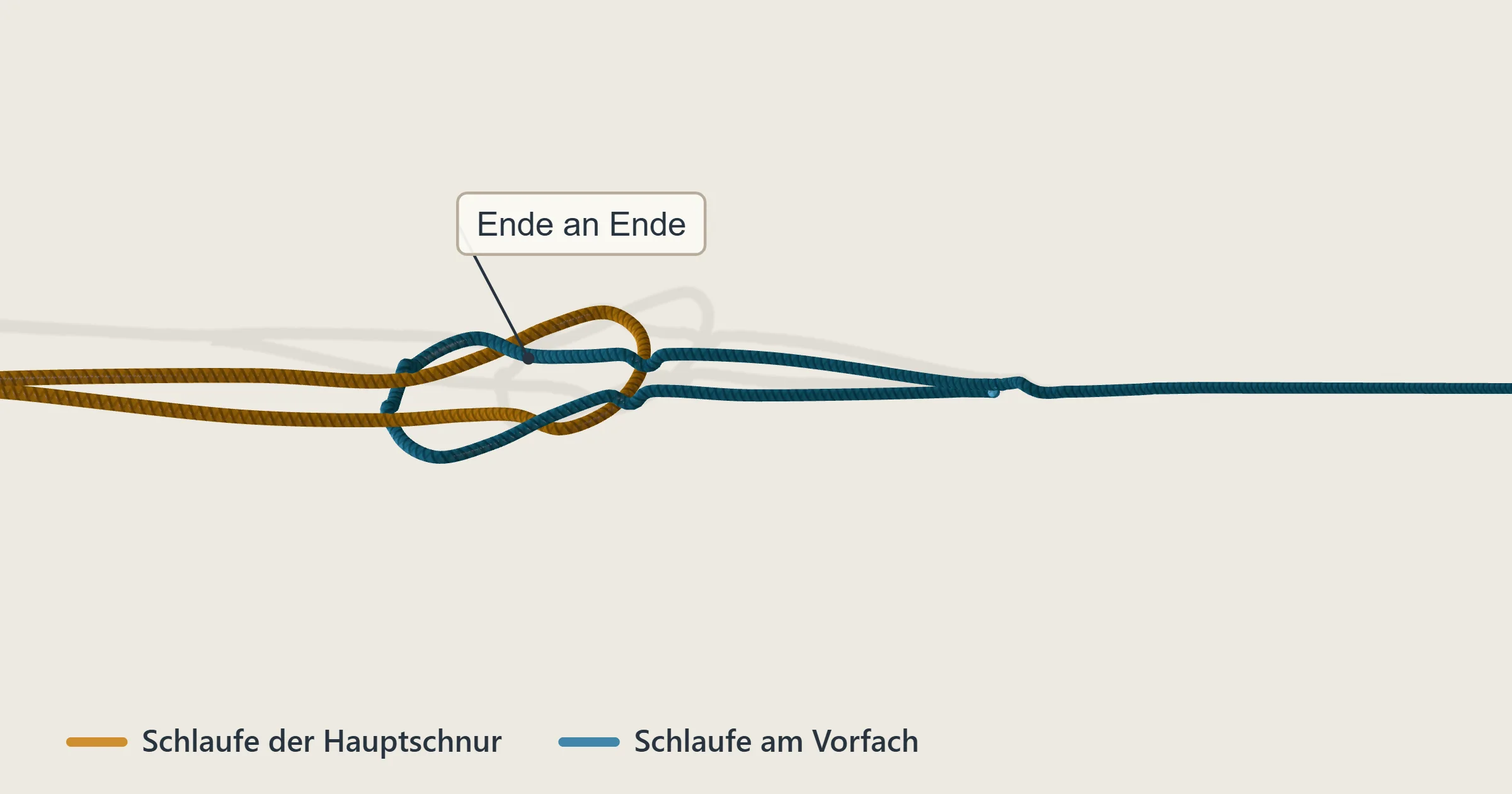
The loop-to-loop connection hooks two loops into each other without needing another knot. It usually joins hooklength and main line, and with thicker line it can even be separated again.
What is the loop-to-loop connection good for?
On pole-fishing waters it is the rule between main line and hooklength. It is also common in fly fishing because many fly lines already come with a loop at the end from the factory. A Blinker article on fly fishing gives a strength of at least 90 per cent for properly interlocked loops, but does not say what the figure refers to.
Two loops make more bulk than a joining knot. For that reason Blinker advises against the connection if it has to pass through the rod rings. It can in practice only be separated with thicker line.
Tying the loop-to-loop connection step by step
- Tying two loops. Both lines need a loop at the end, for example a surgeon’s loop or a figure-of-eight loop.
- Loop through loop. Pass the loop of the main line through the loop of the hooklength.
- Pulling the hooklength through. Then pull the free end of the hooklength, that is, the whole hooklength, through the loop of the main line.
- Drawing up. Pull both lines in opposite directions until the loops slide into each other.
Common mistakes
- Cow hitch (Ankerstich) instead of a clean connection: If one loop flips over, it lies as a noose around the other. The loops must lie in each other end to end.
- Connection in the rings: It is not suitable if it has to pass through the rod rings when you cast.
- Weak loop knots: The connection holds only as well as the two loop knots.
Pull test and knot strength
Pull both lines apart steadily and check that the loops lie end to end and no cow hitch has formed. Do not wrap thin line round bare fingers. A pull test does not measure breaking strength, it only shows gross faults.
Material, diameter and tying technique affect every connection. The line calculator gives you a rough guide using cautious knot factors of our own.
Related knots
Suitable loops are the surgeon’s loop, the figure-of-eight loop and the perfection loop.
Used in these rigs: feeder rig and waggler rig. Also used in pole fishing.
Note: The connection itself has no turns. How well it holds depends on the two loop knots; another Blinker article gives around 80 per cent each for the surgeon’s and figure-of-eight loops. Neither figure comes from published test series.
Sources
- NetKnots – Loop to Loop Knot
- Blinker – Einfache Schlaufenknoten binden
- Blinker – Knoten fürs Fliegenfischen
Sources opened and checked on 2 October 2026. Texts in our own words, sketch drawn independently; no graphics taken from the sources. You will find all knots in the overview of fishing knots.
All figures are guide values without guarantee. Follow the line manufacturer’s instructions.