
Knowledge – Fish
Crucian carp: Identification, difference from the Prussian carp, threat status
The crucian carp (Carassius carassius) is a deep-bodied cyprinid of shallow, plant-rich small waters and copes with oxygen shortage, heat and even the water body freezing solid. Even so it is regarded as endangered in Germany. Many supposed crucian carp are in fact Prussian carp.
In short: The crucian carp is listed as endangered in Germany’s Red List (2023). It is not a target species. What to do if you catch one by accident: Crucian carp as bycatch.
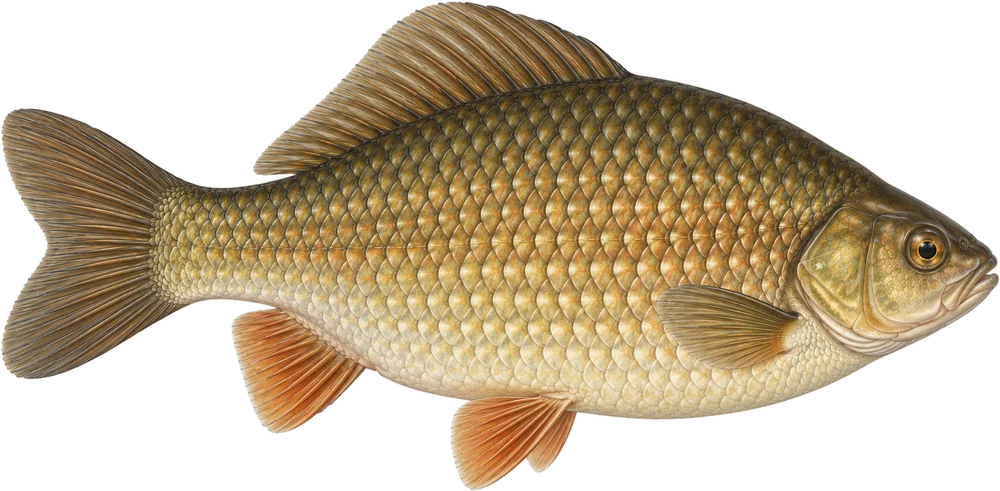
- Small mouth pointing obliquely upwards without barbels, unlike the carp
- Long dorsal fin with an outward-curving (convex) edge
- High-backed body, yellow-brown with a brassy sheen
Catch chances through the year
- Hardly any chance
- Possible
- Good
- Peak season
- Spawning (observe the closed season)
Editorial assessment for waters in Germany, not a measured value and no guarantee. Spawning time is not the same as the legal closed season.
Species profile and sources in the catch calendarAll species compared month by monthThe rules of your federal state
How to recognise it
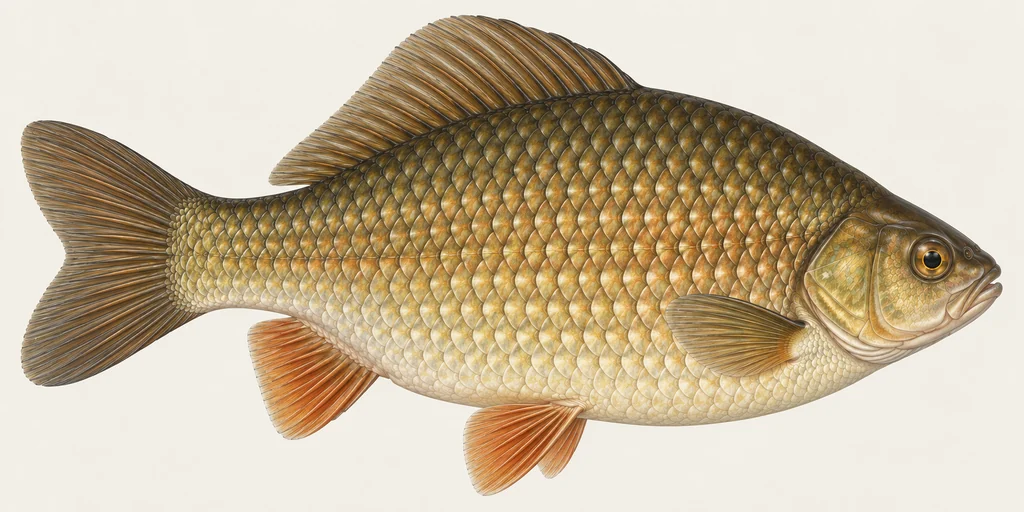
The body of the crucian carp is stocky, deep and flattened from the side. The head looks small, the mouth is small and directed obliquely upwards. Barbels are absent. The tall, long dorsal fin has an outwardly curved edge in deep-bodied animals. Young fish often carry a black spot on the caudal peduncle, which often fades with age.
The scales are yellow-brown to bronze-brown with a brassy sheen. The lateral line has 31 to 36 scales. The crucian carp usually stays small: Baden-Württemberg gives 15 to 25 cm, Bavaria 15 to 30 with a maximum of 40. In the literature 50 to 60 cm can be found; FishBase knows 64 cm and up to three kilograms. The deep-backed form is the See-/Tellerkarausche (lake or plate crucian carp), shallow-backed fish are called Teichkarausche (pond crucian carp). With dense stocks and food shortage a stunted form arises, the Stein-/Teichkarausche.
The carp is easy to tell apart because it has barbels. The Prussian carp is difficult. On a live fish the dorsal fin helps: in the crucian carp the edge is curved outwards, in the Prussian carp straight or slightly curved inwards. In young fish this is often indistinct.
The colour of the belly lining is then decisive: in the crucian carp it is pale, in the Prussian carp darkly pigmented. The scale count in the lateral line is 31 to 36 in the crucian carp, 27 to 33 in the Prussian carp, and the Prussian carp also looks paler and silvery yellow. Take care when gutting, because the dark pigment layer of the Prussian carp comes off easily. Crosses of carp and crucian carp, so-called Karpfkarauschen, occur.
Side by side
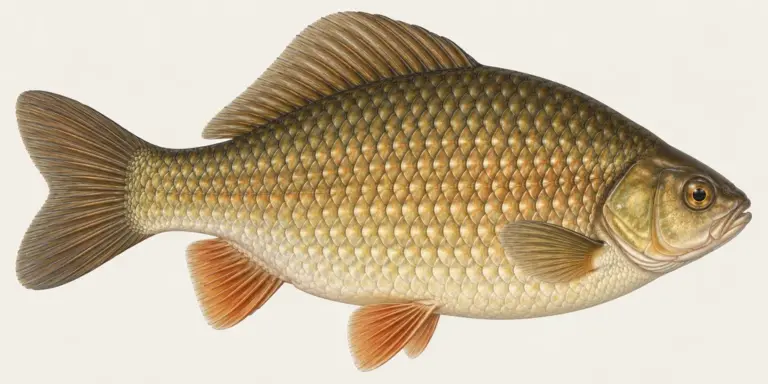
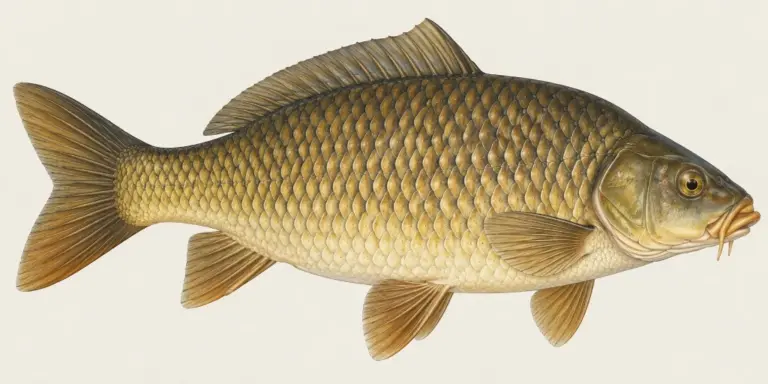
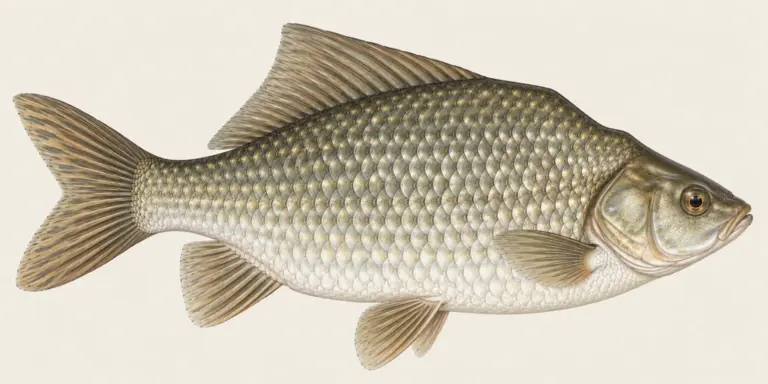

AI-generated illustrations.
Where it lives
The crucian carp lives in still-water areas that are warm in summer and rich in plants, and on slow-flowing stretches with a muddy bed. It prefers cut-off, silted-up oxbow lakes and floodplain waters, but also village ponds, peat pits and acidic bog waters. There it is often the only fish species. Saxon sources also mention ditches and brackish water.
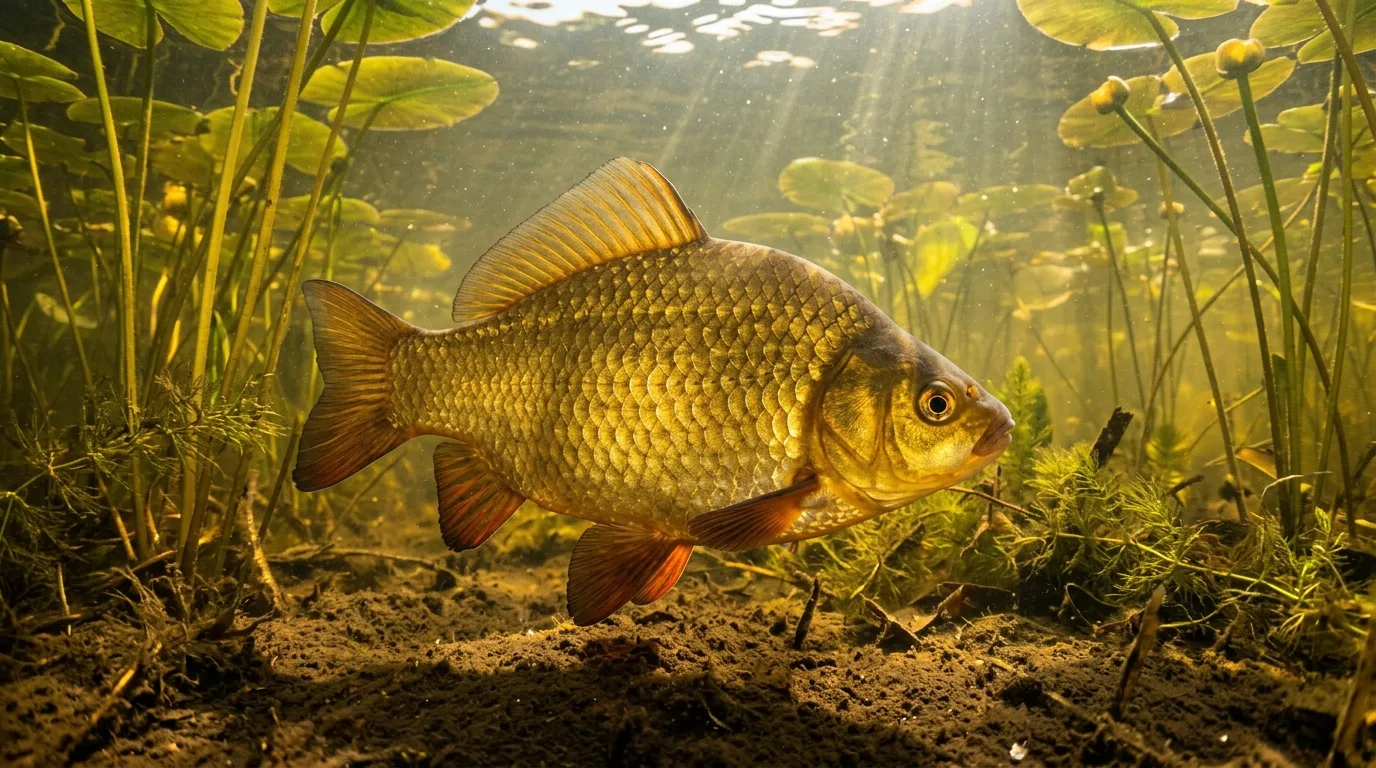
Compared with other fish it is a weak competitor. According to FishBase it is usually absent from waters with many species and predators, but without other fish it can become very numerous. The optimum temperature is 27 degrees, the lethal temperature 38 degrees. At low temperatures it survives months without dissolved oxygen, in summer only hours to days. It even survives freezing solid or brief drying out, buried in the mud.
Holding spots in the picture
Choose the season and time of day: the picture shows where the species stands then. Spots outlined in red apply only in the chosen season. Tap a fish or a spot in the list to bring it closer. The picture is schematic and AI-generated, every water is different.
Active time Crucian carp feed throughout the day, but above all at night. Specimen fish often bite best in the morning and evening. In cloudy small waters crucian carp can be caught well by day too; in clear lakes and at bathing spots rather in the dark.
Active time Crucian carp feed throughout the day, but above all at night. Specimen fish often bite best in the morning and evening. In cloudy small waters crucian carp can be caught well by day too; in clear lakes and at bathing spots rather in the dark.
Active time Crucian carp feed throughout the day, but above all at night. Specimen fish often bite best in the morning and evening. In cloudy small waters crucian carp can be caught well by day too; in clear lakes and at bathing spots rather in the dark.
Active time Crucian carp feed throughout the day, but above all at night. Specimen fish often bite best in the morning and evening. In cloudy small waters crucian carp can be caught well by day too; in clear lakes and at bathing spots rather in the dark.
In the lake
reed edge
Crucian carp are found here only in spring, summer and autumn.
Water lilies and weed bed
Crucian carp are found here only in spring, summer and autumn.
Deep bottom
Crucian carp are found here only in autumn.
The crucian carp lives in shallow, summer-warm, heavily overgrown or silted waters. There it stands at shallow reed and weed edges and in and beside water lilies and weed beds. In uniformly shallow waters the shoals roam in search of food, often together with carp of the same size.
Spring: Crucian carp are caught mainly from late spring. In May and June it spawns in the shallows among water plants.
Summer: Summer belongs to the fishing season, which extends into early autumn.
Autumn: On warm autumn days crucian carp can be found in deep hollows.
Winter: The crucian carp spends the winter buried in the mud in winter torpor.
In the river
Calm bay with aquatic plants
Crucian carp are found here only in spring, summer and autumn.
In a river system the crucian carp is mostly confined to densely overgrown oxbows and floodplain waters. It avoids cold, fast-flowing waters.
Winter: The crucian carp spends the winter buried in the mud.
Depth: Shallow reed and weed edges down to at most two metres of depth are mentioned.
Size comparison: AI-generated drawing, schematic.
How it hunts and spawns
Crucian carp stay near the bottom and hidden in the weed. Where predators are present they are mostly active at dusk and at night; according to FishBase they feed all day but mainly at night. Young fish live first on zooplankton, later on insect larvae, snails, worms and plant parts.
Spawning falls in May and June at water temperatures from 14 degrees. The females spawn several times and in batches in the shallows on lush underwater vegetation, the males follow them with splashing. According to FishBase a female lays 130000 to 250000 sticky eggs; the larvae hatch after four to eight days and attach themselves to plants with an adhesive organ.
When it is active
The crucian carp is active only in the warm season, from late spring to early autumn. Large animals feed mainly at night, in turbid small waters also by day. In May and June it spawns in the shallows on water plants.
In winter it lies in winter torpor, buried in the mud.
There is no catch calendar for the crucian carp on our site, because it is not a target species. As bycatch it most often ends up on the hook in summer, when small natural baits for other coarse fish are lying in ponds.
You will find the monthly overview of all species and the water temperature check in the catch calendar.
From the blog: Fish of the Year 2027: the crucian carp and what anglers can do for it · Freshwater fish in Germany: which species you catch where · Roach or rudd, bream or silver bream: how to tell these silver fish apart reliably
What to do with a bycatch
As bycatch: Fishing for crucian carp? – why the species is not a target and what to do if you catch one by accident.
The crucian carp is not a target species: it is endangered, and Bavaria, Berlin, Hesse and Rhineland-Palatinate protect it all year or ban catching it; the rules are under “What you need to observe”. It goes on the hook almost only as bycatch, when small worms, maggots or sweetcorn kernels for other coarse fish lie on the bottom in ponds and oxbow lakes.
If you have hooked one, play it briefly and leave it in the water or lay it on a wet unhooking mat. You remove the hook with wet hands or a disgorger and return it at once, even where taking it would be allowed. More on the pages Landing and unhooking fish and Returning fish.
Be sure of the species first: Check the belly lining and dorsal fin before you take a supposed Prussian carp. In the trade, Prussian carp are sometimes sold as crucian carp.
Release gently: Return every crucian carp without delay: unhook in the water, handle only with wet hands, no long photos. Tips are on the page Returning fish.
Suitable lures
We deliberately show no baits for this species.
Rigs for these baits: waggler rig, float rig, running leger rig.
Endangered (Red List 2023), protected all year or with a fishing ban in several states: do not target it, return bycatch gently.
What you need to observe
The crucian carp is listed as endangered in Germany’s 2023 Red List; in almost all states the stocks have declined sharply. In Baden-Württemberg it is regarded as critically endangered according to the 2014 Red List. The main cause is the loss of plant-rich small waters; added to that are competition from the Prussian carp and hybridisation.
Closed seasons (Schonzeit), minimum sizes (Mindestmaß) and harvest windows are set by the federal states (Bundesland), and on many waters additionally by the club or leaseholder. They differ depending on the water and the time of year. We give figures only with a date and a source; always binding are the fisheries regulation of your federal state and your fishing permit (Erlaubnisschein). You will find a list of links to the official sources in the catch calendar.
How differently the states decide is shown clearly by the crucian carp: Bavaria, Berlin, Hesse and Rhineland-Palatinate protect it all year or ban catching it; Saxony protects it from 1 February to 30 June with a minimum size (Mindestmaß) of 15 cm. As of October 2026. So always check the rules of your state to see whether the species may be fished for or taken where you are.
Even where catching it is allowed, we advise not taking any crucian carp. Unhook it, if possible, still in the water and with wet hands, and return it gently. What exactly applies is governed by state law and the fishing permit (Erlaubnisschein).
According to the recommendation of the Landesfischereiverband Baden-Württemberg, stocking with crucian carp belongs in the hands of the fisheries authority (Fischereibehörde). Never release fish on your own initiative, because that can bring Prussian carp into crucian carp waters.
What closed season, minimum size and harvest slot mean and where to find them is explained on the page Closed season and minimum size explained.
What state law prescribes for the closed season (Schonzeit) and minimum size (Mindestmaß) of this species is given in the “At a glance” box on the state pages for Bavaria, Berlin, Hesse, Rhineland-Palatinate and Saxony. For the other states our overview does not list this species; there the state fisheries regulation (Landesfischereiverordnung) is decisive.
Frequently asked questions (FAQ)
May I fish for crucian carp?
You should not target them. Germany’s 2023 Red List lists them as endangered, in Baden-Württemberg they are regarded as critically endangered, and several federal states ban catching them entirely. If one ends up on the hook as bycatch, you return it at once.
How do I tell whether it is a crucian carp or a Prussian carp?
Most reliably by the belly lining: pale in the crucian carp, dark in the Prussian carp. The crucian carp also has an outwardly curved dorsal fin and 31 to 36 scales in the lateral line, the Prussian carp a straight to slightly concave dorsal fin and 27 to 33 scales.
How does the crucian carp survive the winter?
It buries itself in the mud and falls into winter torpor. At low temperatures it manages for months without dissolved oxygen and even survives the water body freezing solid.
Sources
The rating of catch chances is an editorial assessment. The facts come from these sources, and the text is worded in our own words. The illustration is an original design by Angel Momente in the style of a natural history plate (AI-generated, see the AI notice).
- Landesfischereiverband Bayern: Fischlexikon (Laichzeit, Lebensraum, Nahrung, Aktivität)
- FishBase: Carassius carassius (Höchstalter, Bauchfell, Lebensraum, Nahrung)
- Blinker: Steckbrief Karausche (Fangzeit, Standplätze, Köder, Methoden)
- Rote-Liste-Zentrum: Karausche (Rote Liste der Süßwasserfische Deutschlands 2023: stark gefährdet)
- Landesfischereiverband Baden-Württemberg: Die Fischart Karausche, ein Spezialist für Flussauen (2017)
- Sächsisches Landesamt für Umwelt, Landwirtschaft und Geologie: Artenkunde verwechselbare Fischarten (Karausche und Giebel)
- Freistaat Sachsen, Fischereibehörde: Sächsische Fischereiverordnung, Schonzeiten und Mindestmaße 2022
- FISCH & FANG: Karausche, Vergiss mein nicht (Standplätze von Karausche und Giebel, Beißzeit)
- Bayern.Recht: Verordnung zur Ausführung des Bayerischen Fischereigesetzes (AVBayFiG), Anlage Schonzeiten und Schonmaße
- Freistaat Sachsen: Sächsische Fischereiverordnung, Anlage Schonzeiten und Mindestmaße
- Land Hessen: Hessische Fischereiverordnung (HFischV), § 1 Fang- und Entnahmeverbote
- Land Berlin: Landesfischereiordnung, Anlage 1
- Fischereiamt Berlin: Die Angelkarte und ihre Auflagen
- Land Rheinland-Pfalz: Landesfischereiordnung, § 20
- Wikipedia: Karausche (Merkmale, Schuppenzahl, Lebensweise, Laichzeit, Gefährdung, Fangverbote)
Created with AI support from the sources listed. Figures only appear in the text if a source gives them. Last updated: 8 November 2026. Found a mistake? Write to us. Who is behind this site: About me.
More in the lexicon
- All fish species at a glance
- Catch calendar – month, water temperature and profile for 93 species
- Line calculator – breaking strain after the knot, drag guideline, backing
- Angling methods