
Knowledge – Fish
Prussian carp: Difference from the crucian carp, habitat and baits
The Prussian carp (Carassius gibelio) is an undemanding cyprinid without barbels that lives in ponds, lakes and slow rivers. It looks so much like the rare crucian carp that many anglers confuse the two. In many stocks there are only females, which reproduce with the help of males of other species.
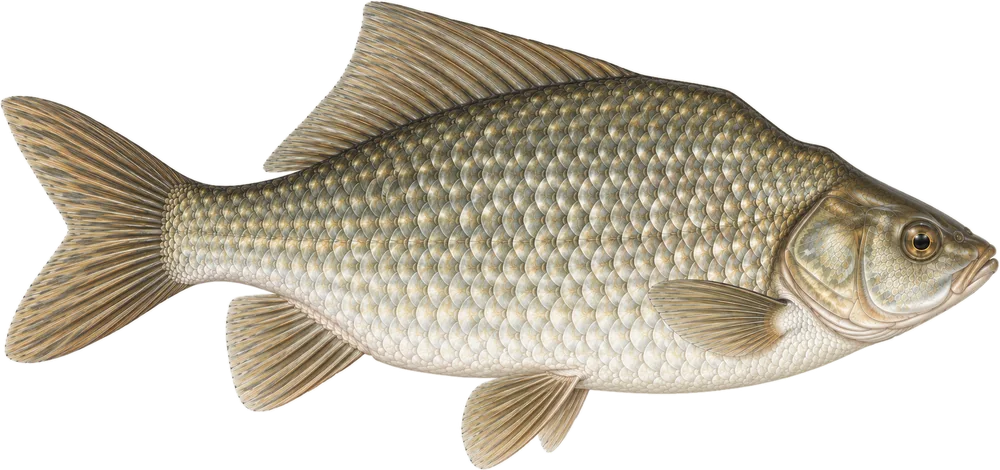
In short: You catch the Prussian carp best in August, by day, in the evening and at night. Good spots on a lake: weed beds and the drop-off edge; on a river: a quiet bay. Proven baits: worms and maggots on a fine float or a ledger rig, also small boilies. The Prussian carp is often confused with the highly endangered crucian carp. In the Prussian carp the edge of the dorsal fin is straight or slightly concave and the belly lining dark. Step by step: fishing for Prussian carp.
- Dorsal fin with a straight or slightly concave edge
- Distinct bend where the head meets the back
- Terminal mouth without barbels
Catch chances through the year
- Hardly any chance
- Possible
- Good
- Peak season
- Spawning (observe the closed season)
Editorial assessment for waters in Germany, not a measured value and no guarantee. Spawning time is not the same as the legal closed season.
Species profile and sources in the catch calendarAll species compared month by monthThe rules of your federal state
How to recognise it
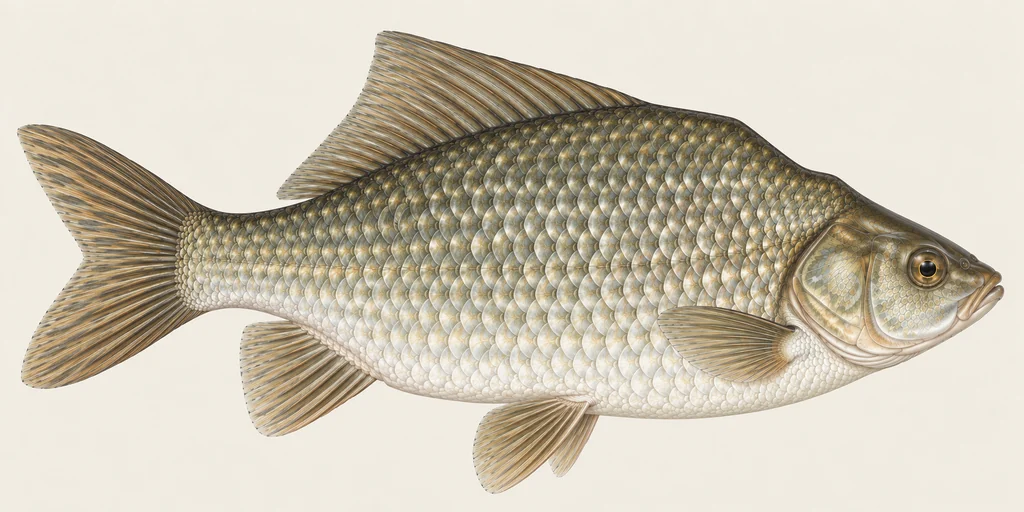
The Prussian carp has a laterally compressed, slightly deep body. From the head to the back the line makes a distinct bend. The mouth is terminal and has no barbels. The tail fin is clearly forked, and the longest hard ray of the dorsal fin is serrated on the inside.
The colouring ranges from silvery grey to yellowish grey. A reliable sign is the darkly pigmented belly lining, that is the membrane that lines the body cavity from the inside. FishBase counts 29 to 33 scales along the lateral line. Prussian carp are usually 15 to 25 centimetres long. The LFV Bayern gives 45 centimetres as the maximum size, but the Blinker-Hitparade lists fish of up to 58 centimetres.
Prussian carp or crucian carp?
| Feature | Prussian carp | Crucian carp |
|---|---|---|
| Edge of the dorsal fin | straight or slightly concave | convex |
| Belly lining | dark to black | pale |
| Transition from head to back | distinct bend | smooth |
| Scales along the lateral line | 29 to 33 | 31 to 36 |
| Tail base | no dark spot | usually with a dark spot |
The most common look-alike is the crucian carp. Its dorsal fin ends at the top in an outward-curved edge. In the Prussian carp this edge is straight or curves slightly inwards. You can only tell for certain when the fin is raised steeply. Colour helps little: crucian carp are usually golden brown and Prussian carp more silvery, but the specialist magazine Blinker does not regard colouring as a reliable feature.
A small carp has barbels at the mouth; the Prussian carp does not. The LFV Bayern describes the goldfish as a cultivated form of the East Asian Prussian carp. The two are alike in body shape, but according to the NÖ Landesfischereiverband the goldfish has somewhat larger scales.
Side by side
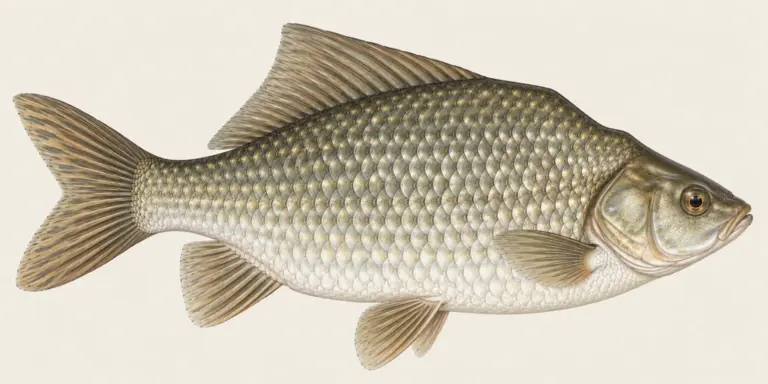
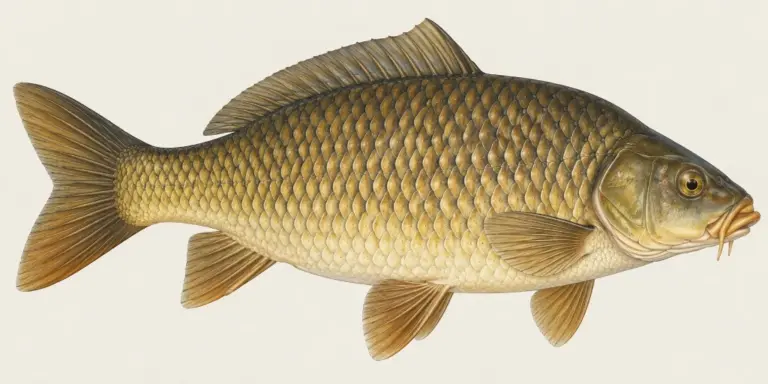
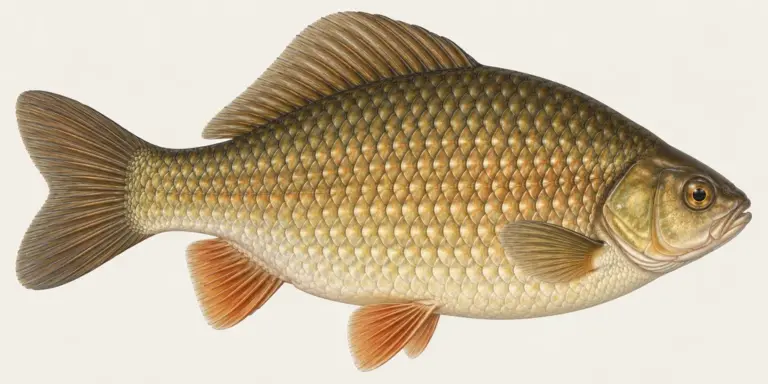

AI-generated illustrations.
Where it holds
The Prussian carp lives in many kinds of still and slow-flowing water: ponds, pools, oxbow lakes, lakes and lowland rivers, preferably with dense plant growth and a soft bottom. Larvae and juveniles stay in structure-rich zones such as reed beds. FishBase describes the species as very tolerant of oxygen shortage and pollution. Fish from lakes move into river mouths in winter when the lake water becomes low in oxygen.
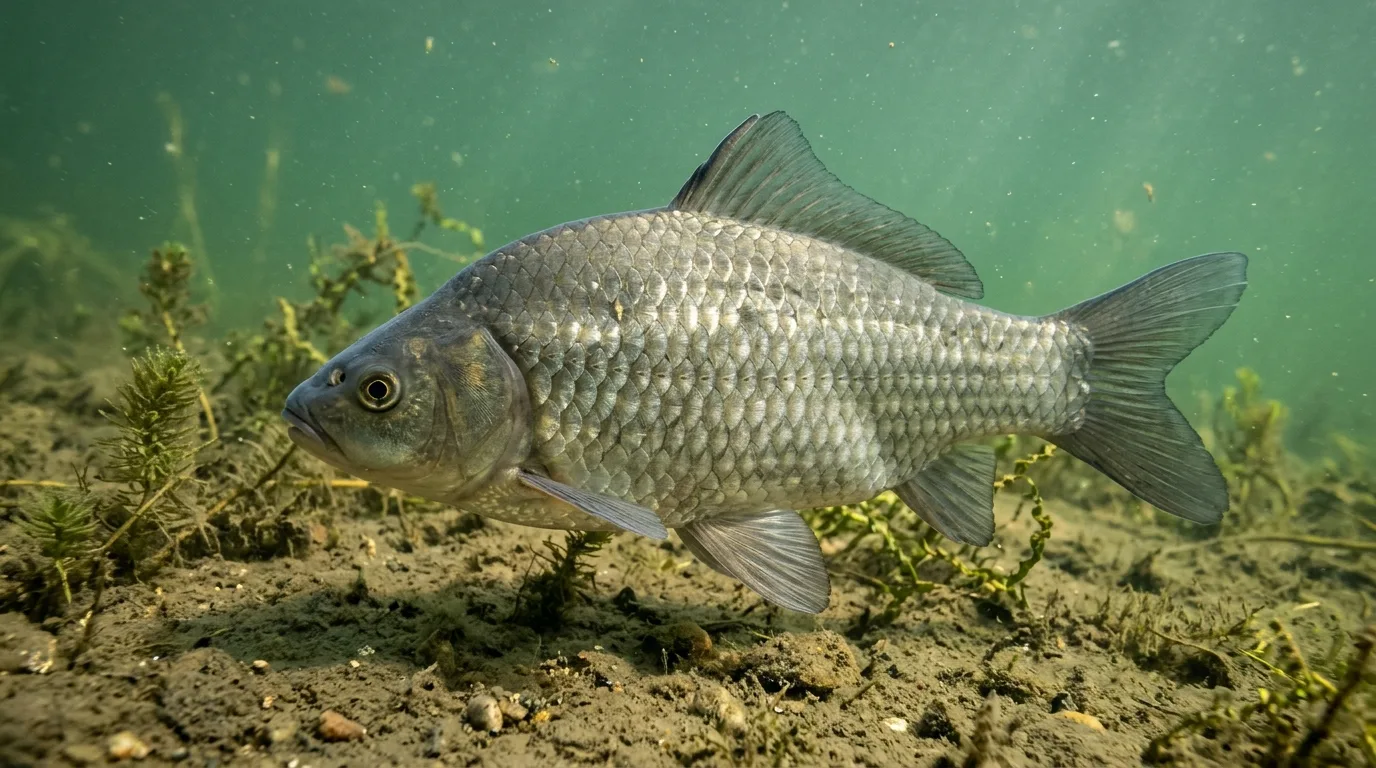
According to the LFV Bayern, the Prussian carp comes from East Asia and Siberia and reached our waters via pond farming. According to FishBase, what its original range in Europe looked like can hardly be established any more, because it was often stocked together with carp and confused with related species. Germany’s 2023 Red List lists it as a neobiota, that is a non-native species, and does not rate it.
Holding spots in the picture
Choose the season and time of day: the picture shows where the species stands then. Spots outlined in red apply only in the chosen season. Tap a fish or a spot in the list to bring it closer. The picture is schematic and AI-generated, every water is different.
Chance of a catch in springgood
Chance of a catch in summergoodSpawning, observe the closed seasons
Catch chance in autumnpossible
Catch chance in winterhardly any
- J
- F
- M
- A
- M
- J
- J
- A
- S
- O
- N
- D
Spawning season
Not the main time Prussian carp are not shy of light and bite well by day too. Sitting on until dusk or trying at night is still worthwhile.
Active time Prussian carp are not shy of light and bite well by day too. Sitting on until dusk or trying at night is still worthwhile.
Active time Prussian carp are not shy of light and bite well by day too. Sitting on until dusk or trying at night is still worthwhile.
Active time Prussian carp are not shy of light and bite well by day too. Sitting on until dusk or trying at night is still worthwhile.
In the lake
Water lilies and weed bed
Prussian carp is present here all year round.
Shelf edge
Prussian carp is present here all year round.
Deep bottom
Prussian carp is present here only in winter.
The Prussian carp stays near the bottom, gladly at drop-offs, weed beds and water lilies. It is most at home in waters with dense plant growth and a soft bottom.
Spring: chance of a catch according to the catch calendar possible in March, good in April and May.
Summer: chance of a catch according to the catch calendar good in June and July, peak season in August. Spawning falls in this period, observe closed seasons. From May to July it spawns in shallow, warm bank water on water plants.
Autumn: catch chance according to the catch calendar good in September, possible in October, hardly any in November.
Winter: chance of a catch according to the catch calendar slim. In winter the fish withdraw to the deepest spots of ponds and small lakes.
In the river
Calm bay with aquatic plants
Prussian carp is present here all year round.
In flowing waters the Prussian carp lives in slow stretches, in backwaters and canals with plant growth and a soft bottom.
Spring: chance of a catch according to the catch calendar possible in March, good in April and May.
Summer: catch chances according to the catch calendar are good in June and July, with August the peak season. The spawning season falls in this period, so observe the closed seasons.
Autumn: catch chance according to the catch calendar good in September, possible in October, hardly any in November.
Winter: catch chance according to the catch calendar hardly any.
Depth: To spawn it comes into the shallow, warm bank water; in winter it sits at the deepest spots of the water.
Size comparison: AI-generated drawing, schematic.
How it feeds and reproduces
Prussian carp live in shoals. They feed on plankton, insect larvae, snails, worms, plant parts and dead organic material (detritus).
According to the LFV Bayern, spawning takes place from May to July in shallow, warm water near the bank. The sticky eggs adhere to water plants or other objects in the water. Older fish spawn earlier than younger ones, and the males reach the spawning grounds before the females.
The special feature is gynogenesis, a form of virgin reproduction. FishBase describes European stocks as predominantly female with a triple set of chromosomes. These females spawn with males of other cyprinids such as carp, roach or bream. Their sperm only triggers the development of the eggs; the genetic material of the foreign species does not contribute. What comes out are females again. The LFV Bayern writes that the Prussian carp often displaces the crucian carp. In Great Britain it is regarded as an invasive species according to Blinker, and the environment agency there asks anglers to report catches with a photo.
When it bites
In the catch calendar the months April to September are rated “Good” and August “Peak season”. This is an editorial assessment based on spawning time and way of life. From May to July, Prussian carp ready to spawn stay in the shallow, weedy bank zone.
Where crucian carp and Prussian carp live in the same water, you catch both species in the same spots. That is why it pays to look at the dorsal fin of every fish.
Today’s catch index needs JavaScript. Season and spawning time are in the catch calendar.
You will find the monthly overview of all species and the water temperature check in the catch calendar.
From the blog: Fish of the Year 2027: the crucian carp and what anglers can do for it · Roach or rudd, bream or silver bream: how to tell these silver fish apart reliably
What you catch it with
Step by step: Fishing for Prussian carp: tips on bait, rigs and tackle – season, swims, baits, tackle and rules on one page.
The NÖ Landesfischereiverband names the bottom rig and the float as fishing methods. According to Blinker, most Prussian carp are caught stipping, that is fishing with a long rod and a fine float. A light float rig along weed and reed edges suits its swims.
In the Blinker-Leserhitparade 2025, in which crucian carp and Prussian carp are rated together, the biggest reported fish were caught on worm, maggots and boilies. Small hooks and a fine hooklength suit the small mouth.
Raise the dorsal fin: Before you identify the fish, raise the dorsal fin fully with a wet finger. Only then can you see whether the edge curves outwards or inwards.
If in doubt, treat it like a crucian carp: The crucian carp is listed as endangered in Germany’s Red List, while the Prussian carp is non-native. If you are not sure, you release the fish gently.
Suitable lures
Worms and maggots on a fine float or a ledger rig, also small boilies.
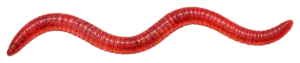
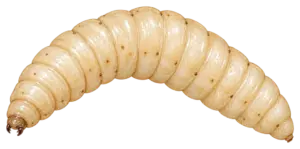
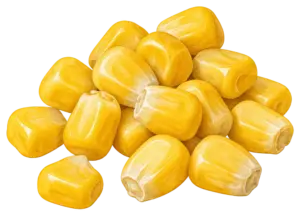
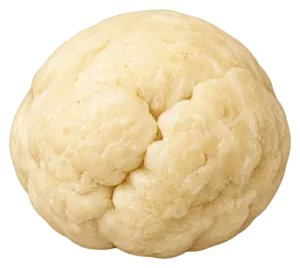
AI-generated illustrations. A click opens the lure’s page.
Rigs for these baits: running leger rig, float rig.
What to do in the kitchen with a Prussian carp you have kept
In Eastern Europe and East Asia the Prussian carp is used as a commercial fish, and in China it is even bred specifically for the table. Like every cyprinid it has many small Y-shaped bones lying free in the flesh. Before you fry or bread it, you therefore score the back and tail section crosswise at intervals of two to three millimetres. Alternatively you put the flesh through a mincer. How to prepare it is shown in gutting fish and filleting fish.
You should only keep a Prussian carp you have identified with certainty, because the very similar crucian carp is highly endangered. If it comes from water with blue-green algae, their breakdown products can accumulate in the flesh and cause a musty, mossy taste. This off-taste is in the whole fillet and cannot be washed out.
What you need to observe
The Prussian carp is not rated in Germany’s 2023 Red List because it is regarded as non-native. Whether a closed season or a minimum size applies to it is set by state law.
Closed seasons, minimum sizes and harvest windows are set by the federal states (Bundesländer). They differ by state, type of water and time of year. We give figures only with a date and a source; what is always binding is the fisheries regulation of your federal state and your fishing permit (Erlaubnisschein). You will find a list of links to the official sources in the catch calendar.
A fish of legal size that you want to keep you stun and kill at once, in line with animal welfare rules. Protected, undersized fish or fish too large under a harvest slot you unhook, if possible still in the water and with wet hands, and release gently. What exactly applies is regulated by state law and your fishing permit (Erlaubnisschein).
What closed season, minimum size and harvest slot mean and where to find them is explained on the page Closed season and minimum size explained.
Frequently asked questions (FAQ)
How do I tell a Prussian carp from a crucian carp?
Most reliably by the dorsal fin and the belly lining. In the Prussian carp the fin edge is straight or slightly concave and the belly lining dark. The crucian carp has a convex fin edge and a pale belly lining.
Are there really Prussian carp without males?
Yes. Many European stocks consist almost entirely of females. They use the sperm of other cyprinids as a trigger for the development of the eggs, but its genetic material does not contribute.
Is the goldfish related to the Prussian carp?
Yes. The LFV Bayern describes the goldfish as a cultivated form of the East Asian Prussian carp. They are alike in body shape; the goldfish has somewhat larger scales.
Sources
The rating of catch chances is an editorial assessment. The facts come from these sources, and the text is worded in our own words. The illustration is an original design by Angel Momente in the style of a natural history plate (AI-generated, see the AI notice).
- Landesfischereiverband Bayern: Fischlexikon (Giebel, Karausche)
- FishBase: Carassius gibelio (Größe, Alter, Merkmale, Fortpflanzung)
- FishBase: Carassius carassius (Vergleichsmerkmale Karausche)
- NÖ Landesfischereiverband: Fischarten in Niederösterreich, Prussian carp
- Rote-Liste-Zentrum: Giebel (Rote Liste der Süßwasserfische Deutschlands 2023: nicht bewertet, Neobiota)
- Rote-Liste-Zentrum: Karausche (Rote Liste 2023: stark gefährdet)
- Blinker: Karausche und Giebel, wie erkenne ich den Unterschied? (2022)
- Blinker: Giebel bedrohen englische Fischfauna (2022)
- Blinker: Hitparade 2025, so fangen unsere Leser (Karausche/Giebel)
- Blinker: Neuer Giebel-Rekord (58 cm, 2013)
- Spektrum Akademischer Verlag: Lexikon der Biologie, Crucian carp
- Wikipedia: Giebel (Fisch), Bedeutung für den Menschen
- Chinese Academy of Sciences: CAS in Media, grätenfreier Giebel aus der Genom-Editierung (2025)
- Landesfischereiverband Bayern: Lernportal der Fischerjugend, Betäuben und Schlachten (Gräten)
- Landesfischereiverband Bayern: Lernportal der Fischerjugend, Fische vorbereiten für die Zubereitung
- FISCH & FANG: Karausche, Vergiss mein nicht (Standplätze von Karausche und Giebel, Beißzeit)
- Blinker: Traum-Giebel (Winterstandplatz an der tiefsten Stelle)
Created with AI support from the sources listed. Figures only appear in the text if a source gives them. Last updated: 8 November 2026. Found a mistake? Write to us. Who is behind this site: About me.
More in the lexicon
- All fish species at a glance
- Catch calendar – month, water temperature and profile for 93 species
- Line calculator – breaking strain after the knot, drag guideline, backing
- Angling methods