
At a glance
- Chosen
- 59 per cent of 8,200 valid votes
- Red List
- endangered across Germany, strong long-term decline
- Causes
- lost small waters, Prussian carp and released goldfish
- For you
- return any bycatch at once, never move fish
How the vote turned out
Three species were on the ballot, proposed by the Bundesamt für Naturschutz, the Gesellschaft für Ichthyologie and the Deutscher Angelfischerverband (DAFV): crucian carp, river lamprey and North Sea houting. Voting was open until 1 September 2026. Of the 8,200 valid votes, 59.07 per cent went to the crucian carp, 24.77 per cent to the river lamprey and 16.16 per cent to the North Sea houting.
Organised anglers have awarded the title since 1991, together with the two specialist partners. Since 2023 the public has made the choice online. When the candidates are selected, criteria include how important a species is for nature conservation, whether it occurs in German waters and which habitat it stands for. It is the second time the crucian carp holds the title; it was already Fish of the Year in 2010. Before it came the perch in 2023, the cod in 2024 and the eel in 2025.
A fish that survives under the ice without oxygen
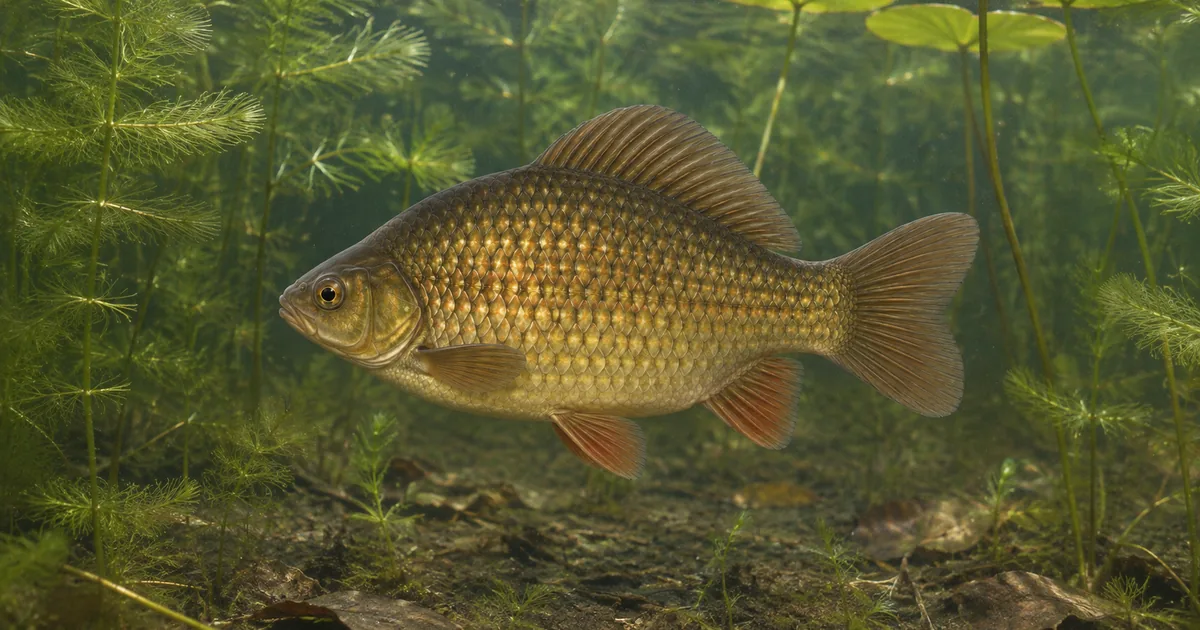
The crucian carp is a member of the carp family with a deep, laterally compressed body, large scales and no barbels. It usually grows to 20 to 35 centimetres; up to 64 centimetres have been recorded. It lives in natural ponds, small pools, oxbow lakes and ditches with dense plant growth below the surface. How large and how deep-bodied it grows depends on the water. According to the Fischartenatlas Sachsen-Anhalt, stunted crucian carp, meaning small fish from overcrowded populations, stay at 10 to 15 centimetres in ponds without predators. In shallow lakes rich in food and with pike, on the other hand, particularly deep-bodied fish of up to 40 centimetres are found.
In cold winter water, according to the DAFV, it can last several months in water that holds almost no oxygen. Its body then obtains energy by a pathway that ends in ethanol instead of lactic acid, and it releases the alcohol into the water through its gills. This keeps toxic waste products from building up in its tissues, the kind that push other species to their limits in such conditions. In summer this does not work: without any oxygen at all, it then survives only about a day.
That explains why it is at home in shallow, densely vegetated waters in particular. Under a closed ice cover, oxygen there becomes so scarce that other fish species cannot live in such ponds in the long run. How temperature and oxygen in the water are connected is explained on the page Water temperature and oxygen.
Why the crucian carp has disappeared from many waters
The 2023 national Red List of freshwater fish and lampreys lists the crucian carp as endangered, rare and in strong long-term decline. In the last ten years it has declined further. Within Germany the picture varies widely: according to the state list of North Rhine-Westphalia it is critically endangered there, while in Mecklenburg-Western Pomerania it is still fairly widespread and considered not threatened.
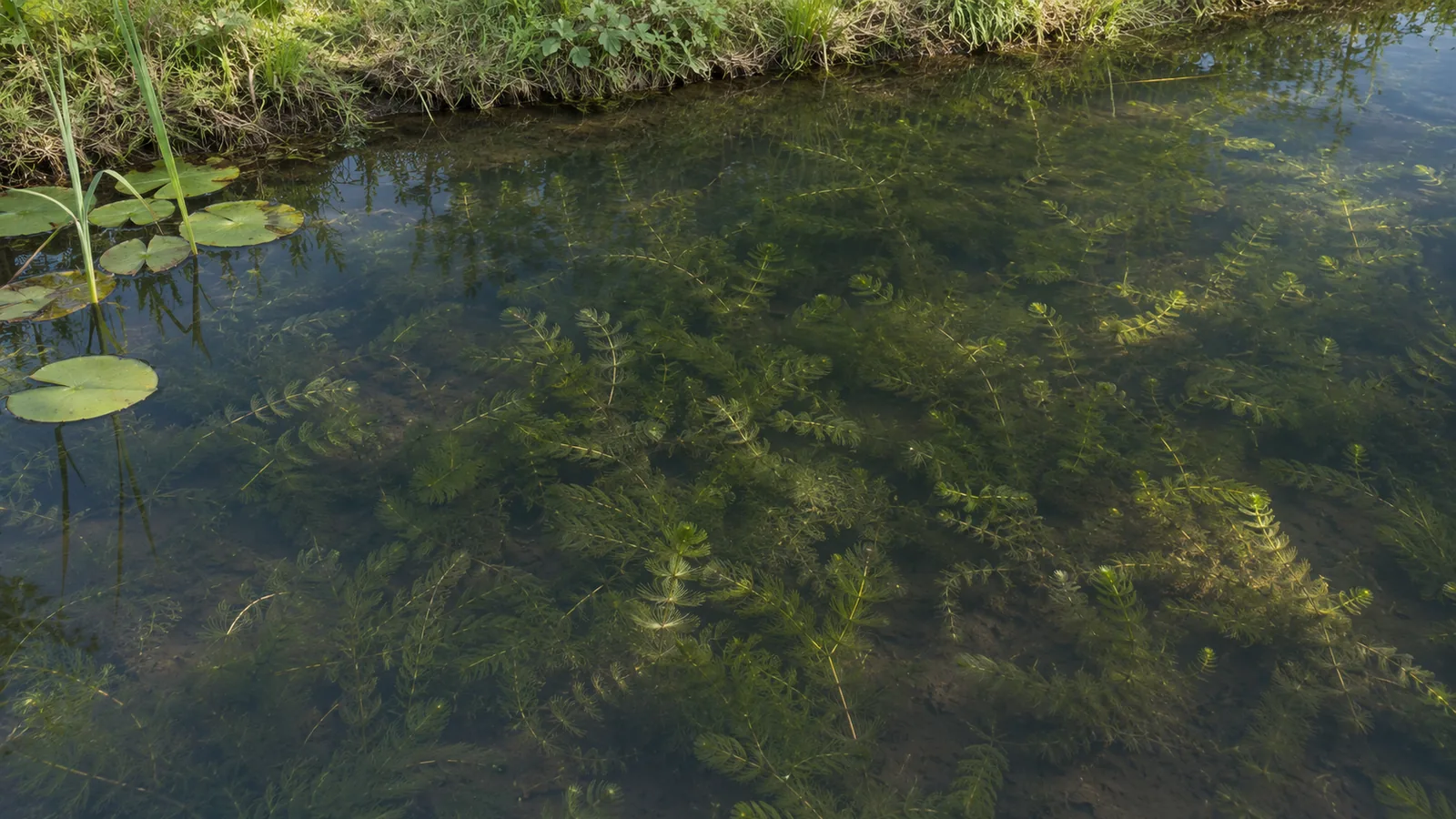
The main reason is the loss of its habitat. Small waters silt up or lose their value, banks are reinforced, ponds are dredged regularly, and nutrients from the surroundings push back the underwater plants on which it lays its sticky eggs in May and June. Because many of these ponds are small and appear on no conservation list, their disappearance often goes unnoticed. The Red List, too, sees the main reason in plant-rich small waters continuing to dry out and degrade. Many experts fear that climate change will make this worse.
The second reason is its introduced relatives. According to the Red List, the Prussian carp apparently only reached Central Europe via Russia after 1945. It outcompetes the crucian carp and takes over waters it gets into. On top of that come goldfish that escape into the wild from garden ponds and aquariums. The sources disagree on whether these relatives interbreed with the crucian carp. The DAFV writes that both do, so genetically pure stocks are becoming rarer. The Red List is more cautious: for Germany, interbreeding with the introduced species has been suspected but not yet proven. The Landesfischereiverband Baden-Württemberg distinguishes: the crucian carp can form hybrids with goldfish and common carp, and in British crucian carp populations they were found in 38 per cent of the cases studied. Prussian carp here, by contrast, are mostly all-female, reproduce without males and do not interbreed with the crucian carp. The Prussian carp is still a danger to it, as a competitor in the same pond.
Crucian carp or Prussian carp on the hook
On a live fish, the dorsal fin helps first: in the crucian carp its edge curves outwards. The peritoneum, the membrane lining the inside of the body cavity, is more reliable. It is pale in the crucian carp and dark in the Prussian carp, but you only see that when gutting the fish. With hybrids, the species often cannot be identified reliably at the water at all. Further features such as the scale count are in the crucian carp profile.
If a golden-brown, deep-bodied fish without barbels is on the hook and you are not sure whether it is a Prussian carp, treat it as a crucian carp: unhook it in the water and return it straight away.
What you can do as an angler and in your club
The title is not a law. Whether you may catch and keep crucian carp is still decided by your federal state, plus the conditions of your fishing permit (Erlaubnisschein). Bavaria protects the crucian carp all year, Hesse bans catching and taking it all year, and Saxony has a closed season (Schonzeit) from 1 February to 30 June with a minimum size (Mindestmaß) of 15 centimetres (as of 4 November 2026). What applies in your state is set out in the state fisheries regulation; how to read it is explained on the page Closed season and minimum size.
- Do not target the crucian carp. If one takes your bait as bycatch, unhook it in the water and return it straight away, as described on the page Returning fish.
- Never release fish into another water on your own initiative, and that includes goldfish from the garden pond.
- If you know of crucian carp in a club pond, tell the water warden (Gewässerwart). Only someone who knows about them can take them into account during work parties and stocking.
Clubs manage many small still waters and therefore, in the DAFV’s view, bear a direct responsibility. The federation and its specialist partners list what helps the crucian carp in their announcements:
- protect existing small waters and create new ones
- avoid dredging and bank reinforcement in known crucian carp waters
- reduce nutrient input from the surroundings
- do not stock Prussian carp or other non-native members of the carp family
- stock crucian carp only from stocks proven to be genetically pure, and only once the water has been secured for them
Why so many small waters are managed by clubs, and how to become a member and have a say, is explained on the page Angling club.
Frequently asked questions
Can I still fish for crucian carp in 2027?
The title changes nothing here; state law and your fishing permit remain decisive. Because the species is endangered, you should not target it even where it is allowed, and return any bycatch.
Who chooses the Fish of the Year?
The Bundesamt für Naturschutz, the Gesellschaft für Ichthyologie and the Deutscher Angelfischerverband propose three species. Since 2023 a public online vote has decided. The result for 2027 was announced on 2 November 2026.
How do I tell crucian carp from common carp?
By the mouth. The common carp has barbels on its upper lip; the crucian carp has none.
Related
- Crucian carp: features, habitat and the state rules in the profile
- Crucian carp as bycatch: why it is not a target fish
- Prussian carp: the introduced relative in the profile
- Water temperature and oxygen: what happens in the water under ice
- Returning fish: how bycatch survives
- Eel fishing ban: what applies to the Fish of the Year 2025
Sources
- Deutscher Angelfischerverband: Die Karausche ist Fisch des Jahres 2027 (2. November 2026) (Ergebnis, Merkmale, Überwinterung ohne Sauerstoff, Rote Liste, Ursachen, Maßnahmen)
- Deutscher Angelfischerverband: Fisch des Jahres 2027, jetzt abstimmen (17. Juni 2026) (Kandidaten, Frist, Verzicht auf Giebelbesatz)
- Gesellschaft für Ichthyologie: Karausche Fisch des Jahres 2027 (gemeinsame Bekanntgabe)
- Rote-Liste-Zentrum: Artensteckbrief Karausche, Rote Liste der Süßwasserfische und Neunaugen 2023 (Einstufung, Trend, Ursachen, Hybridisierung nicht belegt)
- Landesfischereiverband Baden-Württemberg: Die Fischart Karausche, ein Spezialist für Flussauen (2017) (Giebel ohne Hybriden, britische Befunde)
- Ministerium für Landwirtschaft und Umwelt Sachsen-Anhalt: Fischartenatlas Sachsen-Anhalt, Teil I (2012) (Kümmerform, hochrückige Fische in Hechtgewässern)
- Bayern: AVBayFiG, Anlage Schonzeiten, Schonmaße und räumlicher Geltungsbereich (ganzjährige Schonzeit)
- Hessen: Hessische Fischereiverordnung vom 14. April 2023, § 1 (Fang- und Entnahmeverbot)
- Sachsen: Sächsische Fischereiverordnung, Anlage Schonzeiten und Mindestmaße (Schonzeit und Mindestmaß)
Text AI-assisted, title image, drawing and the image in the text AI-generated. Sources opened and checked on 4 November 2026; no graphic was taken from the sources.
All information without guarantee. Whether, when and at what size you may catch or keep crucian carp is set by state law and your fishing permit.