
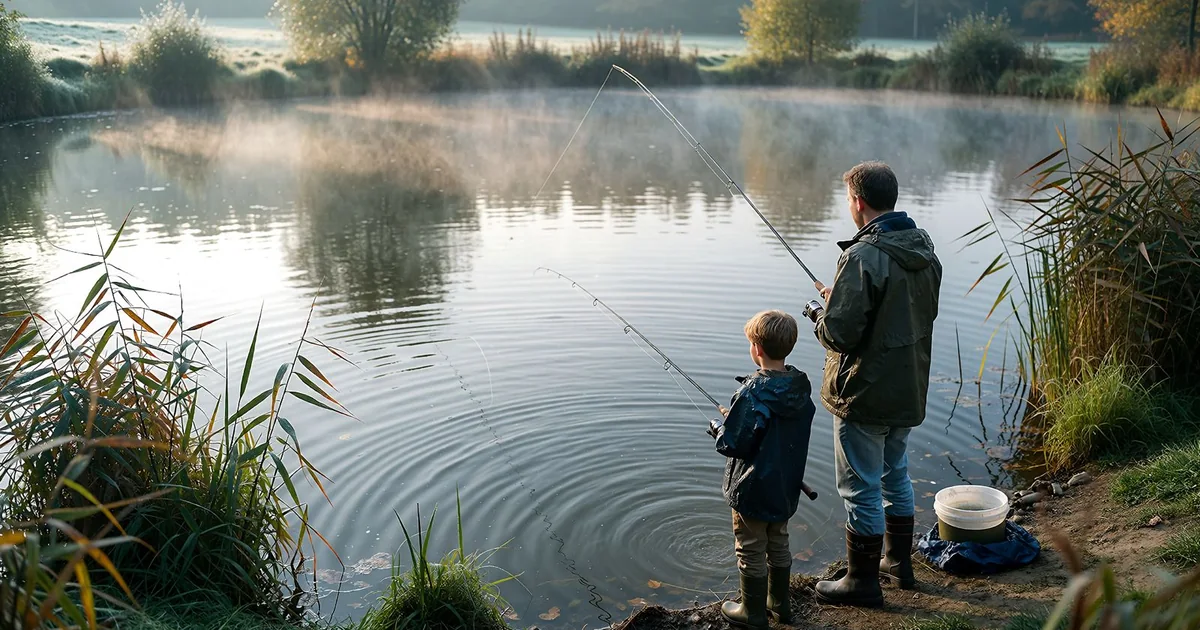
At a glance
- Position
- Gently sloping, open bank with no branches, shade and a toilet nearby
- Fish
- Roach on the pole, small perch too from July
- Supervision
- An adult within arm’s reach, plus a children’s life jacket
- Papers
- Adult’s licence, fishing permit, state rules for the child
- Catch
- Decide beforehand, only the adult kills
Choose a gently sloping bank with shade
I choose the spot by the bank, not by the fish. A firm, gently sloping strip of bank where the water deepens slowly and nothing crumbles away is good. The Bundesinstitut für Öffentliche Gesundheit (BIÖG) names slippery slopes and terrain that is hard to see across among the most common causes of accidents involving children near water. That is why I skip steep banks, sheet piling and undercut bank edges on the first trip.
On the first trip I also avoid trees right at the bank, overhanging branches and lots of wood in the water. When casting, the hook quickly snags in the branches there, and in the water the rig gets caught on the wood. Every snag means re-rigging, and the child has to wait all that time. In front of open water without obstacles, the child can cast in peace, and we both fish in a more relaxed way.
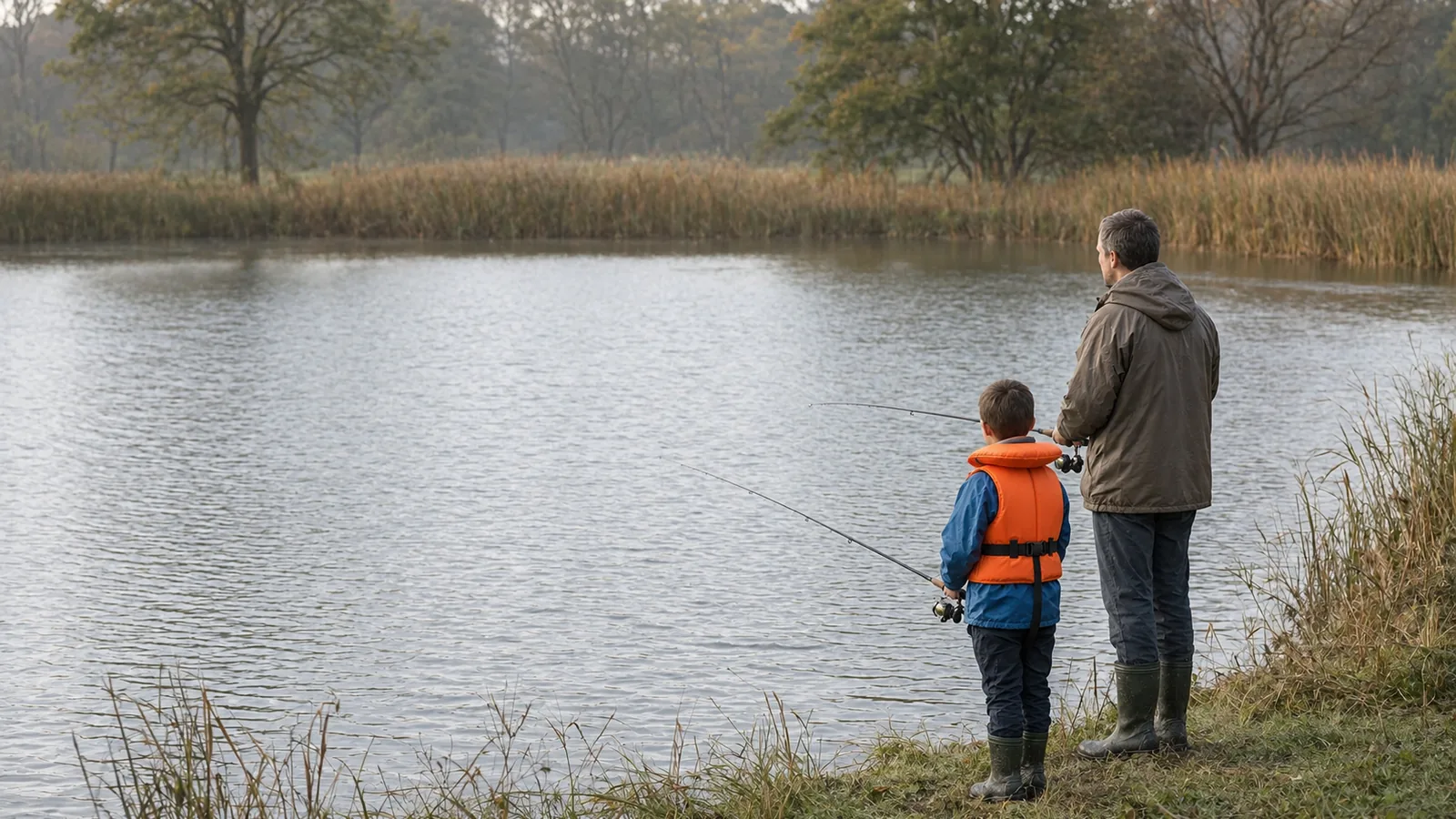 AI-generated
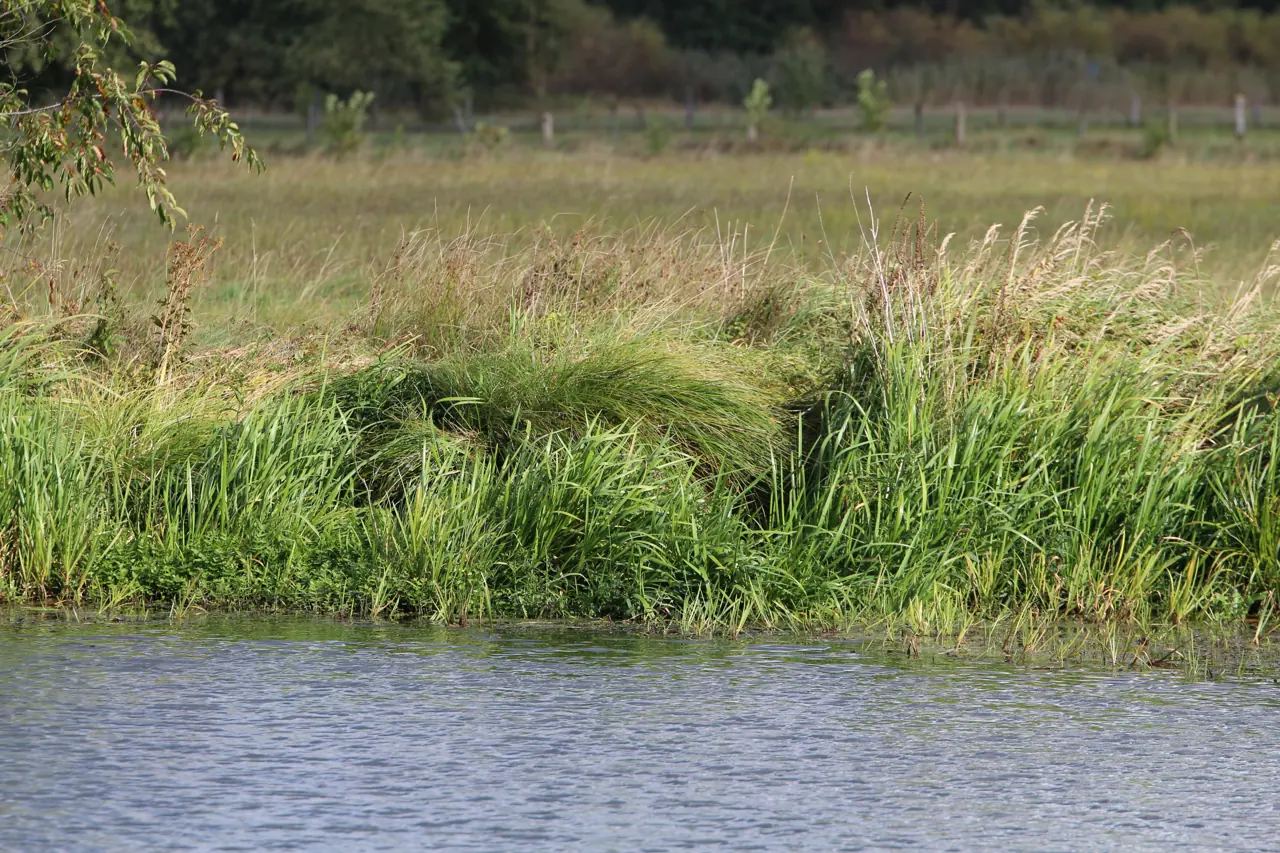
Before setting off, I check whether there will still be shade at midday at the seat behind the casting lane and how far it is to the nearest toilet. I plan short sessions with breaks and decide on the finishing time at home. At a trout pond, I find out beforehand whether caught fish have to be taken home, so the child knows what will happen at the end.
Pick a fish that bites often
The first time, the float should move often. Roach are my first choice for this, because the Rote Liste Zentrum lists them in Germany as very common with a stable population. I fish for them with a pole and float close to the bank, because the child can then see the bite.
According to the German Anglers‘ Association (DAFV), young perch live in shoals. They suck in bait greedily, so the hook often sits far back. In the catch calendar, the good time for roach starts in March and for perch in July. Whether a closed season (Schonzeit) applies during spawning is set by the state.
| Feature | Roach | Perch |
|---|---|---|
| Method for children | pole with float close to the bank | float with worm, short casts |
| Good months according to the catch calendar | from March, main season July to October | from July, main season September and October |
| Spawning according to the catch calendar | April to May | March to June |
| When unhooking | smooth body, hold with wet hands | spines in the dorsal fin, spike on the gill cover, hook often deep |
Set up the spot so everyone has room
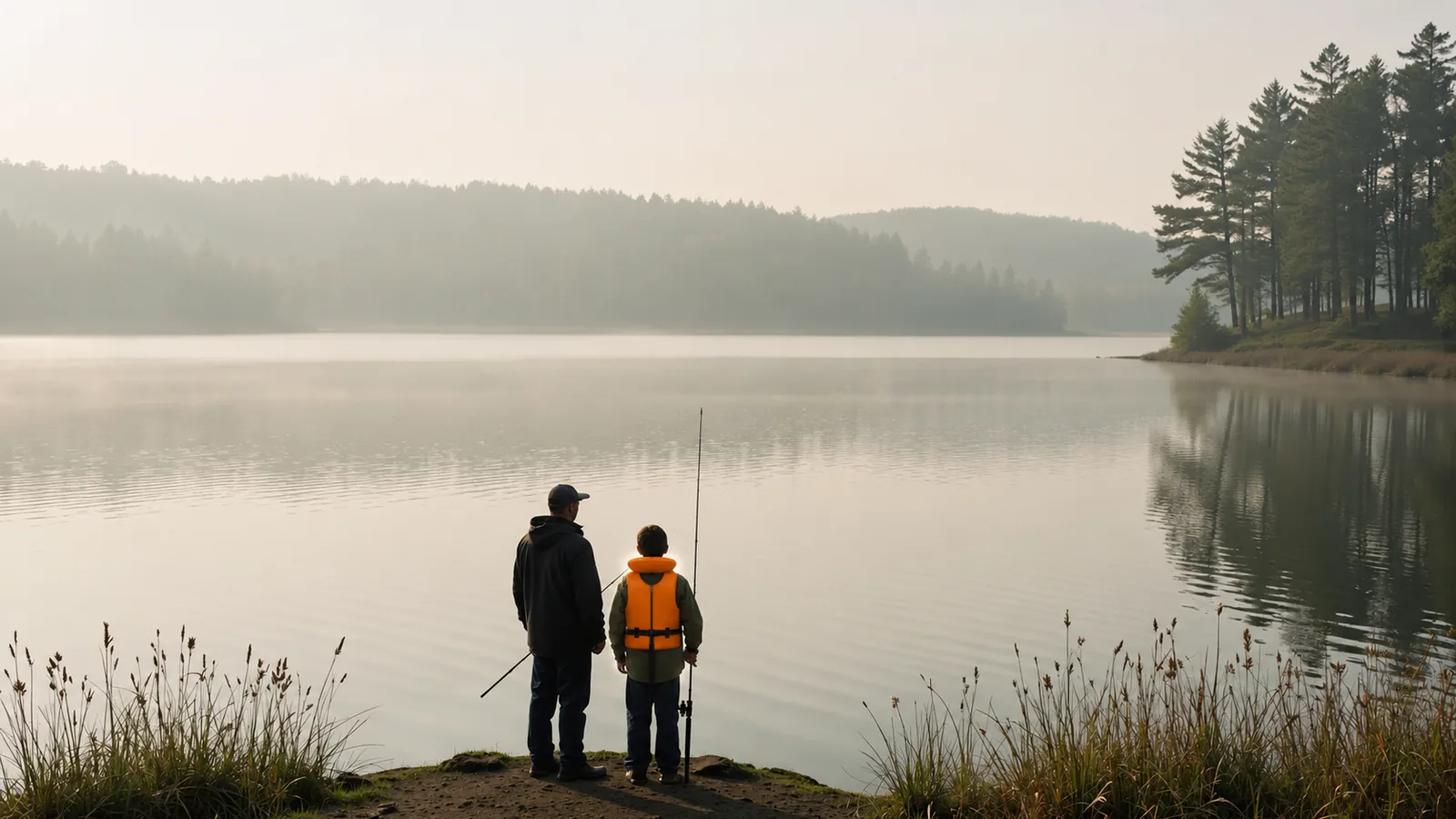
I set up the spot so that the child sits a little way back from the water and I stand to the side in front, between the child and the bank. We only cast where nobody is standing, and there is enough space between two rods that the tips do not touch when swinging back.
Before every cast I look around, because beginners easily get hooks caught in clothing or skin. Sunglasses with a polarising filter also protect the eyes from a stray bait. I never set up under power lines.
I go through the rules at the spot before the first cast and repeat them now and then, above all that the child never goes to the water alone. The DLRG Hamburg recommends this because younger children quickly forget a one-off explanation. A rubbish bag lies in plain sight at the spot. The Landesanglerverband Brandenburg (LAVB) even requires clearing litter within four metres of the spot beforehand.
Plan supervision, life jacket and sun protection firmly
Drowning is silent. According to DLRG training material, people who are drowning rarely call for help and disappear from the surface after 20 to 60 seconds. The BIÖG describes how children usually go under without a sound. That is why an adult always stays within arm’s reach at the water and the child wears a children’s life jacket.
Supervision is an adult’s job, never an older sibling’s, as the BIÖG stresses. According to the DLRG Hamburg, non-swimmers stay within arm’s reach even with a life jacket, because buoyancy aids do not give complete protection. The Federal Ministry of Transport recommends life jackets for children at the water even outside a boat, which is why I put the children’s life jacket on at the car.
The Bundesamt für Strahlenschutz (BfS) advises seeking shade at midday from a UV index of 3 and not taking babies into full sun. In the first year of life, no sunscreen should go on the skin; clothing and shade protect instead. Because children copy adults, I wear a hat and glasses myself. For heat and ticks, the same applies as on any summer day at the water.
If a hook is stuck in a child’s skin, I do not pull it out myself. The German Red Cross (DRK) states that only a doctor should remove foreign bodies. I treat the area as for any hook injury and drive to a surgery or A&E. This section does not replace medical advice.
Pack the bag the evening before
I add to the basic kit from My first day fishing for children, and choose the rod according to the advice on the children’s rod. The evening before, I pack using this list:
- adult’s fishing licence and ID, fishing permit for the water
- children’s life jacket in the right size
- pole or children’s rod with float, spare hooks
- bait in a lidded maggot box
- landing net and unhooking mat
- disgorger and forceps for deeply set hooks
- priest and knife, only if a fish is being taken
- hat, sunglasses, light long clothing and sunscreen
- drinking water, food and something to sit on
- water and soap for washing hands
- plasters and dressings
- rubbish bag
- Charged phone for the emergency number 112
Hands are washed before eating and after touching fish and bait, as the BIÖG recommends after any contact with animals.
Check what the child is allowed to do by law
Each federal state sets its own age limits, rules on accompaniment and papers. Two examples show how far apart the rules are.
In Hesse, children up to their tenth birthday may help an adult with fishing rights at that adult’s hand-held rod: siblings from one household or two children from different households (§ 29 Abs. 3 Hessisches Fischereigesetz). They stay within the adult’s immediate reach. From ten to under sixteen, young people fish by themselves without a licence if an adult holder of a fishing licence (Fischereischein) supervises. Since 2022 there has been no youth licence for this, but anyone living in Hesse pays a fishing levy (Fischereiabgabe) of 3,50 euros to the municipality every year (§ 35, plus § 27 Hessische Fischereiverordnung). A licence of their own is possible from 14 with an exam (§ 30).
In Brandenburg, children under eight may fish with a coarse fishing rod if an adult with fishing rights supervises them constantly and directly; they then fish on that adult’s fishing permit (§ 18 Brandenburgisches Fischereigesetz). At this age they are not allowed to net, unhook, stun or kill fish. From eight, a youth fishing licence for coarse fishing is available on application (§ 17 Abs. 6), and according to the agriculture and environment ministry the child may then fish unaccompanied. Under 14 there is no fishing levy (Fischereiabgabe), but a fishing permit is still needed.
For other states and holidays, the law at the water is what counts; the overview is in the legal section under Fishing with children. I read the water’s fishing permit in full beforehand.
Handle the caught fish calmly
I talk about what will happen to a fish before the first cast, as the brochure “Abenteuer Angeln” from the Austrian Kuratorium für Fischerei und Gewässerschutz (ÖKF) also advises. I return small roach and perch after a quick look, if the rules at the water allow it.
The fish is only handled with wet hands, because its slime layer is delicate; that is in the ÖKF brochure too. With perch, I fold the spiny dorsal fin down and watch out for the spike on the gill cover described by the Landesfischereiverband Bayern. I remove a deep hook myself over the damp mat. Unhooking and returning fish caught by children follow the same steps as usual.
If a fish is to be taken, I kill it. Under § 4 Animal Welfare Act (Tierschutzgesetz), only someone with the necessary knowledge and skills may kill a vertebrate. The child watches, as the ÖKF brochure suggests: first observe, later do it themselves under guidance. I follow the sequence from Stunning and killing fish.
Frequently asked questions
From what age can a child fish alongside an adult?
Each federal state decides. In Brandenburg even children under eight fish with a coarse fishing rod if an adult supervises right next to them at all times; in Hesse, children up to ten help at the adult’s rod.
Does a child need a life jacket on a gently sloping bank?
I put one on there too, as the Federal Ministry of Transport recommends for children at the water. But the life jacket does not replace supervision within arm’s reach.
May my child unhook the fish themselves?
That depends on the state; in Brandenburg it is forbidden for children under eight. I let younger children hold the fish with wet hands and remove the hook myself.
Related
- Roach, profile of the starter fish
- Roach fishing, rig and bait
- Perch, features and way of life
- Perch fishing, methods from the bank
- Children’s rod, which rod suits which age
- Fishing with children: the law, rules in all states
- My first day fishing, from licence to first cast
- Perch in autumn: where it lies and what to catch it on, when the perch season carries on
Sources
- Bundesinstitut für Öffentliche Gesundheit (BIÖG): Safety at the water, Händewaschen (Ertrinken, Böschungen, Aufsicht, Hygiene)
- DLRG Landesverband Hamburg: Allgemeine Sicherheitstipps (Armreichweite, Regeln wiederholen)
- DLRG Ortsgruppe Burscheid: Ausbildungsunterlage Ertrinkungsnotfall (leises Ertrinken)
- Bundesministerium für Verkehr: Sicherheit auf dem Wasser (Kinder-Rettungsweste auch am Ufer)
- Bundesamt für Strahlenschutz (BfS): Tipps zum UV-Schutz (Schatten, Säuglinge, Vorbild)
- Deutsches Rotes Kreuz (DRK): Wundversorgung und Verbände (Fremdkörper)
- Regierungspräsidium Kassel: Hessisches Fischereigesetz (§§ 29, 30) und Leitfaden Fischereiaufsicht (Jugendschein abgeschafft, Abgabe) und Hessische Fischereiverordnung (§ 27, Höhe der Abgabe)
- Land Brandenburg: Fischereigesetz für das Land Brandenburg (§§ 17, 18)
- Agrar- und Umweltministerium Brandenburg (MLEUV): Angelfischerei in Brandenburg (ohne Begleitung ab acht, Abgabe)
- Bundesministerium der Justiz: Tierschutzgesetz § 4 (Töten nur mit Sachkunde)
- Rote Liste Zentrum: Roach (Bestand)
- Deutscher Angelfischerverband (DAFV): Der Flussbarsch, Fisch des Jahres 2023 (Schwarm, tiefer Haken)
- Landesfischereiverband Bayern: Fischlexikon (Barschdorn)
- Österreichisches Kuratorium für Fischerei und Gewässerschutz (ÖKF): Abenteuer Angeln (Fang vorher klären, nasse Hände, zusehen)
- Landesanglerverband Brandenburg (LAVB): Gewässerordnung (Platz säubern)
- Blinker: Haken in der Hand, Polarisationsbrille (Abstand, Augenschutz)
Text AI-assisted, title image, drawing and two images in the text AI-generated, photo of the bank: Iwan Belokurov. Sources opened and checked in October 2026; no graphic was taken from the sources.
All information is a guide without guarantee. It replaces neither supervision at the water nor medical advice. Age limits, accompaniment, closed season and minimum size are set by state law.