
Knowledge · Tackle
Maggot box and worm tub: Keeping live bait fresh
A maggot box keeps maggots, pinkies and casters alive until they go on the hook, and the worm tub does the same for lobworms and brandlings. This explains which bedding, temperature and moisture the two baits need and where the leftovers belong after fishing.
The maggot box: lid, air holes, bedding
In the equipment section for the angling exam (Fischerprüfung), bait boxes count as accessories for keeping natural baits (Fischereiverein Löningen). The English angling magazine Angling Times describes the maggot box as a box with a tight-fitting lid and small holes: air gets in through them and condensation drains away. The British Canal & River Trust advises keeping the holes free of crumbs so the maggots can breathe.
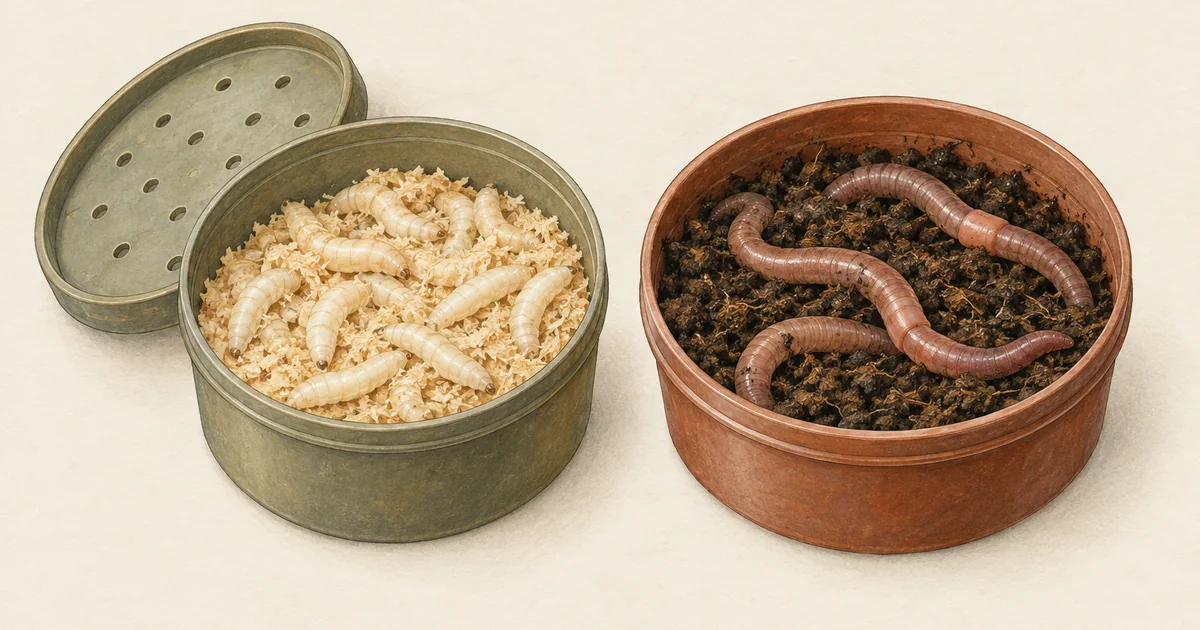
Maggots are the larvae of the bluebottle. In the tackle shop you usually get them with a scoop of sawdust or maize meal; the Trust also mentions bran. The dry bedding soaks up moisture. In warm weather maggots sweat: according to Blinker they turn damp and smell strongly of ammonia, which tends to put fish off rather than attract them. The remedy: wash them, dry them and carry them in an airy linen bag with plenty of sawdust.
It doesn’t need to be bone dry, though. Maggots kept too dry shrivel and die sooner, which is why half a litre of sawdust is mixed with 150 ml of water for storage. The British sources stress keeping them dry, German articles recommend slightly damp sawdust.
Don’t fill the box to the brim. The Trust advises filling it only halfway with maggots. Packed tightly, the larvae generate heat themselves, sweat and pupate faster. Against escapees there are boxes with a large hole in the lid: the maggots do climb the wall but fail at the rim of the lid, which overhangs inwards.
Keep cool: maggots, pinkies and casters
Warmth speeds up development. Warm maggots quickly turn into casters, the brown pupae, while cold slows their metabolism. Blinker calls a fridge at 4 °C well suited, with the maggots lasting up to two weeks there. Rute & Rolle advises setting the appliance to 0 to 2 °C instead of the usual 6 to 8 °C and, with really fresh maggots, expects at least a week before the first casters appear. Pinkies, the smaller larvae of the greenbottle, can be kept for several weeks and are therefore in demand in winter. Without a fridge, a cool, dark place is the next best solution.
If you store them for longer than a day or two, Angling Times recommends tipping the maggots onto a maggot riddle and letting them crawl through into a clean tray. Skins, dead maggots and casters that have already pupated stay in the riddle. A mesh size of 3,5 mm is mentioned.
Storing casters
Casters belong in a freezer bag with little air, but not none at all: a lot of air lets them keep maturing until they float, too little suffocates them. Air and mix them every other day and they keep in the fridge for 8 to 10 days. A sniff test with ten to fifteen crushed casters shows whether they are still good: neutral means fine, sour means dead.
In the fridge: lid on, stand the box upright and keep it away from open food. The Canal & River Trust also advises asking the owner of the fridge first. Escaped maggots among the groceries are an experience you can do without.
The worm tub: damp, cool, dark
According to Blinker, worms need cool and damp conditions, while wet does them harm. You store collected lobworms in damp newspaper that isn’t dripping. At 2 to 5 °C in the fridge they survive, according to the magazine, up to three weeks even in a small worm tub. A larger crate with damp paper in an unheated cellar keeps them fresh even longer.
Brandlings and the giant red worm, sold commercially as dendrobaena, are different. They don’t need to be chilled and like it warm. In a breeding crate, 10 to 30 °C in the substrate is considered harmless. In one case, though, the temperature in a crate that was too wet and fermenting rose to 65 °C and all the worms died. If worms gather under the lid, something is wrong with the substrate. Sawdust or straw meal then binds the moisture. Even the hardy dendrobaena doesn’t belong in a car at around 30 °C for hours.
| Baits and lures | Bedding | Temperature | Shelf life |
|---|---|---|---|
| Maggots | Sawdust, maize meal, bran | 4 °C or 0–2 °C | one to two weeks |
| Casters | freezer bag, little air | Fridge | 8–10 days, air every two days |
| Lobworms | damp newspaper | 2–5 °C | up to three weeks in the tub |
| brandling, dendrobaena | soil with compost | 10–30 °C in the substrate | no cooling needed |
At the water: shade and a closed lid
Worms tolerate heat and sun worst, and both together are the worst of all. At more than 25 °C in a heated-up car they arrive at the water falling apart. In summer the baits therefore travel in a cool bag. According to Rute & Rolle, the maggot box also never belongs in full sun at the water. Put the lid back on after every dip in, maggots are quick and use every gap.
The best way to keep casters while fishing is in water; the warmer it is, the more important that becomes, otherwise they dry out. In winter the problem reverses: in icy cold the maggot box goes in your trouser pocket or an old wool sock so the maggots don’t die off.
Wash your hands, take leftovers home
The Bundesinstitut für Öffentliche Gesundheit (BIÖG, the German federal public health institute) recommends washing your hands after handling animals, animal feed or animal waste and always before eating, lathering for 20 to 30 seconds. Angling Times expressly advises washing your hands after handling maggots. This advice is no substitute for medical advice.
You don’t tip leftover maggots into the water. For a study published in 1987 in Cardiff, researchers spread grain or maggots in normal amounts on the bed of a reservoir for twelve weeks. Grain reduced the density of nearly all bottom-dwelling animals, and maggots had a similar effect. Whether and how much you may feed is set out in the water rules (Gewässerordnung) and in your fishing permit (Erlaubnisschein).
You don’t release worms. Fisch & Fang reported on researchers at the University of Minnesota: European earthworms released by anglers are changing the forests there because they eat up the leaf litter on the ground. The scientists recommend disposing of leftover bait worms with the rubbish. Live maggots go back in the fridge; casters left over after fishing are dead and usable for two days at most.
Common mistakes
- Forgetting the bait in the car. Warm maggots pupate quickly and eventually hatch as flies. Worms break down at more than 25 °C in a heated-up car.
- Filling the box to the brim. Tightly packed maggots heat each other up, sweat and pupate sooner.
- Keeping worms wet instead of damp. Dripping paper or substrate does harm. In a breeding crate with too much water and compost, the temperature once rose so far that all the worms died.
- Leaving bait in the sun or a hot car. Heat and sun together do the most damage to worms.
- Overlooking blocked air holes. Then the maggots lack air and condensation stays inside.
Frequently asked questions
How long do maggots last in the fridge?
At 4 °C up to two weeks is quoted. At 0 to 2 °C, with really fresh maggots, you can expect at least a week before pupation.
Why do my maggots smell sharp?
In warm conditions maggots sweat and give off ammonia. Washing, drying and fresh sawdust help, plus fewer maggots per box and a cool place.
What to do when the maggots have pupated?
Don’t throw them away. Casters are a good bait in themselves for many fish species. What doesn’t go on the hook is mixed into the groundbait, as the article on casters describes.
How long do lobworms last?
At 2 to 5 °C in the fridge up to three weeks is quoted in the worm tub, and even longer in a larger crate with damp newspaper in a cool place. Freshly collected lobworms catch best.
Related
- Maggots and larvae: baiting up, target fish and rig
- Worms: which kind for which fish and how long
- Pole fishing: rod without a reel, maggot on a fine hook
- Feeder fishing: maggots and worm pieces in the feeder
- Cool box and cool bag: transporting bait and catch cool
- Sun, heat and ticks: protection for long days at the water
- Line calculator: breaking strain and knots for the fine hooklengths in maggot fishing
Sources
- Blinker: Tipps zum Aufbewahren und Anködern (Schwitzen, Leinenbeutel, Deckelrand, Winter, Caster)
- Blinker: Angeln mit Maden (4 °C, zwei Wochen, Pinkies) und Blinker: Caster-Herstellung (Sägemehl, Sieb, Caster lagern)
- Blinker: Würmer suchen und lagern (Feuchte, 2 bis 5 °C, Hitze), Blinker: Wurmzucht anlegen: So wird’s gemacht (Mistwürmer, 10 bis 30 °C, Nässe) und Blinker: Angeln mit Wurm (Dendrobena, Frische)
- Rute & Rolle: Maden, echte Allrounder für Friedfische (0 bis 2 °C, Sonne)
- Angling Times: How to buy, store and use maggots for fishing (Luftlöcher, Einstreu, Füllmenge, Kühlschrank, Hygiene)
- Canal & River Trust: Large maggots (Kleie, Füllmenge, Luftlöcher)
- Bundesinstitut für Öffentliche Gesundheit: Händewaschen (Anlässe und Dauer)
- Environmental Pollution (1987): The impact of angler groundbait on benthic invertebrates (Wirkung auf Bodentiere)
- Fisch & Fang: Angel-Würmer bedrohen die Wälder Amerikas (ausgesetzte Köderwürmer)
- Fischereiverein Löningen: Gerätekunde (PDF) (Köderdosen für natürliche Köder)
Text AI-assisted, drawing AI-generated. Sources opened and checked in October 2026; no graphics taken from the sources.
All figures are guide values without guarantee. How long maggots and worms keep depends on freshness, quantity and temperature, and what you may feed is set by the water rules (Gewässerordnung).