
Knowledge – Fish
Roach fishing
Roach fishing means keeping a shoal at the spot with little feed and fishing finely with a float. Here is the way there in nine steps, each with a link to the detailed page.
 Choose another fish117 fish with guides
 EelOff-peak season
 EelpoutPossible
 IdePossible
 ArapaimaGood
 GraylingPeak season
 Atlantic salmonSpawning time, please spare
 Brown troutSpawning time, please spare
 Brook troutSpawning time, please spare
 BarbelOff-peak season
 BarramundiSpawning season
 Greater amberjackGood
 Topmouth gudgeonOnly as bycatch
 Blue marlinSpawning season
 BonefishSpawning season
 BonitoGood
 BreamOff-peak season
 Dusky grouperOnly as bycatch
 CobiaPossible
 Spiny dogfishOnly as bycatch
 CodPeak season
 ChubPeak season
 MinnowOnly as bycatch
 European sturgeonOnly as bycatch
 FlounderPeak season
 PerchPeak season
 Largemouth bassGood
 Ballan wrasseOnly as bycatch
 Yellowfin tunaSpawning season
 Giant trevallyGood
 Prussian carpPossible
 BrillPossible
 Gilthead breamSpawning time, please spare
 Golden doradoSpawning season
 Golden mahseerOnly as bycatch
 Dolphinfish (mahi-mahi)Good
 Grass carpPossible
 Great barracudaGood
 GudgeonPossible
 White breamPossible
 DaceOff-peak season
 PikePeak season
 HalibutOff-peak season
 HerringPossible
 GarfishOut of season
 Huchen (Danube salmon)Possible
 Crucian carpOnly as bycatch
 CarpOff-peak season
 RuffeOff-peak season
 VendaceOnly as bycatch
 DabPeak season
 GurnardPossible
 Coley (saithe)Peak season
 Chinook salmonHardly any chance
 King mackerelSpawning season
 LingPeak season
 TuskOff-peak season
 MackerelPossible
 Bighead carpOut of season
 WhitefishPossible
 Conger eelOff-peak season
 Sea troutSpawning time, please spare
 Grey mulletPossible
 Murray codSpawning season
 MuskellungeGood
 Common nasePossible
 Nile perchPossible
 PayaraPossible
 Peacock bassPeak season
 PermitGood
 WeeverOnly as bycatch
 PollackOff-peak season
 BurbotOff-peak season
 AspPossible
 Red snapperSpawning season
 Rainbow troutPeak season
 RoosterfishGood
- RoachPeak season
 RedfishOut of season
 Bluefin tunaOnly as bycatch
 RuddPossible
 Russian sturgeonOnly as bycatch
 HaddockOff-peak season
 SnakeheadPossible
 TenchOff-peak season
 SpirlinOnly as bycatch
 PlaiceOff-peak season
 Greenland halibutOnly as bycatch
 Round gobyOnly as bycatch
 SwordfishGood
 Lake troutSpawning time, please spare
 HakeSpawning time, please spare
 Alpine charSpawning time, please spare
 MonkfishPossible
 SoleOff-peak season
 SailfishGood
 Silver carpOut of season
 SnookPeak season
 PumpkinseedOnly as bycatch
 SpratOnly as bycatch
 Atlantic wolffishSpawning time, please spare
 TurbotPeak season
 SterletOnly as bycatch
 SmeltOnly as bycatch
 Horse mackerelPossible
 TaimenGood
 TarponGood
 TigerfishSpawning season
 BleakPossible
 WahooGood
 Wels catfishOff-peak season
 WhitingPeak season
 Sea bassOff-peak season
 ZanderPeak season
 White-eye breamOnly as bycatch
 Blue breamOnly as bycatch
 Brown bullheadPossible
 VimbaOnly as bycatch
Season in October according to the catch calendar, an estimate and not a guarantee of a catch. The fish pictures are reduced natural-history plates and AI-generated.
Best time
From July to October, mostly in the evening.
In January: GoodIn February: PossibleIn March: GoodIn April: Good, spawning seasonIn May: Good, spawning seasonIn June: GoodIn July: Peak seasonIn August: Peak seasonIn September: Peak seasonIn October: Peak seasonIn November: GoodIn December: Good
Good spot
- Lake: open water and weed bedsopen water, weed beds and surfaceopen water and weed bedsdeep water
- River: stone embankment and quiet baystone embankment, quiet bay and main currentstone embankment and quiet baydeep pools and stone embankment
Starter tackle
- Rod: whip or pole 6–8 m to start with, 8–10 m for more distant spots; in winter with fine elastic 0,6–0,8 mm
- Line: monofilament 0,10–0,12 mm for fine fishing, 0,18–0,20 mm to start with
- Hook: 14–16 to start with, 18–20 for cautious fish, up to 24 in winter
- Rod: match rod of about 3,60 m with a fast tip, for bread flake in winter also 4,50–5,10 m
- Line: monofilament 0,15–0,17 mm
- Hook: 16–20 for maggots and casters, 12–16 for bread flake
- Rod: feeder rod 3,05–3,45 m, light to medium, with a fine quiver tip
- Line: monofilament 0,15–0,20 mm
- Hook: size 14
In short
In short: You will catch roach best from July to October, especially in the evening. Good spots on a lake: open water and weed beds; on a river: stone embankment and quiet bay. Tried and tested baits: worms and maggots, plus sweetcorn or bread on a light float.
Quick to recognise
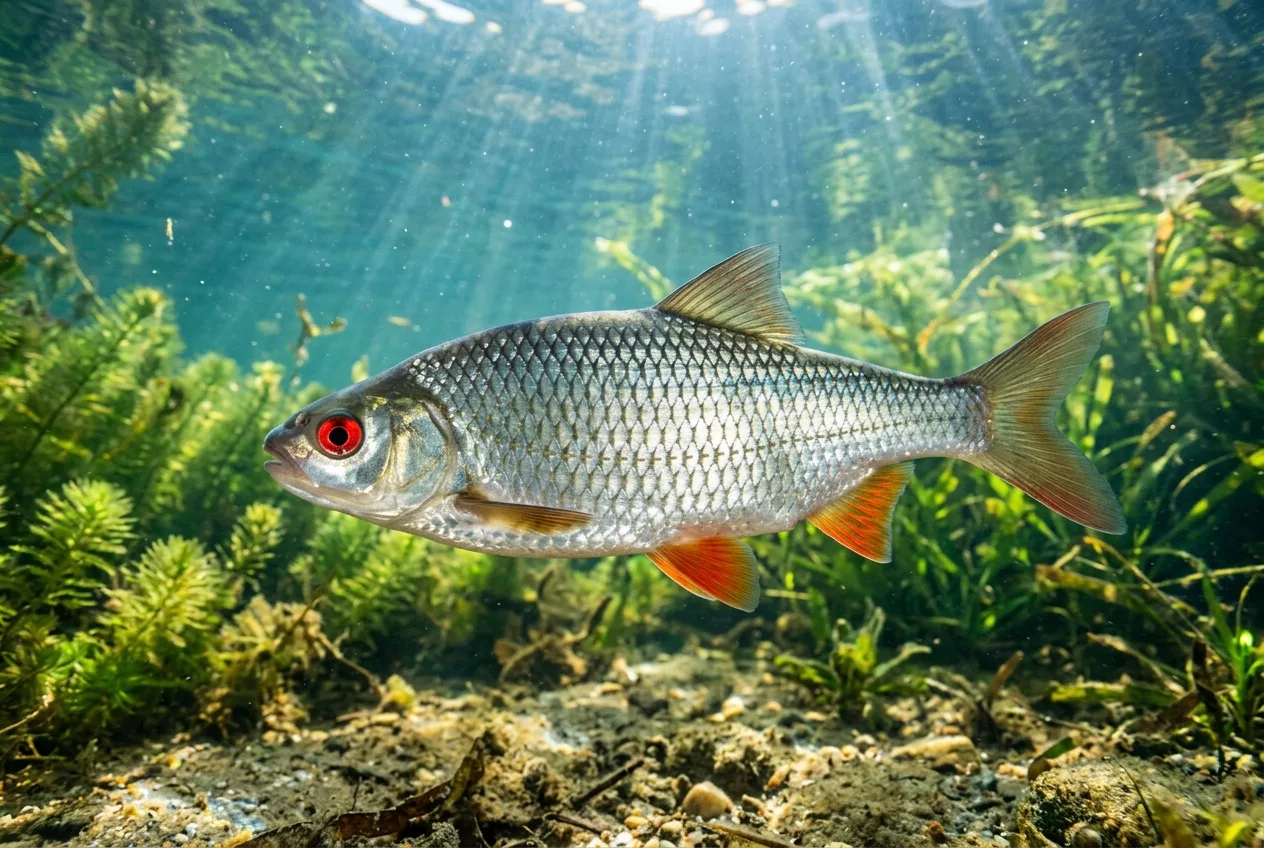
An adaptable shoaling fish, known regionally as Plötze, with a small, toothless mouth. It usually measures 15 to 25 centimetres, rarely more than 35.
When
You can catch roach all year round, best from July to October. Spawning takes place in April and May, depending on the water from about 6 to 12 degrees. Whether a closed season (Schonzeit) applies then is set by your federal state (Bundesland). On rivers in winter, dusk brings the most bites.
- JanGood
- FebPossible
- MarGood
- AprGood, spawning
- MayGood, spawning
- JunGood
- JulPeak season
- AugPeak season
- SepPeak season
- OctPeak season
- NovGood
- DecGood
Peak seasonGoodPossibleHardly any chanceSpawning season
Spring tactics
Before spawning, roach in rivers often gather in dense groups below weirs. One or two dung worms on a fine float often bring bigger fish now. Whether a closed season (Schonzeit) applies during the spawning period is set by your federal state (Bundesland).
Summer tactics
After spawning the shoals spread out across the water, and in rivers in high summer they also hold in strong current. You then need heavier floats such as the Avon. Try different depths; many roach are now in mid-water.
Autumn tactics
The fish build up reserves and also take larger baits such as tinned sweetcorn. Many experienced coarse anglers regard autumn as the best time for big roach, especially from about an hour before dusk into the dark.
Winter tactics
Feed sparingly with dark, quickly breaking-up groundbait so that the fish stay hungry and do not stand out over light ground. Fish finely with a thin hooklength, small hooks and hemp or maggots. On rivers, mild days with slightly cloudy water are worth it; after a cold snap it often stays quiet.
Are they biting today?
In January: Off-peakIn February: PossibleIn March: Off-peakIn April: Spawning season, please spare themIn May: Spawning season, please spare themIn June: Off-peakIn July: Peak seasonIn August: Peak seasonIn September: Peak seasonIn October: Peak seasonIn November: Off-peakIn December: Off-peak
Today’s catch index needs JavaScript. Season and spawning time are in the catch calendar.
From the blog: The first fishing trip with children: plan briefly, set up safely, check the rules · Fishing in November: which fish bite now and where I look for them · Freshwater fish in Germany: which species you catch where
Where it sits now
In the lake
On lakes, roach move in shoals through mid-water and to weedy shallow banks, depending on where the food is. In warm weather they feed just below the surface; in winter they hold deep.
How to go about it: After spawning, the shoals hold sometimes at reed edges, sometimes at the drop-off (Scharkante) or in a bay the wind is blowing into. For distant spots you take a match rod with a waggler; as a rule of thumb the float carries about 1 g per metre of depth. Anyone who fishes only on the bottom misses the fish in mid-water on some days.
| Spring | Open water, weed beds |
|---|---|
| Summer | Open water, weed beds, surface |
| Autumn | Open water, weed beds |
| Winter | deep bottom |
In the river
On rivers you look for algae-covered stone embankments and calm, weedy stretches of bank. In winter the shoals crowd into deep water with little current, often in harbour basins.
How to go about it: Look for every irregularity on the bottom and along the shoreline, such as the edge between the slope and the riverbed. Once found, such spots often produce fish all year round. In winter, quiet harbour basins on canals and big rivers are a good choice.
| All year round | Riprap |
|---|---|
| Spring extra | calm bay |
| Summer extra | calm bay, main current |
| Autumn extra | calm bay |
| Winter extra | Pools |
Biting time: mainly in the evening. What that looks like on the water is shown by the picture of the holding spots just below.
Waters with rules for roach
Holding spots in the picture
Choose the season and time of day: the picture shows where the species stands then. Spots outlined in red apply only in the chosen season. Tap a fish or a spot in the list to bring it closer. The picture is schematic and AI-generated, every water is different.
Chance of a catch in springgoodSpawning, observe the closed seasons
Catch chance in summerPeak season
Catch chance in autumnPeak season
Catch chance in wintergood
- J
- F
- M
- A
- M
- J
- J
- A
- S
- O
- N
- D
Spawning season
Not prime time In winter, roach on rivers bite mainly at dusk.
Not prime time In winter, roach on rivers bite mainly at dusk.
Active time In winter, roach on rivers bite mainly at dusk.
Not prime time In winter, roach on rivers bite mainly at dusk.
In the lake
Water lilies and weed bed
Roach are found here only in spring, summer and autumn.
Deep bottom
Roach are found here only in winter.
Open water
Roach are found here only in spring, summer and autumn.
Just below the surface
Roach are found here only in summer.
Roach are shoaling fish. In still waters they like to stay in mid-water, and also on shallow stretches of bank with vegetation. Depending on the food supply they move between the bank zone and open water.
Spring: chances of a catch according to the catch calendar are good. This is when spawning takes place, so observe closed seasons (Schonzeit). Spawning happens in April and May in groups in shallow water, on plants, roots or stones.
Summer: chances of a catch according to the catch calendar are good in June, with peak season in July and August. In warm weather roach prefer to feed near the surface.
Autumn: catch chance according to the catch calendar is peak season in September and October, good in November.
Winter: chances of a catch according to the catch calendar are good in December and January, possible in February. In winter roach withdraw to deep spots. They are still caught even under ice.
In the river
Pools, deep spot
Roach are found here only in winter.
riprap, sheet piling, harbour
Roach are found here all year round.
Calm bay with aquatic plants
Roach are found here only in spring, summer and autumn.
Free current in mid-river
Roach are found here only in summer.
In rivers, roach prefer to stay at algae-covered stone embankments. Add to that shallow, slow-flowing stretches of bank with vegetation. The shoals here are usually smaller than on lakes.
Spring: chances of a catch according to the catch calendar are good. This is when spawning takes place, so observe closed seasons (Schonzeit). Roach make short migrations to spawn. They spawn in the shallows on plants or over gravel.
Summer: chances of a catch according to the catch calendar are good in June, with peak season in July and August. On hot summer days roach in rivers also move into strongly flowing water.
Autumn: catch chance according to the catch calendar is peak season in September and October, good in November.
Winter: chances of a catch according to the catch calendar are good in December and January, possible in February. In winter roach look for deep, calm water. In rivers and canals they like to gather then in big shoals in harbour basins, where there is hardly any current.
Depth: Roach feed at every depth. In the warm season they stay nearer the surface, in the cold season in the deep.
Size comparison: AI-generated drawing, schematic.
How
The float is the method of choice, whether on a pole, a match rod with a waggler or a long whip. In current you hold the float back a few times at the end of the drift: the bait rises and sinks, and that is exactly when most bites come.
Easiest way
To start with, a whip of 6 to 8 m, 0,18 monofilament, a slightly thinner hooklength, a size 14 or 16 hook and a light float of 1 to 4 g are enough. Sit down on a lake bank with plants, on a canal or in a harbour and offer a maggot just above the bottom. A few balls of groundbait at the start and a pinch of maggots now and then keep the fish in front of you.
Pole with a shortened line
The standard for roach in harbours, canals and at the lake bank when the shoal is within rod reach.
- Look for edges
Watch for every change on the bottom and at the bank. Even a hollow 10 to 20 cm deep can gather roach, in winter especially in quiet harbour basins.
- Just above the bottom
Set the float so that the bait hovers a few centimetres above the bottom. If there are no bites, let the lowest small weight or a piece of hooklength rest on the bottom.
- Little and accurate
To start, throw two to three litres of groundbait in a few balls straight in front of the rod tip, ideally with a handful of hemp. After that you add only small amounts of hemp or maggots around the float.
- Short line
No more than 1,5 m of line stays between the rod tip and the float; the rod provides the rest of the length. When fishing hemp you use a stick or drop-shaped weight, because fish easily mistake shot for a seed.
- Baiting hemp properly
Insert the hook behind the pale germ and turn it, so the husk holds the seed. Alternatively a single maggot on a fine hook.
- React at once
Roach often show only with a fine twitch. Strike briefly and lightly as soon as the antenna twitches or dips under.
- Let the elastic work
A fine elastic absorbs the runs of bigger fish. To land the fish you ship the pole back and guide the fish over a small landing net.
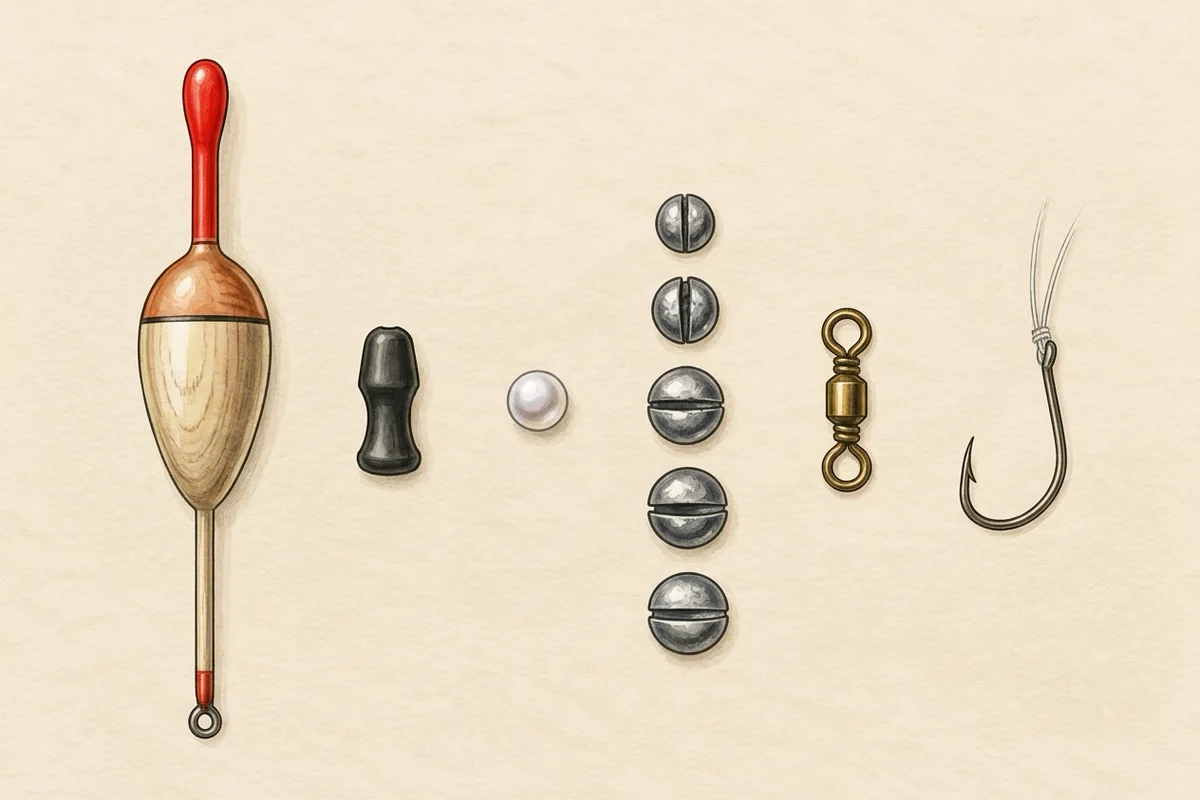
Trotting float on the river
For roach in rivers with an even current, where the float with the bait drifts through a feed trail.
- Edge on the river
Roach like to travel along the edge between the bank slope and the level riverbed, waiting for food brought down by the current. A calm river about two metres deep is ideal.
- Finding the depth
Start with the bait about 10 cm above the bottom. If there are no bites, you adjust the float in steps of 10 cm, because the fish often hold 10 to 50 cm above the bottom.
- One feed trail
Regularly fire a few maggots or some hemp with the catapult to the same spot. If you scatter too widely, the fish spread out and the trail brings hardly any bites.
- Lightly upstream
Put the float into the water with a short underarm cast two to three metres upstream. As it drifts past you, you mend the line.
- Control the line
Let the line run off with the bail arm open and slow it with your finger on the spool rim. A greased line stays on top and makes striking easier.
- The tip goes under
When the fine tip of the float disappears, you strike at once. A hook with a wide gape holds better here.
- Net calmly
Play the fish on fine line with a softly set drag and net it instead of lifting it over the edge.
Light feeder on the bottom
For bigger roach at distance or in deeper water, when the float no longer reaches.
- Calm bottom
Choose a medium-sized river with moderate current or, on a lake, a drop-off (Scharkante) or a bay on the windward side. In winter the fish on lakes hold in the deepest places.
- Feeder with maggots
Fill the feeder with groundbait and a few live maggots. For roach, less and faster-breaking groundbait is enough than for bream.
- Fine hooklengths
To the 0,15 to 0,20 main line you add a thinner hooklength of about 0,14 mm with a size 14 hook.
- Pinpoint accuracy
Cast to the same spot every time so that feed and fish gather there.
- Fine tip
A soft quiver tip also shows the plucks of big roach. Strike at a clear movement.
- Landing net ready
Big roach fight surprisingly hard on fine tackle. Keep the landing net ready and do not lift them out by the thin line.
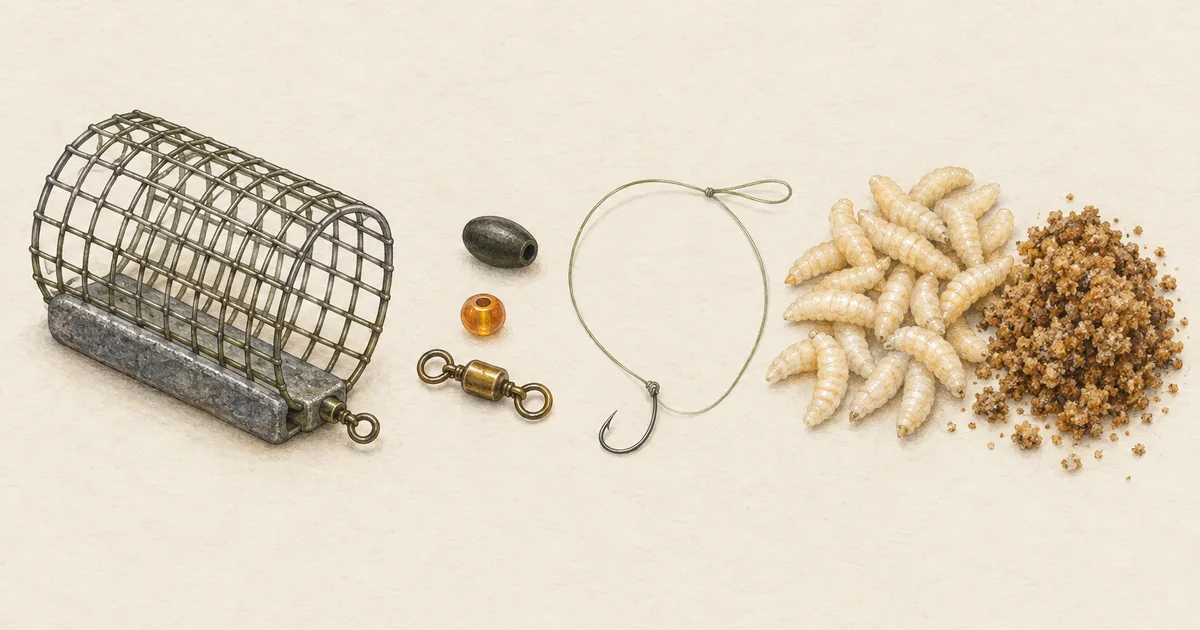
What with
Maggots bring many bites; for bigger roach, sweetcorn with a maggot is a good cocktail. Paste, bread flake and dung worms also catch. For feeding, smaller, quickly breaking-up balls and a few maggots now and then are enough.
- Maggots & larvaeall year round, as a single maggot, a bunch or a caster with two maggots
Maggots bring the most bites and at the same time serve as attractors in the feed trail.
- Sweetcorn & particlessweetcorn in autumn, hemp in winter and in harbours
In autumn roach take larger seeds; in winter boiled hemp often catches better than any other bait.
- Bait pastefor bigger roach, on the whip and in winter on rivers
Paste made from white bread swells in the water, is easy to see and tends to attract the bigger fish.
Tackle
A float rod, such as a match or Bolognese rod, or a whip without a reel. If the roach bite only cautiously, take a hooklength thinner than 0,10 millimetre and tiny size 20 hooks.
Pole with a shortened line
- Rod
- Whip or pole 6–8 m to start with, 8–10 m for more distant spots; in winter with fine elastic 0,6–0,8 mm
- Line
- Monofilament 0,10–0,12 mm for fine fishing, 0,18–0,20 mm to start with
- Leader
- always thinner than the main line, usually 0,08–0,10 mm, in winter also 0,06 mm
- Hooks
- 14–16 to start with, 18–20 for cautious fish, up to 24 in winter
- Weight, float, lead
- Float with 0,5–1,5 g in harbours and still water, 1–4 g on a gently flowing river
Trotting float on the river
- Rod
- Match rod of about 3,60 m with a fast tip, for bread flake in winter also 4,50–5,10 m
- Reel
- small fixed-spool reel with a finely adjustable drag, alternatively a centrepin reel
- Line
- Monofilament 0,15–0,17 mm
- Leader
- about 0,14 mm, with a small swivel against line twist
- Hooks
- 16–20 for maggots and casters, 12–16 for bread flake
- Weight, float, lead
- stick float in calm water, in stronger current an Avon float with more carrying capacity; shot string over up to two thirds of the depth
Light feeder on the bottom
- Rod
- Feeder rod 3,05–3,45 m, light to medium, with a fine quiver tip
- Reel
- small to medium fixed-spool reel with a fine drag
- Line
- Monofilament 0,15–0,20 mm
- Leader
- about 0,14 mm
- Hooks
- size 14
- Weight, float, lead
- small feeder
Common mistakes
- Fishing only on the bottom: Roach often hold in mid-water. Adjust the depth in small steps until the bites come.
- Too much feed added: Heavy balls thrown in while fishing fill the fish up or scare them off. Add only hemp or a few maggots.
- Light groundbait in winter: Over a light bottom, roach in cold water feel exposed. Colour the groundbait dark and keep the amounts small.
- Split shot when fishing hemp: The fish snap at the lead balls because they look like seeds. Use a stick or drop-shaped weight.
- Feed scattered too widely: On a river a broad feed trail gets lost. Keep hitting the same spot with the catapult.
Rules
Each federal state (Bundesland) sets its own closed season (Schonzeit) and minimum size (Mindestmaß). Choose your state; the values come from our state pages.
Baden-Württemberg
Our overview for Baden-Württemberg does not list the roach. What applies there is on the page Fishing in Baden-Württemberg, with the state’s spots.
Bavaria
Our overview for Bavaria does not list the roach. What applies there is on the page Fishing in Bavaria, with the state’s spots.
Berlin
- Minimum size
- –
- Closed season
- none
Correct as of October 2026. All rules, exceptions and sources: Fishing in Berlin.
Brandenburg
- Minimum size
- –
- Closed season
- none
As of October 2026. All rules, exceptions and sources: Fishing in Brandenburg.
Bremen
Our overview for Bremen does not list the roach. What applies there is on the page Fishing in Bremen, with the state’s spots.
Hamburg
Our overview for Hamburg does not list the roach. What applies there is on the page Fishing in Hamburg, with the state’s spots.
Hesse
Our overview for Hesse does not list the roach. What applies there is on the page Fishing in Hesse, with the state’s spots.
Mecklenburg-Western Pomerania
Our overview for Mecklenburg-Western Pomerania does not list the roach. What applies there is on the page Fishing in Mecklenburg-Western Pomerania, with the state’s spots.
Lower Saxony
Our overview for Lower Saxony does not list the roach. What applies there is on the page Fishing in Lower Saxony, with the state’s spots.
North Rhine-Westphalia
Our overview for North Rhine-Westphalia does not list the roach. What applies there is on the page Fishing in North Rhine-Westphalia, with the state’s spots.
Rhineland-Palatinate
- Minimum size
- 15 cm
- Closed season
- none
- Note
- observe the general closed seasons (Schonzeit)
As of October 2026. All rules, exceptions and sources: Fishing in Rhineland-Palatinate.
Saarland
Our overview for Saarland does not list the roach. What applies there is on the page Fishing in Saarland, with the state’s spots.
Saxony
- Minimum size
- –
- Closed season
- none
Correct as of October 2026. All rules, exceptions and sources: Fishing in Saxony.
Saxony-Anhalt
Our overview for Saxony-Anhalt does not list the roach. What applies there is on the page Fishing in Saxony-Anhalt, with the state’s spots.
Schleswig-Holstein
Our overview for Schleswig-Holstein does not list the roach. What applies there is on the page Fishing in Schleswig-Holstein, with the state’s spots.
Thuringia
Our overview for Thuringia does not list the roach. What applies there is on the page Fishing in Thuringia, with the state’s spots.
The regulation and your fishing permit (Erlaubnisschein) are what count. Lake Constance, the Rhine and the coast, for example, have their own rules: Fishing waters in Germany.
After the catch
Playing and landing
Strike briefly and let the rod or a fine elastic absorb the runs; on thin hooklengths every hard pull breaks off. Net bigger roach instead of lifting them out by the line. Handle them only with wet hands, unhook them in the water if possible, and return at once every fish you may not keep.
Roach in a closed season (Schonzeit) or under size you return carefully with wet hands. If you keep one, you stun and kill it properly. Whether you may use it as a dead bait fish is set by your federal state (Bundesland).
Frequently asked questions
Which hook size for roach?
To start, size 14 to 16; for cautious fish 18 to 20. For hemp, fine-wire hooks of size 16 to 18 fit; for bread flake rather 12 to 16.
Which line for roach fishing?
On the whip 0,10 to 0,12 mm, on the match rod on rivers 0,15 to 0,17 mm. The hooklength is always slightly thinner than the main line.
When do roach bite best?
Autumn is considered the best time for big roach. In winter on rivers dusk brings the most bites; when they are in a feeding mood, they often bite during the day too.
How deep do roach hold?
In rivers usually 10 to 50 cm above the bottom, sometimes up to a metre above it. In lakes they like to stay in mid-water, in winter on the bottom at the deepest spots.
Which bait for big roach?
Bread flake, a caster with two maggots or sweetcorn are good. Very big roach also take a lobworm now and then, often when fishing for eel or tench.
How long should hemp be boiled for roach?
Soak it overnight and then boil it on a low heat until the seeds split and show white, usually 15 to 30 minutes. Then rinse in cold water.
Similar species
Anyone who catches roach can fish for these species with similar tackle too:
 Fishing for ruddPossible
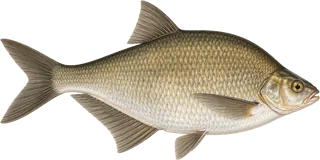 Fishing for breamShoulder season
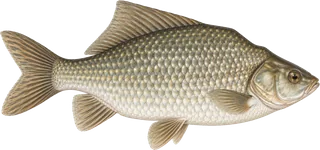 Prussian carp fishingPossible
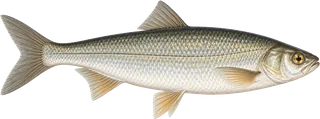 Dace fishingShoulder season
Sources
Correct as of October 2026. The practical knowledge comes from 12 sources, summarised in our own words.
View all 12 sources
- Steckbrief Rotauge: So fängst Du zickige Plötzen · BLINKER (Redaktion)
- Zielfisch Rotauge: So fangen die Profis · FISCH & FANG (Markus Heine)
- Zielfisch Rotauge: Rotaugen mit Stil · FISCH & FANG (Specimen Hunting Group Dortmund)
- Die besten Köder zum Rotaugenangeln für das ganze Jahr · BLINKER (Redaktion)
- Rotauge: Im Winter richtig füttern und mehr fangen · BLINKER (Redaktion)
- Kaltes Silber: Rotaugen im Winter fangen · BLINKER (Redaktion)
- Rotaugen im Hafen · BLINKER (Redaktion)
- Die richtige Pose zum Stippen im Fluss · BLINKER (Redaktion)
- Grundkurs Stippfischen: So fängt jeder · RUTE & ROLLE (Georg Baumann)
- Brassen angeln: Alle Grundlagen und die 4 besten Methoden (Abschnitt Matchangeln) · BLINKER (Redaktion)
- Fische landen: Wie nutze ich Kescher, Lip-Grip und Co.? · BLINKER (Redaktion)
- LFV Fischlexikon: Fische bayerischer Gewässer (Rotauge) · Landesfischereiverband Bayern
Text AI-assisted, based on the sources named and these pages: Roach (profile), Float fishing, Pole fishing, Maggots & larvae.