
Knowledge – Fish
Barbel fishing
Barbel fishing means holding the bait firmly on the bottom in the current and making the swim interesting with feed. Here is the way there in nine steps, each with a link to the detailed page.
 Choose another fish117 fish with guides
 EelOff-peak season
 EelpoutPossible
 IdePossible
 ArapaimaGood
 GraylingPeak season
 Atlantic salmonSpawning time, please spare
 Brown troutSpawning time, please spare
 Brook troutSpawning time, please spare
- BarbelOff-peak season
 BarramundiSpawning season
 Greater amberjackGood
 Topmouth gudgeonOnly as bycatch
 Blue marlinSpawning season
 BonefishSpawning season
 BonitoGood
 BreamOff-peak season
 Dusky grouperOnly as bycatch
 CobiaPossible
 Spiny dogfishOnly as bycatch
 CodPeak season
 ChubPeak season
 MinnowOnly as bycatch
 European sturgeonOnly as bycatch
 FlounderPeak season
 PerchPeak season
 Largemouth bassGood
 Ballan wrasseOnly as bycatch
 Yellowfin tunaSpawning season
 Giant trevallyGood
 Prussian carpPossible
 BrillPossible
 Gilthead breamSpawning time, please spare
 Golden doradoSpawning season
 Golden mahseerOnly as bycatch
 Dolphinfish (mahi-mahi)Good
 Grass carpPossible
 Great barracudaGood
 GudgeonPossible
 White breamPossible
 DaceOff-peak season
 PikePeak season
 HalibutOff-peak season
 HerringPossible
 GarfishOut of season
 Huchen (Danube salmon)Possible
 Crucian carpOnly as bycatch
 CarpOff-peak season
 RuffeOff-peak season
 VendaceOnly as bycatch
 DabPeak season
 GurnardPossible
 Coley (saithe)Peak season
 Chinook salmonHardly any chance
 King mackerelSpawning season
 LingPeak season
 TuskOff-peak season
 MackerelPossible
 Bighead carpOut of season
 WhitefishPossible
 Conger eelOff-peak season
 Sea troutSpawning time, please spare
 Grey mulletPossible
 Murray codSpawning season
 MuskellungeGood
 Common nasePossible
 Nile perchPossible
 PayaraPossible
 Peacock bassPeak season
 PermitGood
 WeeverOnly as bycatch
 PollackOff-peak season
 BurbotOff-peak season
 AspPossible
 Red snapperSpawning season
 Rainbow troutPeak season
 RoosterfishGood
 RoachPeak season
 RedfishOut of season
 Bluefin tunaOnly as bycatch
 RuddPossible
 Russian sturgeonOnly as bycatch
 HaddockOff-peak season
 SnakeheadPossible
 TenchOff-peak season
 SpirlinOnly as bycatch
 PlaiceOff-peak season
 Greenland halibutOnly as bycatch
 Round gobyOnly as bycatch
 SwordfishGood
 Lake troutSpawning time, please spare
 HakeSpawning time, please spare
 Alpine charSpawning time, please spare
 MonkfishPossible
 SoleOff-peak season
 SailfishGood
 Silver carpOut of season
 SnookPeak season
 PumpkinseedOnly as bycatch
 SpratOnly as bycatch
 Atlantic wolffishSpawning time, please spare
 TurbotPeak season
 SterletOnly as bycatch
 SmeltOnly as bycatch
 Horse mackerelPossible
 TaimenGood
 TarponGood
 TigerfishSpawning season
 BleakPossible
 WahooGood
 Wels catfishOff-peak season
 WhitingPeak season
 Sea bassOff-peak season
 ZanderPeak season
 White-eye breamOnly as bycatch
 Blue breamOnly as bycatch
 Brown bullheadPossible
 VimbaOnly as bycatch
Season in October according to the catch calendar, an estimate and not a guarantee of a catch. The fish pictures are reduced natural-history plates and AI-generated.
Best time
From August to September, mostly in the morning and evening.
In January: Hardly any chanceIn February: Hardly any chanceIn March: PossibleIn April: GoodIn May: Possible, spawning seasonIn June: Possible, spawning seasonIn July: Good, spawning seasonIn August: Peak seasonIn September: Peak seasonIn October: GoodIn November: PossibleIn December: Hardly any chance
Good spot
- River: deep pools, behind stones and the main currentdeep pools, behind stones and the main currentdeep pools, behind stones and the main currentdeep pools
Top baits
Starter tackle
- Rod: 3,60–3,90 m feeder rod; on a big river up to about 4,50 m and 150–200 g casting weight
- Line: mono 0,20–0,30 mm; in a current braid 0,12–0,14 mm with a 0,25–0,30 mm mono shock leader
- Hook: strong-wire eyed hooks size 2–10, size 10 for maggots
- Rod: 3,30–3,90 m, test curve about 1,75–2,25 lb
- Line: mono 0,22–0,30 mm
- Hook: wide-gape hook, size 4–6 for a 2 cm cube of cheese
- Rod: sturdy match or Bolognese rod, 3,90 m to over 4,20 m
- Line: mono 0,22–0,30 mm
- Hook: strong eyed hooks, size 2–10 depending on the bait
In short
In short: The best time to catch barbel is August to September, mostly in the morning and evening. Good spots on the river: deep pools, behind stones and the main current. Proven baits: hard cheese, luncheon meat, maggots and worm; also pellets and boilies. Most federal states protect barbel between April and June. The closed season (Schonzeit) lasts longer in Brandenburg (until 31 July) and Thuringia (until 31 August), in Berlin the barbel is protected all year, and in Mecklenburg-Western Pomerania you may not keep it (as of October 2026).
Quick to recognise
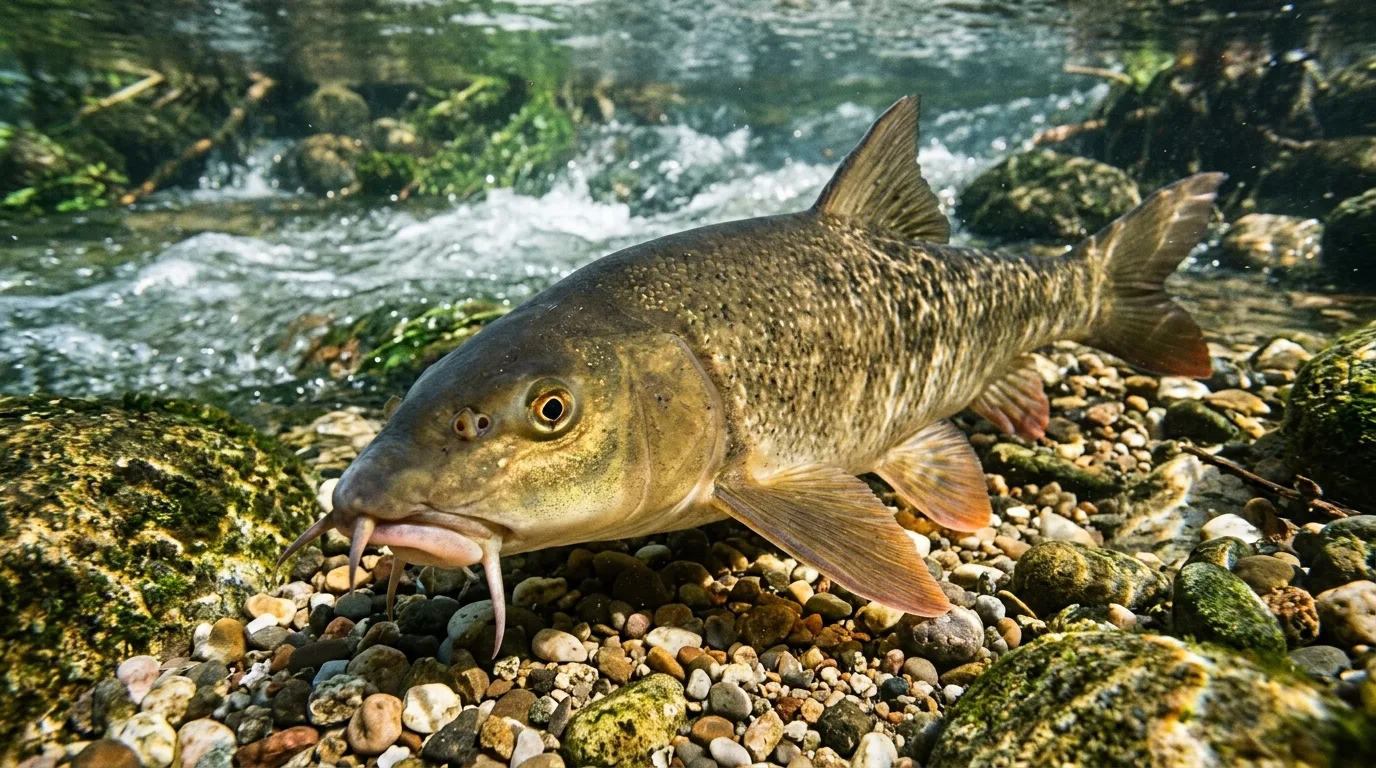
A powerful cyprinid of clear, fast rivers that roots through the bottom with its snout-like mouth. Most barbel measure 30 to 70 centimetres, rarely reaching 90.
When
Peak season is August and September, chances are good in April, July and October; big fish come most readily in low water in late summer and early autumn. From May to July barbel spawn on gravel with a shallow flow over it. Most federal states protect them between April and June, Brandenburg until 31 July and Thuringia until 31 August, Lower Saxony not at all. In Berlin the barbel is protected all year, and in Mecklenburg-Western Pomerania you may not keep it (as of October 2026). From November, with the first night frosts, they usually rest through winter until March.
- JanHardly any chance
- FebHardly any chance
- MarPossible
- AprGood
- MayPossible, spawning season
- JunPossible, spawning season
- JulGood, spawning
- AugPeak season
- SepPeak season
- OctGood
- NovPossible
- DecHardly any chance
Peak seasonGoodPossibleHardly any chanceSpawning season
Spring tactics
Not much happens in March. When the water warms up in April, barbel feed more and the chances improve. During the spawning run leave the shallow gravel bars alone. Almost everywhere the closed season begins in spring, earlier or later depending on the state, and in Berlin the barbel is protected all year; the dates for your state are below under the rules.
Summer tactics
After spawning the best time begins. In low water barbel in big rivers often hold in the middle of the current, so the bait can lie in the navigation channel. In small, clear rivers they retreat under undercut banks and roots in bright sun.
Autumn tactics
From mid-September natural food gets scarcer, and it is the big barbel that bite well then. This tails off with the first night frosts. If the water rises afterwards, it is worth a try, because in high water they often feed again.
Winter tactics
Barbel now rest in groups in deep, slow pools and feed little. Only on mild days or when the water is rising fast do they bite now and then. Feed hardly at all then and put a strongly scented bait right into the pool.
Are they biting today?
In January: Off seasonIn February: Off seasonIn March: PossibleIn April: Shoulder seasonIn May: Spawning season, please spare themIn June: Spawning season, please spare themIn July: Spawning season, please spare themIn August: Peak seasonIn September: Peak seasonIn October: Shoulder seasonIn November: PossibleIn December: Off season
Today’s catch index needs JavaScript. Season and spawning time are in the catch calendar.
From the blog: Fishing at locks and weirs: what applies and what the signs mean · Freshwater fish in Germany: which species you catch where · Roach or rudd, bream or silver bream: how to tell these silver fish apart reliably
Where it sits now
In the river
Barbel stand in packs on the bottom over sand, gravel and stones: below weirs, behind bridge piers, in deep channels and pools. By day they stay under overhanging trees or bridges, at dusk they move into shallower, faster water.
How to go about it: On a small river you look for evenly flowing stretches without strong eddies, with gravel and water plants. On a big river good spots are on the border between a groyne field and the main current or at the foot of the stone revetment. At night barbel are hardly bothered by a headtorch, but they are by footsteps on the bank.
| All year round | Pools |
|---|---|
| Spring extra | behind stones, main current, undercut bank, riffle |
| Summer extra | behind stones, main current, undercut bank, riffle |
| Autumn extra | behind stones, main current, undercut bank |
Biting time: mainly in the morning and in the evening. What that looks like at the water is shown by the picture of the holding spots just below.
Holding spots in the picture
Choose the season and time of day: the picture shows where the species stands then. Spots outlined in red apply only in the chosen season. Tap a fish or a spot in the list to bring it closer. The picture is schematic and AI-generated, every water is different.
Catch chances in springpossible
Chance of a catch in summergoodSpawning, observe the closed seasons
Catch chance in autumngood
Catch chance in winterhardly any
- J
- F
- M
- A
- M
- J
- J
- A
- S
- O
- N
- D
Spawning season
Active time Barbel mostly feed at dusk; by day they often stand in a shoal under overhanging trees or bridges.
Not the main time Barbel mostly feed at dusk; by day they often stand in a shoal under overhanging trees or bridges.
Active time Barbel mostly feed at dusk; by day they often stand in a shoal under overhanging trees or bridges.
Not the main time Barbel mostly feed at dusk; by day they often stand in a shoal under overhanging trees or bridges.
In the river
Undercut bank, overhanging branches, timber
Barbel are here only in spring, summer and autumn.
Slack water behind rocks
Barbel are here only in spring, summer and autumn.
Gravelly shallow (riffle)
Barbel are here only in spring and summer.
Pools, deep spot
Barbel are here all year round.
Free current in mid-river
Barbel are here only in spring, summer and autumn.
Barbel stand in a shoal on the bottom, in strong current over sand, gravel and stones. Typical spots are the water below weirs, inflows, the slack behind bridge piers, deep channels in mid-river and deep pools. By day they often stand under overhanging trees or bridges.
Spring: catch chances according to the catch calendar possible in March, good in April, possible in May. At spawning time from May barbel move upriver in shoals, often over long distances. Spawning takes place on shallow gravel bars with water flowing over them.
Summer: catch chances according to the catch calendar possible in June, good in July, peak season in August. The spawning season falls in this period, so observe the closed seasons. Depending on the source, spawning on the gravel bars lasts into June or July. After that the main fishing time begins.
Autumn: catch chances according to the catch calendar peak season in September, good in October, possible in November. As the water cools in autumn the main fishing time ends.
Winter: catch chances according to the catch calendar slim. In winter barbel gather in large groups in deep, slow-flowing places in the river bed.
Depth: The barbel always stays on the bottom.
Size comparison: AI-generated drawing, schematic.
How
Feeder fishing on the bottom is proven: the bait lies still or rolls only slowly, and the weight just holds against the current. In strong current a self-hooking rig with a fixed lead also catches, and on clear, shallow rivers a drifting float.
Easiest way
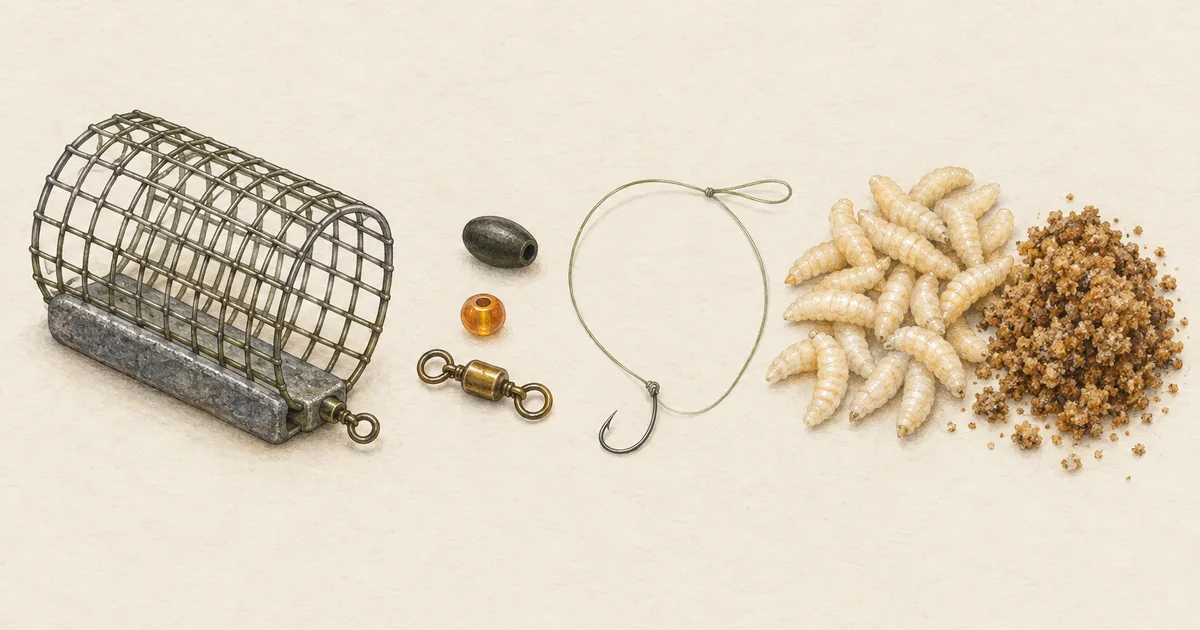
The easiest way in is a 3,60 to 3,90 m feeder rod and a closed feeder full of maggots and hemp. Put it on a current edge where the main flow slows down, and offer two or three maggots on a strong-wire size 10 hook.
Feeder on the edge of the current
The usual method from April to October, on a small river just as in a big current.
- Edge and channel
Look for the line where the strong current eases, often visible from drifting foam. There barbel save energy and still get a steady supply of food. Holes and channels in the river bed are good spots too.
- Maggots and hemp
Fill a closed feeder with maggots and boiled hemp. The maggots crawl out slowly, the current washes the hemp out after them, and that makes a scent trail on the bottom.
- Free-running feeder
Thread the feeder onto the main line with a stop behind it. About 20 cm further on sits a swivel with a hooklength of about 35 cm. That way the feeder stays put at the bite and the barbel feels hardly any resistance.
- Always the same spot
Pick a landmark on the far bank and hit the same spot with every cast. Roughly every 10 minutes you reel the feeder in and refill it, otherwise the swim loses its effect.
- Rod steep
Hold the rod steeply in the current so that no big bow forms in the line. A barbel bite pulls the tip round hard; only then do you strike.
- Against the current
The barbel makes straight for the bottom and runs several times. Let her work against the current and the clutch until she tires, instead of hauling her up by force.
- Waiting for the last run
Have a roomy landing net with a long handle ready. Just before the net the barbel often bolts once more, and then the clutch has to give line.
Cheese on a hair with a fixed lead
For big barbel in the current and for sit-in sessions where the fish hooks itself on the heavy lead.
- Foot of the stone revetment
On a big river you do not need to cast far. The rig often lies best exactly where the stone revetment meets the river bed.
- Prebaiting
For specimen barbel you prebait two to three days beforehand with cubes of cheese and a little hemp, where the state and the water rules allow it. Cheese often catches even without prebaiting.
- Mounting the cheese cube
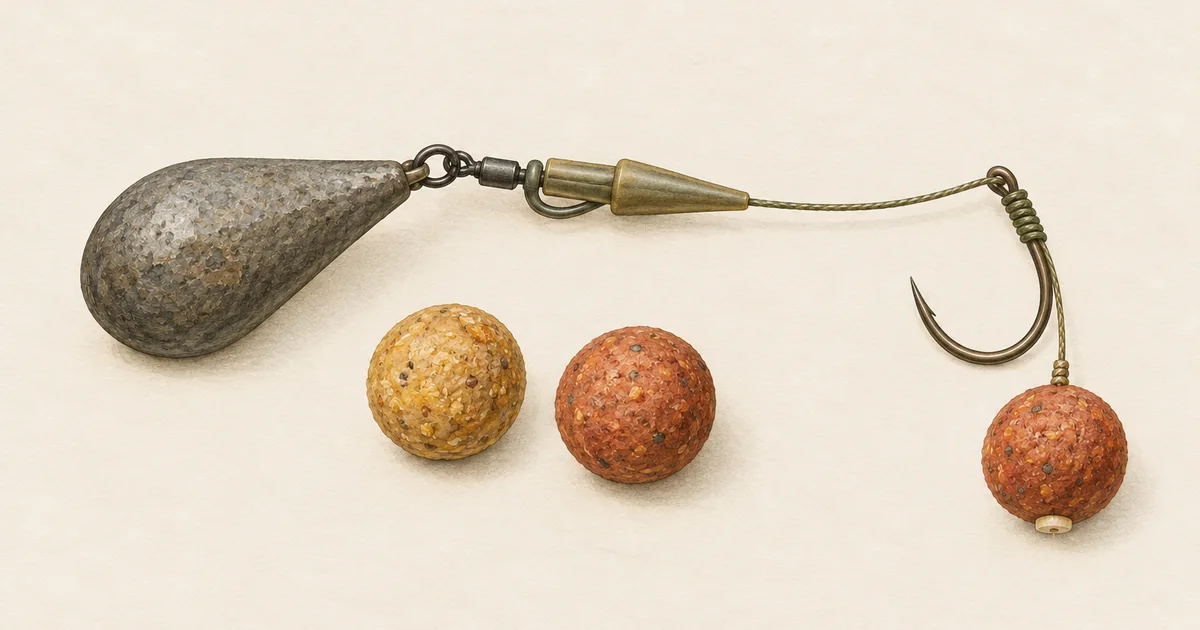
Cut a cube of about 2 cm, leave the rind on one side and pull it onto the hair with the baiting needle. A stop on the rind holds it during the cast. Change the bait roughly every half hour.
- Hair and lead
A hair of about 1 cm in abrasion-resistant material leaves the hook point free. You choose the weight heavy enough to stay put reliably, between 100 and 300 g in a current.
- Resting it securely
Swing the rig out and lay the rod on a tripod that you weigh down with a bag of stones. The rest has to hold a violent bite securely.
- Self-hooking effect
On a fixed lead the barbel usually hooks itself and bolts at once. Pick up the rod promptly and keep in contact.
Drifting float on a clear river
When the current edge is close to the bank, or when on some days barbel take only a drifting bait.
- Searching with polarised glasses
On shallow, clear rivers you first walk the stretch and look with polarised glasses for flashing flanks over gravel and between water plants.
- Preparing several spots
Spread one or two handfuls of feed at several promising spots. On your second round you watch for barbel, rising bubbles or clouded water.
- Measuring the depth exactly
Plumb the depth at the spot carefully. The bait should drift close to the bottom, not hover above it.
- Shotting compactly
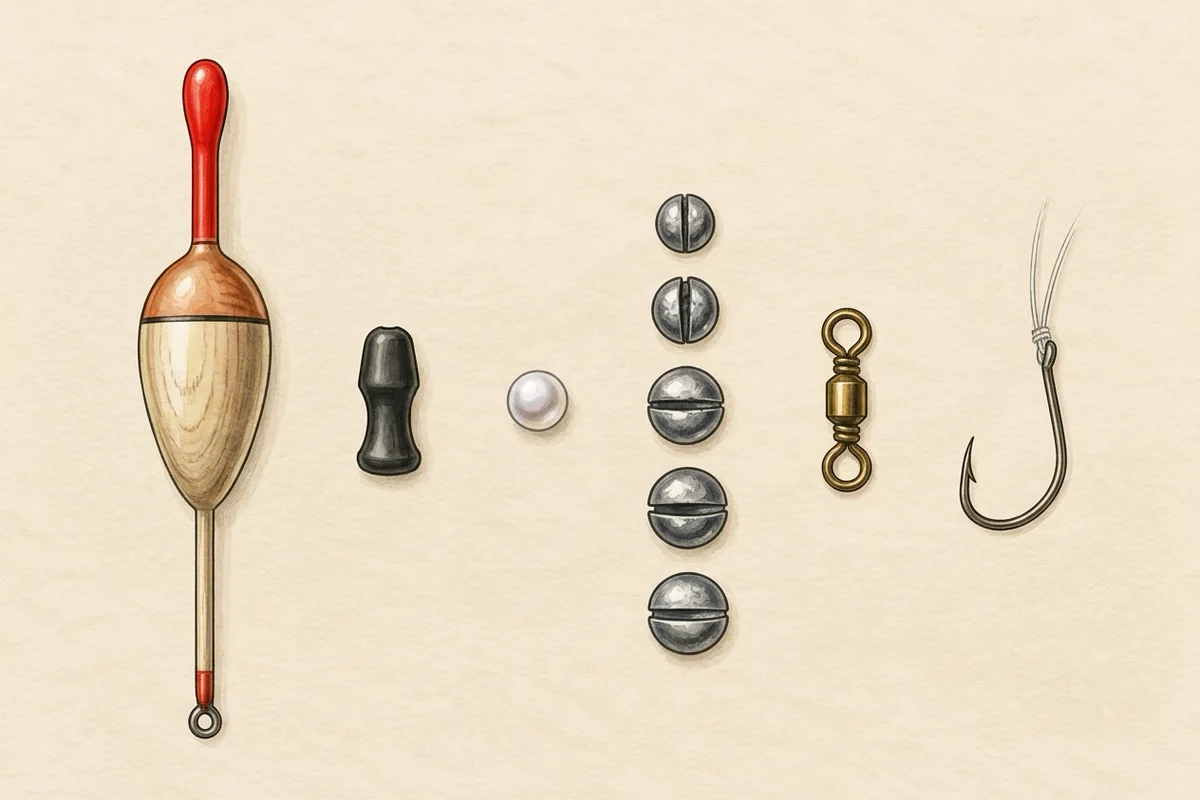
Take a drop-shaped or round float, for about 1,5 m depth and medium current with roughly 3 g carrying capacity. A good four fifths of the lead sits in one piece, below it three to four shot, a small swivel and a hooklength of about 22 cm.
- Let it drift
Let the float travel with the current and keep the line without a big bow. With a long rod you keep the bait under control out to about 30 m.
What with
The classic is cheese, in strong current hard cheese on the hair. In cold water luncheon meat and other meaty baits catch, and when the water is rising worm. Feeding is coarse, with hemp, sweetcorn, maggots, wheat and pellets.
- Cheesesummer and autumn, on small and big rivers alike
It smells strongly and often catches straight away, while pellets usually work only after longer prebaiting.
- Maggots & larvaethe whole season with a feeder, especially on the current edge
They crawl out of the closed feeder bit by bit and keep the barbel on the feed trail; one big maggot on the hook stands out among them.
- Offal and meatcold water, strong current and targeting big barbel
Luncheon meat is regarded as a bait for big barbel and stays on better if you briefly fry one side.
Tackle
A sturdy feeder rod with a feeder, plus line of at least 0,20 to 0,25 millimetres and thick, sharp hooks for the tough mouth. The landing net may rather be too big, and you set the clutch before casting.
Feeder on the edge of the current
- Rod
- 3,60–3,90 m feeder rod; on a big river up to about 4,50 m and 150–200 g casting weight
- Reel
- Fixed-spool reel size 4000, with a high ratio in a current
- Line
- Mono 0,20–0,30 mm; in a current braid 0,12–0,14 mm with a 0,25–0,30 mm mono shock leader
- Leader
- Mono 0,18–0,25 mm, about 35–100 cm long
- Hooks
- Strong-wire eyed hooks size 2–10, size 10 for maggots
- Weight, float, lead
- Feeder usually 50–120 g, from 20 g in low water, 100–300 g in a strong current
Cheese on a hair with a fixed lead
- Rod
- 3,30–3,90 m, test curve about 1,75–2,25 lb
- Reel
- Baitrunner reel size 4000
- Line
- Mono 0,22–0,30 mm
- Leader
- Hair hooklength with a hair of about 1 cm in abrasion-resistant material
- Hooks
- Hook with a wide gape, size 4–6 for a 2 cm cube of cheese
- Weight, float, lead
- Fixed lead or feeder 100–300 g in a current
Drifting float on a clear river
- Rod
- sturdy match or Bolognese rod, 3,90 m to over 4,20 m
- Reel
- Fixed-spool reel size 2500
- Line
- Mono 0,22–0,30 mm
- Leader
- about 22 cm, with a small swivel against line twist
- Hooks
- strong eyed hooks, size 2–10 depending on the bait
- Weight, float, lead
- Float around 3 g for about 1,5 m depth and medium current, up to 8 g in a strong current
More on tackle
- Feeder rod: classes, quivertips and set-up
- Bottom rod: length, casting weight and bite indicator
- Float rod: match, Bolognese and pole
- Line calculator
- Fishing line: monofilament, braid or fluorocarbon?
- Spooling a reel properly – without line twist
- Landing net: mesh, size and handle
- Disgorger: unhooking quickly and gently
Common mistakes
- Rod laid down too flat: In the current that makes a big bow in the line, and bites barely reach the tip. Hold the rod steeply.
- Blunt hook point: Constant contact with gravel quickly dulls straight points. Take hooks with a slightly in-turned point and check them regularly.
- Empty feeder in the water: A washed-out feeder attracts nothing any more. Reel it in about every 10 minutes and refill it so the feed trail does not break.
- Cast too far: In a river barbel often stand right in front of the stone revetment. Cast only to its foot instead of hurling the rig far out.
- Snag on the retrieve: A heavy feeder that comes up slowly wedges itself between the stones. Wind in briskly with a high-ratio reel, then it rises and glides over them.
Rules
Each federal state (Bundesland) sets its own closed season (Schonzeit) and minimum size (Mindestmaß). Choose your state; the values come from our state pages.
Baden-Württemberg
- Minimum size
- 40 cm
- Closed season
- 1.5.–15.6.
As of October 2026. All rules, exceptions and sources: Fishing in Baden-Württemberg.
Bavaria
- Minimum size
- 40 cm
- Closed season
- 1.5.–30.6.
As of October 2026. All rules, exceptions and sources: Fishing in Bavaria.
Berlin
- Minimum size
- –
- Closed season
- protected all year round
Correct as of October 2026. All rules, exceptions and sources: Fishing in Berlin.
Brandenburg
- Minimum size
- 40 cm
- Closed season
- 1.5.–31.7.
As of October 2026. All rules, exceptions and sources: Fishing in Brandenburg.
Bremen
Our overview for Bremen does not list the barbel. What applies there is on the page Fishing in Bremen with the state’s spots.
Hamburg
Our overview for Hamburg does not list the barbel. What applies there is on the page Fishing in Hamburg with the state’s spots.
Hesse
- Minimum size
- 40 cm
- Closed season
- 1.5.–30.6.
- Note
- harvest slot (Entnahmefenster) 40–60 cm
As of October 2026. All rules, exceptions and sources: Fishing in Hesse.
Mecklenburg-Western Pomerania
- Minimum size
- –
- Closed season
- protected all year round
- Note
- ban on keeping, return at once
As of October 2026. All rules, exceptions and sources: Fishing in Mecklenburg-Western Pomerania.
Lower Saxony
- Minimum size
- 35 cm
- Closed season
- none
As of October 2026. All rules, exceptions and sources: Fishing in Lower Saxony.
North Rhine-Westphalia
- Minimum size
- 35 cm
- Closed season
- 15.5.–15.6.
As of October 2026. All rules, exceptions and sources: Fishing in North Rhine-Westphalia.
Rhineland-Palatinate
- Minimum size
- 35 cm
- Closed season
- 1.5.–15.6.
As of October 2026. All rules, exceptions and sources: Fishing in Rhineland-Palatinate.
Saarland
- Minimum size
- 40 cm
- Closed season
- 15.3.–15.6.
- Note
- border Moselle (Grenzmosel) 35 cm
As of October 2026. All rules, exceptions and sources: Fishing in Saarland.
Saxony
- Minimum size
- 50 cm
- Closed season
- 15.4.–30.6.
Correct as of October 2026. All rules, exceptions and sources: Fishing in Saxony.
Saxony-Anhalt
- Minimum size
- 45 cm
- Closed season
- 1.4.–30.6.
- Note
- LAV waters: at most 2 barbel or asp per day
As of October 2026. All rules, exceptions and sources: Fishing in Saxony-Anhalt.
Schleswig-Holstein
Our overview for Schleswig-Holstein does not list the barbel. What applies there is on the page Fishing in Schleswig-Holstein with the state’s spots.
Thuringia
- Minimum size
- 40 cm
- Closed season
- 1.4.–31.8.
As of October 2026. All rules, exceptions and sources: Fishing in Thuringia.
The regulation and your fishing permit (Erlaubnisschein) are what count. Lake Constance, the Rhine and the coast, for example, have their own rules: Fishing waters in Germany.
After the catch
Playing and landing
Strike only when the tip is clearly pulled round, then let the barbel work against the current and the clutch. Net her in a large knotless net and unhook her on a wet mat. If she has to go back, hold her in the water until she swims off under her own power; take care with the serrated hard ray of the dorsal fin.
If a barbel is to go back, you unhook her quickly and give her time in the water to recover. A fish of legal size that you may keep you stun and kill at once. Remove the roe completely, because it is poisonous.
Frequently asked questions
What hook size for barbel?
Take strong eyed hooks in thick wire between size 2 and 10, depending on the bait. Size 10 suits maggots, and for a 2 cm cube of cheese a wide-gape hook in size 4 to 6.
How heavy does the feeder for barbel need to be?
Start with about 50 g and adapt the weight to the current. In low water 20 g is sometimes enough, at a high level you need over 100 g, in a strong current up to 300 g.
Which cheese for barbel?
Medium-aged Gouda is a classic, younger is too soft. Soft cheese or a paste of finely grated cheese also catches, whereas a very strong-smelling cheese is not necessarily better.
Do barbel bite at night?
Yes, barbel feed mainly at dusk and at night. Light bothers them little, but vibrations on the bank bother them a lot. Night fishing is banned in some states and waters, so check your fishing permit (Erlaubnisschein).
In what weather do barbel bite?
More important than the weather on the day is a settled spell in the days before. Under cloudy skies the fishing is often a bit better, and after a flood too.
Similar species
If you catch barbel, you can fish for these species with similar tackle:
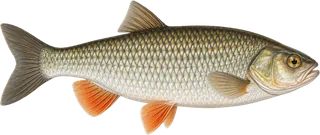 Chub fishingPeak season
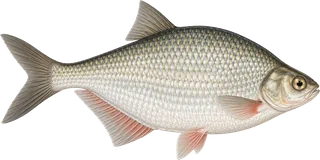 Fishing for silver breamPossible
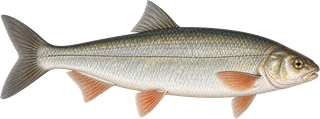 Common nase fishingPossible
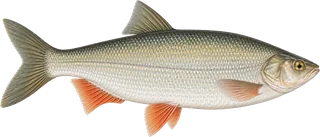 Ide fishingPossible
Sources
As of October 2026. The practical knowledge comes from 10 sources, summarised in our own words.
See all 10 sources
- 50 Barben-Tipps · FISCH & FANG (Markus Heine, Thomas Kalweit)
- Barbenangeln: So fängst Du die kampfstarken Friedfische · BLINKER (Marco Mariani)
- Steckbrief Barbe · BLINKER (Redaktion)
- 10 Tipps zum Heavy-Feedern im Strom · FISCH & FANG (Thomas Kalweit)
- Zielfisch Barbe: Barben in Strömen · FISCH & FANG (Manuel Schneider)
- Zielfisch Barbe: Aus der Köder-Welt. Das ist doch Käse! · FISCH & FANG (Robin Illner)
- Zielfisch Barbe: Einer der stärksten Friedfische (Interview) · FISCH & FANG (Markus Heine mit der Specimen Hunting Group Dortmund)
- Auf die englische Art: Barben an der freien Leine angeln · BLINKER (Tobias Steinbrück)
- Fischlexikon: Barbe · Landesfischereiverband Bayern
- Fische landen: Wie nutze ich Kescher, Lip-Grip und Co.? · BLINKER (Nick Bremer)
Text produced with AI support, based on the sources listed and these pages: Barbel (profile), Feeder fishing, Cheese, Feeder rod.