
Waters · Germany
Fishing on the Oder
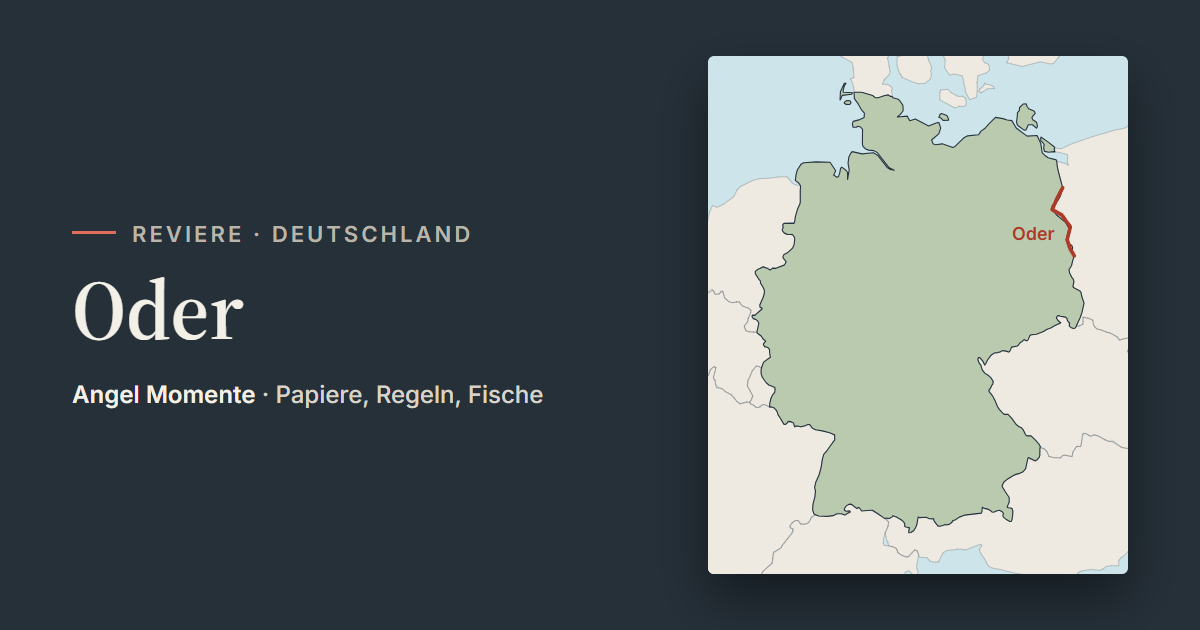
From Ratzdorf at the mouth of the Neisse to Friedrichsthal, the Oder forms the border with Poland. On the German side the Schneider fishery in Brieskow-Finkenheerd issues the fishing permit (Angelkarte) for around 175 kilometres of river and side waters. After the fish kill in summer 2022 the stock is only slowly recovering.
- Papers
- Fishing levy, fishing permit, fishing licence for predators
As of October 2026
At a glance
- Papers
- Fishing levy, fishing permit, fishing licence for predators
| Fish | Minimum size | Closed season | Catch limit | Note |
|---|---|---|---|---|
| Zander | 45 cm | 1.4.–31.5. | – | |
| Wels catfish | – | none | – | |
| Pike | 45 cm | 1.2.–31.3. | – | |
| Asp | 40 cm | 1.4.–30.6. | – | |
| Ide | 30 cm | none | – | |
| Burbot | 30 cm | none | – | |
| Barbel | 40 cm | 1.5.–31.7. | – | |
| Eel | 50 cm | none | 3 per day | |
| Perch | – | none | – | |
| Sturgeon | – | protected all year round | – | release immediately |
Brandenburg state law (BbgFischO); the leaseholder’s fishing permit can be stricter. As of October 2026. What counts are the regulation and your fishing permit (Erlaubnisschein).
Location and waters The border Oder from Neuzelle to the West Oder at Mescherin
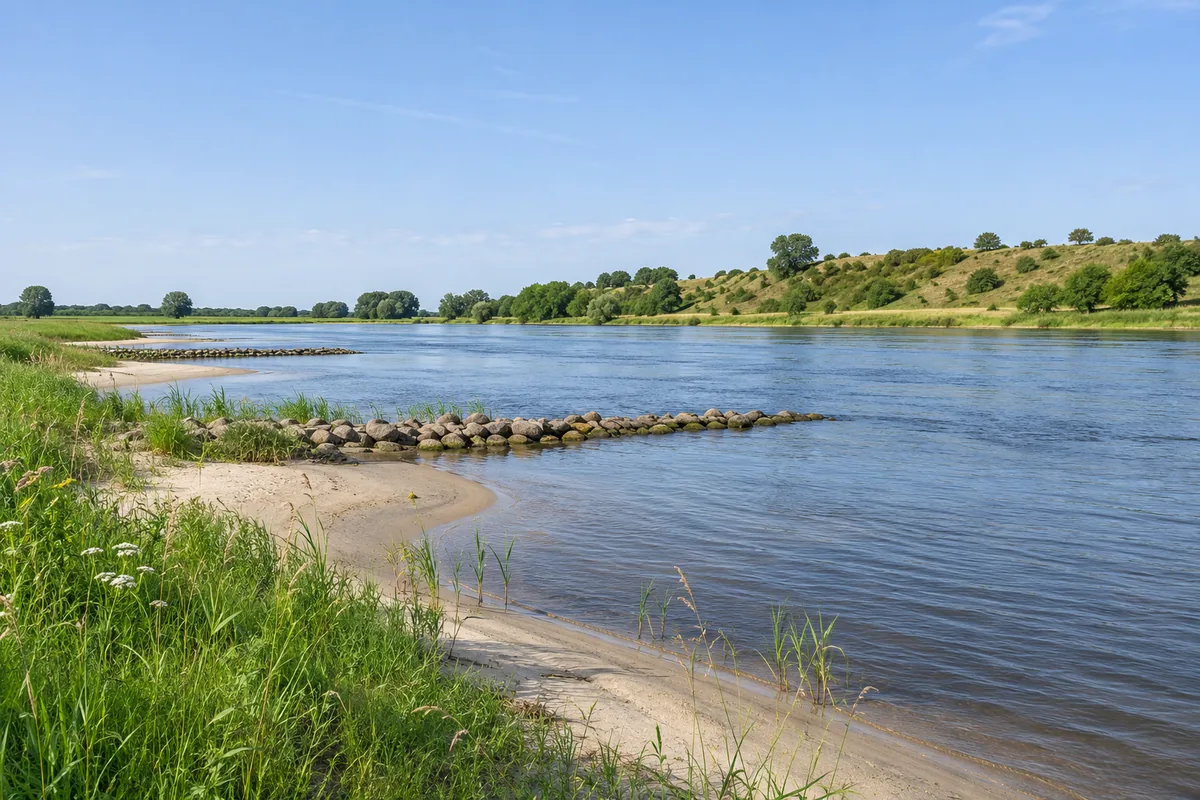
The permit area begins at Oder kilometre 547,5 level with Neuzelle, about five kilometres below the mouth of the Neisse, and extends to kilometre 704 at the Mariendorfer Wehr weir. It also includes the West Oder down to Mescherin below Gartz, the old and side arms, the waters in the Oderbruch, the polder waters and the Schwedter Querfahrt (leaseholder’s overview of waters). The short stretch between the mouth of the Neisse and Neuzelle is not included. In the north lies the Lower Oder Valley National Park with its polders, for which a separate fisheries regulation applies. For the Polish bank see Oder in Poland.
In August 2022 a severe environmental disaster struck the Oder over a length of around 500 kilometres. An alga had multiplied massively and released toxic substances (report by the Federal Environment Ministry). The river’s high salt content favoured this. According to the Oder report of June 2026, fish and mussels are recovering, but full recovery will still take several years (BMUKN, June 2026).
Fish and best time Wels catfish, zander, asp, ide and burbot
Commercial fishermen mainly sell wels catfish, bream, zander, pike, tench, carp, eel and perch. Ide, asp and burbot, on the other hand, matter mainly to anglers. Eels only survive in the Oder thanks to stocking (Wolter, Nationalpark-Jahrbuch 2024). Since 2006 the Baltic sturgeon has been reintroduced, including in the Oder (Naturwacht, Anglerfaltblatt). A sturgeon on the hook goes straight back.
The middle Oder between Ratzdorf and the mouth of the Warta was hit much harder by the fish kill than the lower Oder below the Warta. For species of the main channel such as bream and silver bream, stocks fell by 72 to over 99 per cent. Gravel spawners such as barbel have a particularly hard time, because they already lacked spawning grounds before 2022. For most species, Christian Wolter of the Leibniz-Institut für Gewässerökologie expects a first new generation of spawners by 2026/2027. The course of the year is shown in the catch calendar.
Papers and permit Fishing licence, fishing levy and fishing permit for the Oder
Brandenburg law applies on the Oder. From the age of 14 you need proof of the fishing levy (Fischereiabgabe), a fishing permit (Angelkarte) and, for predator fishing, a fishing licence (Fischereischein). With a coarse-fishing rod you can fish without a licence, as can guests without a residence in Germany on a short stay. The levy costs 12 euros for a calendar year or 40 euros for five years. If you have paid it in another federal state and do not live in Brandenburg, you are exempt. Children from the age of eight may fish on their own; younger ones only with a coarse-fishing rod and under the constant supervision of an adult who holds a fishing permit. You may also show your papers on your phone if they were issued digitally (Fischereigesetz; Abgabeverordnung). The licence and levy stamps are available from the lower fisheries authorities, on the Oder from the Oder-Spree, Märkisch-Oderland and Uckermark districts.
The leaseholder sells the Oder fishing permit through his website, with the purchase handled by Fiskado (Oder permit online). It may be issued for no more than one calendar year and only once the levy has been paid. If you fish in the national park, you receive an information sheet from the national park administration with the permit. If the leaseholder tightens sizes, closed seasons or the night fishing rules, this is stated on the permit.
Special rules Lower Oder Valley National Park, number of rods and eel limit
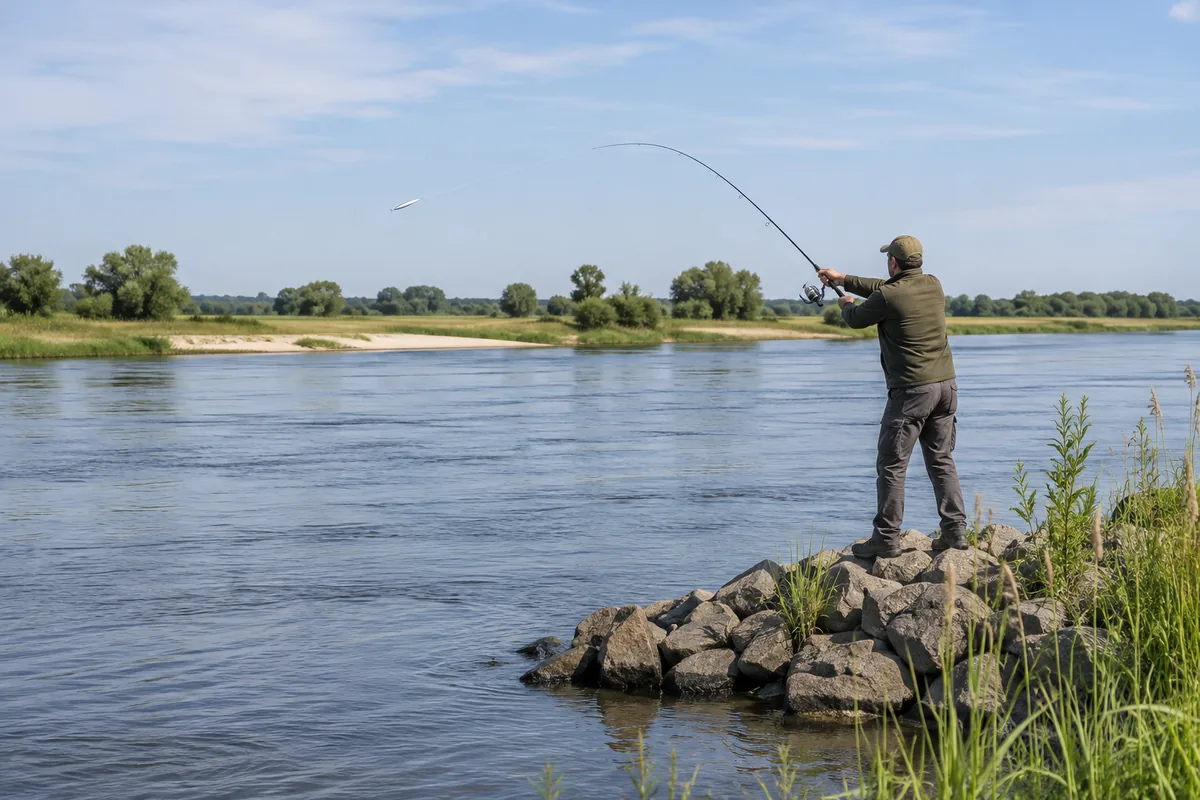
Under the fisheries regulation you fish with no more than two rods, and with only one when spinning. Live baitfish are banned. You may keep no more than three eels a day. Keep at least 50 metres away from set nets, fyke nets and other fishing gear, and show consideration for the commercial fishermen (Fischereiordnung). Fishing is banned altogether in the Brieskow lock.
In the national park a 50-metre circle stays clear around beaver lodges, and from 1 February to 30 June a 300-metre circle around the nests of eagles, black storks, cranes, herons and other species, for white-tailed eagles from January. Fishing is banned in protection zone I b and from the banks of zones I a and I b. The regulation named exception stretches for this, but these were time-limited. The national park administration knows which are still open today. In the polders there is no fishing from 1 March to 30 June, except at the places shown on the map. Depending on how the breeding season goes, the nature conservation authority may open them from 16 June at the earliest. Fishing is banned in the polders at night. You reach the water via tracks and paths, and you cross reed beds only on existing paths. Groundbait is allowed, but no more than two litres per angler and day, five litres on the federal waterway (Nationalpark-Fischereiverordnung).
Related
- Fishing in Brandenburg
- Oder in Poland and Szczecin Lagoon
- Fishing on the river and Reading the current
- In the fish lexicon: wels catfish, asp, zander and burbot
- Closed season and minimum size explained
Sources
- Fischerei Schneider, Brieskow-Finkenheerd: Gewässerübersicht, Oderkarte online
- Land Brandenburg: Fischereigesetz, Fischereiordnung, Fischereiabgabe, Fischerei im Nationalpark Unteres Odertal, Angelfischerei in Brandenburg, Friedfischangeln ohne Fischereischein
- Bundesumweltministerium: Bericht zum Fischsterben 2022, Oder-Bericht 2026
- Christian Wolter: Fischbestand der Oder, Nationalpark-Jahrbuch 2024
As of October 2026. Since the 2022 fish kill, the Oder’s fish stock has been surveyed on an ongoing basis. Which stretches in the national park are open may change.
Guide without guarantee, as of October 2026. What counts are the Brandenburg fisheries act (Fischereigesetz) and fisheries regulation (Fischereiordnung), the regulation on fishing in the Lower Oder Valley National Park and the conditions on the leaseholder’s fishing permit.