
Knowledge – Fish
Barbel: Identification, swims in the current, bait, playing
The barbel (Barbus barbus) is a powerful member of the carp family that lives on the bottom of clear, fast-flowing rivers and gives the barbel zone its name. It migrates far upstream to spawn and fights hard. Its roe is poisonous.
In brief: You catch the barbel best from August to September, above all in the morning and evening. Good spots on a river: deep pools, behind stones and in the main current. Proven baits: hard cheese, luncheon meat, maggots and worm; also pellets and boilies. Most states protect the barbel between April and June. The closed season (Schonzeit) is longer in Brandenburg (until 31 July) and Thuringia (until 31 August), in Berlin it is protected all year, and in Mecklenburg-Western Pomerania you may not keep it (as of October 2026). Step by step: Fishing for barbel.
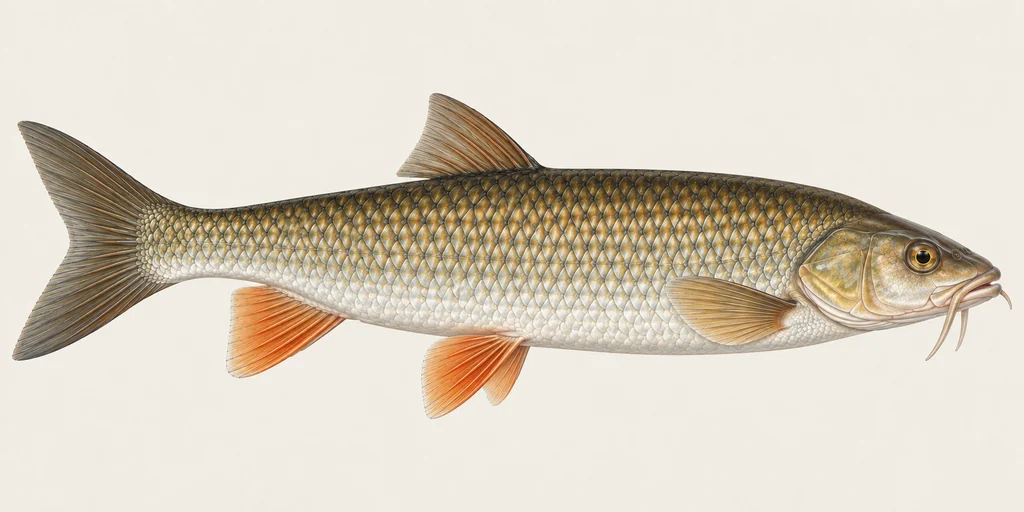
- Four barbels on the upper lip of the inferior mouth with fleshy lips
- Elongated body with a flattened belly
- Longest hard ray of the dorsal fin, serrated at the back
Catch chances through the year
- Hardly any chance
- Possible
- Good
- Peak season
- Spawning (observe the closed season)
Editorial assessment for waters in Germany, not a measured value and no guarantee. Spawning time is not the same as the legal closed season.
Species profile and sources in the catch calendarAll species compared month by monthThe rules of your federal state
How to recognise the barbel
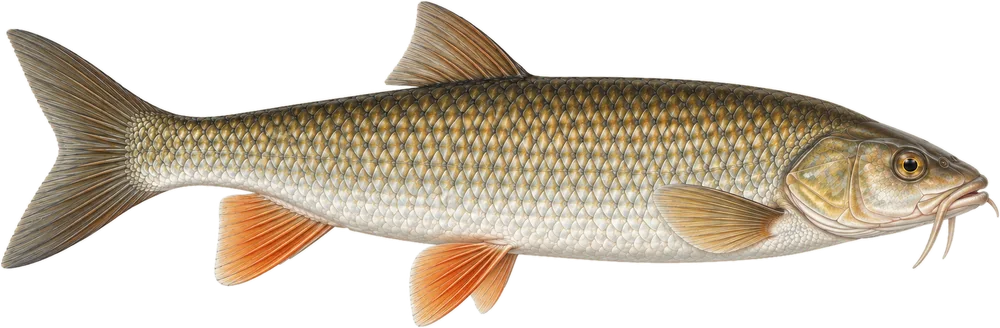
The barbel is slim and elongated, the underside slightly flattened. The snout extends forward like a trunk. The mouth lies underneath, the lips are thick, and four barbels sit on the upper lip. With these feelers it detects food on the bottom.
The dorsal fin is short and tall, and its last unbranched ray is serrated on the rear edge. The tail fin is clearly notched. The back is brownish to greenish, the flanks shimmer brassy, the belly is whitish. The pectoral, pelvic and anal fins are tinged reddish, and some fish look strongly yellow.
The barbel usually grows 30 to 70 centimetres long, according to the LFV Bayern. Blinker gives an average of 40 to 60 centimetres and one to three kilograms. Large fish reach 90 centimetres. FishBase lists 120 centimetres, 12 kilograms and 15 years as maximum values. Barbel mature after three to four years.
Young barbel resemble the gudgeon. The difference lies in the barbels: the barbel has four, the gudgeon two.
In Austria there is also the Hundsbarbe. It keeps dark spots even in old age. Its dorsal fin does not taper to a point and has no serrated first ray.
Side by side
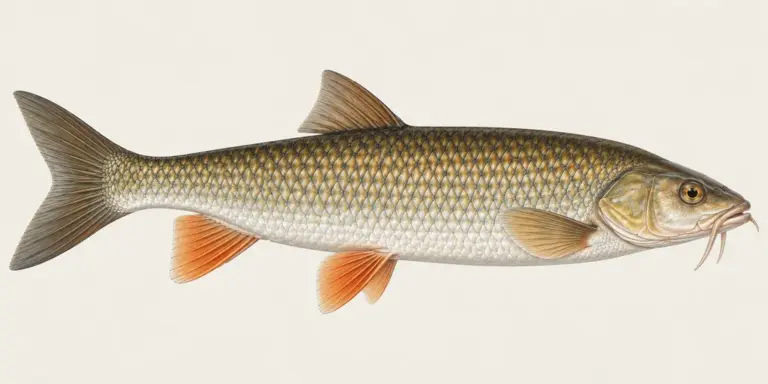
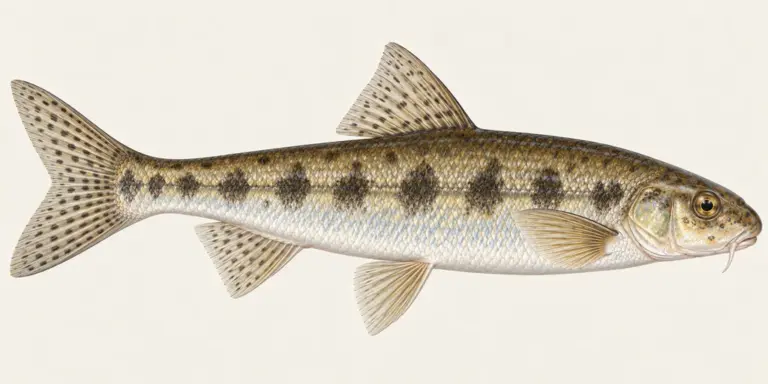
AI-generated illustrations.
Where the barbel lives
The barbel is the lead fish of the barbel zone: clear, oxygen-rich middle reaches with a sand or gravel bed and fast current (Fish zones in a river). With sufficient flow it also moves up into the grayling zone, and in the bream zone it is regularly found.
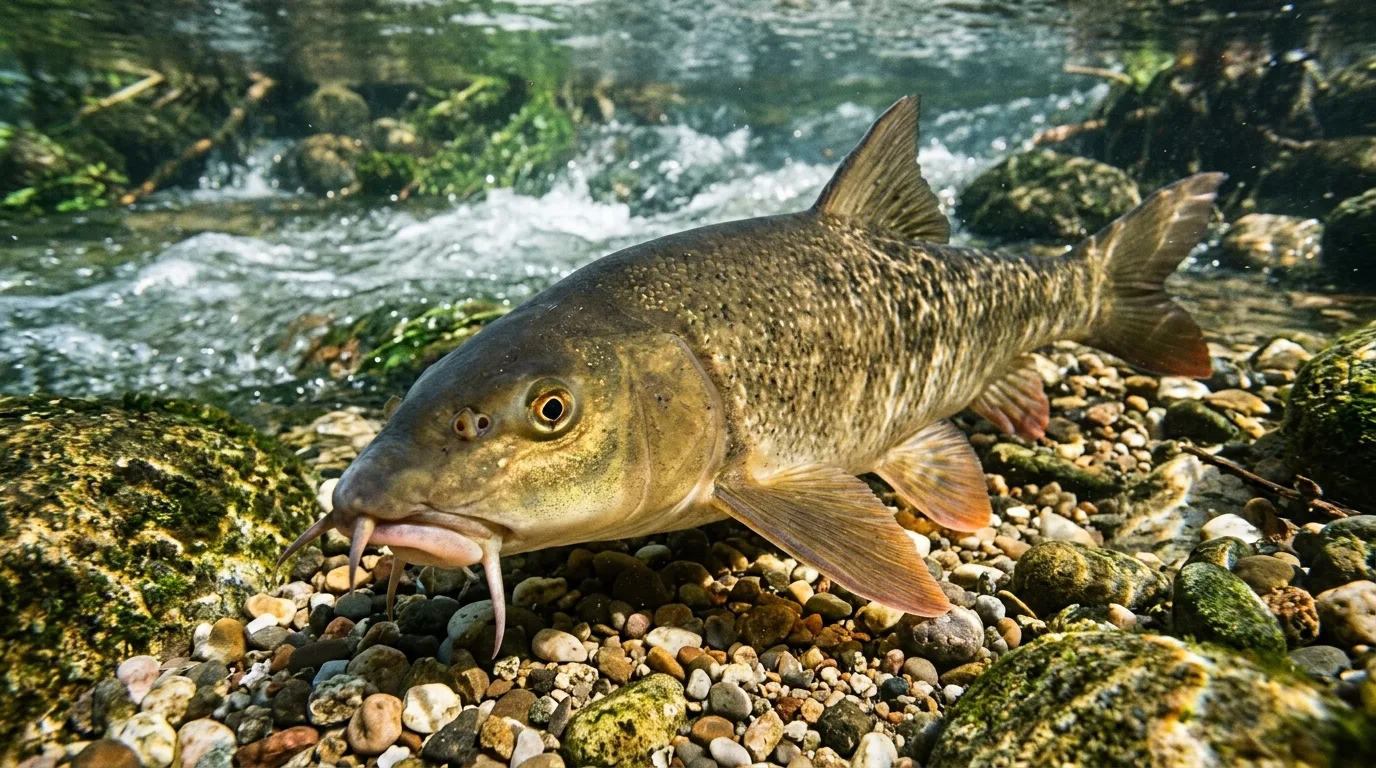
During the day barbel stand in shoals under cover, for example under overhanging trees and bridges. They usually stay in deeper spots with little current then. At dusk they move into shallower water with more current and feed there. Deep pools and the areas behind weirs count as good swims.
In the river the barbel shares the current channels with chub, vimba, common nase and grayling. It tolerates high water temperatures but salt poorly. It makes lower demands on water quality than on the structure of the water. If shallow gravel bars for spawning and shallow bank stretches for the young fish are missing, that limits recruitment.
Holding spots in the picture
Choose the season and time of day: the picture shows where the species stands then. Spots outlined in red apply only in the chosen season. Tap a fish or a spot in the list to bring it closer. The picture is schematic and AI-generated, every water is different.
Catch chances in springpossible
Chance of a catch in summergoodSpawning, observe the closed seasons
Catch chance in autumngood
Catch chance in winterhardly any
- J
- F
- M
- A
- M
- J
- J
- A
- S
- O
- N
- D
Spawning season
Active time Barbel mostly feed at dusk; by day they often stand in a shoal under overhanging trees or bridges.
Not the main time Barbel mostly feed at dusk; by day they often stand in a shoal under overhanging trees or bridges.
Active time Barbel mostly feed at dusk; by day they often stand in a shoal under overhanging trees or bridges.
Not the main time Barbel mostly feed at dusk; by day they often stand in a shoal under overhanging trees or bridges.
In the river
Undercut bank, overhanging branches, timber
Barbel are here only in spring, summer and autumn.
Slack water behind rocks
Barbel are here only in spring, summer and autumn.
Gravelly shallow (riffle)
Barbel are here only in spring and summer.
Pools, deep spot
Barbel are here all year round.
Free current in mid-river
Barbel are here only in spring, summer and autumn.
Barbel stand in a shoal on the bottom, in strong current over sand, gravel and stones. Typical spots are the water below weirs, inflows, the slack behind bridge piers, deep channels in mid-river and deep pools. By day they often stand under overhanging trees or bridges.
Spring: catch chances according to the catch calendar possible in March, good in April, possible in May. At spawning time from May barbel move upriver in shoals, often over long distances. Spawning takes place on shallow gravel bars with water flowing over them.
Summer: catch chances according to the catch calendar possible in June, good in July, peak season in August. The spawning season falls in this period, so observe the closed seasons. Depending on the source, spawning on the gravel bars lasts into June or July. After that the main fishing time begins.
Autumn: catch chances according to the catch calendar peak season in September, good in October, possible in November. As the water cools in autumn the main fishing time ends.
Winter: catch chances according to the catch calendar slim. In winter barbel gather in large groups in deep, slow-flowing places in the river bed.
Depth: The barbel always stays on the bottom.
Size comparison: AI-generated drawing, schematic.
What it eats and how it migrates
The barbel protrudes its trunk-like mouth and roots through the bottom. In doing so it also turns over single stones. It eats worms, insect larvae, small crustaceans, snails and mussels, occasionally plant matter and small fish. Larger barbel also hunt fish.
In spring the shoals move upstream to shallow gravel bars. Spawning migrations of several hundred kilometres are documented, and according to the Swiss authority up to 100 kilometres. Spawning runs from May to July, mostly during the day and in several bursts. The males then carry whitish, grainy spawning tubercles. The larvae hatch after about two weeks and stay between the stones until their yolk sac is used up.
The roe is poisonous. It causes vomiting and severe diarrhoea (LFV Bayern). The Bayerische Landesanstalt für Landwirtschaft also lists the barbel in its exam questions as a fish with inedible roe at spawning time. So remove the roe completely if you use a barbel. This is no substitute for medical advice: if you have symptoms after eating, talk to a doctor.
When it bites
With the first night frosts the biting drops off markedly, and until spring barbel rest for the winter. They stand in groups in deep, slack spots. On mild days and when the water is rising fast they still take bait.
The main season is August to October, but with the cooling in autumn the biting drops off. You have the best chances of big fish at low water in late summer and early autumn. Barbel are sun worshippers, so a session at midday is worthwhile. Anglers report that large fish can also be caught at night on boilies on the hair.
In cold water barbel like meaty baits. If the water rises, you try a worm. During the spawning migration in early summer a closed season (Schonzeit) may apply. Check your state law before a session.
Today’s catch index needs JavaScript. Season and spawning time are in the catch calendar.
You will find the monthly overview of all species and the water temperature check in the catch calendar.
From the blog: Fishing at locks and weirs: what applies and what the signs mean · Freshwater fish in Germany: which species you catch where · Roach or rudd, bream or silver bream: how to tell these silver fish apart reliably
How to catch it
Step by step: Fishing for barbel: tips on bait, rig and tackle – season, swims, bait, tackle and rules on one page.
The proven method is feeder fishing on the bottom (feeder rig, feeder rod). The bait should lie still or roll only slowly over the bottom. You choose a pear-shaped weight on a short side arm just heavy enough to hold against the current. In a strong flow you reach for a sturdy bottom rig with feeders between 100 and 300 grams. There, legering with a fixed lead as a self-hooking rig is also one of the most effective methods.
Barbel are not hooklength-shy. For line, the angling magazines name at least 0,20 to 0,25 millimetres, best of all mono or braid. Strong, sharp hooks of thick wire matter because the mouth is tough. For cubes of cheese, sturdy single hooks in sizes 6 to 12 are used. A short hooklength shows the bite more reliably but makes the barbel more suspicious. Try different lengths.
Feed generously: hemp, sweetcorn, maggots, wheat and pellets keep the fish in the swim. The feeder is open for crumb and closed for maggots.
The classic bait is cheese. In a strong current hard mountain cheese stays on the hair, while medium-aged Gouda dissolves. Then there is luncheon meat, especially in cold water (Offal and meat), as well as maggots and worm (Maggots and larvae, Worms). The long lobworm, however, brings many missed bites. Paste and bread flake only hold in a weak current.
On clear, shallow rivers you can spot barbel with polarised sunglasses, because they give themselves away by flashing flanks. Float fishing with a trotting float on a long match or Bolognese rod, which guides the bait close over the bottom, is also worthwhile there. In trout streams you fish with dark nymphs on the bottom. Large barbel occasionally take small baitfish or crankbaits.
Barbel bites are hard and unmistakable. Do not strike at every tug, because fine tugs often come from fish nudging the feeder. In the fight the barbel digs in on the bottom, flees at lightning speed and thrashes wildly once more before the landing net. Tire it against the current. The landing net should be too big rather than too small, and the drag must be right.
Do not use the roe: The roe of the barbel is poisonous. Remove it completely if you use a barbel, and do not eat it.
Strong hooks, matching drag: Barbel have tough mouths and run several times in the fight. Take sharp hooks of thick wire and set the drag before casting.
Take your time releasing: If a barbel has to go back, you unhook it quickly and hold it in the water until it has recovered.
Suitable lures
Hard cheese, luncheon meat, maggots and worm; also pellets and boilies.
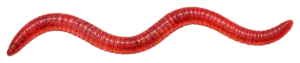
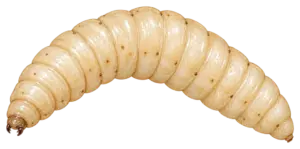
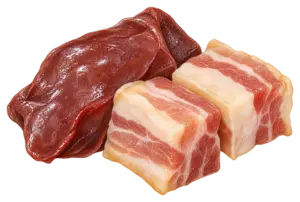
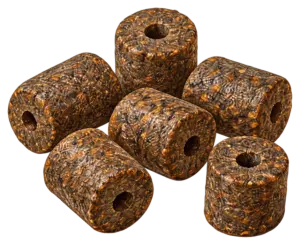
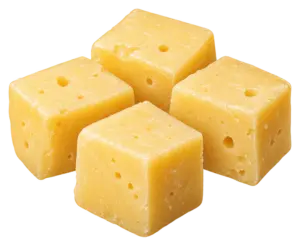
AI-generated illustrations. A click opens the lure’s page.
Rigs for these baits: feeder rig, hair rig, running lead rig, float rig.
What the barbel is worth in the kitchen and what never belongs in the pan
As a food fish the barbel does not rank highly. Its flesh tastes rather bland and is riddled with numerous bones. In parts of Switzerland it is therefore hardly fished, it plays only a very small role in the fishery there, and it is only used commercially to a small extent. If you take a barbel of legal size, you need patience when filleting because of the many bones.
The most important step is gutting: at spawning time the roe of the barbel is inedible. So take it out of the body cavity completely and throw it away before you process the flesh further.
What you need to observe
Closed seasons (Schonzeit), minimum sizes (Mindestmaß) and harvest windows are set by the federal states (Bundesland), and on many waters additionally by the club or leaseholder. They differ depending on the water and the time of year. We give figures only with a date and a source; always binding are the fisheries regulation of your federal state and your fishing permit (Erlaubnisschein). You will find a list of links to the official sources in the catch calendar.
A fish of legal size that you want to keep is stunned and killed straight away in line with animal welfare rules (Stunning and killing a fish). Protected fish, undersized fish and fish that are too big under a slot limit are unhooked with wet hands, ideally in the water, and returned gently (Returning a fish).
The barbel is on the near threatened list (Vorwarnliste) in the German Red List of 2023, having previously counted as least concern. Germany bears an increased responsibility for the species. The stock had recovered since the 1990s, but the increase has come to a halt. As reasons the list names transverse barriers with their effects on the habitat and predation pressure from cormorants (Rote-Liste-Zentrum). The IUCN rates the barbel worldwide as least concern.
If you go for large barbel with small baitfish: many federal states (Bundesländer) ban fishing with live baitfish, and in Bavaria it is expressly stated in the implementing regulation to the fisheries act. Only dead baitfish are allowed, as far as your state law permits (Baitfish rig).
What closed season, minimum size and harvest slot mean and where to find them is explained on the page Closed season and minimum size explained.
What state law prescribes for closed season and minimum size for this species is in the “At a glance” box on the pages for Baden-Württemberg, Bavaria, Berlin, Brandenburg, Hesse, Mecklenburg-Western Pomerania, Lower Saxony, North Rhine-Westphalia, Rhineland-Palatinate, Saarland, Saxony, Saxony-Anhalt and Thuringia. Our overview does not list this species for the other states; there the state fisheries regulation (Landesfischereiverordnung) applies.
Frequently asked questions (FAQ)
Is the barbel poisonous?
The roe is poisonous. It causes vomiting and severe diarrhoea, and the Bayerische Landesanstalt für Landwirtschaft names the barbel as a fish with inedible roe at spawning time. Remove it completely. This is no substitute for medical advice.
What is the best bait for barbel?
Cheese, luncheon meat, maggots and worm on the bottom. In a strong current hard cheese stays on the hair better, paste and bread flake only in a weak current.
When and where do you catch barbel?
The main season runs from August to October, but with the cooling in autumn the biting drops off. You find them in the current over gravel, behind weirs and in deep pools, often under cover during the day and feeding at dusk.
Sources
The rating of catch chances is an editorial assessment. The facts come from these sources, and the text is worded in our own words. The illustration is an original design by Angel Momente in the style of a natural history plate (AI-generated, see the AI notice).
- Landesfischereiverband Bayern: Fischlexikon (Laichzeit, Lebensraum, Nahrung, Aktivität)
- FishBase: Barbus barbus (Höchstalter, Lebensraum, Nahrung, giftige Eier)
- Land Hessen (HLNUG): Fischökologische Untersuchung der Diemel, Artgutachten, Kapitel Barbe
- NÖ Landesfischereiverband: Fischarten in Niederösterreich, Barbe (Kennzeichen, Unterscheidung)
- LAVES Niedersachsen: Vollzugshinweise zum Schutz von Fischarten, Barbe (Lebensweise, Fortpflanzung, Gefährdung)
- Kanton Basel-Stadt, Amt für Umwelt und Energie: Barbe (Merkmale, Größe, Wanderung)
- Nationalpark Donau-Auen: Barbel, Barbus barbus
- Rote-Liste-Zentrum: Barbe (Rote Liste der Süßwasserfische Deutschlands 2023: Vorwarnliste)
- Blinker: Steckbrief Barbe (Standplätze, Fangzeit, Köder, Gerät)
- Fisch & Fang: 50 Barben-Tipps (Fluss und Strom, Futter, Köder, Drill)
- Bayerische Landesanstalt für Landwirtschaft: Prüfungsfragen zur Staatlichen Fischerprüfung 2023/2024 (Barteln, ungenießbarer Rogen, verbotene Fangmethoden)
- Blinker: Barbenangeln, so fängst du die kampfstarken Friedfische (Grundmontage und abtreibende Pose, 2024)
- FISCH & FANG: Zielfisch Barbe, einer der stärksten Friedfische (Interview, Jahreszeiten und Nachtfrost)
- Kanton Freiburg, Amt für Wald und Natur: Flussbarbe (Fischerei und Gastronomie, Verbreitung)
- Wikipedia: Barbe (Merkmale, Schuppenzahl, Laichzeit, Geschlechtsreife, giftiger Rogen)
Created with AI support from the sources listed. Figures only appear in the text if a source gives them. Last updated: 8 November 2026. Found a mistake? Write to us. Who is behind this site: About me.
More in the lexicon
- All fish species at a glance
- Catch calendar – month, water temperature and profile for 93 species
- Line calculator – breaking strain after the knot, drag guideline, backing
- Angling methods