
Knowledge – Fish
Gudgeon: Features, habitat, best time and baits
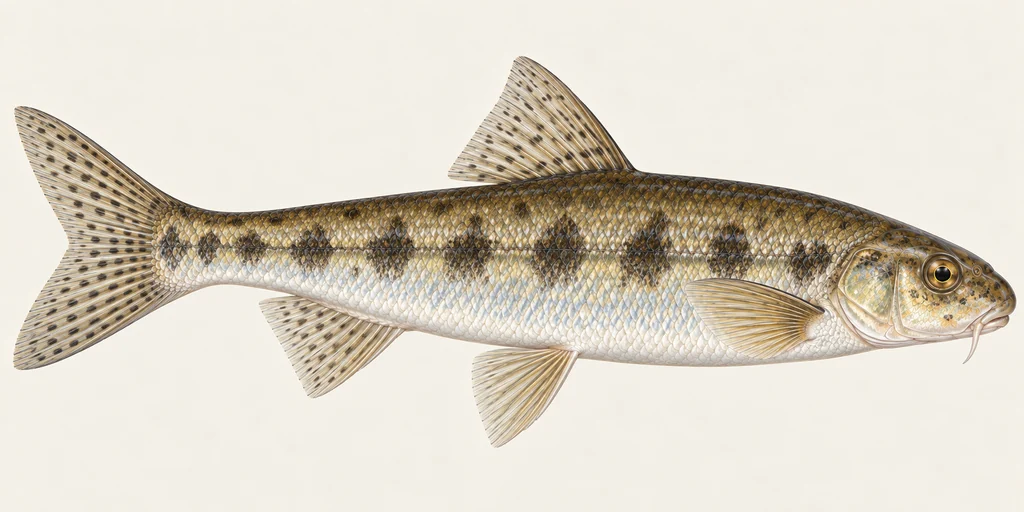
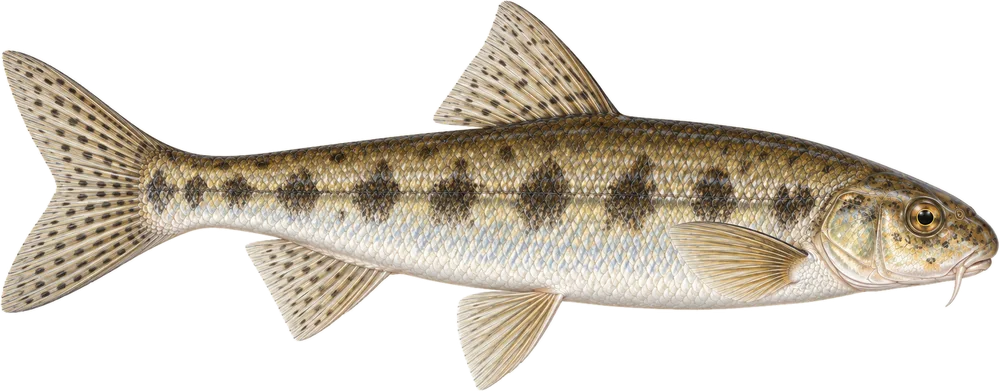
The gudgeon (Gobio gobio) is a small shoaling fish that lives on the bottom of streams, rivers and lakes over sand and gravel. You can recognise it by two barbels and a row of spots along the flanks. In the fish communities of many rivers it is an indicator species, and for anglers it is above all a fish for fine tackle.
In brief: The best time to catch gudgeon is July to August, mainly during the day. Good spots in the river: riffles. Proven baits: a single maggot, pinkie or a small piece of worm on a fine pole rig right on the bottom. A popular baitfish, but only dead: many federal states (Bundesländer) expressly ban live baitfish. In Brandenburg the gudgeon has a year-round closed season, and in Berlin, according to the fisheries office (Fischereiamt), you may neither catch it nor use it as bait (as of October 2026). Step by step: Gudgeon fishing.
- Inferior mouth with one short barbel in each corner
- Longitudinal band with a row of dark, bluish shimmering spots on the flank
- Relatively large head and large scales on a spindle-shaped body
Catch chances through the year
- Hardly any chance
- Possible
- Good
- Peak season
- Spawning (observe the closed season)
Editorial assessment for waters in Germany, not a measured value and no guarantee. Spawning time is not the same as the legal closed season.
Species profile and sources in the catch calendarAll species compared month by monthThe rules of your federal state
How to recognise it
The gudgeon has a spindle-shaped, almost round body with relatively large scales. The head is flattened and has large eyes, and the mouth is on the underside (inferior). There is a short barbel in each corner of the mouth. Laid back, it usually reaches the middle of the eye, according to FishBase.
The most important identification feature is the lateral band along the flanks: a row of dark, bluish-shimmering, irregular spots. They can merge into a band. The back looks grey-brown to greenish-brown, the belly is lighter. How strong the colouring is depends heavily on the water. The milters (males) have larger pectoral fins and carry spawning tubercles during the spawning season.
On average the gudgeon grows to 10 to 15 centimetres, and according to the Landesfischereiverband Bayern to 20 centimetres at most. FishBase gives 21 centimetres as the maximum length, 12 centimetres as the common length and 8 years as the highest reported age. As for weight, the figures range from up to 100 grams in Rute & Rolle to up to 220 grams in FishBase.
Young barbel are the most likely to be confused with the gudgeon. The barbel has four barbels on the upper lip, the gudgeon only two, one in each corner of the mouth. It also has a snout that is extended like a trunk.
The stone loach has six barbels on the upper jaw, very small scales and a lateral line set off in a lighter colour. It is sandy to brownish with dark marbling. There is also the whitefin gudgeon (Donaustromgründling, formerly Weißflossengründling). Its barbels are longer and, laid back, usually reach the rear edge of the eye, whereas in the gudgeon only to the middle of the eye.
Side by side
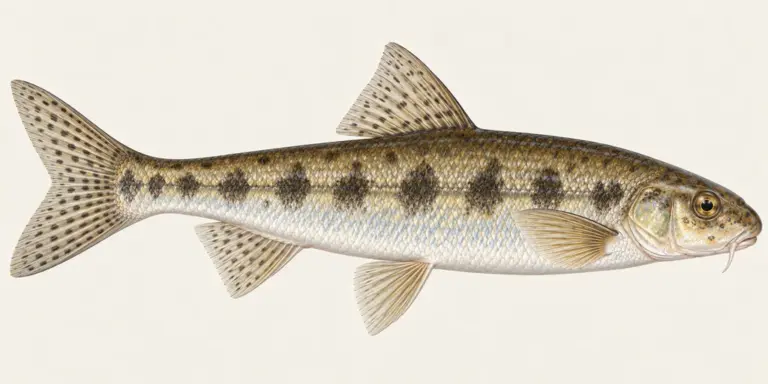
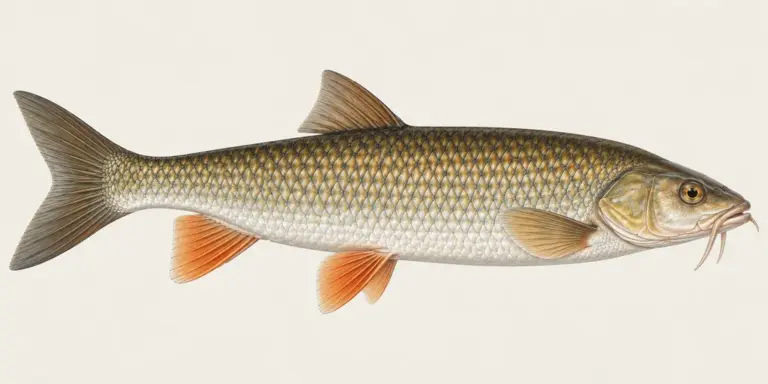
AI-generated illustrations.
Where it holds
According to FishBase, the gudgeon lives in almost all types of water with a sandy bottom: in small mountain streams, in large lowland rivers and in large lakes, and according to the Canal & River Trust also in ponds and canals. It prefers clear water with a sandy or gravelly bottom and also occurs in the brackish water of the Baltic Sea. It lives as a bottom fish in small shoals.
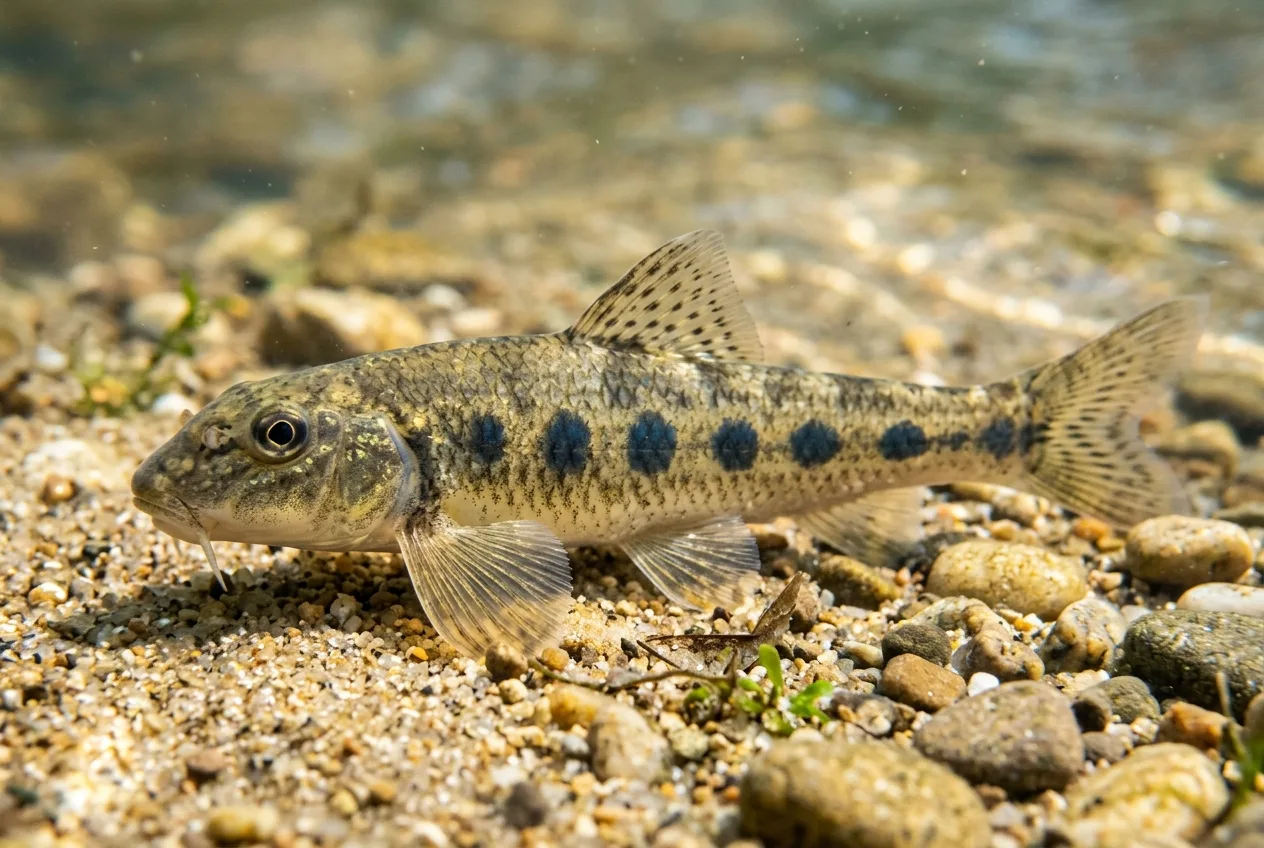
The young fish stay on the bottom in detritus-rich sandy areas with little current. When in danger, adults bury their whole body in the substrate. The Landesfischereiverband Bayern names water pollution and silting up as threats.
The species matters for river fishing: in the lower reaches of rivers the gudgeon is one of the indicator species of the reference fish communities. The 2023 Red List places it among the species with a short-term negative population trend and assigns Germany increased responsibility for the species because it lies at the centre of its range. A decline is reported from eastern Germany, presumably due to river engineering and pollution.
Holding spots in the picture
Choose a season and time of day: the picture shows where the species sits then. Tap a fish or a spot in the list to bring it closer. The picture is schematic and AI-generated, every water is different.
Catch chances in springpossible
Catch chance in summerPeak season
Catch chance in autumnpossible
Catch chance in winterpossible
- J
- F
- M
- A
- M
- J
- J
- A
- S
- O
- N
- D
Spawning season
No main time Normally the gudgeon is active by day. When predators disturb it, it shifts to low-light periods.
Active time Normally the gudgeon is active by day. When predators disturb it, it shifts to low-light periods.
No main time Normally the gudgeon is active by day. When predators disturb it, it shifts to low-light periods.
No main time Normally the gudgeon is active by day. When predators disturb it, it shifts to low-light periods.
In the river
Gravelly shallow (riffle)
Gudgeon are found here all year.
The gudgeon lives in a shoal, always on the bottom over sand or gravel. It inhabits fast-flowing rivers and streams as well as calmer stretches and the margins of still waters. When in danger it buries itself in the substrate. In canals it stays close to the bank, at most two to three metres from the edge, and likes to gather below locks, where overflows wash in food.
Spring: catch chance according to the catch calendar possible in March and April, good in May. In May and June spawning takes place in shallow, flowing water by stones and aquatic plants.
Summer: catch chance according to the catch calendar is good in June and peak season in July and August.
Autumn: according to the catch calendar, the chance of a catch is good in September and possible in October and November.
Winter: catch chance according to the catch calendar possible.
Size comparison: AI-generated drawing, schematic.
How it feeds and spawns
The gudgeon searches the bottom for insect larvae, molluscs, small crustaceans and fish spawn, occasionally also for carrion. It feels the bottom with its barbels. Normally it is active during the day. If disturbed by predators, it shifts its activity to times of low light.
It spawns in May and June in shallow water over stones, sand or plant material. The sticky eggs first drift with the current, then sink and attach to the bottom. Larvae and young fish stay on the bottom. In food-rich waters an individual spawns several times in a season, in food-poor streams only once a year, but over several years.
When it bites
Gudgeon can be caught mainly from spring to autumn. In this site’s catch calendar, July and August are at the highest level, May, June and September at the second highest, the remaining months at „possible“. This is an editorial assessment, not a measured series.
As the water temperature falls, the bites become rarer, but the gudgeon does not stop feeding altogether. The Scottish umbrella body of coarse anglers calls it a reliable biter even in cold winter weather, which is why match anglers look for it precisely then. Because the gudgeon is active by day, you do not need to wait for dusk.
Today’s catch index needs JavaScript. Season and spawning time are in the catch calendar.
You will find the monthly overview of all species and the water temperature check in the catch calendar.
From the blog: Roach or rudd, bream or silver bream: how to tell these silver fish apart reliably
What you catch it with
Step by step: Gudgeon fishing: tips on bait, rig and tackle – season, swims, bait, tackle and rules on one page.
You catch gudgeon with the pole on a light pole rod or with a finely shotted float rig. Because it looks for food on the bottom, the bait must lie on the bottom or trail just above it. Small maggots on the bottom catch well according to Rute & Rolle, as do small pieces of worm.
A single maggot or a small piece of worm is a good bait. The hook should match the size of the fish, so it should be small.
Anglers report that a little fine feed or slightly stirred-up bottom draws the shoal to the spot. The bite often shows as a short tug on the float. Gudgeon are small, so a landing net is rarely needed. Handle them with wet hands and unhook them quickly, as described on the page Landing and unhooking a fish. Anything you will not use goes straight back, as set out in Returning a fish.
Bait on the bottom: set the float so that the bait rests on the bottom or trails just above it. A gudgeon rarely rises for food because it looks for it on the bottom.
Do not move baitfish around: the gudgeon has been carried as baitfish into waters where it did not occur naturally. Do not release baitfish into another water. The question catalogue of the angling exam (Fischerprüfung) expressly names baitfish brought along as a way of spreading fish diseases.
Suitable lures
A single maggot, pinkie or a small piece of worm on a fine pole rig right on the bottom.
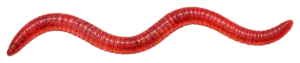
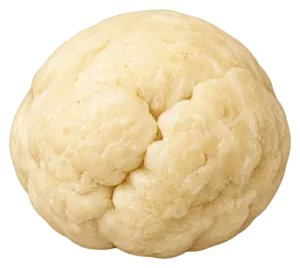
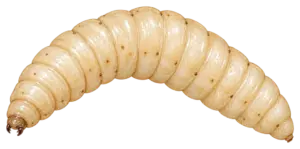
AI-generated illustrations. A click opens the lure’s page.
Rigs for these lures: float rig, running ledger rig.
Use as deadbait only; the rules on baitfish are set out in state law (Landesrecht) and the water regulations (Gewässerordnung).
Gudgeon in the frying pan
Gudgeon are small, but according to the Müritzeum their flesh tastes excellent. They are usually coated in breadcrumbs and fried in a pan. Because of their size they are rarely caught for the kitchen. How to gut and scale small fish is explained on the kitchen pages.
What you need to observe
The gudgeon is often used as baitfish. In Brandenburg, however, it has a year-round closed season (Schonzeit), and in Berlin, according to the fisheries office (Fischereiamt), you may neither catch it nor use it as bait (as of October 2026). Many federal states (Bundesländer) expressly ban fishing with live baitfish; use deadbait. The reason lies in the Animal Welfare Act (Tierschutzgesetz), which permits pain, suffering and harm to animals only for a reasonable cause. Catching, using and transporting baitfish are governed by state law (Landesrecht) and the water regulations (Gewässerordnung).
Closed seasons (Schonzeit), minimum sizes (Mindestmaß) and harvest windows are set by the federal states (Bundesland), and on many waters additionally by the club or leaseholder. They differ depending on the water and the time of year. We give figures only with a date and a source; always binding are the fisheries regulation of your federal state and your fishing permit (Erlaubnisschein). You will find a list of links to the official sources in the catch calendar.
A fish of legal size that you want to keep you stun and kill at once, in line with animal welfare rules. Protected, undersized fish or fish too large under a harvest slot you unhook, if possible still in the water and with wet hands, and release gently. What exactly applies is regulated by state law and your fishing permit (Erlaubnisschein).
What closed season, minimum size and harvest slot mean and where to find them is explained on the page Closed season and minimum size explained.
What state law sets for the closed season (Schonzeit) and minimum size (Mindestmaß) of this species is in the box „Auf einen Blick“ on the state pages for Berlin and Brandenburg. Our overview does not list this species for the other states; the state fisheries regulation (Landesfischereiverordnung) is what counts there.
Frequently asked questions (FAQ)
How do I tell a gudgeon from a young barbel?
Count the barbels. The gudgeon has two, one in each corner of the mouth, the barbel four on the upper lip. The gudgeon also has the lateral band of bluish-shimmering spots.
What do I use, and at what depth, to fish for gudgeon?
Light tackle on the pole or a finely shotted float. A small maggot or piece of worm lies on the bottom or trails just above it.
May I use gudgeon as baitfish and release them elsewhere?
Only dead, because many federal states (Bundesländer) expressly ban live baitfish. In Brandenburg and Berlin it is out of the question altogether: Brandenburg protects it all year round, and in Berlin, according to the fisheries office (Fischereiamt), you may neither catch it nor use it as bait. You should never release baitfish, because that is how the gudgeon has already been carried into waters where it does not belong.
Sources
The rating of catch chances is an editorial assessment. The facts come from these sources, and the text is worded in our own words. The illustration is an original design by Angel Momente in the style of a natural history plate (AI-generated, see the AI notice).
- Landesfischereiverband Bayern: Fischlexikon (Laichzeit, Lebensraum, Nahrung, Aktivität)
- FishBase: Gobio gobio (Höchstalter, Aktivität, Nahrung)
- Müritzeum Waren: Tierartenlexikon Gründling (Merkmale, Verwechslung, Bestandslage)
- Bundesamt für Naturschutz: Rote Liste und Gesamtartenliste der Süßwasserfische und Neunaugen Deutschlands 2023 (Naturschutz und Biologische Vielfalt 170/6)
- LAWA-Projekt O 10.20 (Leibniz-IGB, 2021): Temperaturempfindlichkeiten der Fischgemeinschaften
- Rute & Rolle: Fischkunde Gründling (Größe, Köder, Verschleppung)
- Wikipedia: Gründling (Größe, Laichtemperatur, Köderfisch)
- Bundesministerium der Justiz: Tierschutzgesetz, § 1 (Grundsatz)
- Hessisches Landwirtschaftsministerium: Bundeseinheitlicher Fragenkatalog der Fischerprüfung (Fassung Hessen 2025)
- Canal & River Trust: Gudgeon (Flüsse, Seen, Teiche und Kanäle; Angeln nah am Ufer am Grund)
- Scottish Federation for Coarse Angling: Gudgeon, Know your fish (Lebensraum, verlässlich auch bei Winterkälte, Kanäle unterhalb von Schleusen)
- Land Brandenburg: Fischereiordnung des Landes Brandenburg (BbgFischO), Anlage zu § 2
- Fischereiamt Berlin: Die Angelkarte und ihre Auflagen
Created with AI support from the sources listed. Figures only appear in the text if a source gives them. Last updated: 8 November 2026. Found a mistake? Write to us. Who is behind this site: About me.
More in the lexicon
- All fish species at a glance
- Catch calendar – month, water temperature and profile for 93 species
- Line calculator – breaking strain after the knot, drag guideline, backing
- Angling methods