
Knowledge · Tackle
Pole: No reel, fine and direct
A pole has neither rings nor a reel: the line hangs from the tip, and the length of the rod decides how far out your bait sits. This page covers the two designs, sensible lengths, the elastic in the top section and how the rig hangs from the tip.
Telescopic whip and take-apart pole
Today the pole is made from light carbon fibre, either as an extending rod or as a take-apart one (Rod & reel). On the telescopic whip the sections slide into one another and are pulled out one after another at the water. The Kopfrute is a take-apart rod made of separate sections that are joined in a fixed order. What generally distinguishes take-apart from telescopic rods is explained in the overview Fishing rods.
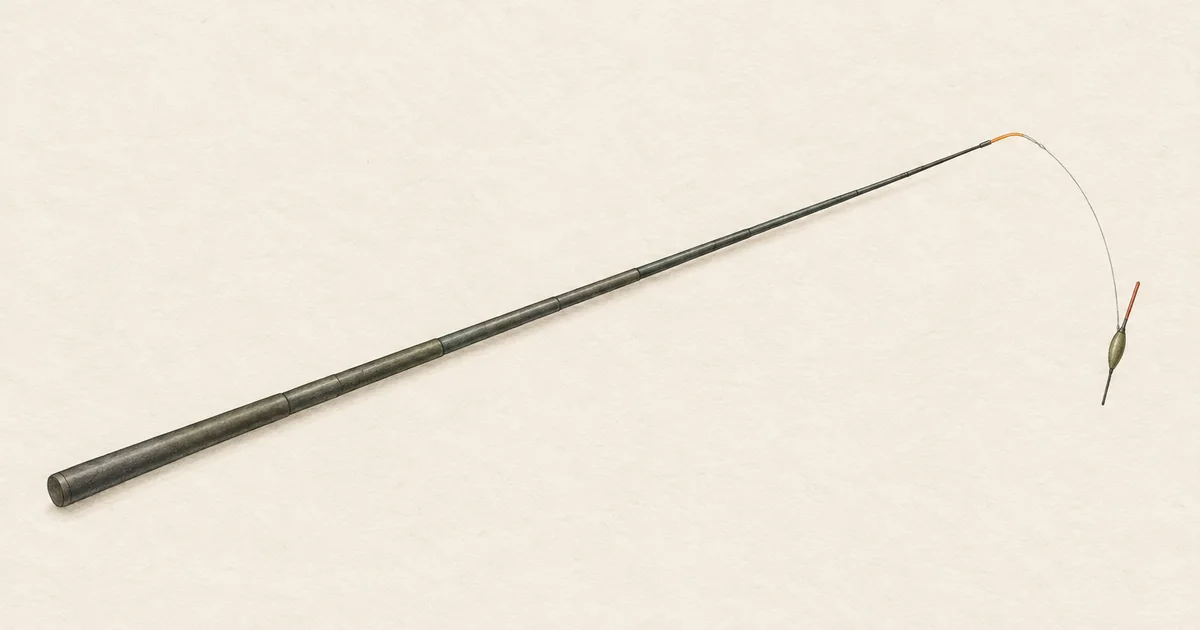
The names get mixed up. The tackle guide of the Landesfischereiverband Baden-Württemberg separates them by the tip: the Stipprute has rings, the Kopfrute does not. Other sources call any long rod without a reel a Stipprute. Here the extending rod is called a telescopic whip and the take-apart rod a Kopfrute.
| Feature | Telescopic whip | Kopfrute |
|---|---|---|
| Length (guide value) | 6–8 m to start with | usually 10–13 m |
| Line | about as long as the rod | much shorter than the rod |
| Landing | lift the rod, fish to hand | take off the rear sections |
| Elastic | possible, medium strength | in the top section, depending on the fish |
Rod length and line length
The training material of the Löningen fishing club for the angling exam (Fischerprüfung) gives about 3 to over 10 m for poles, the Landesfischereiverband Baden-Württemberg up to 15 m. For a first telescopic whip, 6 to at most 8 m is a guide value, together with a test in the shop: if you can hold the rod there without effort, it suits you. If you start straight away with a Kopfrute, a Blinker article for beginners advises 10 to 11 m. Your bait cannot sit further out than the rod is long (Fig. 1).
On the telescopic whip the line is about as long as the rod. Take it a little shorter so that after lifting you can comfortably reach the hook and the fish. It should not be longer, otherwise you cannot get the fish into the landing net properly.
On the Kopfrute it is the other way round. A bream angler leaves at most 50 cm of line between float and tip. That keeps the rig on the feeding spot even in wind and lets the strike go in without delay. An article on elastic describes the same advantage: when the tip is vertically above the float, no bow of line slows the strike.
Taking sections off without breakages
When a fish is hooked on the pole, you push the pole back and take off the lower sections until the remaining length matches the line. To do this, you rest the pole on a pole roller, over which the rear sections run back. For beginners, a tulip-shaped pole support is also a good idea: it holds the unshipped section so that it does not hit the ground and break. The section on the shortened line further down shows the process step by step.
The elastic in the top section
Without a reel the fish cannot take line. The buffer comes from a piece of elastic in the hollow top section, which the fish pulls out of the rod when it runs. When you need it is explained under Float rod. Here the subject is construction and strength. According to Fisch & Fang the elastic stretches to more than three times its length.
- Bush at the tip: So that the elastic runs freely, the tip is usually shortened a little and a PTFE slide bush is glued in. A lubricant applied regularly keeps the elastic supple.
- Length: The elastic can run through one, two or three sections. A long one stretches further than a short one, which is why two to three sections are usual for big fish.
- Retainer: At the bottom it is held by a cone that wedges in the tube, or by a small ladder. On the ladder you wind the elastic up or off and so set the pre-tension.
- Connector: It sits on the free end. You hook the loop of the rig into it, and a change takes seconds.
The system is tensioned correctly when the connector sits firmly on the bush at rest. If a few centimetres of elastic hang out of the tip after the fight, the rig tangles easily.
Which strength
You choose the strength according to the size of the fish and the carrying capacity of the float. The figures from the two magazines are close together:
- Fine: under 1 mm diameter for still water and smaller fish. For the finest rigs it is 0.6 to 0.8 mm.
- Medium: 1 to 1.4 mm, the all-rounder. For bream, 1.0 to 1.2 mm is quoted.
- Heavy: over 1.4 mm for heavy floats in current and for targeting big bream, tench and carp. For barbel and carp the figures go up to 2 mm, and a bream specialist fishes hollow elastic of 1.8 to 2.3 mm.
As a rule of thumb, Blinker says that a fish of average size should pull the elastic about 50 cm to 2 m out of the tip.
Important: According to Blinker the line must never carry more than the elastic. Otherwise, in a snag, it is not the line that breaks but the whole elastic that is pulled out of the rod. How much your line still holds with knots is shown by the line calculator. Before every fishing day, check the first few centimetres of the elastic and cut off any porous sections.
The rig at the tip
On the telescopic whip you tie the line directly to the end of the rod; the Landesfischereiverband Baden-Württemberg calls it the head line. On the Kopfrute with elastic the rig hangs from a loop in the connector. Below it comes a fixed float, built as in the float rig but finer.
How fine is shown by an article on big bream: in calm weather, with no undertow and in not too deep water, a float with 0.2 g carrying capacity is enough, because the lighter it is, the less resistance the fish feels. The line has to match. A light float on line that is too thick is hard to get out with a long line, and in wind sometimes impossible. With elastic the line may be thinner. You choose the hook as small as possible; sizes and shapes are covered under Fishing hooks. Which shot suits the carrying capacity is worked out by the float loading calculator.
You wind finished rigs onto winders. Narrow and short winders are best avoided: on narrow ones the float body gets squashed, on short ones the antenna or keel can break.
Long line or unshipped pole
An article in Rute & Rolle distinguishes two ways of fishing with a pole. In one, a long line is fixed to the tip; in the other, the line is much shorter than the pole. The line tied directly to the tip is called a tip line (Kopfschnur). In the question catalogue for the angling exam in Saxony-Anhalt it is a line attached to the rod tip, usually as long as the pole.
Fixed line on telescopic pole and whip
For the long line you usually use a telescopic pole. There are also put-in rods that come from England, where they are called whips. Because you can leave sections out, a whip lets you fish different lengths: according to Rute & Rolle an 8-m rod can be used with a long line at anything between 3 and 8 m. The name is not entirely consistent. The Canal & River Trust, which looks after the canals in England and Wales, calls the telescopic rod a whip.
Such rods are built differently from a take-apart pole. A second article in Rute & Rolle describes them as thicker-walled, slimmer and usually shorter. Their action is semi-parabolic or fully parabolic, so the rod bends far down into the butt section instead of only giving at the tip. According to the first article, telescopic poles and whips are lighter than a take-apart pole and slimmer in the butt section, and telescopic rods are also considerably cheaper.
For the line tied directly to the tip, Fisch & Fang describes a simple attachment with two short pieces of silicone tubing. One is glued on about 4 cm from the end of the rod, and the line goes behind it with a loop. Then you wind it round the tip and secure it with the second piece of tubing, which was threaded onto the line beforehand. Where the fixed line reaches its limits is shown in an article on pole fishing on a big river. Against barbel, a rig tied directly to the tip does not hold for long there, which is why a tip with elastic is standard in many places.
Which line when
- Still water or a sluggish canal, medium-sized silver fish biting quickly: long, fixed line. Rute & Rolle considers it the faster method then; you catch more fish in a short time.
- Wind, or feed that needs to land exactly on the spot: shortened line. With a long line you feed with a catapult, and hemp or sweetcorn end up widely scattered. In wind, the bait on the long line easily drifts away from the swim.
- Very light float at distance: shortened line. The long line needs heavier floats as the rod gets longer; on a take-apart pole, according to Rute & Rolle, a float carrying 0,2 g is enough even at 13 m.
- Strong current: take-apart pole with elastic. A Blinker article on bream in summer only accepts put-in poles there, because the pole has to be unshipped to land the fish.
With a take-apart pole the bait is not cast but pushed out to the spot with the pole. Rute & Rolle names lengths of up to 16 m. On a river the line between the tip and the float can be longer than the 50 cm used on still water. Fisch & Fang leaves about 1 m there, so that the rig can be guided over stones and obstacles.
Unshipping step by step
How much you need to unship depends on the length of your rig. An example from the Fisch & Fang article on the Rhine: the pole is 13 m long, the water 4,5 m deep, the rig measures 6 m. To land the fish, 13 − 6 = 7 m are unshipped. That leaves 6 m of pole, the same as the line, and the fish can be netted in front of you.
- After the strike the elastic does the work. Lead the fish gently away from the swim so that the other fish stay there (Blinker).
- Push the pole back over the roller with both hands until the joint where the remaining length matches the rig is in front of you.
- Break it down there. The rear section stays on the roller or in the pole support.
- Guide the fish with the front section to the landing net. Blinker recommends a long handle and, for big bream, a net head of 50 to 55 cm.
- Then put the sections back together in order and push the pole forward over the roller.
The pole does not always have to be used at full length. In a winter article in Rute & Rolle a pole angler fishes two swims, one at 11,5 m and one at 5 m. He has prepared both rigs including the main line; to switch, he unships the pole to the right length and swaps the line. And on streams and town canals, according to Blinker, the front five sections of the pole are enough to reach cover on the far bank.
Pole roller behind the seat
The pole roller stands behind your spot, and the pole runs over it when you push it back. Together with the pole support for the unshipped sections, a Blinker article for beginners counts it as basic equipment so that the pole does not get damaged. It also names a seat box with adjustable legs or a built-in platform that stands securely on an uneven bank.
Allow for the length behind you. With a 13 m pole, several metres of carbon fibre quickly end up on the roller and behind it. The Canal & River Trust asks anglers not to block the towpath and to watch out for pedestrians and cyclists. Its answers to frequently asked questions also cover a pole that a cyclist rode over.
Fish and spots
The pole is used mainly for whitefish such as roach, rudd, bleak and bream. At what depth which species sits is shown on the page Pole fishing. The Kopfrute for bream is only worthwhile if the fish move within its reach. Then you present the bait more finely and precisely than with a match or feeder rod. You put the feed in exactly where you want it, and a pole angler tops up with a small cup on the end of the rod. How to mix and sieve it is covered under Feed bucket and Riddle.
Long poles usually have a tip action: stiff except for the front section, fast on the strike (training material of the Löningen fishing club). This action is not suited to playing big fish, whose lunges go almost undamped into your arm. The Löningen material expressly warns about rod breakage with carp.
A long rod under power lines
Carbon fibre conducts electricity, so the training material of the Löningen fishing club urges caution near pylons. You do not have to touch a line for this: if rod or line comes too close, an electric arc can form, according to the grid operator Creos. Creos gives anglers a minimum distance of 4 m, Netze BW 5 m if the voltage of the line is not known.
In a thunderstorm you stop fishing, according to the local training material. Which distances the specialist bodies give and what to do after an electric accident is covered under Power lines and fishing rods, and for the weather under Thunderstorms and weather.
Common mistakes
- Buying a rod that is too heavy: Hold it in your hand before buying. If it already tires you there, it is not right for you.
- Line longer than the telescopic whip: The fish then hangs out of reach, and netting becomes a struggle.
- Line stronger than the elastic: In a snag it pulls the elastic out of the rod together with the connector.
- Elastic too strong for the rig: If a bream suddenly takes the fine rig meant for bleak, a very strong elastic barely cushions its lunges, and the thin hooklength is at risk.
- Detached sections on the ground: Without a holder the section hits the ground and can be damaged beyond repair.
Frequently asked questions
Can a telescopic whip be fitted with elastic?
Yes. Medium elastics of 1 to 1.4 mm are also considered well suited to telescopic whips. For small fish you do not need any; you simply swing them in.
Can a broken section be replaced?
On telescopic rods, according to the Löningen fishing club, the end cap at the bottom can be unscrewed, which lets you swap defective sections. Whether a suitable spare part exists depends on the model.
What is the difference between a pole and a Bolognese rod?
Both are long, but the Bolognese rod has rings and a reel (Fisch & Fang). This lets you reach spots further out and give line. More under Bolognese rod; the comparison with the match rod is under float rod.
What is a whip?
In England this is the name for a rod without a reel for a long, fixed line, usually shorter than a take-apart pole. Rute & Rolle describes it as a put-in rod whose length you change by leaving sections out; the Canal & River Trust uses the name for the telescopic rod. In neither case is it a take-apart pole that you unship.
Related
- Float rod: match, Bolognese and pole compared
- Pole fishing: rig, plumbing the depth and feeding at the swim
- Float rig: float, weight and hook step by step
- Floats: shapes and carrying capacity
- Telescopic rod: extending rods at a glance
- Seat box: a solid seat and storage at the pole swim
- Power lines and fishing rods: distances and what to do in an emergency
Sources
- Blinker: Kopfrute mit Gummizug (Gummistärken, Faustregel, Schnur schwächer als Gummi, Pflege, Telestippe, Kleinfische), Brassen angeln, alle Grundlagen (Kopfrutenlänge, 50 cm Schnur, Abroller, Hohlgummi, 0,2-g-Pose, Reichweite, Drill und Kescher), Kopfrute für Anfänger (10 bis 11 m, Klemmhalter, Abroller und Sitzkiepe als Grundausrüstung), Wenig Sonne, viel Brassen (Steckrute in starker Strömung), Rotauge im Winter (fünf Teile an Bächen), Fehler beim Stippangeln (Schnur und Pose, Haken, Wickelbretter)
- Fisch & Fang: Abgepuffert (Aufbau des Gummizugs, Stärken, Vorspannung, Anhieb), Die Kurve kriegen (Spitzenaktion langer Stippruten), Friedfisch italienisch (Bologneserute mit Ringen und Rolle), Strom-Stippen (Rechenbeispiel Abstecken, 1 m Schnur im Fluss, feste Montage und Barben), Schnell und sicher (Schnur fest an der Spitze)
- Rute & Rolle: Grundkurs Stippfischen (Bauformen, Einstiegslänge, Schnurlänge), Stippen: kurz oder lang (lange und verkürzte Schnur, Whip, Längen, Füttern, Wind, Posen), Lang auf Karpfen (Bau und Aktion der Whip), Im Winter mit der Kopfrute (zwei Plätze, abstecken und Schnur wechseln)
- Land Sachsen-Anhalt: Fragenkatalog zur Fischerprüfung (Kopfschnur, Prüfungsstoff)
- Canal & River Trust: Beginner’s guide: canal fishing (Whip als Teleskoprute), Setting up the rig (Weg freihalten), Canal and river fishing FAQs (überfahrene Rute)
- Fischereiverein Löningen: Zusammenfassung Gerätekunde (Längen, Bruchgefahr), Gerätekunde (Kohlefaser leitet, Spitzenaktion, Endkappe)
- Landesfischereiverband Baden-Württemberg: Gerätekunde zur Fischerprüfung (Stipp- und Kopfrute, Kopfschnur, Länge bis 15 m)
- Creos: Vorsicht bei elektrischen Leitungen (Kohlefaser leitet, Lichtbogen ohne Berührung, 4 m Abstand) und Netze BW: Gefahren durch Stromleitungen (5 m bei unbekannter Spannung)
- Wikipedia: Stipprute (Schnurlänge an der Teleskoprute, ergänzend)
Text AI-assisted, drawing AI-generated. Sources opened and checked in October and November 2026, no graphics taken from the sources.
All figures are guide values without guarantee. Lengths and elastic strengths differ from model to model, and the section on power lines is no substitute for instruction by specialists or medical advice.