
Knowledge · Tackle
Bolognese rod: A long float rod not built for distance casting
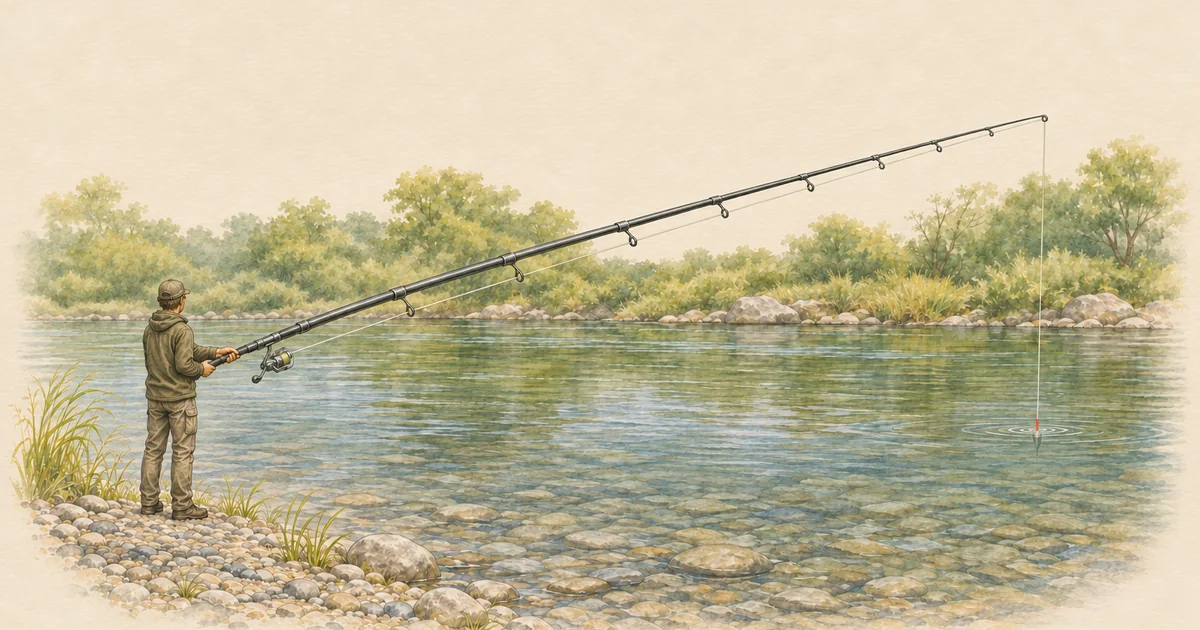
The Bolognese rod is a long telescopic rod with guides and a small fixed-spool reel, built for a float that drifts with the current on a river. Its strength is not long casting, as with the match rod, but control: with it you lift the line off the water and steer the float down its run. That is almost as direct as with a pole, and yet the reel still gives line in the fight.
Design: telescopic with guides and reel seat
The tackle guide of the Landesfischereiverband Baden-Württemberg describes the Bolognese rod as a telescopic rod with guides, a reel seat, a strong backbone and tip action: under load it bends mainly in the upper part. According to Fisch & Fang, Bolognese fishing is float fishing Italian-style. It originated on fast Italian rivers, where the bait was trotted down to barbel and roach. Today it is also used for bream, chub and common nase.
The association gives lengths of 4 to 12 m. The practical articles are narrower: Fisch & Fang gives 6 to 8 m, and a Blinker author mostly fishes 5 to 7 m. According to Fisch & Fang, longer rods take more practice to cast and to play fish on. According to Blinker, some models can be adjusted in length and then also suit smaller waters.
Because the sections slide into one another, a telescopic rod carries tube guides, according to the teaching text of the Fischereiverein Löningen. How they sit and what that means for care and transport is covered under Telescopic rod.
Stiff or soft
For your first attempts, Fisch & Fang recommends a robust model made of a mix of carbon and glass fibre. Later the action counts: the rod should be stiff and therefore fast, otherwise the strike does not arrive quickly and precisely at up to 30 m. According to the article, only carbon fibre achieves this. The fine tip still matters: it also cushions the runs of bigger fish, as Blinker describes with a 7 m rod for big trout.
Guides, reel and line
The guides of a good Bolognese rod stand well away from the blank, the rod tube. That way the line runs freely even in rain and does not stick to the wet blank (Fisch & Fang). A few fairly large guides do not ice up so quickly in winter, writes Blinker about a roughly 4 m chub float rod that some tackle shops sell as a Bolognese rod. On good models, according to Fisch & Fang, a folding reel seat is included. The Löninger tackle guide names the folding or snap-lock fitting as one of the usual ways of attaching the reel.
A small fixed-spool reel is enough. Fisch & Fang gives a line capacity of 100 m of 0,20 mm and praises match reels because their high gear ratio retrieves quickly. Fill the spool well, otherwise the line comes off poorly on the cast; how to do that without twist is shown in Spooling a reel.
The main line depends on the fish. For coarse fish Fisch & Fang spools 0,14 to 0,18 mm: the thinner it is, the further the rig flies. For chub in winter Blinker gives 0,18 or 0,20 mm, for barbel that bolt into the weed 0,25 mm. What the line holds after the knot is worked out by the Line calculator. Set the drag on the loose side and, with a big fish, add braking with your finger on the spool rim (Fisch & Fang, see Setting the reel drag).
Stance: standing, rod at an angle, line in the air
Fisch & Fang fishes standing up, holds the rod at an angle of about 45 degrees and keeps the line between tip and float tight so that it does not touch the surface (Fig. 1). That demands concentration. In return you guide the bait almost as precisely as with a pole, and the strike connects because there is no bow in the line to swallow the force. A barbel guide in the same magazine gives around 30 m as the distance at which the float can still be controlled on a long rod.
So that the long rod does not tire you, Fisch & Fang recommends a blank with a small diameter and a slim handle. Above 7 m some of the fun is lost in the fight, according to Blinker, and in stronger wind long rods soon reach their limit. The sources checked give no guide value for the balance point. Hold the rod and reel together in your hand before you buy.
The length creates distance: you do not have to stand right at the edge and you stay invisible in clear water, writes Blinker. According to another Blinker article, chub are very easily spooked in winter, so tread quietly and do not let your shadow fall on the water. If you put the rod down, it belongs in a rest: a big rainbow trout can pull an unsecured Bolognese rod into the water (Blinker, see Rod rest).
Letting the float drift and guiding it
In running water and in stronger wind, according to Fisch & Fang, you control the float on the long Bolognese rod much better than on the match rod. Where the fish lie is shown in Read the current. The sequence according to Fisch & Fang and Blinker:
- Feel out the bottom: Cast the finished rig and watch the float. If it lies at an angle or flat, the water is shallower than set and the lead is resting on the bottom. If it stands up, the water is getting deeper. Ledges of more than 20 cm and hollows are good spots, because food collects there (Fisch & Fang). For still water there is the plummet.
- Set it over depth: Set the float 10 to 20 cm deeper than the water. The bait then trails behind and does not drift past the fish too fast.
- Feeding: Groundbait or maggots go into the water slightly upstream of the swim with the catapult (Blinker). Whether you may feed and how much is stated in the water rules and the fishing permit.
- Lay in and lift: Place the rig at the start of your run, lift the rod and tighten the line until it hangs free above the water.
- Walk with it: Let the float drift with the current and follow it with the rod tip. On longer stretches you walk along the bank with it. If you stay put and just pay out line, the current washes the float towards your own bank (Blinker, Fig. 2).
- Hold back: Check the float briefly again and again instead of letting it run at the full speed of the current. The current then lifts the bait slightly and it dances just above the bottom. That is exactly when bites often come, according to Fisch & Fang and Blinker.
- Recognise the bite: If the float goes under, feel through the line whether the bait is caught on the bottom or a fish has taken, and strike at once if it is a fish (Blinker). Bream usually lift the float slightly, roach pull it under (Fisch & Fang).
- Start again: At the end of the run you reel in and lay in again at the top. When chub fishing in winter, bites mostly come in the first few runs, according to Blinker; if they do not, try the next spot downstream.
Floats and shotting for the current
Bolognese floats are usually shaped like an upside-down teardrop: wide at the top, pointed at the bottom. Their antenna is easy to see because the float often drifts further out. If the antenna itself carries some weight, the float does not go under when the bait drags over the bottom. For the colour, Fisch & Fang advises: yellow in dull weather, light red in sunshine, and against the light a waterproof black marker makes the tip visible. The shapes are shown on the page Floats.
The carrying capacity, i.e. the lead in grams that the float carries, depends on the current. Fisch & Fang gives 4 to 12 g. Slim shapes of 4 to 8 g suit still or slow-flowing water such as groyne fields and oxbows, stockier ones of 8 to 12 g stronger current. In a shallow river less is often enough. For barbel at 1,5 m depth and moderate current Blinker gives 3 g, in extreme cases 8 g, and for chub in clear winter water 2 to 4 g.
For the lead, Fisch & Fang distinguishes two cases. In calm water, four to eight small shot go on the line as a string, with weights and spacing getting smaller towards the hooklength. In the current, the article prefers single-point shotting, i.e. a single drop-shaped lead. A Blinker article on barbel fishing pinches 80 to 85 per cent of the weight onto the main line as a torpille, an elongated lead. The rest is spread over three or four shot below it. The set-up is shown in Float rig.
Worked example: Your float carries 10 g and the water is flowing strongly. Following the split from the Blinker article, 8 to 8,5 g go onto the main line as a torpille. You spread the remaining 1,5 to 2 g over three or four small shot below it. Which shot sizes add up to this weight is worked out by Float shotting.
Bolognese rod, match rod, whip and pole
Compared with the pole, the Bolognese rod has guides and a reel. This lets you present the bait further out and play fish more safely, says Fisch & Fang. Compared with the match rod it is considerably longer, and according to the same article you can still fish a fixed float at more than 4 m depth, where you would otherwise have to switch to a sliding float. The magazine therefore sees the method filling the gap between match and pole fishing. Lengths and casting weights of all float rods are compared in Float rod, the rod without a reel in Pole.
| If … | then | because |
|---|---|---|
| the float is to drift under control on a river | Bolognese rod | the long rod keeps the line off the water |
| the swim is over 4 m deep but you want to fish a fixed float | Bolognese rod | a fixed float even at this depth |
| the run lies along the far bank of a small river | long Bolognese rod | in the Blinker example only 6 m was enough |
| the feeding spot on a lake is far out | Match rod with waggler | it is built for casting at distance |
| the fish are feeding close in front of you | Whip or pole | finest rig, no reel needed |
The figure of about 6 m comes from a Blinker article about a small river. For barbel on a big river, another Blinker article considers match or Bolognese rods suitable only from 4,20 m, otherwise the float is hard to control in the current.
Safety: Carbon fibre conducts electricity very well. In its teaching text for the angling exam (Fischerprüfung), the Fischereiverein Löningen says to stop fishing during thunderstorms and to take care near power pylons. An extended Bolognese rod reaches many metres into the air. Look up before you extend it and read Power lines and fishing rods and Thunderstorms and weather.
Common mistakes
- The longest rod to start with: Above 7 m, casting and playing fish get harder; for beginners Fisch & Fang recommends 6 to 7 m.
- Floppy rod for distance: At ranges of up to 30 m, the strike does not arrive quickly and precisely enough with a soft blank.
- Line lying on the water: The bow in the line takes the power out of the strike, and you lose direct contact with the float.
- Standing still and paying out line: The float swings towards your own bank instead of staying on its run. Walk with it.
- Drag screwed down: When a fish runs, the reel then gives no line. Set it looser instead and brake with your finger.
Frequently asked questions
Which length suits a beginner?
Fisch & Fang recommends 6 to 7 m, and a Blinker author mostly fishes 5 to 7 m. Longer rods take practice and become unwieldy in wind.
Why is the float set over depth?
If the float is set 10 to 20 cm deeper than the water, the bait trails behind and does not drift past the fish too fast. If you briefly hold back, the current lifts it.
Bolognese rod or match rod for the river?
For a drifting float the Bolognese rod is the better choice, because it lifts the line off the water. If the swim is far out, the match rod has the advantage.
Can I fish a lake with the Bolognese rod?
Yes. For still water Fisch & Fang names slim floats of 4 to 8 g. At a trout lake Blinker lets the float drift at the inflow or in a crosswind. Fisch & Fang catches carp on an 8 m rod and uses it to keep them away from bankside scrub during the fight.
Related
- Float rod: match, Bolognese and pole compared
- Match rod: the float rod for casting at distance
- Pole: telescopic whip and take-apart pole without a reel
- Float fishing: fixed float, sliding float and bite indications
- Floats: shapes and carrying capacity
- Float shotting: shot matched to the carrying capacity
- Read the current: finding edges, scour holes and back eddies
- Line calculator: what the main line holds after the knot
Sources
- Fisch & Fang: Friedfisch italienisch (Herkunft, Längen, Aktion, Ringe, Rolle, Schnur, Bremse, Haltung, Loten, Übertiefe, Bisse, Posen, Bebleiung)
- Fisch & Fang: Karpfen lang gemacht (Entstehung, Karpfen an 8 m) und 50 Barben-Tipps (Kontrolle auf 30 m)
- Blinker: Einfach auf Barben angeln am kleinen Fluss (6 m, Füttern, Mitgehen, Biss) und Barbenangeln (4,20 m, Tragkraft, Bebleiung)
- Blinker: Forellenangeln mit der Bolorute (5 bis 7 m, Spitze, Forellensee, Rutenhalter) und Winter-Taktik für dicke Döbel (Ringe, Schnur, Posen, verzögert fischen)
- Blinker: Wie funktioniert die Tocco-Technik? (Abstand zum Ufer, Länge verstellbar)
- Landesfischereiverband Baden-Württemberg: Gerätekunde (PDF) (Bauart, Aktion, Länge 4 bis 12 m)
- Fischereiverein Löningen: Gerätekunde zur Fischerprüfung (PDF) (Tubenringe, Klappverschluss, Kohlefaser und Gewitter)
Text AI-assisted, drawings AI-generated. Sources opened and checked in November 2026, no graphics taken from the sources.
All information is a guide without guarantee. Length, action and guides differ from model to model, and the current at your swim decides which float carries enough.