
Knowledge · Tackle
Match rod: Long float rod for long casts
The match rod is a ringed float rod with a fixed-spool reel, built for the waggler far out, where a pole no longer reaches. This page goes deeper than the one on the float rod: length and sections, rings, reel and line, casting at distance, and the differences by target fish.
Origin and use
In English, match means competition, and the method comes from competition: according to Fisch & Fang, competition anglers from Peterborough in England developed the waggler to cast far and to fish rough water as well. The match rod and waggler then challenged the unringed poles of continental Europe. Today coarse anglers reach for it when bream, roach or carp feed so far from the bank that a rod without rings can no longer reach them.
Long Kopfruten cannot be held steady for hours in wind, reports a practical article; with the waggler he then fishes further out. On the river it works in gentle current: there, according to a second practical report, it puts the rig about 18 m out behind a stone revetment, where the Kopfrute reaches its limit. The pole and the Bolognese rod are compared on the page Float rod.
Length, sections and casting weight
Blinker counts the lengths 3.60 m, 3.90 m and 4.20 m among the classics. According to it they come from 3.60 to 5.40 m and longer. The article still considers a 4.50 m rod acceptable, and anything above that sluggish in the hand. If the length is printed on the blank in feet, 13 ft is about 3.96 m and 14 ft about 4.27 m; further values are converted by the unit converter.
A specialist article advises against a telescopic match rod and in favour of a take-apart rod in two or three pieces: it is thicker at the handle, carries noticeably fewer rings because of the sliding joints, and its action is worse. More on the design is under telescopic rod.
The values differ depending on the target fish:
| Use | Rod | Reel | Main line |
|---|---|---|---|
| Bream at distance | 4.20 m, soft, up to 25 g | about 90 cm of retrieve per turn of the handle | 0.16 mm plus shock leader |
| Roach in the river | 3.90 m, very fast blank | Size 4000 | abrasion-resistant, sinks well |
| Tench over weed | strong match rod | Size 2500 | 0.20 mm |
| Carp in a gravel pit | 3,90–4,50 m, 30–40 g | Size 4000 | 0.18–0.22 mm |
The values in the table come from articles in Blinker (bream, tench, carp) and Rute & Rolle (river). The page on the float rod gives up to about 25 to 30 g for the match rod. The carp match rod is above that at 30 to 40 g; it needs a strong backbone to land hard-fighting fish safely.
Worked example: According to Fisch & Fang, long-distance wagglers carry 6 to 20 g below the body, in extreme cases 40 g. A 16 g waggler plus an assumed 2 g for shot and bait makes 18 g and suits a rod up to 25 g. A 40 g waggler is far above that and is at the upper limit even for the carp match rod.
Many small rings
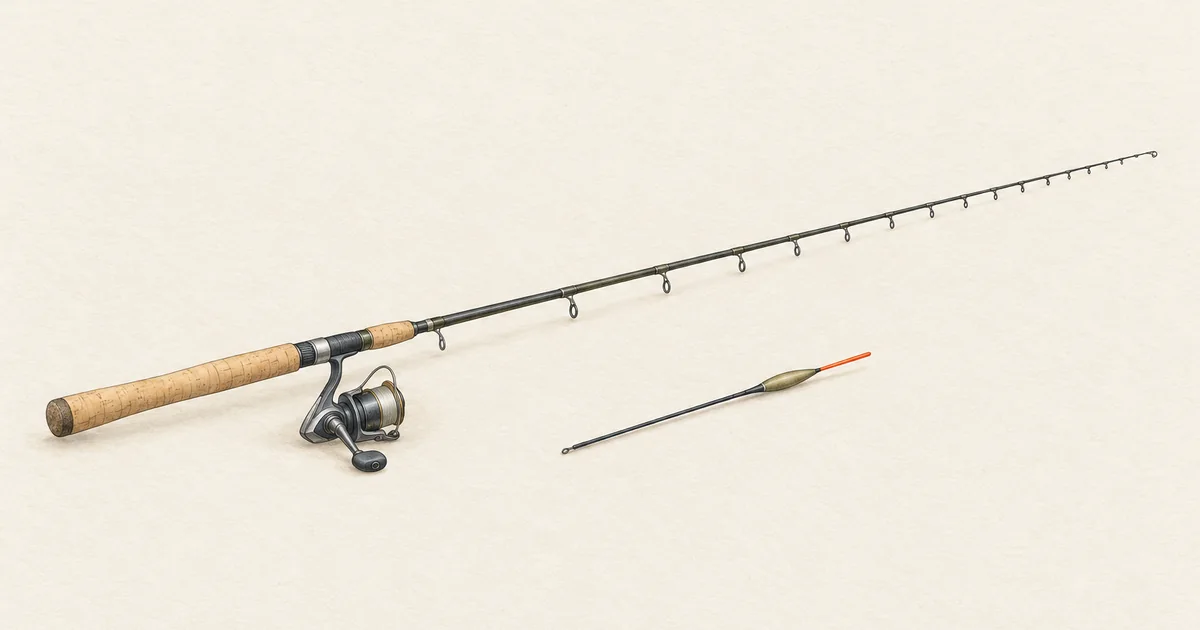
The close spacing of many small rings is typical. Rings spread the forces of casting and playing a fish over the blank. A second reason shows in rain: if the rod has too few rings, the wet line sticks to the blank and the cast gets shorter. The fixed-spool reel hangs beneath the rod, with the rings pointing down (Fig. 1). A multiplier, by contrast, sits on top and needs a different ring layout.
Check the rings regularly. According to the exam questions in Bavaria and Saxony-Anhalt, the end or tip ring is the one most stressed by friction. A damaged ring harms the line, and it then breaks more easily when a bigger fish pulls (LfL Bayern).
Action: soft on the lake, fast on the river
What the action is, the overview Fishing rods explains. For the match rod, a specialist article describes a compromise: the rod should be strong enough to get the rig far out and at the same time forgiving enough that fine rigs hold and the run of a big fish is absorbed. For still water and moderate current, Fisch & Fang names a soft 3.90 m match rod as the first choice.
On the river, by contrast, a practical report relies on a very fast blank, one that springs back quickly, so it can make use of the quick bites there. A specialist article also finds a blanket recommendation difficult, as waters, distances and fish are too varied.
Reel and line
A fixed-spool reel goes with the match rod. In the articles behind the table, the size ranges from 2500 for tench to 4000 for carp and the river. For long casts at bream, according to Blinker, the reel should take in a lot of line per turn of the handle, about 90 cm is quoted, and wind it on evenly. The page on the fixed-spool reel gives 70 to 80 cm according to another article and explains what the value depends on.
The main line is thin monofilament line that sinks. For fishing on a lake, sinking mono is recommended; on the river a practical report uses abrasion-resistant line that sinks well. For bream at distance, one angler fishes 0.16 mm.
Thin line breaks easily in a powerful cast, thick line loses distance through air resistance. The same author therefore adds a shock leader, a length of thicker line that cushions the load when casting: 15 m of 0.22 mm, joined with the Albright knot. It must not be too thick, otherwise it slides badly through the rings. According to the exam questions of the LfL Bayern, the line should not be thinner and the hook not smaller than necessary. What your line still holds after the knot is shown by the line calculator.
Casting and feeding at distance
A practical article describes the cast in four steps:
- Hold the rod in front of your body, with the rig hanging about 20 cm below the tip.
- Open the bail arm and hold the line with your index finger.
- Bring the rod briskly back and straight away forward again. At 11 o’clock you release the line.
- Just before the rig arrives, you lay your finger lightly on the spool rim and so slow its flight.
So that every cast lands in the same place, the author aims at a fixed point on the opposite bank. After the first good cast he marks the line in front of the reel with a grease pencil. Another author also clamps it in the line clip on the spool after plumbing, because his balls of feed have to land exactly on the spot. Once the waggler is set, you sink the line so that the wind cannot push a bow into it; the steps are covered under Waggler rig.
You usually get feed out with the catapult. A feed tub can be cast directly with the match rod and takes the feed down to the bottom. For a feed rocket, the article recommends a second rod. A long landing net handle helps with landing: if the angle between rod tip and fish becomes too steep, many fish are lost in this phase. More under landing net.
Common mistakes
- Buying the longest rod: Above 4.50 m the match rod becomes sluggish.
- Reaching for a telescopic match rod: It has fewer rings, the line sticks in rain, and the action suffers.
- Floating or too thick main line: Floating line stays on top, where the wind catches it. Thick line slows the cast.
- Shock leader too thick: It runs badly through the small rings and costs distance.
- The fine bream rod for carp: For carp the match rod needs a strong backbone, see the table.
Frequently asked questions
Match rod or feeder rod?
If the fish feed far out, that is really a case for the feeder on the feeder rod. If you prefer to watch the float go under, the match rod reaches 40 m and more when tackle, rig and cast are right.
Why does the waggler often slide at distance?
A fixed float can be set at most to the length of the rod. At 50 m out the water is often deeper. There the waggler runs freely on the shock leader as far as the stop knot, and according to the author’s experience this rig is also easier to cast.
Which float goes on the match rod?
Usually the waggler, which is attached only at the bottom of the line so that the line can run under water. For carp in a gravel pit, an article on carp fishing gives wagglers with 3 to 15 g carrying capacity, depending on distance and depth. The shapes are explained on the page Floats.
Related
- Float rod: match, Bolognese and pole compared
- Waggler rig: spreading the lead, sinking the line, setting the depth
- Float fishing: fixed and sliding floats at a glance
- Catapult: putting feed accurately out at distance
- Monofilament line: stretch, breaking strain and care
- Float shotting: shot matched to the carrying capacity
Sources
- Blinker: Brassen angeln, alle Grundlagen (Einsatz, 40 m, Rute, Rolle, Schnur und Schlagschnur, gleitender Waggler, Wurftechnik)
- Blinker: Informationen rund um das Thema Matchruten (Längen, Futterdose, Futterrakete) und Blinker: Teleskopierbare Matchruten (Steckrute aus zwei oder drei Teilen, Nachteile der Telematchrute) und Blinker: Die richtige Angelrute (Ringe verteilen die Kraft, Beringung je nach Rolle)
- Blinker: Karpfenangeln mit der Matchrute im Baggersee (Karpfen-Matchrute, Waggler, Kescher) und Blinker: Das erste Mal auf Schleie (Schleienrute)
- Rute & Rolle: Mit Waggler am Fluss (Fluss, schneller Blank, Rolle, Schnur) und Rute & Rolle: Waggler fürs Frühjahr (Wind, Schnurclip)
- Fisch & Fang: Wer erfand den Waggler? (Herkunft), Fisch & Fang: Pfiffiges zum Posenfischen (sinkende Schnur, Weitwurf-Waggler) und Fisch & Fang: Locker flockig auf Rotaugen (weiche Matchrute)
- Bayerische Landesanstalt für Landwirtschaft: Prüfungsfragen zur Fischerprüfung 2023/2024 (PDF) (Ringe, Schnurwahl) und Land Sachsen-Anhalt: Fragenkatalog zur Fischerprüfung (PDF) (Spitzenring)
Text AI-assisted, drawing AI-generated. Sources opened and checked in October 2026; no graphics taken from the sources.
All figures are guide values without guarantee. Length, casting weight and action differ from model to model; what is printed on your rod is what counts.