
Knowledge · Tackle
Monofilament line: Stretch, breaking strain and care
A monofilament line is a single, round thread of polyamide and, on many reels, the mainline for float and bottom fishing. This is about what is not printed on the spool: how much it stretches, how much of its breaking strain is left after knots and water, and when it has to come off.
Material and manufacture
Monofilament lines are made of polyamide, usually called nylon in the trade. The tackle guide for the angling exam (Fischerprüfung), provided by the Fischereiverein Löningen, describes them as single-strand and drawn in one piece. The starting material is polyamide granulate. It is melted and pressed through fine nozzles. This extrusion helps determine diameter and breaking strain. The thread is then stretched to the desired diameter.
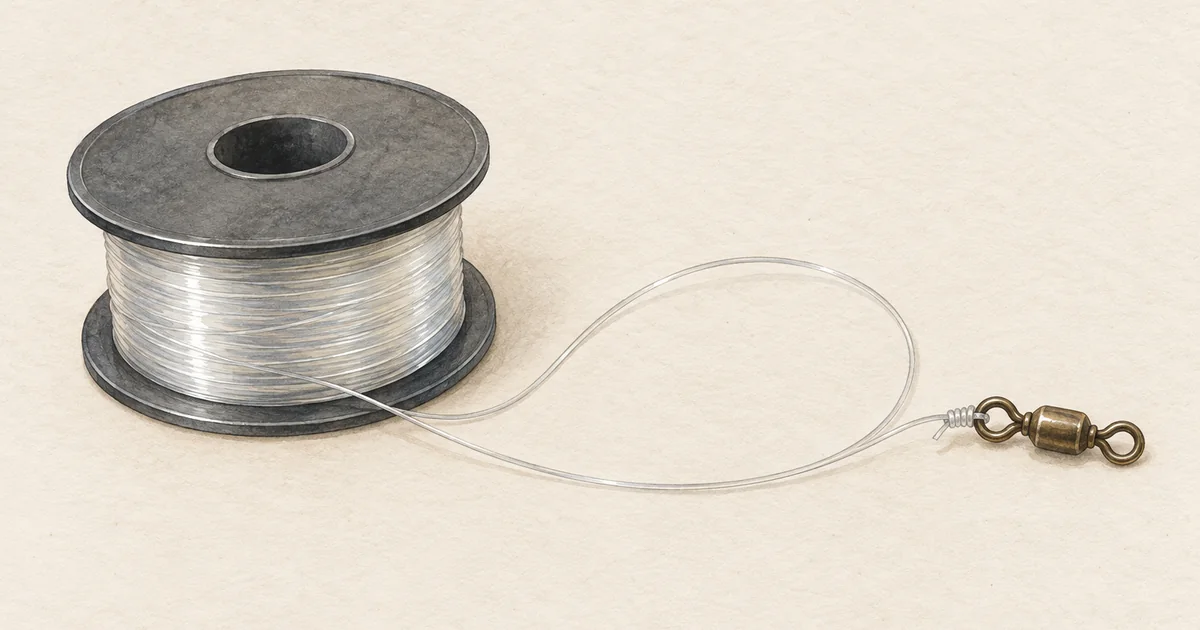
Because the line consists of a single strand, it is almost transparent and smooth. From a certain diameter on, however, it is clearly stiffer than braid. If it lies on the spool for a long time, it keeps the spool’s curve and comes off the reel in coils. This is called the memory effect. How monofilament compares with braid and fluorocarbon is shown in the comparison of the three line types.
Stretch: cushion in the fight, delay at distance
Polyamide gives under tension. Blinker gives about 15 percent for many monofilaments, whereas braid hardly stretches at all. The source does not say what load the value refers to. Treat it as a rough guide value.
In the fight the stretch is a cushion. It absorbs sudden force peaks when casting and fighting and prevents the hook from pulling out. Carp, tench and coarse fish with their soft mouths are named as beneficiaries.
At distance the same property becomes a drawback. The tackle guide for the angling exam (Fischerprüfung) notes that too much stretch delays the strike. The stretch can also swallow tentative bites outright. A carp angler warns in Blinker that at 300 metres with monofilament you may not notice at all that a fish has been hooked. Rute & Rolle describes a middle way: braided mainline with two to three rod lengths of monofilament in front of it as a cushion for the final phase of the fight. The two are joined with a shock leader knot.
Diameter and breaking strain
The breaking strain of a monofilament depends on its diameter. At the same diameter it carries less than braid, so for the same breaking strain you need a thicker line. The tackle guide for the angling exam (Fischerprüfung) distinguishes two values: the linear breaking strain, which the manufacturer states, and the knot strength.
What the figure on the spool means
The print states the linear breaking strain, that is, the load the straight thread can bear. As soon as you tie a knot, the lower knot strength applies, and in practice that is the decisive value. A comparison of figures between different lines therefore says little as long as it is unclear how they were measured.
Knots and moisture
Every knot costs breaking strain; how much depends on the knot and on how it is tied. For the uni knot Blinker gives around 80 percent of the breaking strain. Moisten every knot before tightening, otherwise friction heat builds up that can weaken the line.
Wet polyamide is weaker than dry. A study by the Leibniz Institute of Polymer Research Dresden and TU Dortmund describes how absorbed water markedly lowers the stiffness and strength of polyamide 6. The study measures the material, not finished fishing line. You cannot read a percentage for the line itself from it.
How to calculate: If the breaking strain on the spool is given in lb, multiply by about 0,454. 20 lb becomes roughly 9,1 kg. The loss at the knot comes off that, and wet line carries a little less still. The line calculator estimates the remaining strength after the knot, and the unit converter translates the units.
Uses
Where monofilament has its strengths, with diameters as guide values:
| Use | What monofilament does there | Guide value |
|---|---|---|
| Float fishing | Short distance, the stretch protects soft mouths | none given |
| Bottom fishing for eel and carp | Abrasion-resistant on contact with the bottom | Carp: 0,30 mm, near snags 0,40–0,45 mm |
| Spinning for trout | Inconspicuous, the stretch prevents fish coming off | none given |
| Shock leader | Cushions, withstands mussels and stones | on mussel edges 0,50–0,60 mm |
| Leader | Planned break point between mainline and hook | one size thinner than the mainline |
Monofilament is less suitable where direct contact counts. That applies to spinning with very direct lure contact and to fishing at great depths, for example in Norway. There braided line is usually the better choice. The tackle guide assigns monofilament hooklengths to coarse fish and steel hooklengths to predators. What helps against pike teeth is covered under pike hooklength.
Ageing: light, heat, abrasion
Monofilament ages even when it is fished little. Over time line loses breaking strain and, even with little use, can be considerably weaker after a few years. UV light, heat, sunlight and salt water are cited as causes. Spare spools therefore do not belong on the windowsill or under the rear window of the car.
Monofilament tolerates abrasion on stones, mussels and branches better than braid, but it still gets rough. You cut off the rough first metres, as described in the line comparison.
The trade sources evaluated here give no fixed interval for replacing the whole fill. Reasons to change are: breakoffs have shortened the line so much that too little is left on the spool, the line is damaged over a longer stretch, or it has been on the reel for many years. A carp angler writes there that he changes his monofilament mainline at least once per season because it is susceptible to the weather. How the new line goes onto the spool without twist is shown under Spooling a reel correctly.
Line scraps do not belong on the bank
Broken-off line is barely visible in the water. NABU Berlin reports that swans, herons and ducks get tangled in line drifting in the water or hanging from branches. According to NABU, the animal clinic of the Freie Universität Berlin regularly sees birds with line wound around their legs. If limbs are constricted and die off, the animals have to be put down. NABU and the clinic call for all line scraps, baits and hooks to be disposed of properly.
You cut old line into shorter pieces as you strip it off so that birds and other animals cannot get caught in it. It is best to take away any scraps you find at the water. NABU recommends throwing them away only at home, because animals search rubbish for food at night.
Common mistakes
- Fishing too thin. Because of knot strength, the tackle guide for the angling exam (Fischerprüfung) warns: „Fische nie dünner als nötig.“ (never fish thinner than necessary).
- Trusting the print blindly. It states the breaking strain of the straight thread; at the knot it is less. Set the drag by the weakest link, see Setting the reel drag.
- Pulling knots tight dry. Friction heat weakens the line at exactly the spot that holds least anyway.
- Fishing pure monofilament at long range. The stretch swallows bites and the strike. There braid with a monofilament shock leader helps.
- Leaving the fill on the reel for years. Even rarely used line loses breaking strain over time.
Frequently asked questions
How often should I change monofilament line?
The trade sources give no fixed interval. Replace it when it is damaged over a longer stretch, when the spool gets too empty because of breakoffs, or when the fill is already years old. One carp angler changes it once per season.
Is a thicker line always safer?
It carries more, but brings drawbacks. Thick monofilament is stiffer, casts worse, is harder to knot and may be more conspicuous to the fish. Less fits on the spool as well.
What does an IGFA class on the spool mean?
The IGFA keeps world records by line class in kilograms. For the record, the class is an upper limit: a line of the 4 kg class may bear no more than 4 kg in the test, converted 8,81 lb.
Related
- Fishing lines compared: monofilament, braid and fluorocarbon side by side
- Braided line: the mainline when bites are to come through at distance
- Fluorocarbon: the second single-strand type among fishing lines
- Spooling a reel correctly: new line without twist
- Setting the reel drag: starting value by breaking strain
- Line calculator: breaking strain after the knot and spool capacity
- Uni knot: an all-round knot for monofilament of any diameter
Sources
- Blinker: Monofile Angelschnur, ein Strang für viele Situationen (Einsatzbereiche, Steifheit, UV-Alterung, Knoten anfeuchten, Uni-Knoten rund 80 %)
- Blinker: Karpfenschnur, die richtige Leine fürs Karpfenangeln (Dehnung etwa 15 %, Durchmesser, Schlagschnur, Wechsel pro Saison)
- Blinker: Alles neu, mit frischer Schnur in die Saison (Anlässe für den Wechsel, alte Schnur zerschneiden)
- Rute & Rolle: Die richtige Schnur, monofile oder geflochtene? (Strecken, Dehnung, Schlagschnur, Abrieb)
- Fischereiverein Löningen: Gerätekunde zur Fischerprüfung (PDF) (Werkstoff, lineare und Knotentragkraft, Dehnung, Vorfach)
- IGFA: International Angling Rules (Schnurklassen als Obergrenze)
- Leibniz-Institut für Polymerforschung Dresden und TU Dortmund: Polyamide 6 in Water, Polymers 2021 (Wasser senkt Steifigkeit und Festigkeit von Polyamid)
- NABU Berlin: Angelmüll gefährdet Berliner Wasservögel (Gefahr für Wasservögel, Entsorgung)
- Wikipedia: Monofilament fishing line (Extrudieren, Kringel, Alterung)
Text AI-assisted, drawing AI-generated. Sources opened and checked in October 2026; no graphics taken from the sources.
All figures are guide values without guarantee. The breaking strain, stretch and durability of a line depend on manufacturer, diameter, knot and storage.