
Knowledge · Tackle
Fluorocarbon: A hooklength with low visibility
Fluorocarbon is a single-strand fishing line made of a fluoroplastic, heavier than water and usually used as a short leader in front of a braided mainline. Some of its advantages have been measured, others are mainly printed on the packaging. Here you can read what each of the sources provides.
Material and density
The line is mostly made of polyvinylidene fluoride, PVDF for short. Like nylon line, it is a single strand, just of a different plastic. The most important difference is density: a review article from the University of Warwick gives 1,76 to 1,83 g/cm³ for PVDF. A study in the journal Polymers puts polyamide 6, one of the plastics behind the name nylon, at 1,13 g/cm³. Both are heavier than water. Fluorocarbon therefore sinks quickly, nylon only slowly.
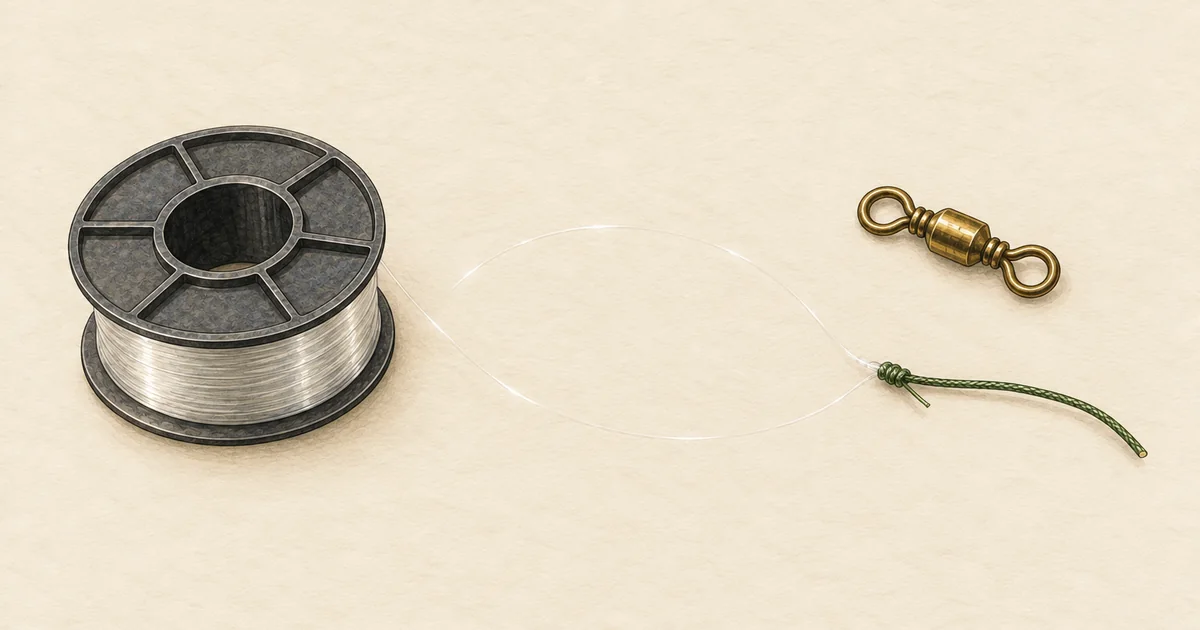
Fluorocarbon does not absorb water and is considered less sensitive to UV light than nylon. In terms of stretch it sits between the other two line types: less than nylon, but more cushion than braid. The table under Fishing line compared shows the refractive index, density and stretch of all three line types side by side.
Visibility: measured value and fishing practice
What is documented is the refractive index, that is, how strongly a material bends light. Blinker gives 1,42 for fluorocarbon, 1,33 for water and 1,53 to 1,56 for nylon. Fisch & Fang found values of 1,4 to 1,43 in manufacturers‘ data. Because the gap to water is smaller, fluorocarbon reflects less light than nylon. Fig. 1 shows this schematically.
That does not make the line invisible. Fisch & Fang compared lines in a glass tank together with a physicist. Because of its round shape, every line acts like a tiny lens in the water. Fluorocarbon was hardly less conspicuous than nylon, and all lines cast clear shadows. Only the thinner lines were slightly less visible.
The sources on this page do not show whether fish bite more often because of this. Observations on clear waters report that perch regularly nudged the fluorocarbon hooklength, even though, going by the manufacturers‘ promises, they should not have been able to see it at all.
In practice: The test suggests that fishing finer brings more than switching material. If you want to fish less conspicuously, start with a thinner hooklength that still matches the breaking strain you need.
Abrasion, stiffness and knots
Fluorocarbon is considered particularly abrasion-resistant, and Blinker calls it „extrem abriebfest“ (extremely abrasion-resistant). On closer inspection this cannot necessarily be confirmed: in use it frays and comes off in fine shavings, much like planed wood. The sources on this page give no firm figure for it.
Stiffness is not in dispute. At the same diameter fluorocarbon is often stiffer than nylon, especially in thick diameters, and carries slightly less. If you switch from a nylon hooklength and want the same breaking strain, you end up with a larger diameter. The line calculator works out how much is left after the knot.
Few turns, tighten wet
The stiffness also costs knot strength. Simple knots such as the clinch knot or the grinner knot are recommended, with fewer turns than for nylon so that the knot closes fully. Before tightening it is moistened, just as you know it from nylon.
As a hooklength on a braided mainline
A piece of fluorocarbon most often sits between the braid and the lure. Ultralight spinning, finesse fishing with small lures and trout-lake fishing are named for this. One angler describes it as a hooklength for perch and zander, expressly where no pike are expected. The braided line in front of it hardly stretches and transmits every touch. The hooklength adds some cushion and a less conspicuous end section. The two are joined with the FG knot.
Hard mono
Hard mono is not fluorocarbon but a monofilament line made specially for predator hooklengths. It is many times harder and also stiffer than ordinary nylon. It is transparent but still recognisable in the water. In thick diameters both materials serve as so-called bite-proof mono hooklengths for pike fishing.
No substitute for steel with pike
Even the trade press, which rates fluorocarbon as pike-proof only from about 0,90 mm and sees it more for large baits, does not call it entirely bite-proof. Only metal hooklengths count as 100 % bite-proof. With deadbait in particular, which is often swallowed deep, steel is recommended. Where pike are present, steel or titanium therefore belongs in front of the bait. More on material and construction can be found under pike hooklength.
Fluorocarbon as mainline
Some spinning anglers, especially for perch, fill the whole spool with fluorocarbon. In its favour:
- It slides more quietly through the water and the rod rings than braid.
- It sinks, so crankbaits run a little deeper on it.
- The knot joining it to the hooklength is no longer needed.
There is a good deal against it too. Because of the stretch, tentative bites come through less clearly, and the strike has to be firmer. The transparent line is hard to watch where it enters the water. Freshly spooled, it springs stubbornly off the spool. It is recommended to spool it parallel and very tight and then let the reel rest for a few days. On a baitcaster the centrifugal brake has to be set tighter than for braid. Strikingly many wind knots are reported, that is, tangles of line on the spool that are hard to untangle. How line goes onto the spool of a fixed-spool reel without twist is shown in Spooling a reel correctly.
Promise and findings
| Claim | What the sources show |
|---|---|
| sinks | documented, density 1,76 to 1,83 g/cm³ |
| does not absorb water | documented, consistent across several sources |
| invisible | refractive index closer to water, hardly less visible than nylon in the tank test |
| more abrasion-resistant than nylon | disputed, the material comes off in shavings |
| pike-proof | not entirely bite-proof, metal remains safer |
Common mistakes
- Using fluorocarbon as pike protection. A thin hooklength for perch fishing will not survive a pike bite. Where pike are present, metal belongs in front of the bait.
- Pulling the knot tight dry. The same applies to fluorocarbon as to nylon: moisten first, then tighten.
- Taking over the diameter from nylon. At the same diameter fluorocarbon carries slightly less. Check the breaking strain printed on the spool, not just the millimetres.
- Relying on invisibility and fishing thick. A thicker hooklength is more conspicuous than a thinner one, whatever the material.
- Not checking the hooklength after the fight. Check it after every fish. Cut off rough, scratched or frayed sections or replace the whole piece.
Frequently asked questions
Is coloured fluorocarbon less visible than clear?
Lines tinted pink or grey are said to be even less visible in the water. In the tank test coloured lines kept their colour, including those whose colour is supposed to vanish in the water. The advantage is therefore not documented.
Does fluorocarbon get worse over time?
Yes. After long use the material goes cloudy, looking scratched like old glass. Poor storage also costs quality. Keep the line cool and dark and do not leave it lying in the sun for long.
Is fluorocarbon suitable for fly fishing?
Fly anglers use it as leader and tippet. With nymphs and streamers it sinks faster than nylon and gets the fly down to depth more quickly. Wet-fly fishing is also among the uses in which fluorocarbon has advantages.
Related
- Fishing line compared: monofilament, braid and fluorocarbon in one table
- Braided line: the mainline the hooklength attaches to
- Monofilament line: nylon as a cheaper alternative for the hooklength
- Pike hooklength: steel, titanium and bite-proof mono hooklengths
- FG knot: a slim join between braid and hooklength
- Line calculator: breaking strain after the knot and drag setting
- Drop-shot rig: a rig for finesse fishing
Sources
- Blinker: Fluorocarbon Angelschnur, die unsichtbare Leine (Brechzahlen, kein Wasser, UV, Abrieb, Dehnung, Steifigkeit, Tragkraft, Knoten mit weniger Windungen, gefärbte Schnüre, Fliegenfischen, Lagerung)
- Fisch & Fang: Die Wahrheit über Fluorocarbon (Wannenversuch, Linseneffekt, Schatten, Durchmesser, Brechzahl laut Herstellern, Abrieb strittig, Perücken, Alterung)
- University of Warwick, Polymers 2021: On the Solubility and Stability of Polyvinylidene Fluoride (Dichte von PVDF)
- Blinker: Fluorocarbon Vorfach für Hecht (nicht völlig bissfest, Knoten anfeuchten, FG-Knoten, Kontrolle nach jedem Fisch) und Blinker: Bissfeste Mono-Vorfächer (Metall zu 100 % bissfest, Hardmono im Wasser erkennbar) und Blinker: Raubfischvorfächer im Vergleich (Hardmono härter und steifer als Nylon)
- Blinker: Fluorocarbon als Hauptschnur, Sinn oder Unsinn? (Vor- und Nachteile als Hauptschnur, Aufspulen, Baitcaster, Vorfach für Barsch und Zander)
- Polymers 2024: Molecular Dynamics Simulation of Hydrogen Barrier Performance of Modified Polyamide 6 Lining of IV Hydrogen Storage Tank with Graphene (Dichte von Polyamid 6) und Wikipedia: Monofilament fishing line (PVDF als Fluorocarbon vermarktet, Nylon sinkt langsam)
Text AI-assisted, drawing AI-generated. Sources opened and checked in October 2026; no graphics taken from the sources.
All figures are guide values without guarantee. The properties of individual fluorocarbon lines differ depending on manufacture and diameter.