
Knowledge · Tackle
Fixed-spool reel: Structure, size and gear ratio
The fixed-spool reel hangs under the rod for spinning, float fishing and bottom fishing. Its spool stands still, and a rotor lays the line on. Here you can read how it works, what the parts are called, and which size and gear ratio suit your fishing.
The spool stands still, the rotor turns
When you reel in, the spool does not turn. Instead the rotor, with its bail arm and line roller, runs around the spool and winds the line on. At the same time it moves up and down. The axis of the spool lies along the rod, and the reel hangs under the casting hand (tackle guide of the Fischereiverein Löningen). In the exam catalogue of the Free State of Saxony for the angling exam, the fixed-spool reel is the most widely used reel in Germany.
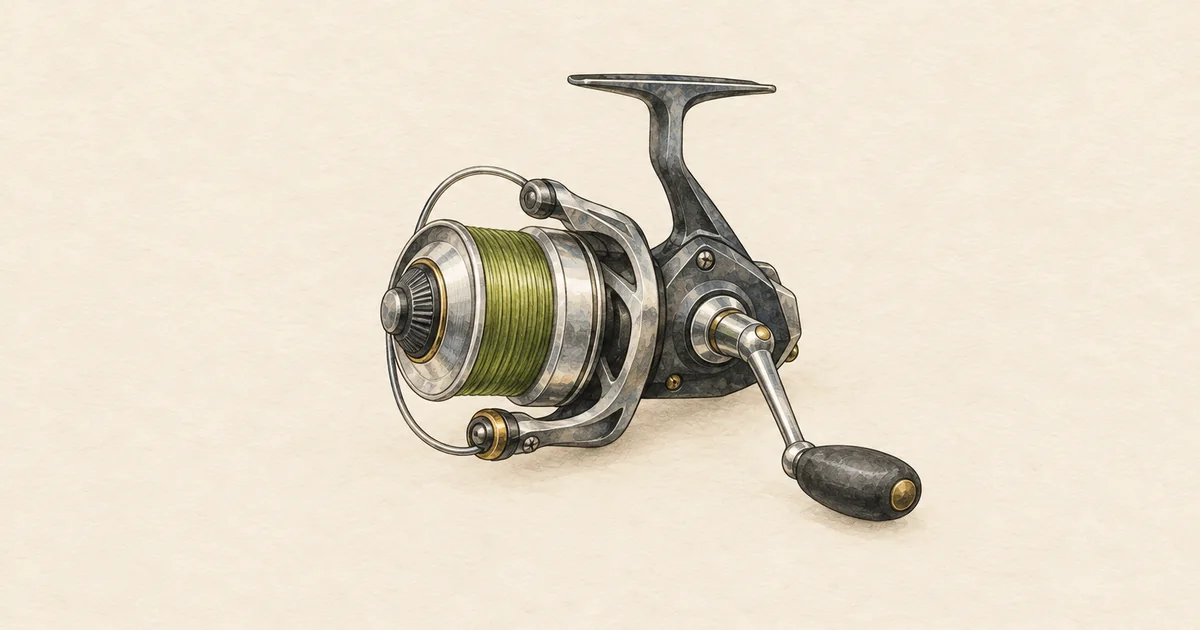
To cast, you flip the bail arm open. The extended index finger of your rod hand stays close to the spool. If you place it on the spool’s rim, you brake line and bait gently. The bail arm must stay open during the cast: the Saxon exam catalogue lists its snapping back as a mishap that skilful handling should avoid.
The parts and their jobs
- Reel foot: the bar on top of the reel. It sits in the reel seat and, depending on the rod, is held by a screw or hinged fitting or by sliding rings.
- Spool: carries the line and can be taken off with a push button or screw, for instance to fit a spare spool with different line. Which spool shapes exist is covered further down.
- Bail arm (line-catching bail): the wire arm on the rotor. Open, it releases the line for the cast; closed, it catches the line and lays it on the roller.
- Line roller: the small roller at the end of the bail arm. Here the line bends through 90 degrees. A rotating, ball-bearing roller is gentlest on the line, as the Saxon exam catalogue puts it.
- Rotor: the cage that turns round the spool and carries the bail arm and roller.
- Handle: drives the rotor through a gearbox. According to the tackle guide of the Fischereiverein Löningen, it can be folded for transport and fitted on either the left or the right side.
- Anti-reverse: prevents the rotor from turning backwards unintentionally. If a fish pulls harder, the drag then releases line.
- Drag: a slipping clutch, either at the front on the spool (front drag) or at the back on the body (rear drag). How to set it is explained under Setting the reel drag.
Winding and spool oscillation
So that the line does not pile up in one place, the rotor and spool move up and down against each other as you wind. The bail arm lays coil next to coil across the width of the spool. This up and down movement is called spool oscillation. You can see the result in Fig. 2.
Clean lay matters above all with thin braid: it keeps wind knots away on the cast and improves casting performance. If the line lies unevenly on the spool, casts can be noticeably shorter because it peels off less well. How far you fill the spool and why monofilament underneath helps against slipping is covered under Spooling a reel correctly. The fill level of 1 to 2 mm below the spool rim also matters when winding.
Size and spool shape
Fixed-spool reels carry a size number. Blinker gives a range of roughly 500 to 30.000: the bigger the number, the more line, or the thicker line, the reel holds. Manufacturers count differently in part. So rely on the line capacity printed on the reel. How much of your line fits on a spool is worked out by the line calculator. Roughly, the sizes can be sorted like this (guide values):
| Method | Size | Note |
|---|---|---|
| Ultralight spinning, fine float and coarse fishing | 500 to 1500 | at a trout lake 1000 and 2000 |
| All-round in fresh water, spinning and bait fishing | 2000 to 4000 | at a trout lake: small ponds 2000 and 3000, large gravel pits bigger |
| Carp with a lot of line, wels catfish with thick line | 6000 to 10.000 | a lot of line (carp) or thick line (wels catfish) |
| Tremarella, trolling and bombarda at a trout lake | Match reels 4500 to 6500 | shallow spool, little line, but long casts |
| Salt water | from 10.000 | reels of this size almost only there |
The size also affects balance and weight. For the trout lake, a Blinker article gives roughly 180 to 230 g for ultralight reels and 270 to 320 g for match reels. Small reels then make long rods top-heavy. How rod and reel go together is covered at Spinning rod. Casting distance differs too: with a 20 g bombarda, the large 6500 match reel easily manages 15 to 18 m more than a small 3000.
Spool shapes
| Spool shape | Effect | Where it is found |
|---|---|---|
| long and shallow (long-cast spool) | less drag as the line leaves the spool edge, longer casts | surf and carp reels, some spinning reels |
| shallow match spool | less line twist, longer casts with light rigs | match reels for trout lakes, often holds only about 150 m of 0,18 mm monofilament |
| Aluminium instead of plastic | more durable | higher-quality reels |
Then there is the line: braid is thinner for the same load and softer than monofilament, which reduces friction in the air and in the rings and increases casting distance. A second spool with different line saves swapping reels, see Spare spool.
Gear ratio and line retrieved per turn of the handle
The gear ratio states how often the rotor turns in one turn of the handle. At 5:1 that is five turns. For most reels the trade press gives about 4:1 to 6:1, and the training material of a local angling club on the fixed-spool reel gives 3:1 to 6:1 (written there as 1:3 to 1:6).
- High gear ratio: The line comes in faster, but the rotor turns with less power. Very slow presentation of the bait gets harder.
- Low gear ratio: more retrieving power for baits and rigs that create a lot of resistance.
How much line comes in per turn of the handle also depends on the spool diameter. A large spool automatically picks up more line. Anyone switching to a bigger reel therefore often retrieves faster without noticing. For ultralight reels about 60 to 65 cm of retrieve per turn of the handle is given, for match reels 70 to 80 cm. You will find a comparison of several reels under Reels.
Worked example with assumed values: Each turn of the rotor lays on one coil. If the filled spool has a diameter of 4,5 cm, one coil is about 14,1 cm long (diameter times 3,14). At 5,2:1 that gives about 74 cm per turn of the handle. If the spool has been fished down to a diameter of 3,5 cm, it is only about 57 cm.
Line twist: where it comes from and what helps
Line twist means the line is twisted in itself and jumps off the spool in coils. It arises wherever line rotates. The Saxon exam catalogue names strongly spinning lures as the main cause, such as a spinner represents when retrieved.
- Fit a small swivel in front of spinning baits. It delays the twist but does not prevent it entirely.
- Look for a ball-bearing line roller. Without a bearing there, thin line twists quickly. Shallow match spools twist less.
Part of the twist already arises when winding on. How the line should come off the supply spool the right way round is explained under Spooling a fishing reel correctly.
Fixed-spool reel or baitcaster
The baitcaster is a multiplier reel for casting: its spool turns and sits on top of the rod. A Blinker article weighs up the two designs like this:
- For the fixed-spool reel: Very light baits fly better; on the baitcaster they pull off too little line, and backlashes form. Anyone who needs the greatest casting distance or has to retrieve quickly in strong current has the advantage with the fixed-spool reel.
- For the baitcaster: The bait flies more steadily because it is always under tension, the casts become more accurate, and contact with the bait is more direct. Casting can be done one-handed.
Then there is the construction. Because the line is deflected at the roller, the fixed-spool reel has less retrieving power than a multiplier reel, and its free-standing spool axis is more delicate. For heavy baits, trolling and heavy sea fishing, multiplier reels are therefore often the better choice. On the baitcaster the spool turns along in the cast and can overrun, which often leads to backlashes. On the fixed-spool reel the spool stands still.
Designs: long-cast reel and fighting-drag reel
The free-spool reel, with its second, very light drag for static fishing, has its own page. Two further designs of fixed-spool reel are aimed at distance and at playing fish.
Long-cast reel
A long-cast reel is a large fixed-spool reel with a long, shallow spool. The line running off its lip meets less friction, so casts go further (see spool shapes above). A Blinker article on distance feeder fishing names a large reel head, over which a lot of line runs off, as a further feature. Fig. 3 shows the shape.
It is needed where the fish are far out:
- Surf fishing: On the Baltic Sea, according to Blinker, anglers fish with large fixed-spool reels with a high gear ratio and a large spool that lays the line evenly. In the past many surf reels laid the line so unevenly that braid was barely fishable. With high-quality reels this is now considered solved. Rod, shock leader and casting are covered under Surf rod.
- Carp at long range: For carp fishing, Blinker lists two types of reel, the free-spool reel and the surf reel. For long distances carp anglers often choose the surf reel because it holds a lot of line and has a large-diameter spool. Long-cast spools are also available for free-spool reels. The matching rod is covered under Carp rod.
- Feeder at distance: The Blinker article describes fishing with the feeder at 80 to 100 m, with a long-cast reel and thin braid. The right rods are covered under Feeder rod.
Two things decide the distance. The first is how full the spool is: in the feeder article the line comes up to 2 mm below the lip. Less costs casting distance, more causes bird’s nests. Rute & Rolle explains this with the friction, which grows the lower the line level drops. The second is the drag during the cast. For surf casting, Rute & Rolle advises screwing it right down so that the spool does not give under the pull of the line. If it does slip, according to the magazine power is lost, and line that comes free during the cast increases the risk of injury. For playing the fish, the setting from Setting the reel drag applies again afterwards.
Fighting-drag reel
The fighting-drag reel is a fixed-spool reel with a rear drag and an additional lever. The Landesfischereiverband Baden-Württemberg describes it in its tackle guide as follows: next to the adjusting knob of the rear drag it has a second wheel with a lever. When you flip the lever, the reel switches to a different, previously set drag force. The association assigns this design to playing specimen fish.
An example from Rute & Rolle shows what two settings are for: many pike anglers screw the drag almost fully down for a firm strike and loosen it as soon as the fish is on. The fighting drag is made for exactly this switch, the magazine says. Because it is a rear drag, the same trade-offs apply. According to Rute & Rolle you can reach it quickly by hand while playing a fish, but it adjusts less finely than a front drag and sometimes gives line jerkily. The front drag is considered more robust and finer there, because larger drag washers fit on the spool. The same magazine advises adjusting it only carefully while playing a fish.
One word, three meanings: “Kampfbremse” (fighting drag) does not always mean the lever drag. On the free-spool reel it is the name of the main drag you switch to from free-spool after the bite. On baitcasters, Blinker calls the star wheel next to the handle the fighting drag; details under Baitcaster and multiplier reel. If the term appears in a reel description, check which design is meant.
Care and servicing
A care article in which a reel servicing specialist speaks names mainly these points for fixed-spool reels:
- Close the bail arm by hand. Anyone who closes it with a turn of the handle after the cast damages parts under the rotor in the long run, and broken material can wedge between rotor and housing.
- Do not free snags through the reel. With the drag screwed down hard, enormous forces act on the line roller and gearing.
- Loosen the drag after fishing. The pressure on the drag washers falls, and so does the wear.
- Look after the drag washers. Felt washers in particular lose braking force after a while. They are cleaned and greased very lightly on both sides, otherwise the drag power drops.
- Keep the handle thread clean. On handles that screw directly into the main gear, dirt collects in the thread. After cleaning it is greased lightly.
- Grease instead of oil. In the gearing only suitable lubricating greases should be used; the ball bearings are greased at the factory.
When rinsing after salt water, never submerge the reel: the vacuum can draw water inside and interfere with the anti-reverse. More on salt water under Reels. Depending on use, the specialist, whose business itself offers servicing, advises a service every one to one and a half years with dismantling, cleaning and fresh lubrication.
Common mistakes
- Buying by size number. Two 3000 reels from different manufacturers can hold different amounts of line. Compare the stated line capacity.
- Overfilling the spool. It is recommended to fill only to 1 to 2 mm below the spool’s rim. Too much line quite often leads to backlashes in the cast.
- Retrieving spinning baits without a swivel. The Saxon exam catalogue names them as the main cause of line twist. A swivel in front of the bait delays it.
- Closing the bail arm with the handle. Over time this damages parts under the rotor.
- Freeing snags through the reel. The line roller and gearing take the force.
- Small reel on a long rod. It makes the rod top-heavy.
Frequently asked questions
Do you wind with the left or the right?
Right-handers wind with the left. That is what the tackle guide of the Fischereiverein Löningen says; the reel hangs under the casting hand there.
Front drag or rear drag?
You set the rear drag at the back of the body, and its force only reaches the spool through additional components. Rear-drag reels are therefore generally somewhat more prone to faults. The front drag, on the other hand, is more awkward in the fight, because you have to adjust it at the front of the spool.
What is a free-spool reel?
A fixed-spool reel that you switch to a very low braking force with a switch. While the rod lies on its rest, the fish can take line almost unhindered, and you switch back for the fight. More on this under Free-spool reel.
What line suits a fixed-spool reel?
With thin braid, clean line laying matters. You will find the comparison of line types under Fishing line compared.
How often should a fixed-spool reel be serviced?
A servicing specialist gives one to one and a half years, depending on use. The reel is taken apart, cleaned, checked for wear and relubricated. Rinsing after every trip in salt water is part of it.
Related
- Fishing reels: all reel types at a glance
- Spooling a fishing reel correctly: direction of unwinding, tension and fill level
- Setting the reel drag: starting value with a spring balance
- Baitcaster and multiplier reel: reels with a turning spool
- Spare spool: a second line in seconds
- Braided line and monofilament line: what goes on the spool
- Spinning: baits, presentation and suitable tackle
- Line calculator: line capacity, breaking strength and backing
Sources
- Blinker: Angelrolle: Mehr als nur ein Schnurspeicher (Funktion, Bremsen, Größen, Übersetzung, Umlenkung, Spule, Füllhöhe, Schnurverlegung)
- Blinker: Die richtigen Rollen für den Forellensee (Rollengrößen, Gewicht, Einzug in cm, Spulendurchmesser, Matchspule, Röllchen)
- Blinker: Angeln mit der Baitcaster-Rolle (Vor- und Nachteile gegenüber der Stationärrolle, Sternrad als Kampfbremse)
- Landesamt für Umwelt, Landwirtschaft und Geologie Sachsen: Prüfungsfragen Gerätekunde, Stand 06/2025 (PDF) (Verbreitung, Bügel beim Wurf, Drall, Röllchen)
- Fischereiverein Löningen: Gerätekunde (PDF) (Rollenachse, Montage, Spule, Kurbel) und Zusammenfassung Gerätekunde (PDF) (Übersetzung, Rücklaufsperre)
- Blinker: Schnurdrall vermeiden (Ursache, Wirbel vor drehenden Ködern)
- Blinker: Beim Werfen immer etwas abbremsen (Zeigefinger am Spulenrand)
- Blinker: Hohe Wurfweite (Spulenform, Schnurverlegung, Geflecht)
- Blinker: 9 Profitipps zur Rollenpflege (Bügel, Hänger, Bremse, Kurbelgewinde, Schmierung, Wartung)
- Blinker: Futterkorb auf Distanz (Weitwurfrolle mit großem Rollenkopf, Füllung bis 2 mm vor den Rand, 80 bis 100 m)
- Blinker: Brandungsangeln, alles über diese Angelmethode (große, hoch übersetzte Rollen an der Ostsee, früher ungleichmäßige Wicklung)
- Blinker: Karpfenangeln, Tipps für eine erfolgreiche Fangstrategie (Freilauf- und Brandungsrolle, große Spule auf Distanz)
- Blinker: Die Freilaufrolle (Weitwurfspulen für Freilaufrollen, Begriff Kampfbremse beim Freilauf)
- Rute & Rolle: Brandungsangeln, 10 Tipps für mehr Meter (volle Spule, Bremse beim Wurf fest)
- Rute & Rolle: Bremsmanöver, die richtige Einstellung (Kampfbremse als Hebel an der Heckbremse, Beispiel Hechtangler, Front- gegen Heckbremse)
- Rute & Rolle: Angel-Basics, die Bremse (Heckbremse im Drill schnell erreichbar, gröber einstellbar)
- Landesfischereiverband Baden-Württemberg: Gerätekunde, Präsentation März 2022 (PDF) (Kampfbremse: zweites Justierrad mit Hebel)
Text AI-assisted, drawings AI-generated. Sources opened and checked in November 2026, no graphics taken from the sources.
All figures are guidelines without guarantee. Which reel suits depends on rod, line, bait and target fish; the details stated on the reel are what count.