
Knowledge · Tackle
Spare spool: A second line in seconds
A spare spool is a second spool for the same fixed-spool reel, ready spooled and labelled. With it you switch from braid to monofilament at the water, or replace a line that has broken or tangled, without taking a second reel along. This explains how the change works, what belongs on the label and what has to fit when you buy.
What a second spool is good for
On a fixed-spool reel the spool stands still and the rotor lays the line around it. It can be removed and swapped for another. Which line suits what is covered in the comparison of fishing lines.
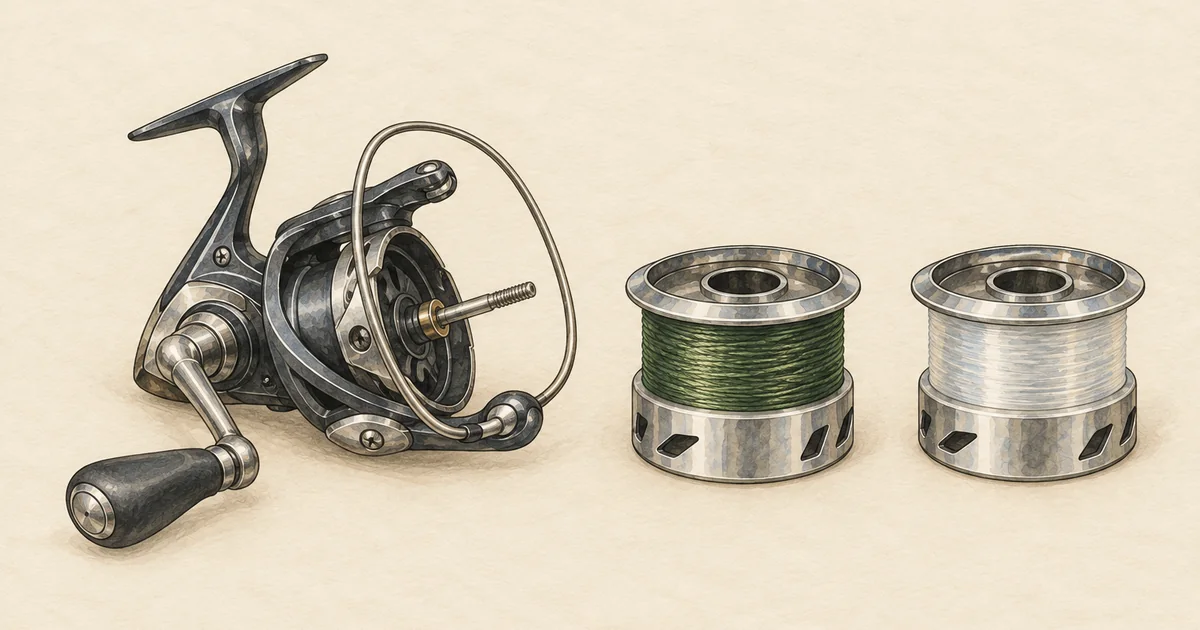
The second purpose is as a reserve. Fisch & Fang advises cutting off a knot that can no longer be undone, because every knot is a planned break point. If too much line is lost in the process, it no longer sits close under the spool rim, and that costs casting distance. With a spare spool carrying the same line, you simply carry on fishing.
What has to fit when you buy
According to Blinker, the size markings on fixed-spool reels differ from maker to maker. A 3000 from one is therefore not necessarily as large as a 3000 from another, and the size number alone does not tell you whether a spool fits your reel.
The spool usually shows the line capacity, for example „200 m/0,20 mm“. It tells you how many metres of line of that diameter fit on it. This figure should be checked in addition to the size. Aluminium spools are considered more durable than plastic ones.
Shallow and deep spools
Spools differ in shape. A long, shallow spool is called a long-cast spool. It offers the line less resistance at the spool lip during the cast, so the bait flies further. Surf and carp reels and some spinning reels usually have particularly shallow spools.
A deep spool holds a lot of line. Many reels take far more line than you need. With braid, a cheap monofilament underlay, the backing, therefore fills the lower part of the spool. It also stops the smooth braid slipping on the spool core. 5 to 10 m is usually enough; with a deep spool it can be up to 100 m of monofilament according to Blinker, depending on fish size and the diameter of the braid. How much backing and how much braid fit on your spool is worked out in the line calculator.
Changing the spool step by step
- Take off the lure or rig and pull the line out of the rod rings.
- On a reel with a front drag, the drag knob sits at the front of the spool. Unscrew it completely and you can pull the spool off.
- With a rear drag, the adjusting screw sits at the back of the body. How the spool is released there depends on the design and is described in the manual of your reel.
- Secure the line end of the removed spool so that it does not unwind, and store the spool somewhere dark and dry.
- Slide the new spool onto the axle until it seats fully and screw the drag knob back on.
- Thread the line through all the rod rings and tie the rig again.
- Set the drag again to suit the breaking strain of the new line.
The drag setting is gone: On a front drag, the drag knob sits at the front of the spool. Anyone who unscrews it to change the spool has also lost the drag setting. The teaching material on tackle from the Fischereiverein Löningen requires the line drag to be set before the first cast to suit the breaking strain of the line. After every change that means: set it again, as described under Setting the reel drag.
Labelling and storing
You can tell braid from monofilament on the spool at a glance, but not a 0,25 from a 0,30 monofilament. So write on a label on the spool the line type, the diameter or breaking strain and the date you spooled it. The date shows you how old the line is. When a line has to be replaced depends on use: modern monofilament lasts a very long time if the line roller and the rod rings are intact, and whether it is damaged can be checked (see below).
For storage the rule is: dark, cool and dry. Fishing lines are made of plastic and endangered by UV light, says the Löninger material. Constant UV exposure makes monofilament brittle and costs breaking strain. The advice: pack reels with monofilament light-tight after fishing, for example in a dark linen or leather pouch.
Before you use a spool that has been stored for a long time, a test helps with monofilament: run the line through a cotton-wool pad. If fibres snag, it is damaged and should be replaced. Freshly spooled monofilament needs at least 24 hours to adapt to the smaller spool. So fill the spare spool the day before. How to do that without twist is shown under Spooling a reel correctly.
Common mistakes
- Buying by size number. The size number alone does not tell you whether the spool fits, because manufacturers state sizes differently in part.
- Not setting the drag after the change. On a front drag the old setting is gone once the knob is unscrewed, and the new line usually carries differently.
- Fishing freshly spooled monofilament straight away. The result is wind knots and twist, because the line still has the shape of the large supply spool.
- Leaving the spare spool half empty. If the line lies far below the rim, it rubs on the lip during the cast. It should be filled to 1 to 2 mm from the spool rim.
- Storing spools without a label and uncovered. Then you do not know at the water what is on the spool, and light damages the line.
Frequently asked questions
Does the spool of another reel of the same size fit?
You cannot rely on it, because the size markings differ from maker to maker. Try the spool on your reel before you fill it.
Are there spare spools for baitcasters too?
On a baitcaster the spool turns itself when you wind in and is mounted on both sides. Whether and how it can be swapped is described in the manual of your reel.
How full should the spare spool be?
Just as full as the main spool, that is, to just below the front rim. If it is too full, wind knots often form during the cast. If it is too empty, the line rubs on the lip. You work out the length for your spool in the line calculator.
Related
- Fixed-spool reel: construction, sizes and drags of the reel the spare spool belongs to
- Spooling a reel correctly: unwinding direction, tension and fill level when spooling
- Setting the reel drag: starting value with a spring balance after changing the spool
- Braided line and monofilament line: the two usual fills in detail
- Line calculator: line length, backing and breaking strain after the knot
- Arbor knot: how the line holds on the spool core
- Float fishing: what the spool with monofilament is meant for
Sources
- Blinker: Angelrolle: Mehr als nur ein Schnurspeicher (stehende Spule, Front- und Heckbremse, Größenangaben je nach Hersteller, Schnurfassung, Weitwurfspule, Aluminium und Kunststoff, Füllhöhe 1 bis 2 mm)
- Blinker: Angelschnur aufspulen: Kein Drall, keine Probleme (5 bis 10 m Unterlage, bei tiefer Spule bis 100 m) und Blinker: Geflochtene Angelschnur im Test (Angabe „200 m/0,20 mm“ auf der Spule)
- Blinker: Richtiger Umgang mit monofiler Schnur (24 Stunden Ruhe nach dem Aufspulen, UV macht spröde) und Blinker: Haltbarkeits-Datum (dunkler Beutel, Wattebausch-Probe)
- Fischereiverein Löningen: Zusammenfassung Gerätekunde (PDF) (Bremse auf die Tragkraft der Schnur einstellen, Schnüre dunkel aufbewahren)
- Rute & Rolle: Angel-Basics: Die Bremse (Frontbremse sitzt vorn auf der Spule)
- Fisch & Fang: Das braucht der Allrounder! (Knoten abschneiden, zu leere Spule kostet Wurfweite)
Text AI-assisted, drawing AI-generated. Sources opened and checked in October 2026; no graphics taken from the sources.
All figures are guide values without guarantee. Which spare spool fits your reel and how to change it is stated in the reel maker’s manual.