
Knowledge · Tackle
Spooling a reel correctly – without twist
A properly filled spool casts further and forms fewer birds‘ nests, that is a tangle of line in the cast. Three things count when spooling a fishing reel: the right direction of unwinding against twist, even tension and the right fill level. Here are the steps for the fixed-spool reel, plus the special points for mono, braid and multiplier reels.
What you need
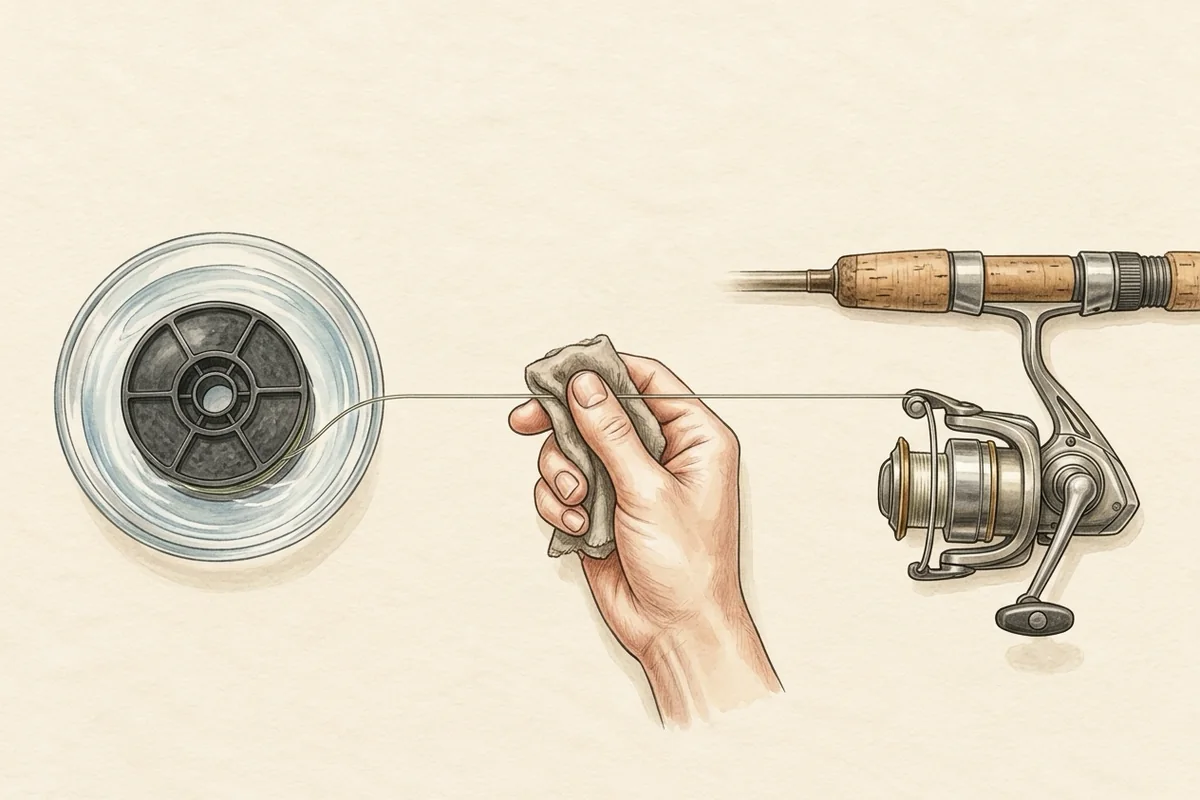
- The reel, firmly mounted on the rod. The butt section of a spigot rod is enough.
- The new line on the supply spool, and for braid additionally mono as backing.
- A pin or wooden spoon on which the supply spool turns freely, or a second person. If you spool on your own, a spooling aid with adjustable resistance helps; more on this below under Accessories.
- A cloth or two fingers to keep tension, and for mono an additional bucket of water.
- A pair of scissors.
How much line and how much backing fit on your spool, you calculate beforehand in the Line calculator. Which type of line is worth it is in the comparison of fishing lines.
Reading the spool print and working out the capacity
On every reel it says how much line fits on the spool. In Germany this is usually a diameter with a length, such as 180 m of 0,25 mm line. Reels for the American and Asian market give instead the breaking strength in lb and the length in yards. A typical line reads 12 lb, 0,32, 320, 350: breaking strength, diameter in millimetres, length in metres, length in yards. You can convert with the unit converter, because 1 lb is around 454 g and 1 yd 91,44 cm.
You do not get far with lb values alone. Monofilament lines of the same diameter can carry very differently, so the lb figures cannot be cleanly translated into millimetres. With braid a PE number is often given as well: PE 0,2 corresponds to a braid of about 0,08 mm, PE 1 about 0,165 mm and PE 6 about 0,40 mm. Braided lines sold in Germany only rarely carry the number; you will find conversion tables under the keyword PE rating.
The capacity figure can be converted to other diameters because the cross-sectional area is what matters: the matching length grows with the square of the diameter ratio. As a formula: new length = printed length × (printed diameter ÷ new diameter)². AngelWoche works this out for a spool that holds 150 m of 0,30 mm line.
| Line | matching length | Calculation |
|---|---|---|
| 0,40 mm | around 84 m | 150 × (0,30 ÷ 0,40)² |
| 0,30 mm | 150 m | Print on the spool |
| 0,13 mm | around 799 m | 150 × (0,30 ÷ 0,13)² |
For braid on backing you calculate in two steps. Example: the spool holds 150 m at 0,30 mm, and you want to spool 130 m of braid of 0,13 mm. The braid takes up 130 × 0,13² ≈ 2,2, the whole spool holds 150 × 0,30² = 13,5. That leaves 11,3 for the backing. At 0,30 mm monofilament that is 11,3 ÷ 0,30² ≈ 126 m, at 0,25 mm about 181 m. It remains an approximation: the print applies to monofilament, and the diameter on the braid packaging often differs from the measurement according to a Blinker test. Measure it yourself and enter it in the line calculator.
As a check when spooling, counting the turns of the handle helps: if you know the line retrieve per turn, you can estimate the length spooled even without a counter. For spinning in fresh water, 100 to 150 m of braid is usually enough, with the backing taking care of the rest. You cannot do entirely without a reserve: according to the Saxony-Anhalt exam catalogue, a reel with too small a capacity does not take enough strong line for large predatory fish.
Line twist: where it comes from
Wherever line rotates, twist arises, and it can never be avoided entirely. But you can keep it small, which also benefits the durability of the line. The Saxony-Anhalt exam catalogue explains it with lures that rotate and hang on the line without a swivel. A swivel does not prevent the twist completely but delays it.
When spooling a second source comes in, the supply spool. If it lies flat on the floor and the line pulls off sideways, the line can run off in the wrong direction and twist. If the spool turns freely on a spindle, however, the line unrolls without twist. The picture shows both ways.
Spooling a fishing reel in six steps
- Thread the line through the bottom ring. Open the bail arm, pull the line through the ring of the rod. That way it runs onto the reel from the front. Without the ring you would always have to hold the reel facing the spool so the line does not catch on the line roller. Later that is no longer possible, so do it first.
- Attach the line to the spool. A knot such as the spool knot or the uni knot holds even when a fish pulls all the line off the reel. Sticky tape does not hold in that case.
- Let the supply spool unwind freely. Put it on a pin, a wooden spoon or a ground spike, or have a second person hold it. If you lay it flat on the ground and wind over it, the line comes off sideways. The spool lifts slightly and rolls away, and the line can also come off in the wrong direction and twist.
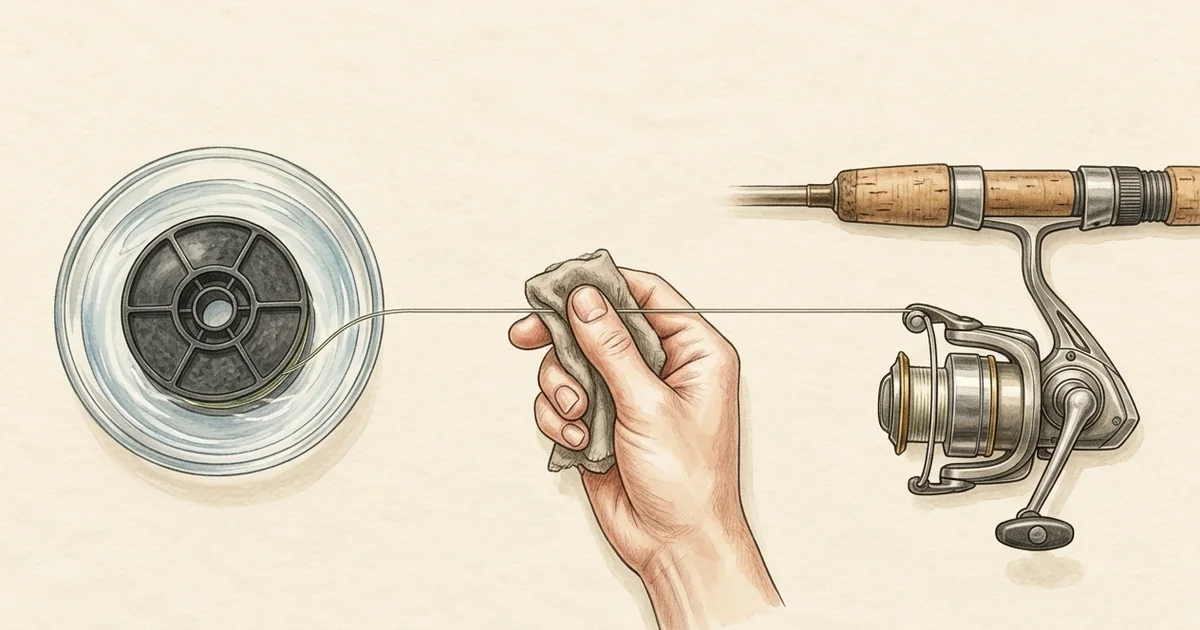
- Wind on under tension. Let the line slide through a cloth as you wind, or press it with thumb and forefinger. Line wound on too loosely later cuts into the lower layers or comes off unevenly.
- Wind slowly and watch how it lays. High speed promotes twist. If the spool fills unevenly or the line bulges, you stop and realign it.
- Check the fill level. The line ends about 1 to 2 mm short of the spool rim.
Two things help at every step. First, the speed: anyone who winds slowly gets less twist. Second, the friction that you create deliberately: do not pull the line through a clamped book or the like, as this creates a lot of friction and heat that can weaken the line. A cloth or a spooling aid with adjustable resistance brakes more gently.
Checking the fill level
You fill the spool of a fixed-spool reel to about 1 to 2 mm below the rim, see Figure 1. If there is less line on it, it rubs on the spool edge on the cast and casting distance falls. If there is more, the line jumps off in loops and tangles into a bird’s nest. Modern spools often take far more line than you need. Then you bring the spool to the right height with backing instead of leaving it empty.
The fill level also changes over the season. Every break-off and every knot cut off shortens the line. If it becomes so short that the spool is no longer well filled, the reel casts worse, and with a big fish the line can run out.
Monofilament line: water and waiting time
Monofilament line is comparatively stretchy and twists quickly when spooled wrongly. A proven method is spooling from a bucket of water: the supply spool lies completely in the water, which brakes it slightly and helps to relax the line. You hold the line between two fingers under light tension and wind slowly. If the line visibly twists, it can help to turn the supply spool over in the bucket.
After that the line needs time. If it comes from a large supply spool onto a small reel spool, it first keeps the shape of the large spool (memory effect). Blinker recommends giving it at least 24 hours to adjust. If you fish straight away, you risk birds‘ nests and twist. So spool a spare spool the day before, see Spare spool.
Braided line: slipping, backing and tension
Braid is very smooth and stretch-free. Without backing the whole fill can turn on the spool core under load, a disaster in the fight. Some reels have a rubber lip on the spool to prevent slipping. Otherwise monofilament goes onto the spool first as backing. As a guide 5 to 10 m is enough; with a deep spool it can be up to 100 m, depending on fish size and diameter of the braid. Even if you need several hundred metres of braid, you spool a few turns of monofilament underneath. You join the two lines with a slim knot, such as the double uni knot, the Albright knot or the FG knot.
Braid has to be spooled markedly tighter than monofilament. If it lies too loose, it cuts into the lower layers under load and no longer peels off, and break-offs and wind knots are the result. It should run off the supply spool, not jump off. Ideal is a second person who holds the spool with a cloth and applies even pressure. As a makeshift, braid is sometimes fixed to the spool core with tape to save backing, especially with shallow spools. Against a fish that takes all the line, according to Rute & Rolle tape does not hold.
Sizing the backing correctly: you work out the amount of backing and braid in the line calculator. With braided line, according to the braid test, the diameter figures on the packaging often differ from the measurement, while the breaking strength figure is more likely to be right. Anyone who wants to calculate precisely therefore measures the diameter themselves.
Multiplier reel and baitcaster
On multiplier reels and baitcasters the spool turns by itself during the cast, so every irregularity has an immediate effect. The line is spooled under constantly high tension, best with a cloth or spooling aid. With braid, a mono backing goes underneath here too. Lay the line on centrally and evenly so that no humps or hollows form. Such faults can later lead to backlashes, that is birds‘ nests in the cast. More on these reels is under Baitcaster and multiplier reel.
Changing line: when and how
The sources checked give no fixed deadline, but three occasions. First, too little line is left because of break-offs. Second, the line is damaged over a longer stretch. Third, it has been on the spool for many years: line loses breaking strength over time, and after some years the losses can be considerable, even if it was hardly fished. Many anglers therefore change before the season.
You do not cut the old line off the spool with a knife, as that can damage the spool. It is better to spool it off, for example with a cordless screwdriver. Dispose of it properly and cut it into short pieces so that birds and other animals do not get caught in it.
Accessories: line spooler and line care
Line spooler
If you buy a reel and line together in a tackle shop, according to Rute & Rolle the line is usually spooled on by machine straight away. For changing line at home there are small spooling devices, usually sold as spooling aids. They replace the second person: they hold the supply spool so that it can turn and brake it evenly. Constant tension lays the line evenly and tightly on the reel spool.
Figure 4 shows a common design that Blinker describes. The supply spool sits on an axle by its centre hole. Two conical, i.e. cone-shaped, rings press into the hole from both sides and so adapt to different hole diameters. A locking screw with a spring presses the rings against the spool. According to Blinker, how tightly you turn it determines the unwinding resistance and therefore how firmly the line goes onto the reel. The devices differ in how they are attached:
- Suction cup: holds on smooth surfaces such as a door, window or piece of furniture.
- Clamp: is clamped to the rod blank, so the supply spool sits on the rod itself.
- Spool and reel holder in one device: here the reel is clamped in as well, so you do not need a rod section with a ring.
How to set up a device with a suction cup or clamp:
- Attach the device firmly; the reel sits on the rod and the line runs through the lowest ring.
- Put the supply spool on the axle and push the two cone rings into the centre hole from left and right. The spool now turns as well, and the line rolls off instead of pulling off sideways, as in Figure 2 above.
- Tighten the locking screw until the spool only turns against noticeable resistance. Braid needs more tension than monofilament.
- Check the winding after the first few metres. If the line lies loosely, tighten the screw a little more.
Line grease and line care products
Line care products have two different jobs. Line grease is meant to keep the line on the surface. When trotting, i.e. fishing with a float that drifts downstream with the current, the line has to float. According to Blinker, you rub line grease into the line as needed over the metres directly behind the float, i.e. towards the rod. More on the method under float fishing and match rod.
The specialist articles mention water-repellent sprays and greases mainly for winter. According to Blinker, frozen line and iced-up rod rings cost casting distance. The same article advises large rings, given a little silicone spray when needed; then you can still fish properly even at minus 5 degrees. For braid in light frost, a Blinker article on zander fishing recommends spraying the line itself with silicone spray. A third article names Vaseline, silicone spray and alcohol-based care spray as products that make the line water-repellent.
Some braided lines are coated at the factory, for example with PTFE or silicone. In the Blinker line test their surface can seem smoother as a result and takes up less water and dirt, but often feels wirier and stiffer. The coating does not noticeably raise the breaking strain, and on its own it is not a mark of quality. With fly line, the coating is an integral part of the line. If it becomes cracked and brittle, friction increases when casting. Fly line care products clean it and refresh the coating. The reel itself has its own rules, see Cleaning a fishing reel.
Casting distance and spray: Friction at the spool lip and the rod rings costs distance, as Blinker describes when comparing monofilament and braid. The sources checked do not show that a spray casts measurably further in dry, mild weather. What is documented is the benefit in frost, when ice on line and rings shortens the casts. Regardless of that, an underfilled spool costs distance, see fill level.
Common mistakes when spooling
| Fault | Cause | Remedy |
|---|---|---|
| Line jumps off in big loops | Spool too full | fill to 1 to 2 mm below the rim |
| casting distance falls, line rubs on the edge | Spool too empty | add backing, see calculation |
| Line coils, bird’s nests on the cast | twist from unwinding off a flat spool, too high a speed or no resting time with monofilament | let the spool turn freely, wind slowly, wait 24 hours |
| Braid cuts in and does not peel off | winding too loose | spool tighter, cloth or spooling aid |
| Braid turns on the spool core | smooth line without backing | put monofilament underneath or use a rubber lip |
- Wrong knot on the spool: tape does not hold when a fish takes all the line. Use the arbor knot.
- Forgot the guide: the line belongs through the bottom guide before spooling; later that is no longer possible.
Frequently asked questions
Can I spool on my own?
Yes. With a spooling aid that holds the supply spool with adjustable resistance, it works on your own. Otherwise you put the spool on a pin and brake the line with a cloth or your fingers.
Can I wind braid straight onto the empty spool?
Better not. Smooth braid can slip on the spool core under load. A mono backing gives grip, usually 5 to 10 m is enough.
How long must freshly spooled mono rest?
At least 24 hours, so that the line adjusts to the smaller spool. Otherwise it twists and forms birds‘ nests more easily.
When should I change the line?
When break-offs have made it too short, when it is damaged over a longer stretch or when it has been on the spool for years. By then the breaking strength has dropped markedly, even with little use.
How do I work out how much backing I need?
Calculate length times diameter squared for the whole spool and for the braid, subtract one from the other and divide the remainder by the square of the backing diameter. The line calculator does this for you.
Related
- Spare spool: a second line, spooled and labelled
- Setting the reel drag: starting value after spooling
- Fishing line compared: monofilament, braid or fluorocarbon
- Braided line and monofilament line: properties in detail
- Fixed-spool reel: construction, size and gear ratio
- Arbor knot: how the line holds on the spool core
- Line calculator: calculate line capacity and backing
- Unit converter: lb, yd and PE figures on the spool rim
Sources
- Rute & Rolle: Die richtige Rollenmontage (Rolle an der Rute, Ring, Spulenknoten, Spannung, langsam kurbeln, Füllstand, maschinelles Aufspulen im Handel, Aufspulhilfe mit Saugnapf)
- Blinker: Angelschnur aufspulen, kein Drall, keine Probleme (Wasser, Unterfütterung, Geflecht, Multirolle, Füllhöhe)
- Blinker: Wie lassen sich Rollen am besten bespulen? (unterster Ring, Vorratsspule am Boden, Aufspulhilfen mit Achse, konischen Ringen und Feststellschraube, Bauformen, drallfreier Ablauf)
- Blinker: Angelrolle, mehr als nur ein Schnurspeicher (Füllhöhe 1 bis 2 mm, Perücken bei zu viel Schnur, Schnurfassung)
- Blinker: Geflochtene Angelschnur im Test (Durchmesser und Tragkraft von Geflecht, Beschichtung der Oberfläche)
- Blinker: Richtiger Umgang mit monofiler Schnur (Memory-Effekt, 24 Stunden Ruhe)
- Blinker: Alles neu, mit frischer Schnur in die Saison (Wechselgründe, Unterfütterung, Rechenbeispiel, Entsorgung, Spannung)
- Blinker: Wie viel Schnur passt auf eine Angelrolle? (Spulenaufdruck, lb, Yards, PE-Nummern)
- Blinker: Schnurdrall vermeiden (Entstehung von Drall, Wirbel)
- Land Sachsen-Anhalt: Fragenkatalog zur Fischerprüfung (Export) (Ursache Schnurdrall, Rollen mit kleiner Schnurfassung)
- Blinker: Einfach treiben lassen, Trotting am Fluss (Schnurfett für eine schwimmende Schnur)
- Blinker: Raubfische im Winter (vereiste Schnur und Ringe kosten Wurfweite, Silikonspray an großen Ringen)
- Blinker: Zanderangeln im Winter, 10 Tipps (Silikonspray für Geflecht bei Frost)
- Blinker: Die besten Hechtköder im Winter (Mittel gegen gefrierende Schnur)
- Blinker: Fliegenschnur, was bedeuten diese Begriffe (Coating, Reibung beim Werfen, Pflegemittel)
- Blinker: Karpfenangeln, das bringt dir geflochtene Schnur (Reibung an Spulenkante und Ringen kostet Wurfweite)
- Hessisches Landwirtschaftsministerium: Fragenkatalog zur Fischerprüfung (PDF) (Begriff Perücke)
- Wikipedia: Fishing reel (Abschnitt Spooling, gleichmäßige Spannung, ergänzend)
Text AI-assisted, drawings AI-generated. Sources opened and checked in November 2026, no graphics taken from the sources.
All figures are guide values without guarantee. Also follow the reel manufacturer’s instructions.