
Knowledge · Tackle
Cleaning and caring for a fishing reel: Step by step
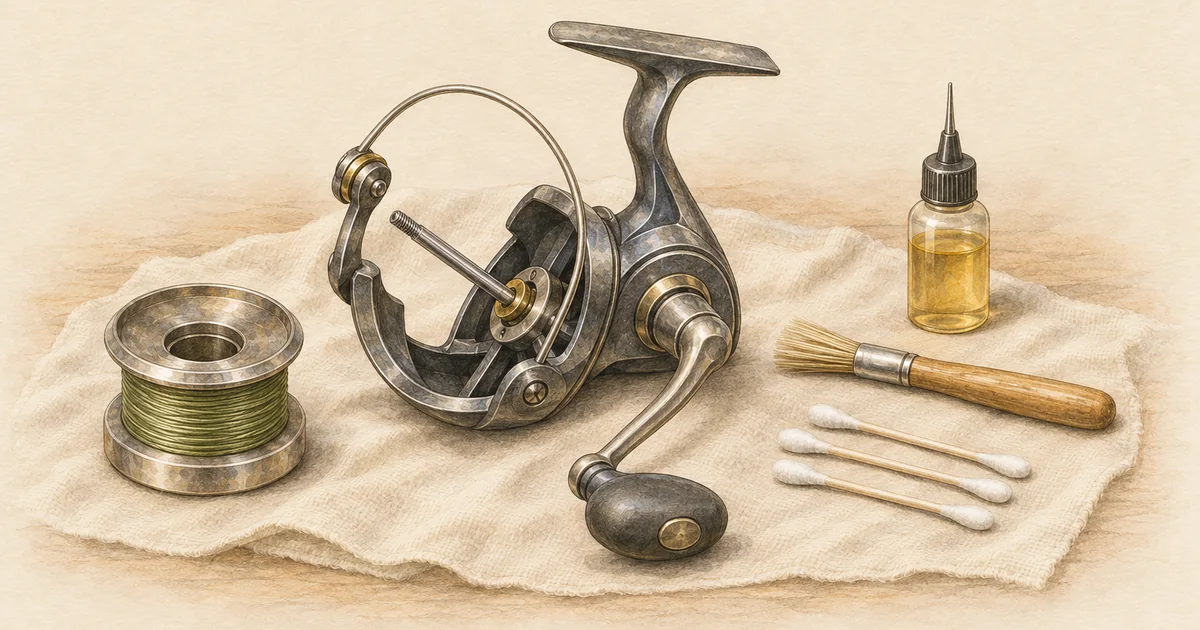
To clean a fishing reel is above all to get rid of salt and dirt without forcing water inside, and to grease the right places instead of oiling them. Here you will find the routine after a day’s fishing, a basic clean of the fixed-spool reel step by step, where to stop when taking it apart, and storage over the winter.
After every day’s fishing
Drying the reel and putting it in the cellar is only the start. That is the view of a care article in Blinker in which a reel servicing specialist has his say. Two simple jobs belong to every day’s fishing, in fresh water too: dry the reel and slacken the drag. The pressure on the drag washers should come off after every outing, not just at the end of the season, so that they wear less.
After salt water
By the sea, rinsing comes on top, after every outing, not just at the end of your holiday. Before that, you tighten the drag and screw the handle in firmly. Then you hold the reel upright and give it a short shower of fresh water at low pressure. A damp cloth is not enough: salt sitting behind covers stays there, and the body halves corrode. How strongly salt attacks metal is explained in Spektrum’s Lexikon der Chemie. Chloride ions, as dissolved in seawater, trigger local corrosion, pitting, with holes as fine as pinpricks. Chromium steels can be affected, but so can aluminium.
On the water temperature, the sources differ. The Blinker article says cold water, the British magazine Sea Angler warm soapy water. They agree that the reel is dried afterwards: according to Sea Angler, even expensive tackle corrodes if it lies salty and wet in damp air. A reel bag with a salt crust also encourages corrosion. According to a Blinker holiday guide, you also rinse hooks and lures from salt water with fresh water and let them dry.
Do not submerge it: no reel is completely sealed. If it lies in a bucket, Blinker says, negative pressure can draw water inside, speed up wear and upset the anti-reverse. Every rinse also carries lubricant out of the bearings and gearbox over time. That makes regular servicing all the more important.
Grease or oil: which part gets what
On lubrication, the servicing specialist in the Blinker article is clear: gear parts never get oil, not in baitcasters and multiplier reels either. Oil is too thin to protect meshing parts from wear in the long run; for that there are greases that suit the reel and how it is used. Before new grease goes into the gearbox, all parts are cleaned so that different lubricants do not mix.
Some reels have a service port through which the gearbox is supposed to be oiled. The specialist strongly advises against this. The port sits at the worm shaft and not above the important gears. The ball bearings stay oil-free too. They are filled with a set amount of grease at the factory; oil thins this grease, and the bearing starts to grind under load. The only exception is the spool bearings; more on that below under the baitcaster.
| Where | Care | Not |
|---|---|---|
| Gearbox | regrease after cleaning | oil, not even through the service port |
| Ball bearings | greased at the factory, leave alone | oil, except on spool bearings |
| Handle thread | clean, then grease lightly | screw in while dirty |
| Drag washers | clean, grease very thinly on both sides | oil |
Rute & Rolle warns that oil on the washers takes away the friction and with it the braking effect. Blinker advises cleaning felt washers in particular and regreasing them very thinly, because felt loses braking force over time. Which washers are cleaned how, and how you then reset the drag, is explained under Setting the reel drag.
The line roller
At the small wheel at the end of the bail arm, Blinker says, the line is turned through 90 degrees before it runs onto the spool. Blinker considers a ball bearing in the roller worthwhile. Without one, thin line quickly twists, according to a Blinker article on reels for the trout lake. Where else twist comes from is explained under Fixed-spool reel.
You often read the advice to oil the bearing in the roller regularly. The servicing specialist sees exactly that as the cause of many grinding bearings, because the oil thins the bearing grease. Rinse the roller along with the rest after salt water and let it dry. If it still grinds, Blinker says new grease rarely helps; usually the bearing has to be replaced.
Basic clean of the fixed-spool reel in six steps
For this, the body stays closed. You need a dry cloth, cleaning alcohol and a grease that your manufacturer specifies for the reel.
- Take off the spool. According to tackle studies (Gerätekunde), it sits on a push button or a screw cap. With a front drag, the drag washers are inside the spool. According to a presentation by the Landesfischereiverband Baden-Württemberg, it is easier to clean than a rear drag.
- Clean the drag washers. Lay them out in their order. Wipe felt with a dry cloth, carbon with cleaning alcohol. Then grease them only very lightly on both sides.
- Unscrew the handle. With handles that screw directly into the main gear, dirt collects in the thread. If the handle is screwed back in like that, the thread can suffer and play develops between handle and gear. Clean it and grease it thinly.
- Wipe the outside. Clean the rotor, bail arm, roller and body with the cloth; after the sea, shower them off first as described above.
- Reassemble. Put the washers back in the same order, fit the spool, screw the handle in firmly, leave the drag slack.
- Check before your next session. Set the drag to the target value and do a pull test; more on this further down.
When the body stays closed
According to the specialist, a thorough service means taking the reel completely apart, cleaning it deeply, checking worn parts, adjusting and relubricating. Depending on use, he recommends this once a year to every eighteen months. His workshop offers such services itself. If you open the body yourself, do so only with the exploded diagram of your model. It shows the reel taken apart into its individual parts, makes their position relative to each other visible and gives the part numbers for spares. Without this diagram, leave the gearbox closed.
Baitcaster and multiplier reel
Here too, the gearbox stays free of oil. The spool of the baitcaster runs in ball bearings that, according to a Blinker article, need a drop of oil now and then, and the level wind needs a little grease regularly. As a rule of thumb, the article says: if you fish two to three times a week, relubricate every two to four months and open the reel once a year to clean and regrease it inside. The care article, by contrast, names grease for the spool bearings. What applies to your reel is in its manual. Not every baitcaster is built for salt water.
Storage over the winter
Before the break, the reel is put away clean and dry, and after the sea only once it has been rinsed. The drag stays slackened over the winter, which takes the strain off the components. You should also wash the reel bag if it has caught salt.
How line is stored and when it should be replaced is explained under Fishing lines compared and Spooling a reel correctly. The line calculator works out how much new line and backing fit on the spool.
Before your first day’s fishing in spring, you check all your tackle. The question catalogue for the angling exam (Fischerprüfung) in Bavaria names the pull test as the most important check before you start fishing; it tests the strength of the whole rig. You reset the drag at the same time, because it was slackened over the winter. According to the catalogue from Saxony-Anhalt, you check the rod rings regularly for worn-in grooves and cracks.
Accessories around the reel
Line clip
The small clip on the rim of the spool has two jobs. In feeder fishing and float fishing with balls of groundbait it fixes the casting distance. When the rig is lying correctly on the baited area, pick a point on the far bank, such as a tree, and put the line behind the clip in that position. After that you cast slightly beyond the spot each time. The line only runs out as far as the clip, the rig is braked in the air and drops where it lay before. According to Blinker, casts made this way scatter only a little to the side even at distances of more than 50 m. For the feeder reel, Fisch & Fang recommends a clip that is gentle on the line.
Cast with feel, though. If the clip stops the rig at full force, it springs back a few metres and lands short of the spot. With heavy feeders or fixed leads, the hard stop can even break the line. In the fight, clipped-up line cannot give. With silver fish Blinker sees hardly any danger in this, but with carp making long runs a break-off threatens. That is why there are also soft rubber clips that release under strong pull. If you take the line out of the clip for a bigger fish, a mark helps you find the distance again: a Blinker article on fishing with the swingtip suggests about 10 cm at the level of the clip, drawn with a line marker or waterproof pen. How to measure the distance beforehand is covered under Plummet.
The clip’s second job is in transport: if the end of the line is tucked behind it, no line slips off the spool. According to another Blinker article it is usually unsuitable for thick monofilament line, and mono also gets kinks in it. Then a rubber band around the spool holds the line in place, also on a loaded spare spool or when a shock leader is already tied on.
Reel bag and protection in transport
In a travel case the reel should be protected from knocks. A Blinker guide to air travel considers the original box well suited for this; a towel around the reel will also do. According to the tackle guide of the Fischereiverein Löningen, the handle of a fixed-spool reel can be folded in for transport. After sea fishing the same applies to the reel bag as to the reel: salt residue in it promotes corrosion, so wash it out and let it dry. What to bear in mind by car, train and plane is covered under Rod transport.
Spare handle and bail arm
According to the same tackle guide, the handle of a fixed-spool reel can be fitted on the left or the right. A Blinker guide for beginners adds that this switch is technically not possible on multiplier reels: there you commit to left- or right-hand wind when you buy. Handles screwed directly into the main gear fall off more often, according to the servicing expert. If a handle is missing or the bail arm is bent, the exploded diagram of your model (above under “When the housing stays shut”) helps identify the part, because it gives the part numbers of the components. Before a new handle goes into the housing, clean the thread as in step 3 above.
Close the bail arm by hand after the cast. If you let it flip over with a turn of the handle, in the expert’s experience you can damage parts under the rotor in the long run. If something breaks off, it can lodge between rotor and housing. The question catalogue for the angling exam in Bavaria includes as exam material that the open bail arm should not spring back when casting.
Reel grease and reel oil
Grease and oil from the care kit belong in different places; the table above assigns them. On oil, the sources contradict each other. A beginner’s guide in Blinker considers a little reel oil on the moving parts sensible after a while, but does not name these parts. The servicing expert rules out oil on the gearbox and ball bearings and names grease for the spool bearings, and Rute & Rolle warns against oil on the drag washers. According to the expert, good lubricants contain corrosion protection and additives that repel water. Which oil may go on which external part is stated in the manual of your reel.
Common mistakes
- Submerging the reel to rinse it. Negative pressure draws water inside.
- Oiling the gearbox through the service port. Oil does not protect gears for long; they need grease.
- Oiling the bearing in the line roller. According to Blinker, the oil thins the bearing grease and the bearing grinds.
- Putting oil on the drag washers. The drag loses its friction.
- Storing it with the drag screwed down tight. The pressure wears the washers faster.
Frequently asked questions
How often do I need to clean my reel?
Rinse and dry it after every session in salt water, and slacken the drag after every day’s fishing. A specialist in Blinker recommends a service with dismantling once a year to every eighteen months, depending on use.
Why does my reel grind after oiling?
Blinker names a common cause: oil has thinned the grease in a ball bearing, which no longer lubricates the balls properly. New grease rarely helps; usually the bearing has to be replaced.
Can I take the reel apart myself?
You can remove and clean the spool, drag washers and handle. Only open the body if you have the exploded diagram of your model and the right grease. Otherwise leave it to a workshop.
Can the line break at the line clip?
Yes, if the clip brakes a heavy feeder hard on the cast or a strong fish such as a carp wants to take line. When fishing for silver fish, the risk is low according to Blinker. Soft rubber clips release the line under strong pull.
Related
- Fixed-spool reel: design, roller and twist
- Fishing reels: types and suitability for salt water
- Setting the reel drag: spring balance and care of the washers
- Baitcaster and multiplier reel: the three brakes of the rotating spool
- Spooling a reel correctly: new line after the winter break
- Monofilament line: ageing and storage
- Line calculator: line capacity, backing and drag value
- Rod transport: rod and reel safely on your travels
Sources
- Blinker: 9 Profitipps zur Rollenpflege (Salzwasser, Fett statt Öl, Kugellager, Bremsscheiben, Kurbelgewinde, Lagerung, Wartung, Bügel von Hand schließen, Schmierstoffe)
- Blinker: Angeln mit der Baitcaster-Rolle (Spulenlager, Schnurführung, Wartung, Salzwasser) und Blinker: Angeln am Mittelmeer (Haken und Köder nach dem Salzwasser)
- Blinker: Angelrolle, mehr als nur ein Schnurspeicher (Umlenkung am Schnurlaufröllchen) und Blinker: Rollen für den Forellensee (Kugellager im Röllchen gegen Drall)
- Rute & Rolle: Bremsmanöver, die richtige Einstellung (kein Öl auf Bremsscheiben)
- Sea Angler: Look After Your Tackle (Salzkorrosion, Seifenwasser, Trocknen, Taschen)
- Spektrum, Lexikon der Chemie: Lochfraßkorrosion (Chlorid-Ionen, betroffene Metalle)
- LfL Bayern: Fragenkatalog Fischerprüfung 2023/2024 (PDF) (Zugprobe vor dem Angeln, Bügel beim Auswerfen) und Land Sachsen-Anhalt: Fragenkatalog zur Fischerprüfung (Export) (Ringe auf Rillen und Risse prüfen)
- Fischereiverein Löningen: Gerätekunde (PDF) (Spulenwechsel per Druckknopf oder Schraube, Kurbel anklappbar und links oder rechts montierbar) und Landesfischereiverband Baden-Württemberg: Präsentation Gerätekunde (PDF) (Frontbremse leichter zu reinigen)
- Blinker: Welche Aufgabe hat der Schnur-Clip an der Rollenspule? (Wurfweite festlegen, Streuung, Abriss, weiche Clips, Transport) und Blinker: Angeln mit Schwingspitze (Schnur am Clip markieren)
- Fisch & Fang: Das brauchen Sie zum Feedern (schnurschonender Clip an der Feederrolle)
- Blinker: Gummiband beim Angeln, 6 praktische Tipps (Clip bei dicker Mono, Gummiband für Spule und Ersatzspule) und Blinker: Mit Angelausrüstung auf Flugreisen (Rolle im Karton oder Handtuch)
- Blinker: Angeln, alles Wichtige für deinen Einstieg (Kurbelwechsel, Multirolle, Rollenöl)
- Wikipedia: Explosionszeichnung (Begriff und Teilenummern, nur ergänzend)
Text AI-assisted, drawing AI-generated. Sources opened and checked in November 2026; no graphics taken from the sources.
All figures are guide values without guarantee. Which lubricants your reel tolerates and whether you should open it is stated in its manufacturer’s manual.