
Knowledge · Tackle
Transporting rods: Car, roof rack, bike, train and plane
If you want to transport rods, each route comes with different rules. In the car, load securing and overhang under § 22 StVO count; on the train, space in the luggage rack; on the plane, sports baggage, rod tubes and the lists for hand luggage and dangerous goods.
Which route, which solution
Whether the rod arrives in one piece depends on its longest section and the means of transport.
| If you travel by … | and the rod is … | then … |
|---|---|---|
| Car | broken down | bag or tube secured in the boot |
| Car | assembled, in daily use | holder inside the car or on the roof |
| Bicycle | short multi-section | directly on the bike |
| Bicycle | two-piece | upright on the rucksack |
| Train | in a bag or tube | space by the seat or in the rack, without endangering anyone |
| Plane | Sections up to about 75 cm | in a sleeve, in the suitcase |
| Plane | longer | in a tube as sports luggage |
Inside the car: stowed firmly, not loose
§ 22 paragraph 1 of the StVO (German road traffic regulations) requires load to be stowed and secured. According to the legal text, even in an emergency stop or a sudden swerve it must not slip, fall over, roll or fall off, and it should not ‘create avoidable noise’. § 23 paragraph 1 adds that whoever is driving is responsible for making sure the load does not impair their view or hearing. So lay your rods down in a way that keeps them where they are when you brake hard and leaves the view to the rear clear.
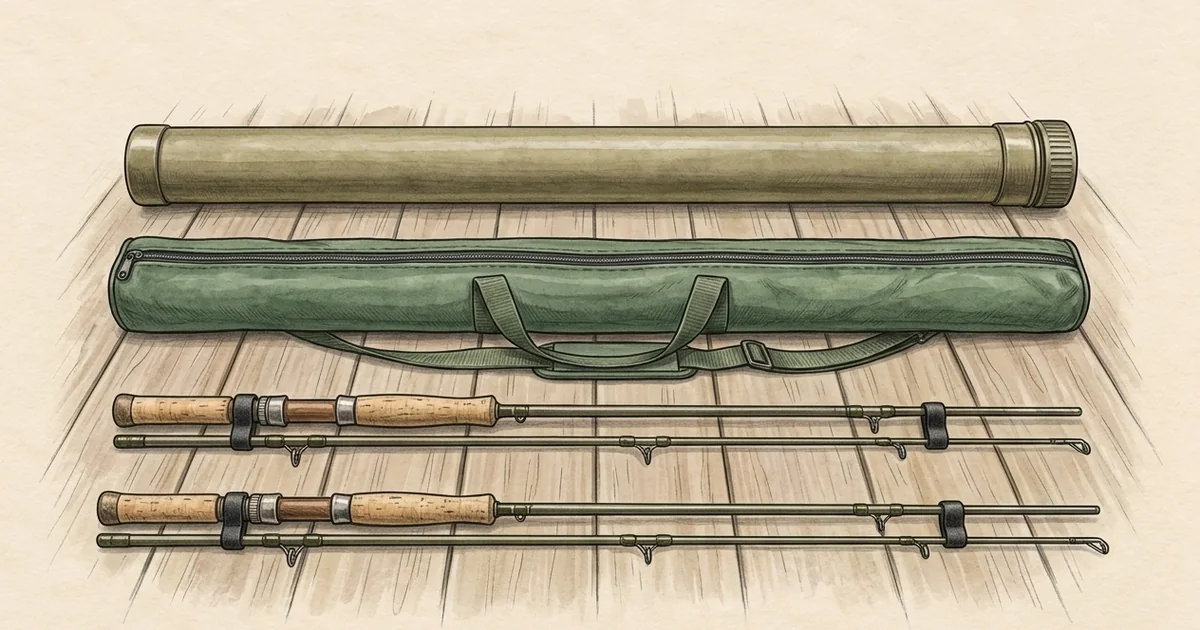
Broken-down rods travel best in a bag or tube in the boot. How long the cover needs to be, and why loose rod sections so often break in doors and tailgates, is explained under Rod bag.
If you change swims every day on holiday, leave the rods made up. Rute & Rolle describes two types of interior rod holder. Strap systems hang under the headlining, held at the back by suction cups on the windows and at the front by the grab handles. Foam rests sit between the headrests.
On the roof: roof load, rack and overhang
Long, made-up rods or a rod tube can also travel on the roof. According to TÜV SÜD, the permitted roof load is not in the vehicle documents but in the owner’s manual, usually between 30 and 100 kg depending on the vehicle. Racks and attachments count towards it: TÜV reckons around 5 kg for the crossbars and around 20 kg for a roof box.
The base rack must suit the vehicle model and belongs only on the fixing points intended for it. TÜV SÜD advises against using racks or accessories without a type marking and recommends checking the rack and load again after the first few kilometres. No information from a testing body could be found on rod holders with magnetic or suction feet placed directly on the bodywork; what counts there is their instructions and § 22 StVO.
With a rack and attachments the car reacts more sensitively to crosswinds, for example behind stretches of woodland and on bridges. According to TÜV SÜD, the StVO sets no maximum speed for driving with a roof box; TÜV SÜD recommends no more than 130 km/h on the motorway. According to TÜV SÜD, the permitted speed for a box is given in its instructions, and it is worth checking the same for a rod holder. Think about the height before entering a multi-storey or underground car park.
Overhang to the front, rear and sides
How far a load may stick out is governed by § 22 StVO in paragraphs 3 to 5. To the front: below a height of 2,50 m, nothing may project beyond the vehicle. To the rear it may project up to 1,50 m, and up to 3 m on a journey of up to 100 km. If the end sticks out more than 1 m beyond the rear reflectors, it must be marked, for example with a light red flag of at least 30 × 30 cm held open by a crossbar. It is fitted no higher than 1,50 m above the road. If lighting is required under § 17, a lamp with red light goes in the same place, plus a red reflector no higher than 90 cm. To the side, paragraph 5 applies: individual poles or posts must not stick out.
Worked example: A made-up 13-ft rod, around 3,96 m according to the Unit converter, lies on a 4,50 m long estate car. The butt end sits 1 m behind the front, so nothing sticks out at the front. At the back the rod ends at 1 m + 3,96 m = 4,96 m, i.e. 46 cm behind the rear, less than the 1,50 m from paragraph 4. For the flag, the distance to the rear reflectors is what counts: if they sit 10 cm in front of the rear end, it is 56 cm, so under 1 m.
Theft in the car park
The Polizeiliche Kriminalprävention (German police crime prevention programme) advises against leaving valuables visible in the car, as they are usually not insured. The boot is not a store either: when staying overnight on a trip, all luggage should come out. Rods in a holder under the headlining can be seen by anyone from outside, so at the holiday home they come inside with you.
On the roof, the rack is an added risk. According to the leaflet, thieves take unsecured sports equipment off the roof rack and sometimes remove an unlocked rack altogether. The police recommend a security lock on every fixing point.
By bike: short sections, strapped tight
Rod and landing net are the bulkiest items when cycling, writes Blinker. Travel rods with short sections and telescopic rods work well, and very short travel rods often fit directly on the bike. Two-piece rods, long landing-net handles and rod rests are harder. They travel upright on a rucksack with side loops, strapped tight with Velcro straps. Heavy items go on the bike so the rucksack stays light.
For cyclists, § 23 paragraph 3 StVO states: ‘Riding without hands is not permitted.’ Plan the transport so that both hands stay on the handlebars. Panniers, trailers and overnight trips are covered under Fishing by bike.
On the train: hand luggage, extra item and luggage racks
On Deutsche Bahn trains, its conditions of carriage apply, here as of 26 October 2026. Under them, you can take easily portable items with you free of charge as hand luggage. There is space above and below your seat and in the luggage racks, and nothing may endanger other passengers or operations. On top of that comes one additional bulky item if there is space in the racks. You have to keep an eye on it yourself. The section gives no fixed length limit for hand luggage or the additional item. What matters is that the tube or rod bag fits at your seat or in a rack without endangering anyone there.
For door-to-door luggage delivery, the conditions only accept suitcases, travel bags, holdalls and rucksacks up to 1,20 m long, 0,60 m wide and high and 31,5 kg. They name fragile items as an example of unsuitable luggage. A rod tube is not one of these types of packaging, and whether a travel rod may go in a suitcase is something you should check with the railway in advance.
If you take a bike on the train, luggage attached to the bike has to come off and go into the racks during the journey, including rods and bags.
Excluded from carriage are, among other things, explosive and flammable substances. Expressly permitted for personal use are, for example, matches and lighters. Gas cartridges for a stove are not on this list, so ask the transport company before a trip with a stove. Batteries outside the device may have no more than 100 Wh. For knives, the conditions refer to the statutory rules; more on this under Angling knife. Other railway companies and transport associations have their own conditions.
On the plane: sports luggage, cabin and dangerous goods
According to Blinker, travel rods with a transport length of up to about 75 cm fit into most suitcases. Longer rods are booked as sports luggage or fishing equipment, and you usually hand the tube in at the oversize baggage counter. How to build and pad a tube is covered under Travel rod. Each airline sets its own baggage rules. For a suitcase, Blinker usually gives 23 kg as the limit, and weights and lures soon add up to a few kilos.
For the cabin, a list from EU Implementing Regulation 2015/1998 applies, published by the Bundespolizei (German Federal Police). Banned there are, among other things, knives and scissors with blades over 6 cm and tools with a blade or shaft over 6 cm that could be used as a weapon. That is why the filleting knife with its long blade travels in the suitcase. The list does not mention line or hooks, but it is worded openly with ‘including’. Blinker advises: reels only without line and lures only without hooks in your hand luggage, pliers with a cutting edge in the suitcase, and the same on the return flight.
The Luftfahrt-Bundesamt (LBA, German Federal Aviation Office) is responsible for dangerous goods. According to its overview, gas-filled camping stoves, gas cartridges, filled fuel containers and lighter gas are not permitted in checked baggage, in hand luggage or on your person. Each person may carry only one ordinary lighter or one small box of matches, carried on the body, for example in a jacket pocket, and not in hand luggage. Both are banned in the suitcase. According to the ICAO table provided by the LBA, power banks belong in hand luggage, no more than two per person, protected against short circuits and not charged on board. Watt-hours and limits are covered under Batteries and power banks.
An automatic lifejacket with a gas cartridge is listed in the same table for checked and hand luggage, but only with the airline’s approval: no more than two lifejackets per person, each with no more than two cartridges and two spare cartridges, packed to prevent accidental inflation.
Before the flight, step by step
- Read the airline’s baggage rules and register the rod tube as sports or special luggage.
- Measure the longest rod section: up to about 75 cm in a sleeve in the suitcase, otherwise into the tube.
- Pack knives, scissors and pliers with a cutting edge in the suitcase.
- If tackle is to go in hand luggage: reels without line, lures without hooks.
- Put power banks and spare batteries in hand luggage, tape over the terminals or put each battery in its own bag.
- Leave gas cartridges and filled fuel containers at home, and carry no more than one lighter on your person.
- Get an automatic lifejacket approved by the airline in advance.
- Sort everything the same way again before the return flight.
Protection for every journey
Covers, tubes and tip protectors are covered under Rod bag. Rod bands hold the sections of a broken-down rod together as a bundle. A practical tip from Blinker: press a soft foam earplug into the open joint. That way no sand gets in on the way, which could later damage the blank, the rod’s load-bearing tube. A piece of line through the earplug helps you pull it out.
Common mistakes
- Rods loose on the back seat or parcel shelf. § 22 StVO requires a load that does not slip even in an emergency stop. A bag, tube or holder keeps the rods in place.
- The rod sticks out over the front of the car. Up to a height of 2,50 m, § 22 paragraph 3 allows no overhang at the front. Slide the rod back in the holder.
- Looking for the roof load in the vehicle registration document. It is in the owner’s manual, and the rack and box count towards it.
- Leaving rods overnight in the car or on an open rack. The police advise taking luggage out when staying overnight and locking every fixing point.
- Knife in hand luggage, gas cartridge in the suitcase. A knife over 6 cm may not go into the cabin, and the cartridge may not go into any flight luggage.
Frequently asked questions
Can I take my rod on the ICE?
Deutsche Bahn’s conditions of carriage give no length limit for hand luggage or an additional bulky item. Both must, however, fit at your seat or in the luggage racks without endangering others. The 1,20 m limit only applies to door-to-door luggage delivery.
Can I take my filleting knife on the plane?
Not into the cabin if the blade is longer than 6 cm. For checked baggage, the EU list only names explosives and incendiaries. The airline may have its own rules, and on the way to the airport the Weapons Act (Waffengesetz) applies, see Angling knife.
How do I take a gas stove on a fishing holiday?
Not on the plane: the LBA bans filled gas stoves and cartridges in all luggage. Gas cartridges are missing from Deutsche Bahn’s list, so ask them in advance. Stoves and fuels by the water are covered under Fishing holiday with tent, motorhome or holiday home.
Related
- Rod bag: sleeve, bag and hard tube in the right length
- Travel rod: transport length, suitcase and building your own rod tube
- Fishing by bike: rods, trailers and panniers
- Fishing holiday with tent, motorhome or holiday home: planning and packing
- Batteries and power banks: watt-hours, charging and flight luggage
- Angling knife: blade, care and what the Weapons Act says
- Line calculator: estimating line strength with a knot
- Unit converter: converting rod lengths from ft to metres
Sources
- Bundesministerium der Justiz: Straßenverkehrs-Ordnung, § 22 Ladung (Sicherung, Überstand nach vorn, hinten und zur Seite, Fahne) und § 23 Sonstige Pflichten (Sicht und Gehör, nicht freihändig Rad fahren)
- TÜV SÜD: Mit Sicherheit mehr Stauraum (Dachlast, Gewicht von Box und Träger, Montage, Seitenwind, Tempo) und Ab Tempo 130 wird es kritisch (Zubehör mit Kennzeichnung, keine Höchstgeschwindigkeit in der StVO)
- Polizeiliche Kriminalprävention: Sicherheit rund ums Fahrzeug (PDF) (Wertsachen, Kofferraum, Diebstahl vom Träger)
- Deutsche Bahn: Beförderungsbedingungen, Stand 26.10.2026 (PDF) (Handgepäck, Traglast, ausgeschlossene Stoffe, Akkus, Messer, Fahrrad, Gepäckversand)
- Bundespolizei: Verbotene Gegenstände (Liste der EU-Durchführungsverordnung 2015/1998 für Handgepäck und aufgegebenes Gepäck)
- Luftfahrt-Bundesamt: Gaskartuschen (gefüllte Campingkocher, Kartuschen und Brennstoffbehälter verboten), Feuerzeuge, Streichhölzer und Gasbrenner (ein Feuerzeug am Körper, nicht im Handgepäck) und ICAO-Bestimmungen Mitnahme Gefahrgüter (PDF) (Powerbanks, Rettungswesten)
- Blinker: Mit Angelausrüstung auf Flugreisen (75 cm, Sportgepäck, 23 kg, Handgepäck, Rückflug), Mit dem Fahrrad zum Fisch (Tele- und Reiseruten) und Bikepacking und Angeln (Ruten am Rad und am Rucksack)
- Blinker: Praxis-Tipp: Schutz beim Rutentransport (Ohrstöpsel gegen Sand), Rute & Rolle: Rutenhalter: Gut gesichert (Bauformen von Haltern im Innenraum)
Text AI-assisted, drawing AI-generated. Sources opened and checked in November 2026; no graphics taken from the sources.
All information is for guidance only and without guarantee. What counts is the current legal text, the conditions of your railway company and the baggage rules of your airline.