
Knowledge · Tackle
Travel rod: Multi-piece for luggage
A travel rod is a multi-piece rod of three to six sections that fits into an ordinary suitcase when taken apart. This page covers how short the sections have to be, what the additional joints do to action and durability and how the rod arrives intact at your holiday destination.
Sections and transport length
A multi-piece rod consists of two or more sections that you plug together when setting up. That is what the question catalogue for the Bavarian angling exam (Fischerprüfung) says. Most are two-piece and still long when taken apart, see Fishing rods.
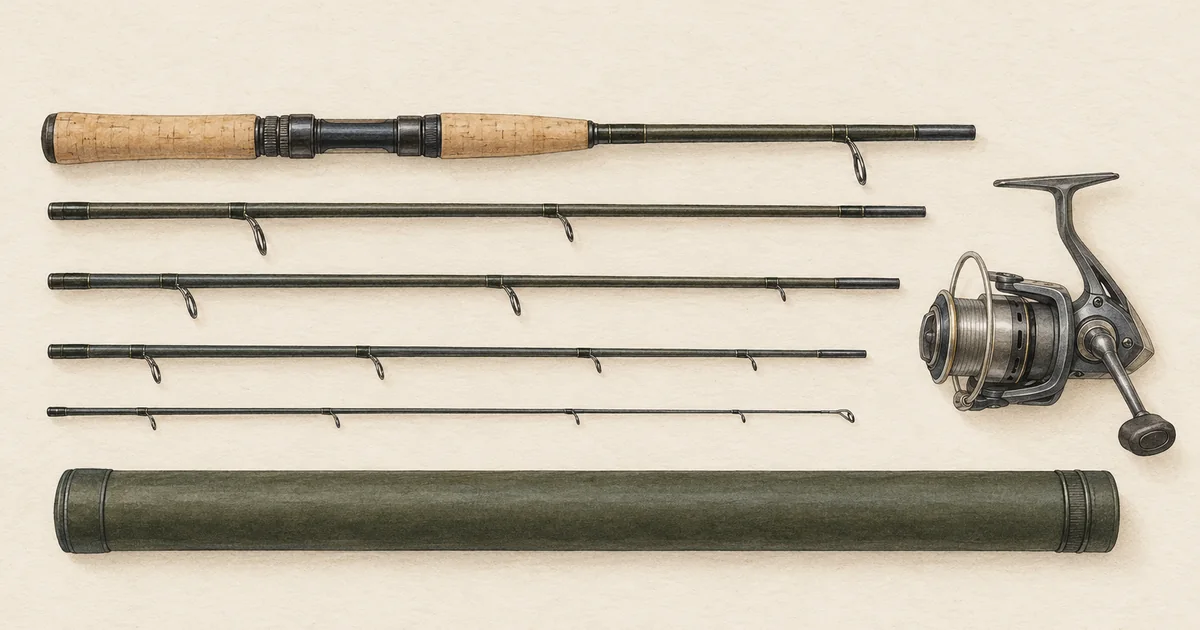
What counts for the suitcase is not the length of the rod but the transport length, that is the longest single section. For a conventional suitcase Blinker gives at most around 75 cm, in an article about saltwater spinning rods about 70 cm. A rod builder advises in another article getting the biggest suitcase possible. Sections of slightly over 70 cm just about fit diagonally into normal luggage, according to him.
How many sections are needed depends on the rod length. The rod builder gives three sections for 7 ft and four sections for 8 to 9 ft. The table uses 1 ft = 30,48 cm, like the unit converter.
| Marking | Rod length | Sections according to the rod builder | Calculated per section |
|---|---|---|---|
| 7 ft | around 2,13 m | 3 | around 71 cm |
| 8 ft | around 2,44 m | 4 | around 61 cm |
| 9 ft | around 2,74 m | 4 | just under 69 cm |
Worked example: Rod length divided by the number of sections gives only the minimum length. Every section is a little longer, because a piece of it disappears in the joint. A 9 ft rod in three sections would already work out at a good 91 cm per section and thus above each of the suitcase limits mentioned.
Action: what the many joints do
Every joint brings additional material into the blank, the load-bearing tube of the rod. The result: the travel rod becomes slightly heavier and its action slightly slower. With modern materials the gap to the two-piece rod is, in Blinker’s assessment, only small now. In its tackle tips for Norway, Rute & Rolle goes further and writes that multi-piece travel rods today are no worse in action than other rods.
Compared with the telescopic rod, the travel rod at the same transport length is usually clearly faster in action and generally more durable. It does not have the telescopic rod’s greatest advantage, though: a four-piece travel rod can hardly be transported fully rigged and compact.
Durability: every joint is a weak point
Among rod builders there is a saying that every cut is a weak point. The more sections, the more possible breaking points. Travel rods are therefore regarded as slightly more fragile by design than one- or two-piece rods, so clean workmanship of the joints is all the more important. The one-piece rod is the most durable, but well-made and reinforced joints also withstand heavy loads.
While fishing itself, in the rod builder’s experience most travel rods break on the strike, the jerk that sets the hook. If you yank the rod up too violently and too steeply, only the tip bends in the end, and it then breaks even on a small fish. Do not hold the tip vertically upwards in the fight either, the struggle with the hooked fish.
The second danger is a joint that works loose. There the thinner end of a section, the spigot, sits in the hollow end of the next one, the socket. Anyone who makes many casts in a row gradually loosens the joints, reports the US magazine Florida Sportsman, mostly in the upper part of the rod. If the spigot only sits at the edge, the wall of the socket can split during casting or in the fight. Loose joints are among the most common reasons for a broken rod.
Assembling, taking apart and care
- Offset assembly: You join two sections so that their guides are twisted 45 degrees against each other or fully opposed, and then push them firmly together while turning until the guides are in line. You should never ram the sections together by force.
- Taking apart: turn both sections slightly in opposite directions and pull them firmly apart at the same time.
- Rechecking: before the first cast check that all joints sit firmly, and repeat this several times during the day.
- Keeping clean: You remove dirt on the joints with a not too hard brush and mild soapy water, and for unvarnished joints Rute & Rolle then recommends graphite wax. Alternatively a thin layer of candle wax, paraffin or beeswax works (Florida Sportsman). Waxed joints are less likely to stick and still come apart more easily when taken apart.
Do not put the rod together under a power line. Carbon fibre rods conduct electricity very well, and the question catalogue for the angling exam in Saxony-Anhalt therefore warns to be careful during thunderstorms and close to power lines.
Transport: sleeve, tube and suitcase
Many travel rods are supplied with a reinforced, shock-resistant sleeve and travel in it inside the suitcase. The rod builder additionally wraps the fabric sleeves of his rods in towels inside a hard-shell suitcase. With the sleeve it matters that the sections fit in completely. If a tip sticks out at the top, it easily catches and snaps off.
One- and two-piece sea rods have to go in a rod tube on flights and be checked in as a separate oversized item, writes Rute & Rolle. According to Blinker, almost all airlines accept luggage up to 2 m in length, booked as sports luggage or fishing equipment and handed in at the oversized baggage desk. Each airline sets its own conditions, so read them before booking. Special luggage is transported separately and, in the rod builder’s experience, does not always arrive together with you.
A rod tube can also be built from a plastic pipe from the DIY store. It should be a few centimetres longer than the rod, so that there is room for padding material below the handle and in front of the tip. It is closed with end caps or tape. In the car an especially large number of rods break in doors and tailgates, because loose sections slip unnoticed into the gap.
Hand luggage: Which items are banned on board is regulated by § 11 of the Luftsicherheitsgesetz together with a list in EU Implementing Regulation 2015/1998. What applies in an individual case you clarify beforehand with the airline and the airport.
Fishing abroad
Each country regulates fishing itself. Two examples: In Denmark, according to the Danish fisheries authority, everyone aged 18 up to the entitlement to the Danish state pension needs a state fishing licence, the lystfiskertegn. For foreign visitors in Norway the Norwegian Directorate of Fisheries says on sea fishing: use only hand-held fishing equipment. Which papers you need in your destination country is covered on the country pages under Fishing waters, for example for Denmark, Norway and Sweden.
Common mistakes
- Buying by rod length. What counts for the suitcase is the longest section, so measure the inside of the suitcase beforehand.
- An all-round travel rod for very hard-fighting fish. A much-travelled angler advises taking the right specialist rod for heavy target fish, even if it has fewer sections, and paying for the special luggage. A compromise rod can otherwise cost you the fish.
- Striking steeply. Then only the tip is working.
- Never rechecking the joints. After many casts it is above all the upper sections that sit looser.
- Rod sections loose in the car or on the ground. In the boot they easily end up in the tailgate, on the ground someone treads on them. Lean rods upright, tips slanting upwards.
Frequently asked questions
Does a travel rod cast worse than a two-piece rod?
It is slightly heavier and slightly slower in action, but with modern materials the difference is small. One practical article no longer sees any disadvantage in the action. A blank with no break at all is only found on the one-piece rod, and those exist only up to about 2 m in length.
May the rod go in hand luggage?
This is regulated by § 11 of the Luftsicherheitsgesetz with the associated EU list and the airline’s luggage rules, so clarify it before the flight. For rods the route remains checked-in luggage: in a sleeve inside the suitcase or in a tube as special luggage.
Is a telescopic rod the better travel rod?
For transport it is more convenient, because it can travel collapsed and fully rigged. In return its action is usually slower and it is less sturdy. For spinning and for very hard-fighting fish, the multi-piece rod is the better choice.
Related
- Fishing rods: construction, casting weight, action and test curve
- Telescopic rod: the collapsible alternative
- Spinning rod: length and casting weight for lures
- Fly rod: line class, length and action
- Sea rod: boat, pirk and surf rods for the coast
- Line calculator: work out breaking strain and backing
- Unit converter: ft, lb and oz into metres and grams
- Fishing waters: rules and papers by travel country
Sources
- Blinker: Ruten-Kompaktklasse: Reise- oder Telerute? (75 cm, Gewicht, Aktion, Haltbarkeit, Telerute, einteilige Ruten) und Blinker: Die richtige Angelrute: Darauf kommt es an (drei bis sechs Teile, Vergleich zur Telerute)
- Blinker: Die perfekte Reiserute für den Angelurlaub: Tipps vom Rutenbauer (Teilung nach Länge, Schwachpunkte, Anhieb, Sondergepäck, Spezialrute)
- Blinker: Mit Angelausrüstung auf Flugreisen: Das müssen Sie beachten (Futteral, Gepäck bis 2 m, Rutenrohr)
- Blinker: Salzwasser-Spinnruten (70 cm, Anfälligkeit), Blinker: Die richtige Meeresrute (Stabilität der Teilungen) und Blinker: Viele Ruten brechen durch falsche Handhabung (Futteral, Auto, Boden)
- Rute & Rolle: Angelruten pflegen: So geht’s richtig! (Reinigung, Graphitwachs) und Rute & Rolle: Gerätetipps für Norwegen (Rutenrohr, Aktion)
- Florida Sportsman: Ferrule Maintenance (Lockern, Riss der Hülse, Zusammenstecken, Wachs) und Fly Fisherman: Rod Ferrules Lead to Rod Breakage (Bruchursache)
- Bayerische Landesanstalt für Landwirtschaft: Prüfungsfragen zur Fischerprüfung 2023/2024 (PDF) (Begriff Steckrute) und Land Sachsen-Anhalt: Fragenkatalog zur Fischerprüfung (PDF) (Kohlefaserruten leiten Strom)
- Bundesministerium der Justiz: Luftsicherheitsgesetz, § 11 Verbotene Gegenstände (verbotene Gegenstände an Bord)
- Dänische Fischereibehörde: Fragen und Antworten zum lystfiskertegn (Angelschein ab 18 Jahren) und Norwegische Fischereidirektion: Meeresangeln in Norwegen, Regeln für ausländische Besucher (nur handgehaltenes Gerät)
Text AI-assisted, drawing AI-generated. Sources opened and checked in October 2026; no graphics taken from the sources.
All figures are guide values without guarantee. What counts are your airline’s luggage rules and the fishing rules in the country you travel to.