
Knowledge · Tackle
Fly rod: Choosing line class, length and action
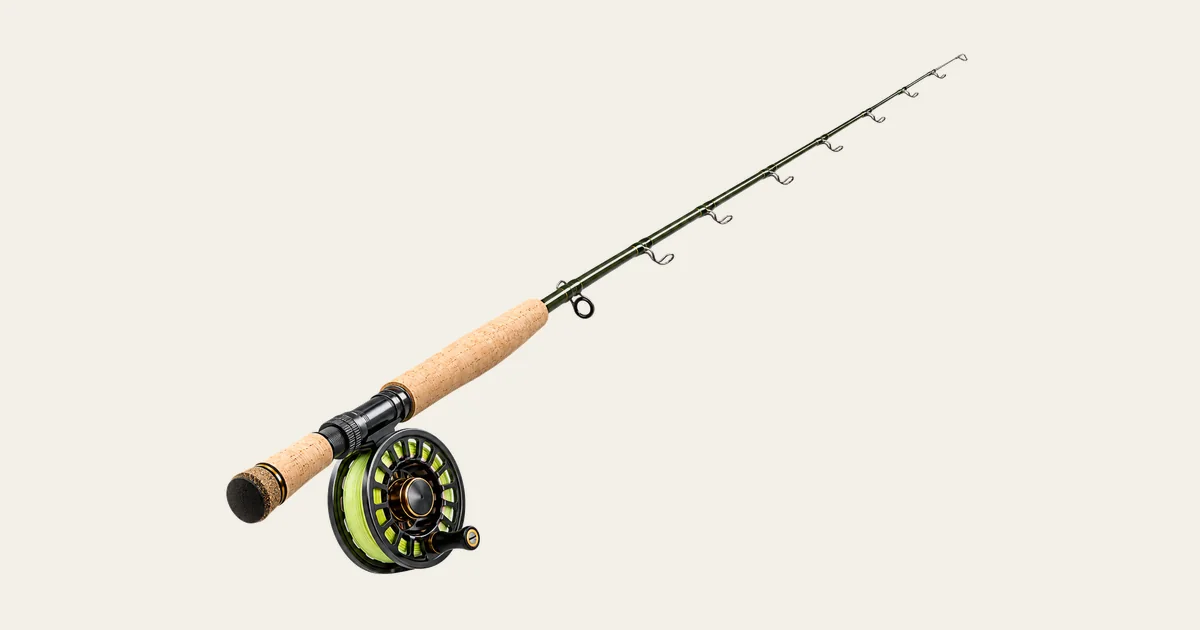
A fly rod casts neither lead nor a heavy lure, but the line itself. That is why it carries no casting weight in grams but a line class, and rod, reel and line must match that class. To start with, specialist magazines recommend a single-handed rod of about 9 feet in class 5 or 6; double-handed rods and tenkara are special forms.
Why the fly rod is built differently
An artificial fly weighs almost nothing. The casting weight is in the thick fly line, and there is no shot; so it says in the teaching material for the angling exam (Fischerprüfung). During the swing, the weight of the line loads the rod. Two special features of the build follow from this:
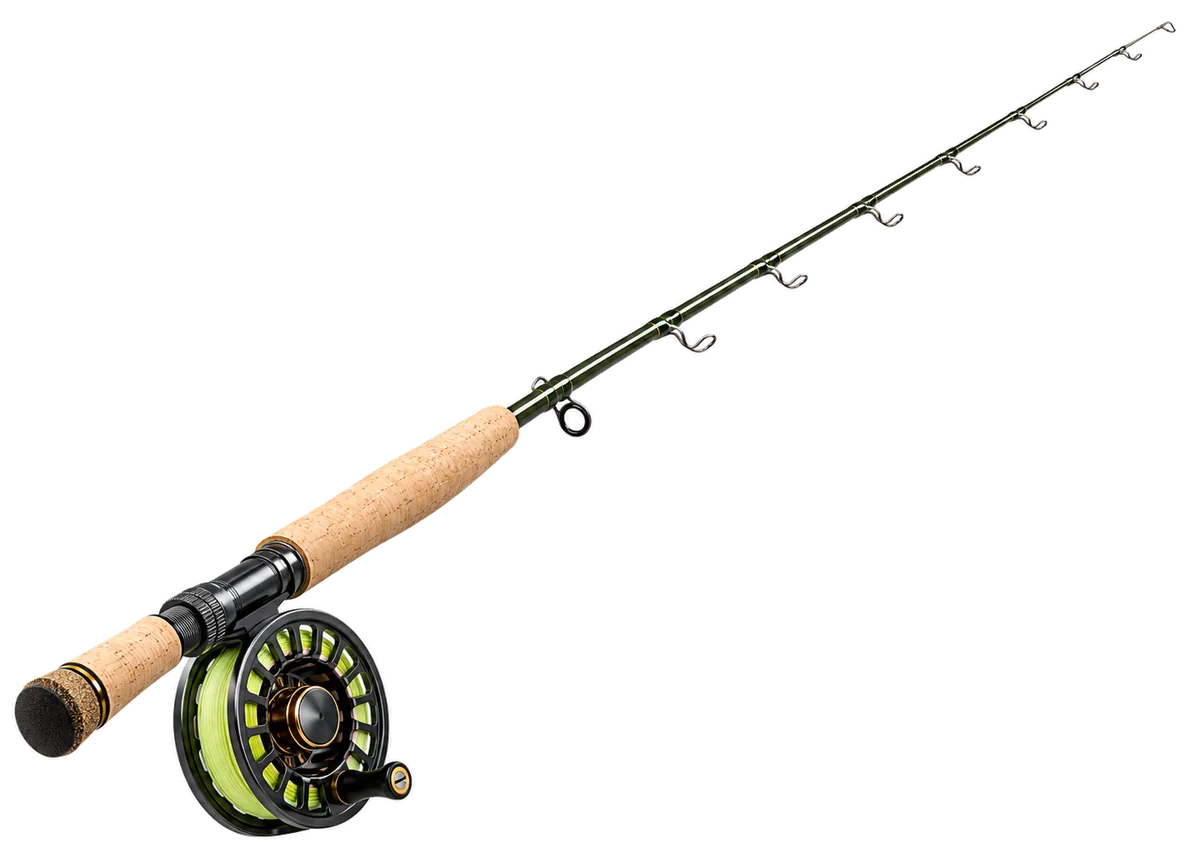
- Reel behind the handle: The reel seat is at the end of the rod, and the reel hangs behind the casting hand. The reel has no gear ratio and serves mainly as line storage.
- Snake rings: this is what the training material for the angling exam (Fischerprüfung) calls the rings of the fly rod through which the line runs along the blank (the rod shaft). As on any rod, the stripping ring sits closest to the reel, and the tip ring finishes it off at the front.
AFTMA classes: what the line class means
The system goes back to the American manufacturers‘ association AFTMA. The class is printed above the handle, usually with the sign # or the abbreviation AFTM, and describes the weight of the line: what counts is its first 9,15 m (30 ft), given in grains, where 1 grain equals 0,065 g. The higher the number, the heavier the line and the stronger the rod. According to specialist magazines the scale runs from 1 to 15, and one article adds a class 0; the exam material lists groups 1 to 12.
| Line class | Line weight (guide value) | Typical use |
|---|---|---|
| 3–4 | 6,5–7,8 g | small stream, dry fly and small nymphs for brown trout and grayling |
| 5–6 | 9,1–10,4 g | all-round on stream and river, also weighted nymphs and small streamers |
| 7–8 | 12,0–13,6 g | Streamers, sea trout on the coast, pike |
| 9–10 | 15,6–18,1 g | large pike streamers, salmon; in fresh water mostly as a two-handed rod |
Dry flies imitate an insect on the surface, nymphs an insect rising under water, streamers small fish. The weights are rounded nominal values for single-handed rods. For two-handed rods the old classification no longer fits, according to the specialist press, and there the line weight is often given directly in grains. For pike, two magazines give classes 8 to 10, for the coast 7 and 8; on windless days a 6 is also enough for sea trout.
Length in feet, single-handed and two-handed rod
The length is printed in feet (ft) on the blank, 1 foot is about 30,5 cm. Specialist magazines name 9 feet as the standard and give 270 cm for it; by calculation it is a good 2,74 m. On narrow, overgrown streams, what matters most is that rod and line find room between the branches. An article in Rute & Rolle from 2025 recommends short lengths of line there and a rod tilted to the side when casting. The unit converter translates other markings.
Fly rods are usually single-handed rods. Double-handed rods, as the name says, are handled with both hands and are meant for big rivers and hard-fighting fish such as salmon. In fresh water, line classes from 9 or 10 upwards are normally fished on a double-handed rod; as an example, one trade magazine mentions 13 ft in class 9, which is just under 4 m. In between come switch rods, mostly 3,30–3,60 m, which can be cast with one hand or two.
Action and sections
The action describes how the blank bends under load. If big streamers are to go a long way, you need a fairly stiff rod. In the view of Rute & Rolle (2019), beginners often get on better with a somewhat slower rod than with the very fast models that are common today.
Fly rods come in two or more sections. For beginners, Blinker describes a four-piece rod; the more sections, the shorter the packed length for travel and rucksack.
Rod, reel and line in the same class
If the rod is marked 6, it needs a class 6 line and a reel marked #5/6 or #6. On the line packaging the class sits between two abbreviations: WF 6 F is a weight-forward line (WF, thicker towards the front) of class 6 that floats (F).
Example: For all-round starter use, trade magazines name a single-handed rod in class 5 or 6, in class 6 at 9 ft long, plus a reel for #5/6 and a floating weight-forward line WF 5 F or WF 6 F. If you are still learning to cast, the trade press says you can choose a line one class heavier, because the rod then loads with a shorter length of line.
Special forms: double-handed rod and tenkara
Double-handed rod
According to a Blinker article from 2024, their typical field is salmon fishing on big rivers, where today they are fished almost only with shooting heads. A salmon profile in Blinker from 2026 considers 14-foot double-handed rods of class #9/10 not unusual on big rivers, which is about 4,27 m; often, though, a 9-foot single-hander of class #7/8 is enough there. For sea trout in rivers, the sea trout profile (2024) names the light double-hander of class 9, and on the coast the single-hander of class 8. According to a Blinker article from 2019, double-handed rods of classes 9 and 10 are also suitable for sea trout and all native predatory fish. More on tackle for salmon rivers is under Salmon fishing.
On rivers there is often no room behind the caster, because bushes or fences restrict the back cast. Then the roll cast helps, in which the line does not unroll backwards overhead: according to Blinker it works even where there is no room for a back cast. For roll and Spey casts when salmon fishing, the Blinker fly line glossary lists a separate Spey line.
The line on a double-hander is also heavier than the class table above would suggest. The Blinker glossary works it out for a 13-foot class 9 rod: by the old classification a shooting head of 15 g should fit, but in fact it has to be twice as heavy. The matching profiles are explained on the Fly line page, and reel and backing on the Fly reel page.
Tenkara: fixed line without a reel
Tenkara is an old Japanese way of fishing that uses only a rod, line and bait. There is no reel. According to an article in Rute & Rolle from 2018, the name means “from heaven”: the line does not lie on the water but falls from the rod tip down into the water. When fishing with an artificial fly it is called kebari, which translates roughly as “hairy hook”.
The line is attached to the rod tip and falls from there into the water. The rods used to be made of bamboo; today they are carbon fibre. When playing a fish, they absorb runs well, writes Rute & Rolle. If you know the pole, you will recognise the principle.
Rute & Rolle describes its use with the example of the Esa style, in which a natural bait drifts in the current instead of a fly. Because you do not need to learn complicated casts and need little space, the magazine sees tenkara as an alternative to classic fly fishing, well suited to somewhat deeper streams, plunge pools and gently flowing water. The limits follow from the design: you can only reach what lies within the length of rod and line, and a fish cannot take line. In Japan the method is mainly used for rainbow trout and smaller native salmonids, which usually do not grow beyond 30 to 40 cm. The magazine considers this form unsuitable for large salmonids such as salmon. With a long rod and a long line, landing is also difficult; Rute & Rolle recommends a landing net with a longer handle.
Common mistakes
- Buying line because it is on special offer: A class 3 or class 8 line does not fit a class 6 rod.
- Starting too light: Classes 1 to 3 are sensitive to wind and cast less far; they are considered unsuitable as a first all-round rod.
- Trusting the number blindly: Manufacturers interpret the classes differently, so one maker’s class 8 rod can be stronger than another’s class 9. Test-casting with reel and line settles it.
- Adding weight to cast further: On a fly rod the line is the casting weight.
- Using the tenkara rod for big fish: without a reel there is no line in reserve, and a big fish cannot take line. According to Rute & Rolle the target fish in Japan usually do not grow beyond 30 to 40 cm.
The pages under Law give an introduction to the rules at the water.
Frequently asked questions
Which fly rod suits a beginner?
Trade magazines name a single-handed rod in class 5 or 6 for starting out, in class 6 at 9 ft long. A reel for #5/6 and a floating weight-forward line go with it.
Why does a fly rod not state a casting weight in grams?
On a fly rod the line is the casting weight; there is no lead. That is why the line class is printed above the handle, and rod, reel and line are matched to it.
May the line be one class heavier than the rod?
If you are still learning to cast, the trade press says you can choose a line one class heavier, because the rod then loads with a shorter length of line. As a rule, though, the line class of the rod belongs on the reel.
What is tenkara?
Tenkara is an old Japanese style of fishing with a rod and line but without a reel. The line is attached to the rod tip and falls from there into the water. According to Rute & Rolle, it is used mainly for rainbow trout and smaller salmonids, which usually don’t grow beyond 30 to 40 cm.
What does WF 6 F mean on the line packaging?
WF 6 F is a weight-forward line of class 6 that floats. Weight-forward means the line is thicker towards the front. The F at the end stands for floating.
Related
- Fly fishing: the method, the cast and the sequence
- Fly line: classes, taper and how it sits in the water
- Fly reel: the reel as a line store
- Flies and feather lures: dry fly, nymph and streamer
- Fishing rods: overview of action and length
- Pole: rod without a reel, with the line on the tip, as in tenkara
- Fishing for Atlantic salmon: tackle for the salmon river, including the double-hander
- Line calculator: breaking strength of the leader tip after the knot
Sources
- Fischereiverein Löningen: Gerätekunde zur Fischerprüfung (Schlangenringe, Rolle hinter der Wurfhand, 9,15 m und Grain) und Fischereiverein Löningen: Zusammenfassung Gerätekunde (Schnur als Wurfgewicht, Rollenhalter am Rutenende, Klassen 1 bis 12)
- Blinker: Das kleine 1×1 der Schnurklassen beim Fliegenfischen (2019; Klassen 0 bis 15, Einsatz je Klasse, Zweihand ab 9 oder 10 und ihre Zielfische) und Blinker: Was bedeuten die Schnurklassen beim Fliegenfischen? (Klassen 1 bis 4, Allroundklasse 5/6, schwerere Schnur für Einsteiger, Zweihand auf Lachs mit Schussköpfen)
- Blinker: Fliegenschnur-Lexikon (Grain je Klasse, Zweihandrute mit 13 ft und Gewicht des Schusskopfs, Spey-Schnur für Roll- und Spey-Würfe)
- Blinker: Fliegenfischen für Anfänger, die besten Geräte-Tipps (9 ft, Klassen 5, 6 und 8, WF-Schnur, Rolle als Schnurspeicher) und Blinker: Fliegenfischen für Einsteiger (Rolle #5/6, Klassen 1 bis 3)
- Rute & Rolle: Mit Fliege auf Hecht? Das kannst Du auch! (2019; Klassen 8 bis 10, Aktion für Anfänger, Unterschiede zwischen Herstellern) und Blinker: So fangen Sie den Hecht mit Streamer und Fliegenrute
- Blinker: Steckbrief Lachs (2026; Zweihand mit 14 ft an großen Flüssen) und Blinker: Steckbrief Meerforelle (2024; Zweihand am Fluss, Einhand an der Küste)
- Blinker: Fit für den Forellensee, der Rollwurf mit der Fliegenrute (2025; Rollwurf ohne Rückraum)
- Rute & Rolle: So angelt Japan, Teil 5: Tenkara (2018; Tenkara ohne Rolle, Bedeutung des Namens, Kebari, Werkstoff, Einsatz, Grenzen und Landen) und Rute & Rolle: Besinnliches Bachfischen (2025; kurze Schnur und seitlich gekippte Rute am zugewachsenen Bach)
- Blinker: Fliegenfischen, 8 kleine Tipps mit großer Wirkung (Switch-Ruten)
- Wikipedia: Fishing rod (ergänzend: Schnur an der Spitze der Tenkara-Rute) und Wikipedia: Fliegenrute (ergänzend: Zweihandruten für Lachs)
Text AI-assisted, drawings AI-generated. Sources opened and checked in October and November 2026; no graphics taken from the sources.
All figures are guide values without guarantee. Manufacturers interpret line class and action differently; what counts is the marking on the rod, reel and line.