
Knowledge – Fish
Grayling: Sail, habitat, fly fishing
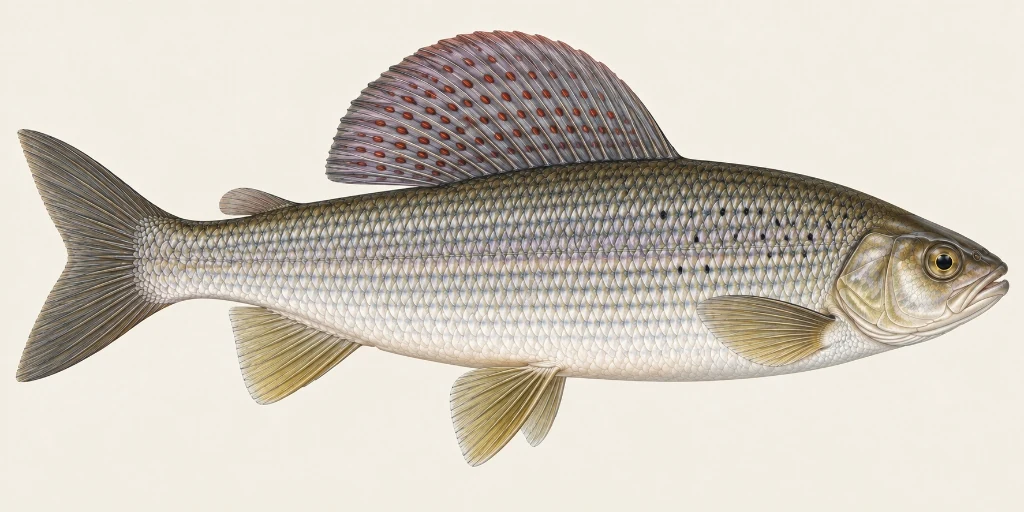
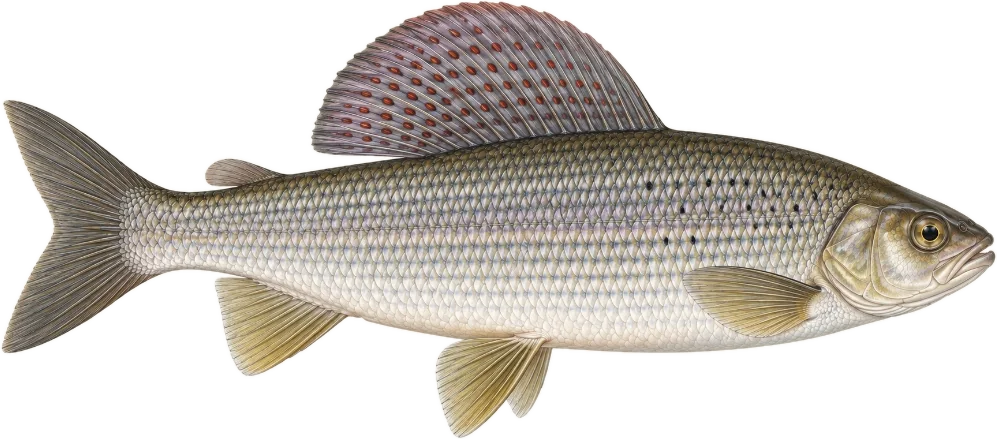
The grayling (Thymallus thymallus) is the characteristic fish of the grayling zone that bears its name, and it stands out for its tall dorsal fin, the “sail”. It needs cool, oxygen-rich water over gravel. In Germany it is classed as severely threatened. It is fished mainly with the fly and with the drifting float.
In short: The best time to catch grayling is from July to October, mainly in the evening. Good spots on a river: the main current, behind stones and an undercut bank. Proven baits: artificial flies; on the float also maggots, worms or caddis larvae. The grayling bites in winter too, but many states already protect it then: Saxony-Anhalt from 1 December, Bavaria and Saxony from 1 January, Baden-Württemberg and Thuringia from 1 February. The closed season (Schonzeit) runs to the end of April or into May, in Saxony to 15 June (as of October 2026). Step by step: Fishing for grayling.
- Large dorsal fin, the “grayling's sail”
- Large round scales in proportion to the size of the body
- Pear-shaped pupil tapering towards the front
Catch chances through the year
- Hardly any chance
- Possible
- Good
- Peak season
- Spawning (observe the closed season)
Editorial assessment for waters in Germany, not a measured value and no guarantee. Spawning time is not the same as the legal closed season.
Species profile and sources in the catch calendarAll species compared month by monthThe rules of your federal state
How to recognise a grayling
The most striking feature is the tall, broad dorsal fin, the sail. It is purple and spotted dark. In males it is drawn out further to the rear, and the anal and pelvic fins are also larger than in females. In the spawning season the sail is especially colourful.
The body is elongated and flattened from the sides. The head is small and the mouth small, pointed and slightly underslung. Like the trout, the grayling has an adipose fin. The pupil tapers to a point at the front. It is grey-green to bluish on top, silvery white on flanks and belly with brass-coloured lengthwise stripes, and small dark spots sit on the front of the body.
Usual lengths are 30 to 50 centimetres, and the Landesfischereiverband Bayern gives 65 centimetres as the maximum. FishBase lists 14 years as the greatest documented age. The species name recalls thyme: freshly caught grayling are said to smell of it, though the scent fades during preparation.
You tell it from the brown trout first by the dorsal fin: the trout has no sail. It usually carries red, pale-ringed spots on a yellowish ground, whereas the grayling is marked silvery with dark spots and brass-coloured lengthwise stripes. The shape of the mouth helps too: the trout’s mouth reaches behind the eye, while the grayling’s is small and pointed. The lake trout also has no tall dorsal fin, and it loses the red spots of the brown trout in the lake.
Side by side
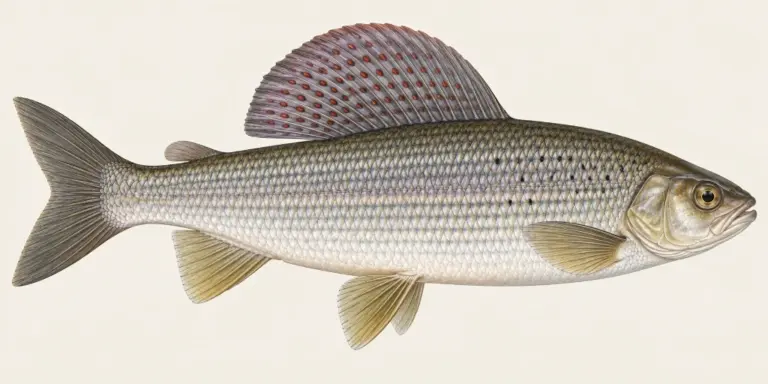
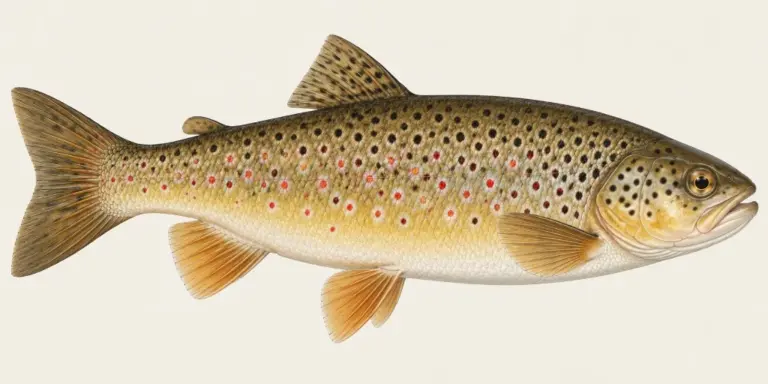
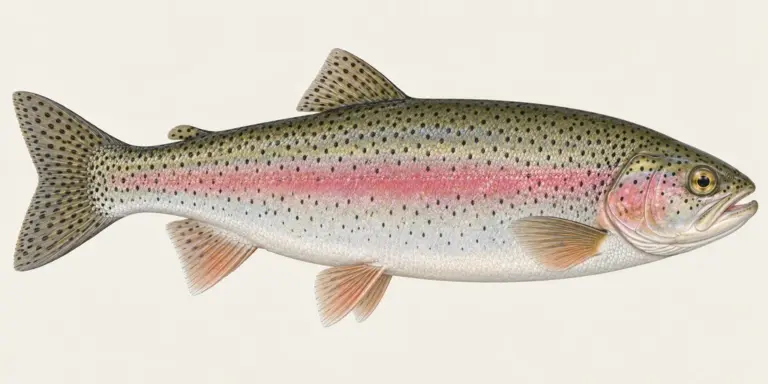

AI-generated illustrations.
Where the grayling lies
The grayling is a resident fish of cool, clear and fast-flowing waters. Compared with the trout zone further upstream, the water in its zone is wider and deeper, the gradient is lower, and in summer it gets a little warmer but stays cool and rich in oxygen, as the Federal Agency for Nature Conservation (Bundesamt für Naturschutz) describes it. In this grayling zone it shares the water with trout, common nase, barbel, vairone (Strömer), Alburnoides bipunctatus (Schneider) and dace. In Scandinavia it also lives in clear lakes. According to FishBase, its natural range stretches from the western edge of the Urals to the Loire and the Rhône, and in the south to the northern Adriatic. In the lowlands with an Atlantic climate, for example in parts of Lower Saxony and North Rhine-Westphalia, it is only rare according to the Lower Saxony state office.
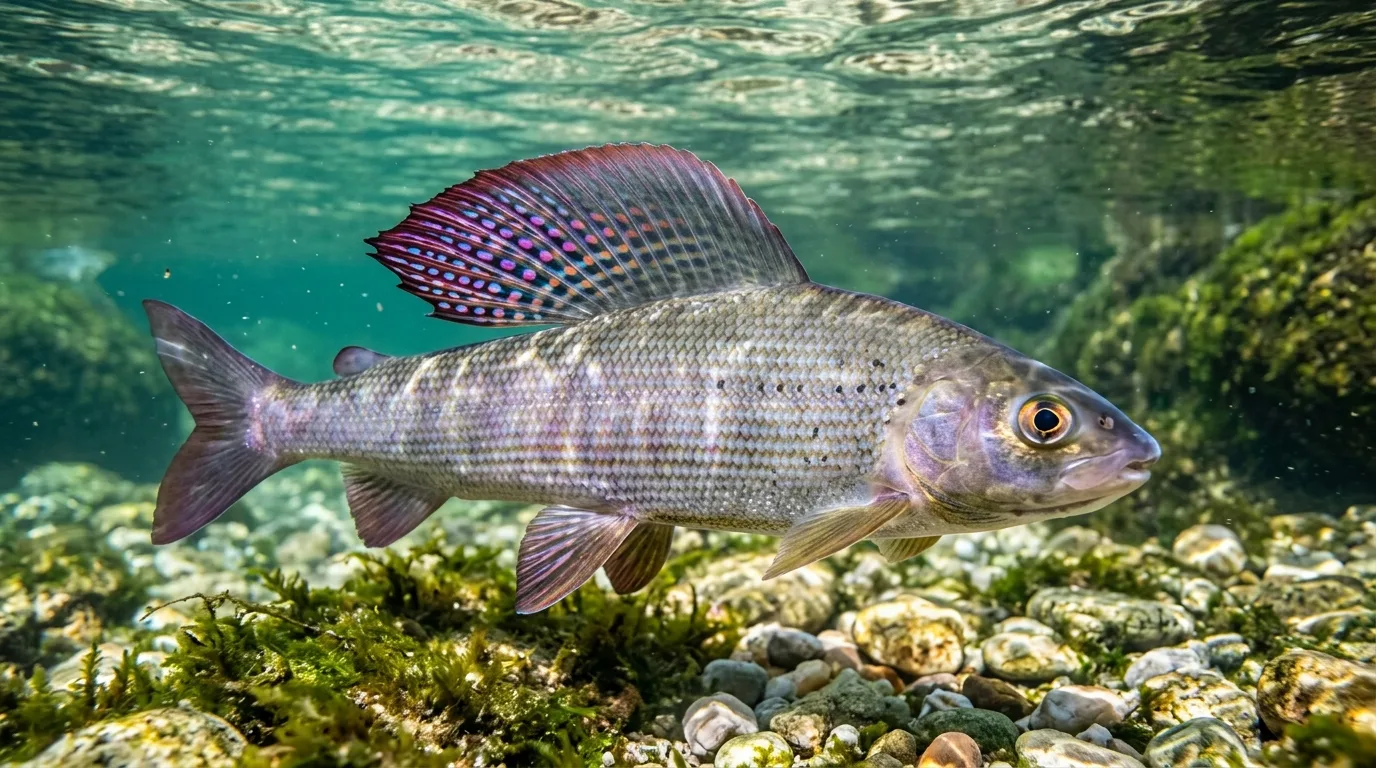
Within the water, grayling lie in small groups in even current over gravel or sand. FishBase describes hollows behind boulders and shaded water under overhanging vegetation as typical places. Unlike many fish, they do not seek cover at the bank when in danger but move out into deeper water.
The species needs variety in a small space: gravel with water flowing over it for spawning, shallow, calm banks for the young fish and deeper channels for the big ones. Because these rarely lie close together, the grayling moves over the course of the day, the year and its life, and weirs and other cross-channel structures hit it hard. You will find more on the types of water under Fishing on the river.
Temperature sets limits. FishBase gives 6 to 18 °C as the range it lives in, and the LAWA project of the states gives 26 °C as the upper lethal temperature.
Holding spots in the picture
Choose the season and time of day: the picture shows where the species stands then. Spots outlined in red apply only in the chosen season. Tap a fish or a spot in the list to bring it closer. The picture is schematic and AI-generated, every water is different.
Catch chances in springhardly anyspawning season, observe the closed seasons (Schonzeit)
Catch chance in summerPeak season
Catch chance in autumnPeak season
Catch chance in winterhardly any
- J
- F
- M
- A
- M
- J
- J
- A
- S
- O
- N
- D
Spawning season
Not a prime time On summer evenings the grayling rises at dusk to the tiniest flies.
Not a prime time On summer evenings the grayling rises at dusk to the tiniest flies.
Active time On summer evenings the grayling rises at dusk to the tiniest flies.
Not a prime time On summer evenings the grayling rises at dusk to the tiniest flies.
In the river
Undercut bank, overhanging branches, timber
Grayling are here only in spring, summer and autumn.
Slack water behind rocks
Grayling are here only in spring, summer and autumn.
Gravelly shallow (riffle)
Grayling are here only in spring.
Pools, deep spot
Grayling are here only in winter.
Free current in mid-river
Grayling are here only in spring, summer and autumn.
The grayling likes to stand in small groups in even current over gravel or sand and is regarded as a fish of open water. FishBase also mentions hollows behind big stones and shaded water under overhanging vegetation. Unlike the brown trout, it does not seek cover under stones when in danger.
Spring: chance of a catch according to the catch calendar slim in March and April, possible in May. Spawning falls in this period, so observe closed seasons (Schonzeit). In spring the grayling spawns on shallow, flowing gravel bars and is protected in many places then. Shortly after spawning it takes bigger mouthfuls.
Summer: chance of a catch according to the catch calendar good in June, peak season in July and August. Over the year its prey gets smaller. On summer evenings it takes the tiniest insects from the surface.
Autumn: catch chance according to the catch calendar is peak season in September and October, good in November.
Winter: chance of a catch according to the catch calendar possible in December, slim in January and February. In winter grayling settle in particularly deep spots where the current is slack. They keep feeding and take bigger mouthfuls too.
Depth: Adult grayling prefer deeper, flowing stretches. They rise from the depths to a fly on the surface.
Size comparison: AI-generated drawing, schematic.
How it feeds and spawns
The grayling feeds on small animals. Its menu includes insect larvae, freshwater shrimps, small crustaceans, snails and worms, plus flying insects that it takes from the surface. Caddis larvae are among its favourite food. Older grayling now and then also eat small fish and fish spawn.
Spawning takes place, depending on the source and the water, from March to May. In Aargau the spawning time falls in February and March, and the larvae hatch there in April. The spawning site lies on shallow gravel bars with water flowing over them, usually 20 to 40 centimetres deep in moderate current. Unlike other salmonids, the grayling does not dig a spawning redd: the female anchors herself in the gravel with her pelvic fins and drives her tail into the sediment with rapid strokes, and the eggs fall into it. If algae or suspended matter lies on the gravel, she does not use the site.
Freshly hatched larvae hide among the stones at first. Later the young fish form small shoals.
When it bites
For a salmonid the grayling spawns late, mostly in March and April, and into May depending on the water. After that and in winter, according to fly anglers’ reports, it readily takes bigger mouthfuls, including a bunch of maggots on the bottom or a small spoon. Over the course of the year the prey shrinks: on summer evenings at dusk and on cold winter days the fish rise to tiny flies and black gnats, and the fly angler needs patterns down to hook size 22.
Hot summers with little water are dangerous for the grayling. The Red List reports several regional grayling die-offs in recent years, for example on Lake Constance. The LAWA project gives 26 °C as the upper lethal temperature. According to the canton of Solothurn, however, it becomes critical above about 20 °C, when the fish crowd into the few cool, deep refuges. On hot days take a water thermometer with you and leave grayling in peace from around 20 °C.
State law sets the closed season (Schonzeit). Depending on the state it begins between December and March and ends between the end of April and mid-June. In Bavaria it applies from 1 January to 30 April, and the minimum size (Mindestmaß) is 35 centimetres (AVBayFiG, as of October 2026). The fishing permit (Erlaubnisschein) may be stricter.
Today’s catch index needs JavaScript. Season and spawning time are in the catch calendar.
You will find the monthly overview of all species and the water temperature check in the catch calendar.
From the blog: Freshwater fish in Germany: which species you catch where
What to catch it with
Step by step: Fishing for grayling: tips on bait, rig and tackle – season, spots, bait, tackle and rules on one page.
The most popular method is fly fishing. For the dry fly, according to Blinker, a simple rod of line class 4 to 5 with a floating line is enough (fly rod, fly line). The tippet is between 0,12 and 0,18 millimetres depending on the fly size. Flies made with roe-deer hair or CdC feathers float well in the current. Imitations of stoneflies and caddis from hook size 14 downwards are usual, and tiny midges go down to size 22.
The nymph may be one size bigger. Imitations of caddis larvae and gold-head nymphs are considered more effective than plain patterns. The grayling’s field of view appears restricted at the sides: anything not drifting towards it, it usually ignores. So place the fly ahead of the fish, because the fish rises from the depths and often drifts along with it a little way.
You catch grayling on the drifting float too. On the High Rhine specialists fish with long cork-handled rods, centrepin reels and natural or artificial baits. Maggots and larvae or worms serve as bait, and you will find the rig under Float rig and Float fishing.
In the fight the grayling turns on its own axis, and the hook pulls out more easily than with trout of the same size. Big bottom-dwelling grayling fight with powerful lunges and keep the sail raised until they are in the net. A wading net is handy when fishing in the river. How to land and unhook the fish gently is explained under Landing and unhooking fish.
Present it ahead of the fish: Cast the dry fly slightly upstream of the riser so that it drifts straight towards the fish. The grayling usually ignores flies drifting past to the side.
Watch for rings: If ring after ring shows on the surface in the same place, there is a grayling there, according to Blinker. Watch first, then cast.
Wade quietly: Grayling are hardly disturbed by wading anglers. Sometimes you catch them right in front of your feet before you make the first long cast.
Suitable lures
Artificial flies; on the float also maggots, worms or caddis larvae.
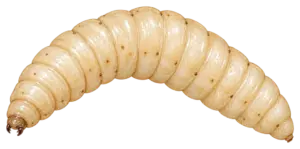
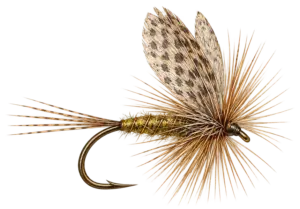
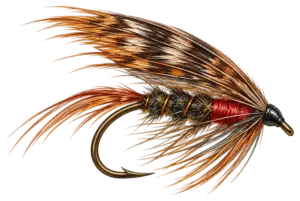
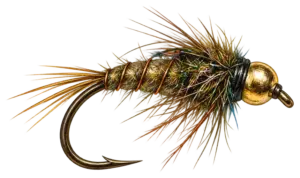
AI-generated illustrations. A click opens the lure’s page.
Rigs for these lures: Float rig.
What you need to observe
The grayling is listed as severely threatened in Germany’s Red List of 2023. The stock is regarded as rare, and the long-term trend shows a sharp decline. The Red List names pollution, river engineering and regulation, warming and predation by fish-eating birds such as the cormorant as causes. The grayling was Fish of the Year in 2011.
Closed seasons, minimum sizes and harvest windows are set by the federal states (Bundesländer), and on many waters additionally by the club or leaseholder. They differ depending on the water and the time of year. We give figures only with date and source, and what is binding is always the fisheries regulation of your federal state and your fishing permit. You will find a list of links to the official sources in the catch calendar. Grayling waters often have their own rules on bait and catch, so read the permit before the first cast.
A fish of legal size that you want to keep you stun and kill immediately, in line with animal welfare (stunning and killing a fish). Protected fish, undersized fish or fish too large under a harvest window you unhook if possible in the water and with wet hands, and release gently (releasing a fish).
What closed season, minimum size and harvest slot mean and where to find them is explained on the page Closed season and minimum size explained.
What state law specifies on the closed season and minimum size for this species can be found in the “At a glance” box on the state pages for Baden-Württemberg, Bavaria, Hesse, Lower Saxony, North Rhine-Westphalia, Rhineland-Palatinate, Saarland, Saxony, Saxony-Anhalt and Thuringia. For the other states our overview does not list this species, and the state fisheries regulation is what counts there.
Frequently asked questions (FAQ)
How do I tell a grayling from a trout?
The grayling has a tall, purple, spotted dorsal fin, a small, pointed mouth and a pupil that tapers to a point at the front. Trout have no such sail, their mouth reaches behind the eye, and brown trout usually show red, pale-ringed spots.
Why do I lose so many grayling in the fight?
The grayling turns on its own axis in the fight, and its mouth is small and pointed. The hook pulls out more easily than with trout. Keep the line tight and do not give the fish too much play until it is in the net.
Do grayling bite in winter?
Yes, according to fly anglers’ reports it also takes bigger mouthfuls in winter and after spawning. On cold days it rises just as readily to tiny black gnats. Many states already protect it in winter, however: Saxony-Anhalt from 1 December, Bavaria and Saxony from 1 January (as of October 2026). What applies on your water is set by state law and your fishing permit.
Sources
The rating of catch chances is an editorial assessment. The facts come from these sources, and the text is worded in our own words. The illustration is an original design by Angel Momente in the style of a natural history plate (AI-generated, see the AI notice).
- Landesfischereiverband Bayern: Fischlexikon (Laichzeit, Lebensraum, Nahrung, Aktivität)
- Anglerverband Niedersachsen: Die Äsche (Steckbrief, Erkennungsmerkmale, Fortpflanzung)
- Kanton Aargau, Sektion Jagd und Fischerei: Die Äsche (Lebensraumansprüche, Laichzeit)
- Bundesamt für Naturschutz: FFH-Arten-Informationssystem Äsche (Äschenregion, Empfindlichkeit)
- LAVES Niedersachsen: Vollzugshinweise Äsche (Nahrung, Verbreitung im Tiefland)
- KEA-BW, Kompetenzzentrum Wasser und Boden: Steckbrief Äsche (Größe, Fahne)
- KEA-BW, Kompetenzzentrum Wasser und Boden: Steckbrief Bachforelle (Größe, Färbung, Laichplatz, Deckung)
- Kanton Freiburg, Amt für Wald und Natur: Forelle (Formen, Größe und Färbung der Seeforelle)
- FishBase: Thymallus thymallus (Höchstalter, Lebensraum)
- Rote-Liste-Zentrum: Äsche (Rote Liste der Süßwasserfische Deutschlands 2023: stark gefährdet)
- LAWA-Projekt O 10.20 (Leibniz-IGB, 2021): Temperaturempfindlichkeiten der Fischgemeinschaften
- Blinker: Steckbrief Äsche (Nahrung, Fliegenfischen, Pose)
- Kanton Solothurn, Staatskanzlei: Fischerei- und Betretungsverbot wegen Trockenheit und Hitze (Äsche und Forelle schon über 20 °C gefährdet, 13.07.2026)
- Bayern: AVBayFiG, Anlage 1 (Schonzeiten und Schonmaße, Fassung ab 1.6.2025)
- Wikipedia: Äsche
- Fischereirevierverband Spittal an der Drau: Äsche (Lebensraum nach Lebensstadium, Winterstandplätze)
Created with AI support from the sources listed. Figures only appear in the text if a source gives them. Last updated: 7 November 2026. Found a mistake? Write to us. Who is behind this site: About me.
More in the lexicon
- All fish species at a glance
- Catch calendar – month, water temperature and profile for 93 species
- Line calculator – breaking strain after the knot, drag guideline, backing
- Angling methods