
Knowledge – Fish
Rainbow trout: Identification, spots and baits
The rainbow trout (Oncorhynchus mykiss) comes from North America and was brought to Europe around 1880. It is the standard fish of trout farming and fishing ponds, but is also caught in streams and lakes. In Germany it counts as a non-native species, which the Bundesamt für Naturschutz lists as established and invasive.
In short: The best time to catch rainbow trout is June and October, especially in the morning and evening. Good spots on the river: the main current and pools; on a lake: a jetty. Proven baits: spoons, small soft lures, trout paste; on the river nymphs, wet flies and streamers. In Baden-Württemberg the rainbow trout is protected from 1 October to 28 February, in Bavaria from 15 December to 15 March with a minimum size (Mindestmaß) of 26 centimetres (as of October 2026). Other states regulate it differently, so check the rule of your own state and of the water before fishing. Step by step: Rainbow trout fishing.
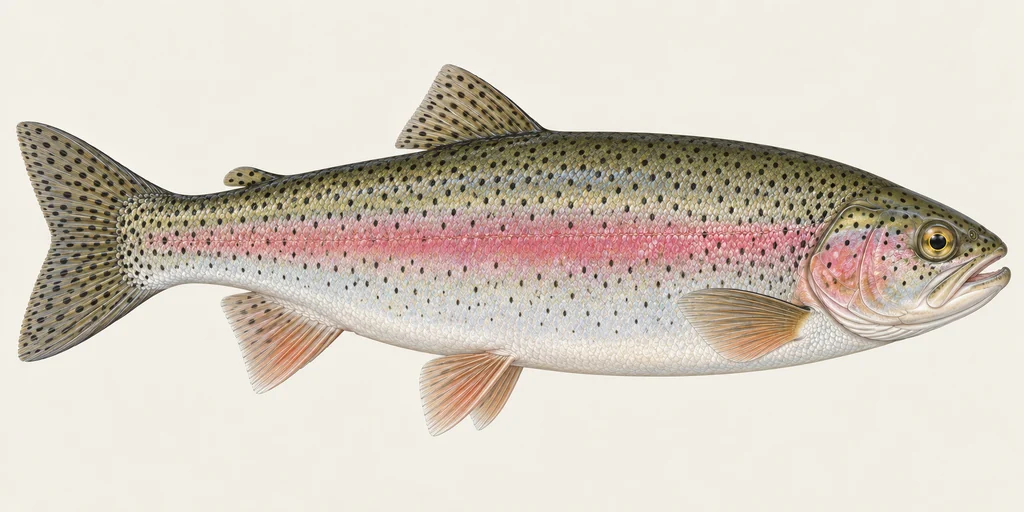
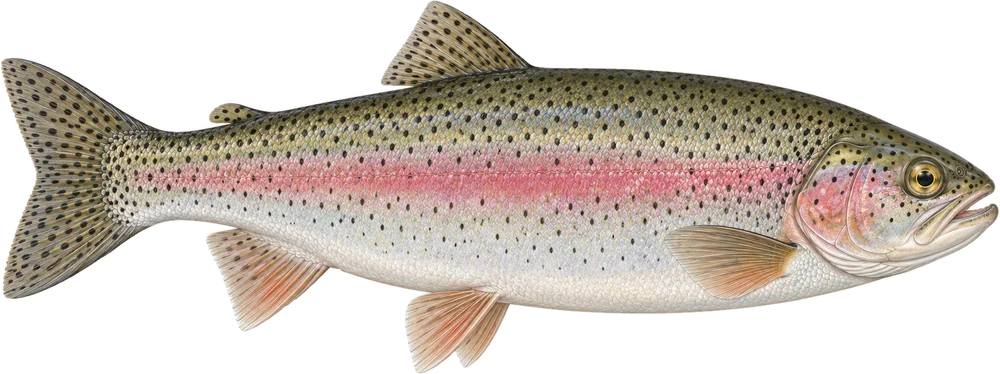
- Pinkish iridescent longitudinal band on the sides of the body
- Many small dark spots on the head, body, dorsal fin, adipose fin and tail fin
- Spindle-shaped body with a blunt snout and wide gape
Catch chances through the year
- Hardly any chance
- Possible
- Good
- Peak season
- Spawning (observe the closed season)
Editorial assessment for waters in Germany, not a measured value and no guarantee. Spawning time is not the same as the legal closed season.
Species profile and sources in the catch calendarAll species compared month by monthThe rules of your federal state
How to recognise a rainbow trout
The body is spindle-shaped, slightly flattened from the sides, with a blunt snout and a wide gape. The back is brownish to olive, the flanks paler. Typical features are a pink, iridescent band along the flanks and numerous small dark spots spread over the head, body and the dorsal, adipose and tail fins.
The colours change with the water and the condition of the fish. Fish from streams and spawners are darker and more strongly coloured, lake fish paler and more silvery. Typical lengths are 25 to 60 centimetres, and the LFV Bayern gives up to 75 centimetres as the maximum. FishBase lists 123 centimetres and almost 26 kilograms as an exception; these are record values.
The rainbow trout differs from the brown trout by the pink longitudinal band and the spots on the tail fin, while the brown trout has red spots with pale rings. At the water the rainbow trout gives itself away by its behaviour: it splashes now here, now there in the middle of the stream, whereas brown trout rise at larger intervals near their lies.
Silvery rainbow trout that end up on the hook on the Baltic coast when fishing for sea trout are called steelhead by anglers. Blinker says they mostly escaped from net farms. Steelhead is properly the migratory form of the species that lives in the sea.
Side by side
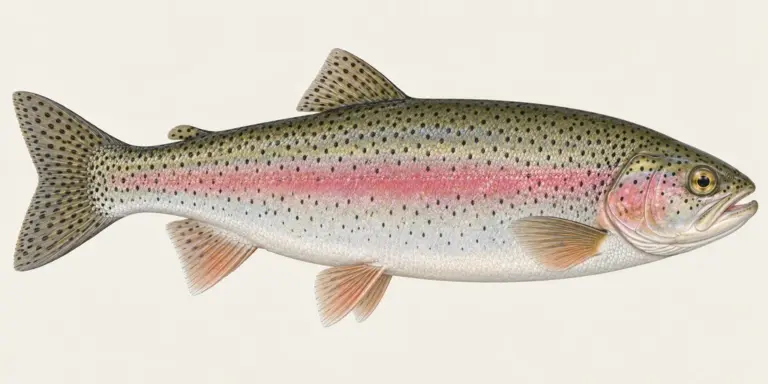
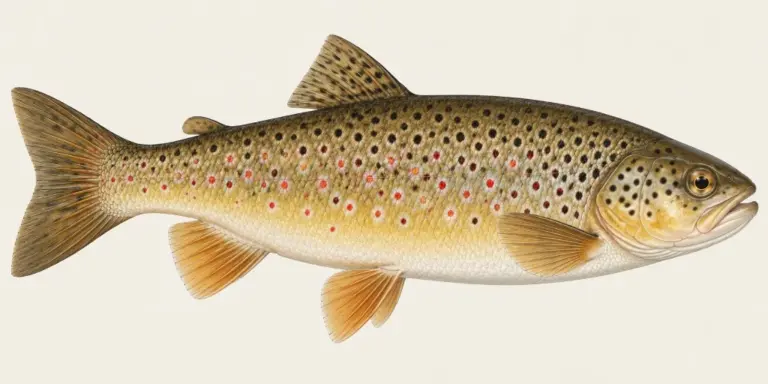

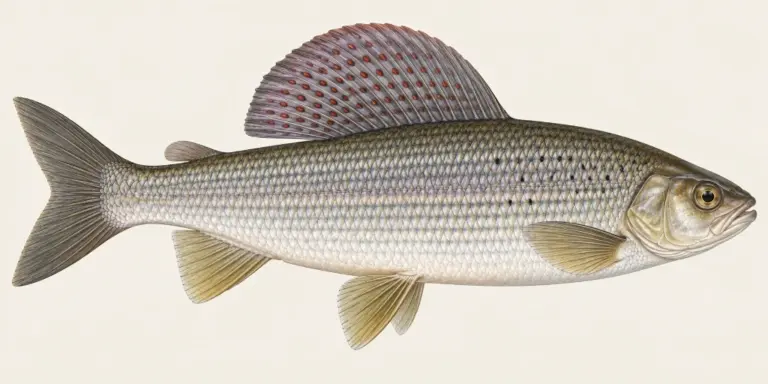
AI-generated illustrations.
Where the rainbow trout stands
Its original home is the west of North America. FishBase lists clear, cold spring brooks, streams, rivers and lakes. In Europe the species has been stocked into almost all types of water. It tolerates warm and low-oxygen spells better than the brown trout, which is also why it is popular in fish farming. According to FishBase it is not usually stocked into waters that reach over 25 °C in summer.
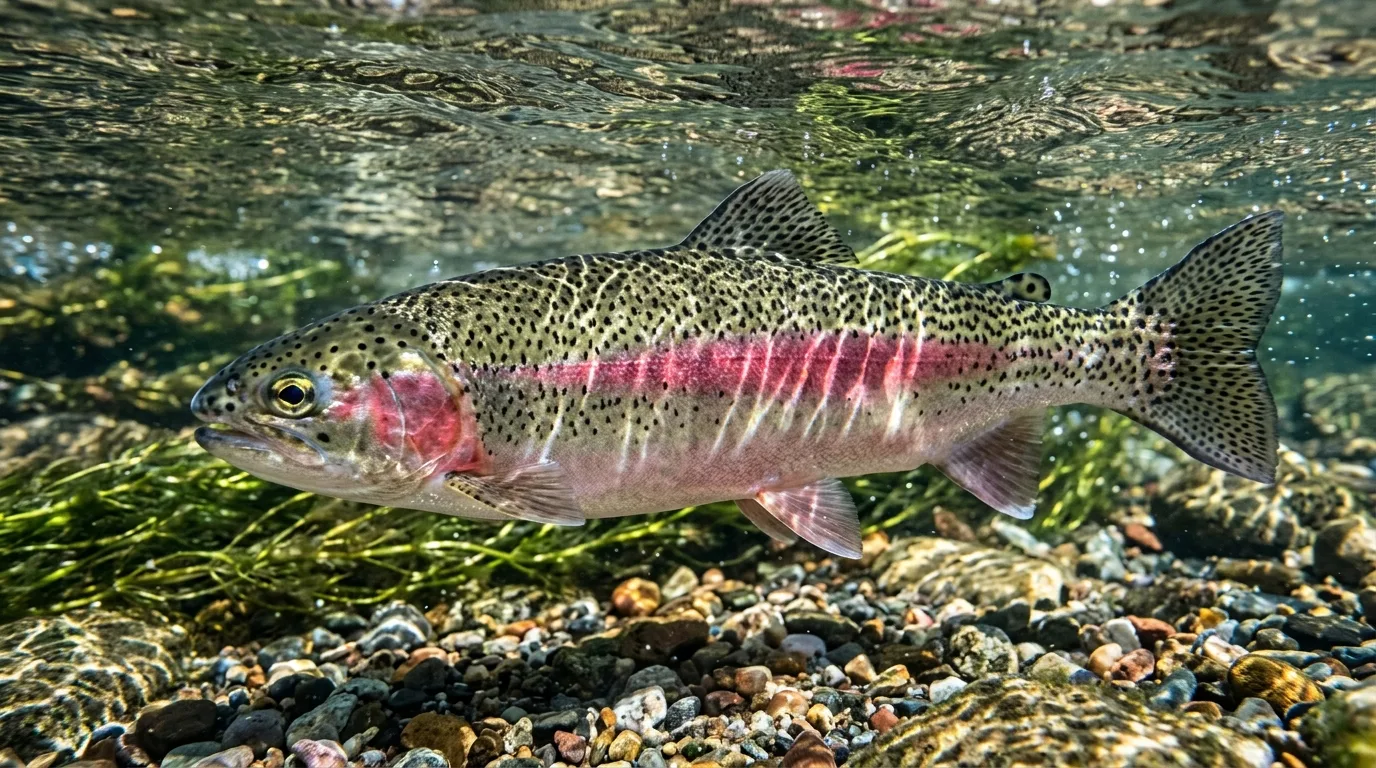
In running water, unlike the brown trout, it does not stand in cover but out in the current, and often cruises just above the bottom in the middle of the river. It uses deep channels, eddies behind bends and foaming water below waterfalls. There it waits directly under the drop or at the exit of the pool, the deep hole.
In still water it looks for spots with fresh water: stream inflows and bottom springs. In trout lakes you catch it anywhere, above all in the current of the inflows. Dam walls and jetties are also worth fishing, because small fish gather there. Rising fish give away their lies (Fishing at a trout pond).
Holding spots in the picture
Choose the season and time of day: the picture shows where the species stands then. Spots outlined in red apply only in the chosen season. Tap a fish or a spot in the list to bring it closer. The picture is schematic and AI-generated, every water is different.
Catch chance in springpossibleSpawning season, observe closed seasons
Catch chances in summerpossible
Catch chance in autumngood
Catch chances in winterpossiblespawning season, observe the closed seasons
- J
- F
- M
- A
- M
- J
- J
- A
- S
- O
- N
- D
Spawning season
Active time The rainbow trout feeds most in the early morning and evening hours.
Not a prime time The rainbow trout feeds most in the early morning and evening hours.
Active time The rainbow trout feeds most in the early morning and evening hours.
Not a prime time The rainbow trout feeds most in the early morning and evening hours.
In the river
Pools, deep spot
Rainbow trout are found here all year round.
Free current in mid-river
Rainbow trout are found here all year round.
Unlike the brown trout, the rainbow trout sits in the open current, often just above the bottom in mid-river. Other spots are deep channels, pools and the foaming water below waterfalls. It is not faithful to one spot and travels long stretches upstream.
Spring: catch chances according to the catch calendar: possible. Spawning falls in this period, so observe the closed seasons (Schonzeit). Spring is regarded as a good time to fish.
Summer: catch chances according to the catch calendar peak season in June, possible in July and August. The species tolerates warmer, lower-oxygen water than the brown trout. According to FishBase it is not usually stocked in waters that warm to over 25 °C in summer.
Autumn: catch chances according to the catch calendar good in September, peak season in October, possible in November. Autumn too is regarded as a good time to fish.
Winter: catch chances according to the catch calendar: possible. Spawning falls in this period, so observe the closed seasons (Schonzeit). The spawning time depends on the strain and, according to the Landesfischereiverband Bayern, runs from October to May. Spawning takes place over gravel bottoms in the upper reaches, but in our waters the species rarely reproduces naturally.
In the lake
jetty, sheet piling, harbour
Rainbow trout are found here all year round.
Deep bottom
Rainbow trout are only found here in winter.
Open water
Rainbow trout are only found here in autumn.
In a lake the rainbow trout stays at stream inflows and bottom springs, and also at dam walls and jetties. It roams, mostly into the wind.
Spring: catch chances according to the catch calendar: possible. Spawning falls in this period, so observe the closed seasons (Schonzeit). In spring the fish often sit close to the shore because the shallow water warms up there first. Bites then come throughout the day.
Summer: catch chances according to the catch calendar peak season in June, possible in July and August. In high summer they seek cooler, oxygen-rich water at inflows and springs and in the shade. They are most likely to bite early in the morning and late in the evening.
Autumn: catch chances according to the catch calendar good in September, peak season in October, possible in November. Until the first frosty nights the fish are very active, roam the whole water and mostly sit in open water.
Winter: catch chances according to the catch calendar: possible. Spawning falls in this period, so observe the closed seasons (Schonzeit). In the cold they sit sluggishly at the deepest spots. Then the bait lies quietly just above the bottom.
Depth: In cold lakes and reservoirs it often stays at medium depths.
Size comparison: AI-generated drawing, schematic.
How it feeds, migrates and spawns
Rainbow trout do not stay put. Especially in larger rivers they travel far upstream looking for insects and snap at them with quick sideways turns. They eat invertebrates in the water and on the surface as well as small fish. In reservoirs and lakes they charge into shoals of fish fry.
The spawning season depends on the strain. The LFV Bayern gives October to May, FishBase November to May. Males usually mature at two years, females at three. The female digs a spawning redd, and depending on size a female lays 700 to 4000 eggs. Natural reproduction in our waters has been proven but occurs rather rarely.
In the wild the rainbow trout reaches up to 11 years of age according to FishBase.
When it bites
You can catch it all year, and spring and autumn count as good times. Because in many strains spring still falls within the spawning season, the catch calendar lists March to May only as possible and June and October as the main season. In midsummer it gets harder, and then you catch mainly early in the morning and late in the evening. The fish feed most strongly early in the morning and in the evening. Blinker reports particular activity after thunderstorms and in light rain.
In summer the fly is often superior to spinning. In waters with heavy angling pressure the fish become wary over time and, after bad experiences, take metal lures less readily (The year at the water).
Today’s catch index needs JavaScript. Season and spawning time are in the catch calendar.
You will find the monthly overview of all species and the water temperature check in the catch calendar.
From the blog: Trout lake in winter: rigging a buoyant bait and setting the right bait height · Freshwater fish in Germany: which species you catch where
What to catch it with
Step by step: Rainbow trout fishing: tips on bait, rigs and tackle – season, spots, baits, tackle and rules on one page.
Spinning anglers value the rainbow trout because it fights hard and jumps in the fight, does not need such precise casts as the brown trout, and takes the lure even on a full stomach (Spinning). In a stream, small spinners, small spoons, spinner flies and tiny plugs catch fish, and with metal above all silver and gold. Plugs in rainbow patterns fit because cannibalism is common in streams. On a river you can also spin with the current, not only against it. On a lake you need lures with casting distance, such as lead-head spinners, dead baitfish on a rig or single-tail twisters, worked just below the surface. A quickly worked lure awakens the predatory instinct.
On managed trout lakes with fish stocked at catchable size, natural baits often catch better: worm or grasshopper on a bubble float, maggot, sweetcorn, floating paste, dyed salmon eggs or dyed herring roe. You switch between floating on the bottom and under a float (float rig). From spring to autumn the slow retrieve of a sbirolino with a long hooklength is considered especially successful (float fishing, sbirolino rig). In winter the fish stand sluggish in the deepest spots, and then the bait lies still just above the bottom.
With a fly rod you catch rainbow trout in rivers and lakes (fly fishing). A rod of class 5 to 6 and around 2,50 metres is enough. The dry fly is difficult because the fish do not rise regularly in one spot but cruise around, on a lake usually into the wind, on a river against the current. You follow the direction of the rings and, after a few false casts, put the dry fly down a little way ahead of them, for example as an imitation of mayflies or caddis flies. The streamer is easier, and you twitch it through the water with even pulls of line. With the dry fly the leader may be as long as the rod, with sinking flies a metre is enough.
Set a soft drag: In the fight the rainbow trout often jumps. With a softly set drag and the rod held low over the water you lose fewer fish at the jump. For spinning rods of around 2,50 metres and fine lines of 0,18 to 0,22 millimetres this applies all the more.
Place the bait ahead of the fish: When you target a rising fish, put the bait a little way ahead of the rings, because the fish cruise around. A leader tip of 0,16 to 0,18 millimetres is enough as long as you do not expect very large fish.
Vary natural baits: When the fish stop taking metal after bad experiences, switch to natural baits and vary between the bottom and the float.
Suitable lures
Spoons, small soft lures, trout paste; on the river nymphs, wet flies and streamers.
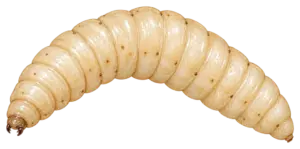
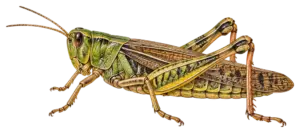
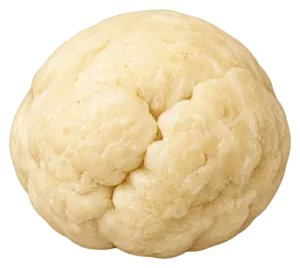
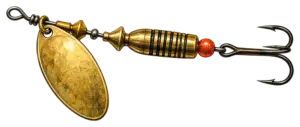
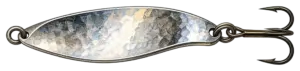
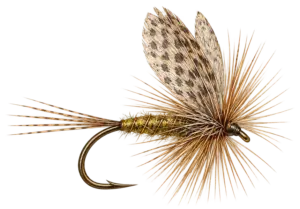
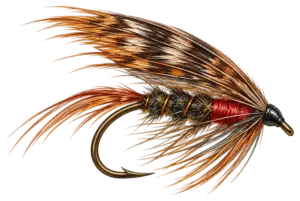
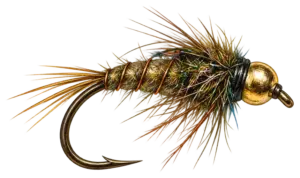
AI-generated illustrations. A click opens the lure’s page.
Also suitable: Streamer, Crankbait.
Rigs for these baits: sbirolino rig, float rig, running ledger rig.
What the rainbow trout tastes like and what to do with it
Trout are distinguished by firm, finely textured flesh whose colour ranges from white through pink to slightly red, depending on food. Large, fat-reared rainbow trout are usually sold as salmon trout, getting their reddish flesh colour from carotenoids in the feed. FishBase records the species as fresh, smoked, canned and frozen.
How to prepare fish is explained on the kitchen pages: Gutting fish, Filleting fish and Smoking fish.
Origin, status and rules
Closed seasons (Schonzeit), minimum sizes (Mindestmaß) and harvest windows are set by the federal states (Bundesland), and on many waters additionally by the club or leaseholder. They differ depending on the water and the time of year. We give figures only with a date and a source; always binding are the fisheries regulation of your federal state and your fishing permit (Erlaubnisschein). You will find a list of links to the official sources in the catch calendar.
A fish of legal size that you want to keep you stun and kill at once, in line with animal welfare rules. Protected, undersized fish or fish too large under a harvest slot you unhook, if possible still in the water and with wet hands, and release gently. What exactly applies is regulated by state law and your fishing permit (Erlaubnisschein).
Many federal states (Bundesland) expressly prohibit fishing with live baitfish; use a dead baitfish.
The rainbow trout is a non-native species. In the 2023 Red List of freshwater fish of Germany it is not evaluated and counts as a neobiont. The Bundesamt für Naturschutz lists it in its invasiveness assessment as an established species on the management list. Stocking and taking are governed by state law and the water’s rules, and at a trout pond the operator’s rules apply in addition.
What closed season, minimum size and harvest slot mean and where to find them is explained on the page Closed season and minimum size explained.
What state law says about the closed season (Schonzeit) and minimum size (Mindestmaß) for this species is in the “At a glance” box on the state pages for Baden-Württemberg and Bavaria. For the other states our overview does not list this species; there the state fisheries regulation (Landesfischereiverordnung) is decisive.
Frequently asked questions (FAQ)
Where does the rainbow trout stand in a stream?
Unlike the brown trout, not in cover but in the open current, often just above the bottom in the middle of the river, in deep channels, behind bends and below waterfalls. It roams widely while doing so.
What do you catch rainbow trout with on a trout lake?
There the fish often take natural baits better, such as worm, maggot, sweetcorn or floating paste, under a float or on the bottom. Metal lures and flies catch well at first, but the fish become wary under heavy angling pressure.
Is the rainbow trout a native species?
No. It comes from the west of North America and arrived in Europe around 1880. In Germany it counts as an established species rated as invasive by the Bundesamt für Naturschutz.
Sources
The rating of catch chances is an editorial assessment. The facts come from these sources, and the text is worded in our own words. The illustration is an original design by Angel Momente in the style of a natural history plate (AI-generated, see the AI notice).
- Landesfischereiverband Bayern: Fischlexikon (Laichzeit, Lebensraum, Nahrung, Aktivität)
- FishBase: Oncorhynchus mykiss (Höchstalter, Bestimmungsmerkmale, Besatz)
- Blinker: Steckbrief Regenbogenforelle (Standplätze, Fangzeit, Köder, Gerät)
- Bundesamt für Naturschutz: Gebietsfremde Fische, naturschutzfachliche Invasivitätsbewertung
- Rote-Liste-Zentrum: Regenbogenforelle (Gesamtartenliste 2023: Neobiota, nicht bewertet, als invasiv eingestuft)
- BMLUK Österreich: Forelle (traditionelle Lebensmittel; Einfuhr, Merkmale, Lachsforelle, Fleisch)
- U.S. Geological Survey: Oncorhynchus mykiss (Rainbow Trout), Nonindigenous Aquatic Species Profile
- Fisch & Fang: Forellensee-Einmaleins (Fangzeiten im Jahresverlauf, Standplätze)
- Fisch & Fang: Zielfisch Forelle, so fangen Sie am Forellensee (Sbirolino, Winterstandplätze)
Created with AI support from the sources listed. Figures only appear in the text if a source gives them. Last updated: 11 November 2026. Found a mistake? Write to us. Who is behind this site: About me.
More in the lexicon
- All fish species at a glance
- Catch calendar – month, water temperature and profile for 93 species
- Line calculator – breaking strain after the knot, drag guideline, backing
- Angling methods