
At a glance
- Rig
- running lead with a buoyancy body, swivel, hooklength and a bait that floats up
- Bait height
- without shot the hooklength, with shot the distance from shot to hook
- Home
- just above the bottom, then higher in small steps
- Ask beforehand
- opening hours, ice, last stocking, baits and what you may take
- Safety
- only from the firm bank, never onto the ice
Present the bait deep and still in the cold pond
The rainbow trout tolerates water from a good half a degree up to about 25 degrees. According to the Saxon State Office for Environment, Agriculture and Geology (LfULG), it grows best between 12 and 18 degrees. A pond in January is far below that.
So I expect sluggish fish holding deep, especially after frosty nights. A bait hovering still suits that better than one that is worked. I cast to the deepest spot within range first; where the fish hold through the year is described in Fishing at a trout pond. If trout show at the surface, at least some of them are holding higher, and I lengthen the hooklength.
In the catch calendar the rainbow trout is rated “Possible” from November to February. At a pond, more depends on when it was last stocked and whether the fishery opens in winter.
Build the buoyant rig piece by piece
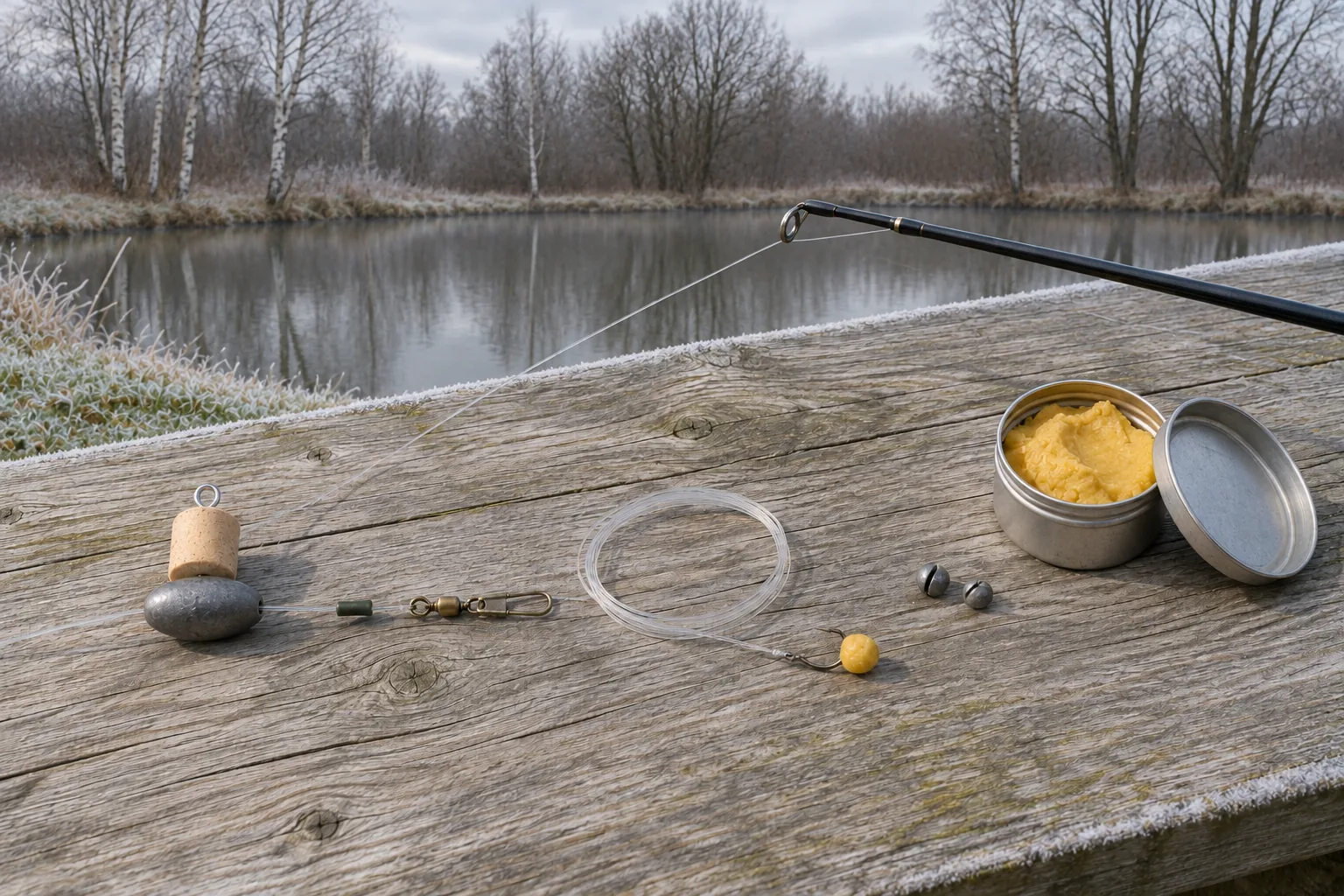
At its core this is a running lead rig with two special features: the lead carries a buoyancy body, and the bait floats up by itself. I build it in this order:
- Thread the bottom lead (Bodentaster) onto the main line: a running lead with a buoyancy body that stands upright on the bottom. On a muddy bottom a Tyrolean stick (Tiroler Hölzl) also does the job.
- Slide on a rubber stopper to protect the knot from the lead.
- Tie on a three-way swivel, for example with the uni knot. It stops the lead and takes the hooklength on its second eye (Swivel and snap).
- Tie in the hooklength, in winter 70 centimetres to one and a half metres long, depending on the height you are after.
- Put on the bait: floating trout paste, or a waxworm or mealworm with a small buoyant bead (Maggots and larvae).
- If needed, pinch a split shot onto the hooklength. It decides how much of the hooklength is allowed to rise.
- Hold the rig in the shallow margin. If the bait does not rise, I use more paste or slide a small buoyant ball onto the hooklength.
 AI-generated
 AI-generated
Set the bait height with the hooklength
The bait pulls the hooklength up from the swivel until it stands straight. With no extra weight it therefore hovers about as high above the lead as the hooklength is long.
With a split shot on the hooklength, only the section between shot and hook rises. In frost I take a good metre of hooklength and pinch the shot on so that the bait sits 10 to 50 centimetres above the bottom. For a new height I only move the shot.
| Where the trout hold | How I set it | In the figure |
|---|---|---|
| tight to the bottom, after frost | shot close to the hook, bait just above the bottom | short hooklength |
| a little higher, nothing happening down below | move the shot towards the lead in stages | medium hooklength |
| in mid-water, fish showing at the top | long hooklength without shot, or switch to a float | long hooklength |
With a float I can hold the bait at any depth; the colder the water, the deeper.
Change the height in small steps
I start deep. If it stays quiet for a quarter of an hour, I move the shot a few centimetres towards the lead and cast to the same spot again. After a bite I know what height the bait was at, and I keep it.
If the pond rules allow two rods, I set them at different heights. If one gets a bite, the other is given the same height.
Without shot I balance the bait so that it rises only slowly and searches the water column by itself. If I want to search rather than wait, I retrieve in short stages: the bait sinks as I wind and rises again in the pause.
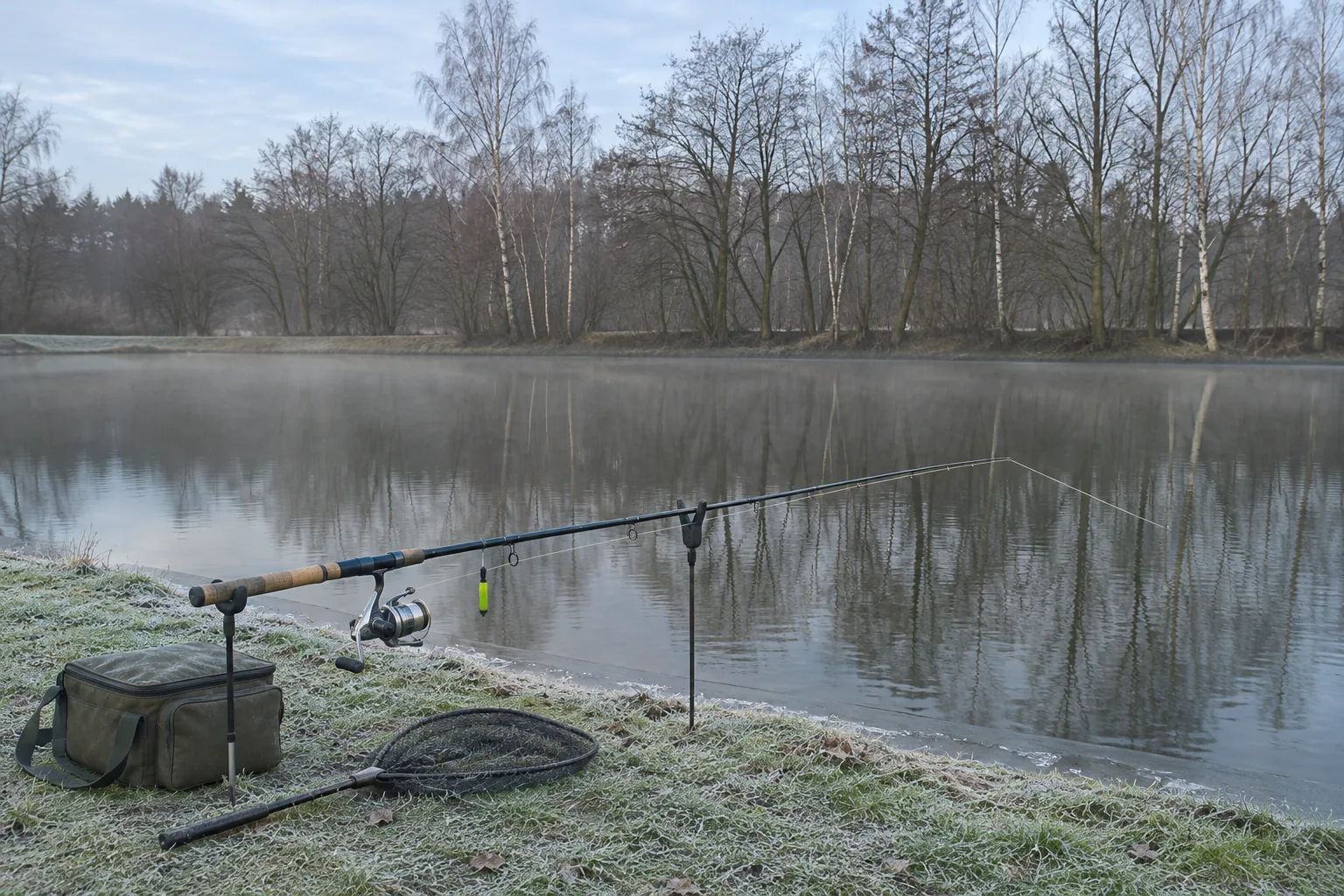
When the rod is on its rests, I leave the bail arm open or switch on the freespool reel and clip on a bite indicator. If a trout takes the bait, I wait until the line runs off steadily and then strike without force.
Check with the operator before you set off
Before I leave, I phone or read the fishery’s website and check these points:
- Whether the fishery is open in winter, and at what times.
- Whether there is ice on the pond and which stretches of bank are clear. Under a closed ice cover, oxygen can run short in small ponds, the Berlin environment administration writes, to the point of fish kills.
- When fish were last stocked and from which day these fish are released for fishing. In Schleswig-Holstein operators must record the delivery date and the release.
- Which baits are allowed and whether groundbaiting is permitted.
- How many fish the ticket allows and whether releasing fish is forbidden.
- Whether there is a place to kill and pack the catch.
The leaflet from Schleswig-Holstein lists the last three points and closed protection zones as the content of a set of pond rules.
At a fishing pond the operator’s rules apply. The Lower Saxony guidance provides for pond rules displayed on site. Whether you also need a fishing licence (Fischereischein) is decided by the federal state. In Mecklenburg-Western Pomerania, for example, the licence requirement expressly applies at fishing-pond fisheries too (LALLF leaflet, as of March 2022). Even where the state does not require a licence, the fishery may ask for one; its house rules cover that. The state rules and the waiting periods after stocking are covered in Fishing at a trout pond and under Fishing licence and angling exam.
From my own experience
- In frost I choose a fishery whose inlet I can reach from the firm bank. The inflowing water often keeps a spot open there when the rest of the pond is already freezing over.
- I plan which fishery to visit in winter around the stocking. I check the fisheries‘ websites regularly, because many announce the next stocking there in advance.
- At the swim I stay a step back from the edge of the bank, move little and recast only rarely. Winter trout often hold close to the bank and notice footsteps and shadows.
Kill the trout and chill it straight away
I land the trout with the landing net, stun it with a firm blow to the head and kill it immediately afterwards. Only then do I remove the hook. That is what the Lower Saxony guidance requires; the blow to the head is permitted by the Tierschutz-Schlachtverordnung (the German regulation on animal welfare at slaughter). The individual steps are shown in Stunning and killing fish.
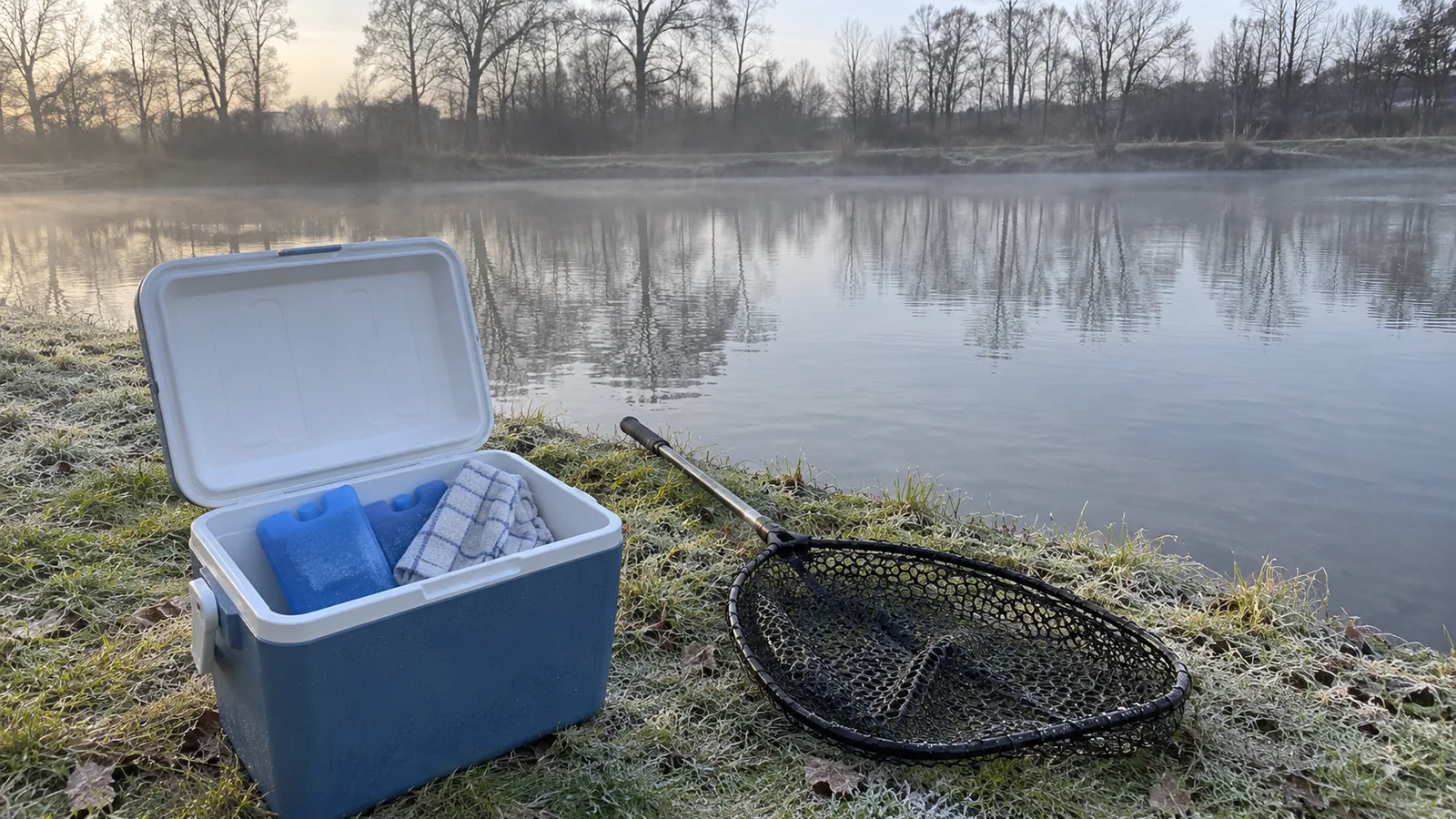
After that the fish goes into the cool box with ice packs. The German consumer advice centre (Verbraucherzentrale) gives 0 to 4 degrees on ice for fresh fish. Gutting and storing at home are described in Storage and hygiene.
When there is ice, fish only from the firm bank
If the pond freezes over, I cast only into the open water in front of the firm bank. I do not go onto the ice, not even for a snagged rig.
The DLRG warns that ice may not bear enough weight even when it looks thick enough. According to its advice, it breaks more easily along an overgrown bank. Guide values and what to do after falling through are covered under Stepping onto ice. This note does not replace safety instruction.
Frequently asked questions
How long should the hooklength be at a trout lake in winter?
I use 70 centimetres to one and a half metres. If there is a shot on it, only the section beyond it rises.
Why does my paste not float up?
Usually the amount of paste does not carry the hook. More paste or a small buoyant ball then helps.
Do rainbow trout bite in frost?
Yes, but they are sluggish and hold deep. I then present the bait still, just above the bottom.
Do I need a fishing licence at a trout pond?
Each federal state decides that for itself; in Mecklenburg-Western Pomerania, for instance, the requirement applies at fishing ponds too. The operator can ask for a licence regardless.
Related
- Rainbow trout: the profile
- Fishing for rainbow trout: step by step
- Fishing at a trout pond: holding spots and rules
- Trout fishing at a pond: methods for active fish
- Running lead rig: leads and bite indication
- Bait paste: types and staying on the hook
- Stepping onto ice: warning signs and self-rescue
Sources
- Sächsisches Landesamt für Umwelt, Landwirtschaft und Geologie, Dr. Gert Füllner: Klimawandel und Teichwirtschaft, Fachtag Fischerei 2020 (Temperaturbereich der Regenbogenforelle)
- Rute & Rolle: Forellenteich, die besten Montagen (26.11.2025; Bodentaster, Vorfachlänge, auftreibender Köder, Einholen in Etappen)
- Fisch & Fang: Forellensee-Einmaleins (2010; Grundmontage bei Frost, Schrot und Köderhöhe, Pose im Mittelwasser)
- Fisch & Fang: Zielfisch Forelle, so fangen Sie am Forellensee (2010; schlammiger Grund, Schrot verschieben, langsam aufsteigender Köder, Anschlag)
- Blinker: Steckbrief Regenbogenforelle (steigende Fische, auftreibender Teig am Grund)
- Blinker: In 14 Schritten zur Köderfischmontage, Seite 2 (Vorfachlänge und Höhe eines auftreibenden Köders)
- Blinker: Tipps zum Hornhechtangeln (Auftrieb vor dem Wurf im Uferwasser prüfen)
- Fischereiverein Löningen: Gerätekunde (Bleie mit Auftriebskörper auf schlammigem Grund)
- LAVES Niedersachsen: Hinweise und Empfehlungen zum Betrieb von Angelteichen (Teichordnung, Reihenfolge nach dem Anlanden)
- LALLF Mecklenburg-Vorpommern: Merkblatt für das Betreiben von Angelteichen (Stand März 2022; Fischereischeinpflicht)
- Land Schleswig-Holstein: Merkblatt Angelteiche (November 2025; Teichordnung, Besatzaufzeichnungen, Hausrecht)
- Berliner Senatsverwaltung für Umwelt: Pressemitteilung vom 25.02.2026 (Sauerstoffmangel unter Eis)
- Tierschutz-Schlachtverordnung, Anlage 1 (Betäubung durch Schlag auf den Kopf)
- Verbraucherzentrale: Fisch, alles zu Haltbarkeit und Lagerung (Temperatur für frischen Fisch) und LfL Bayern: Prüfungsfragen zur Fischerprüfung 2023/2024 (Kühlbox mit Kühlakkus)
- DLRG: Selbstrettung bei Eisunfällen und DLRG-Jugend Bayern: Leitfaden Eisregel-Training (Tragkraft, Eis am bewachsenen Ufer)
Text AI-assisted, drawing and images in the text AI-generated, title photo: Iwan Belokurov. Sources opened and checked in October 2026; no graphic was taken from the sources.
All figures are guide values without guarantee. What is allowed at the pond is set out in the pond rules; whether you need a fishing licence (Fischereischein) is governed by state law.