
At a glance
- Last metre
- don’t stop, keep it moving in an arc along the bank
- Holding spot
- a big step back from the edge
- Strike
- immediately, sideways and low
- Next cast
- change exactly one thing, colour last
- Landing
- only with a large, rubberised landing net
What a follow tells you
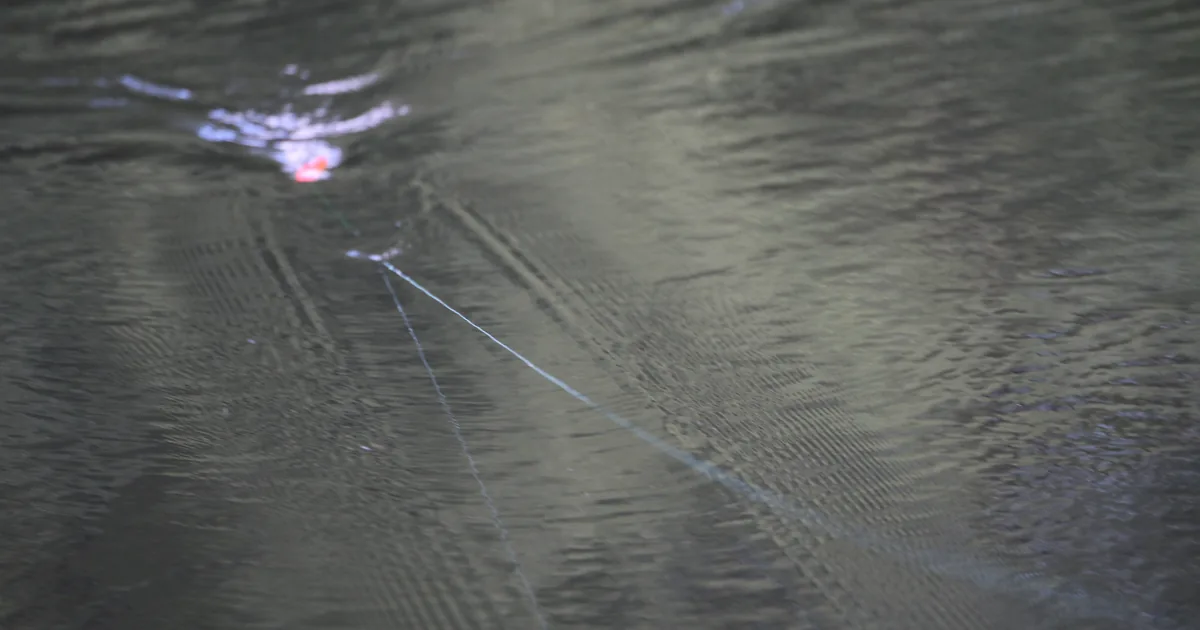
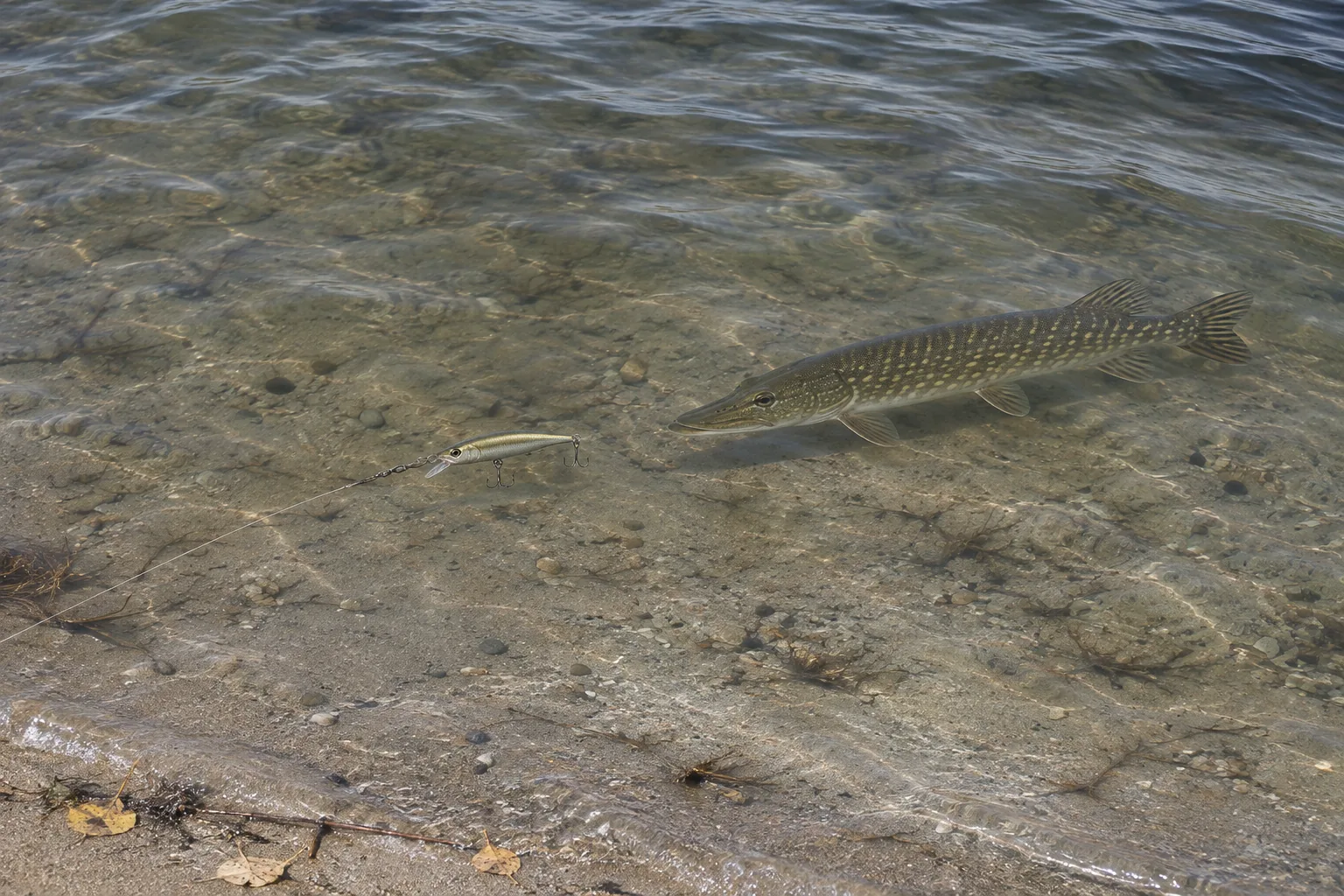
A follower is a pike that follows the lure, often to just short of the bank, and then does not take it. The Anglerverband Niedersachsen describes the pike as a sight hunter with very mobile eyes. According to the pike brochure of the Deutscher Angelfischerverband (DAFV), they point slightly forwards, so that it sees with both eyes at once over an angle of about 80 degrees.
How close a pike gets before it strikes was measured in a tank by the Fischereiforschungsstelle Baden-Württemberg. On average, the pike lined up on a moving lure at around 23 centimetres and attacked from just under 12 centimetres. The researchers see the natural movement of the prey as the most important trigger. Whether the soft plastic in the trial was naturally coloured or garish made no measurable difference to the willingness to attack. The tanks were only half a metre wide, and in a lake the distances may look different. The pattern holds: the pike follows from a distance and only strikes at short range.
With polarised glasses, which take the glare off the surface, I often see a follower several metres before the edge. It shows me that there is a pike there and that the lure has stirred it, but not why it does not take.
Leading the last metre in an arc
The tricky part is the end of the retrieve. If I stop the lure there, it hangs motionless under the rod tip or comes out of the water, and for a fish that reacts to movement the game is over. So I keep it moving without a pause and only change direction. One or two metres before the edge I lower the rod tip and steer the lure in a wide arc along the bank, and if there is room, in a sideways figure of eight.
Nobody can predict whether a pike will take in the arc. If it still turns away, I run a second arc and then lift the lure out calmly. So that the arc has room, I stand a big step back from the edge, and even further back on soft, steep banks. What I watch out for there is collected on the page Bank and waders.
If the pike takes, I strike immediately. In the same tank trial, which was run without hooks, the pike spat out both soft plastics again straight away in more than 94 per cent of cases, while they mostly kept a dead bait fish in their mouths. I strike sideways and low. Overhead, the tip can get caught in branches or a power line, and a lure that comes free flies towards you.
Change one thing before the next cast
After a follow I cast the same line again, but not in the same way. I change exactly one thing per cast so that I know what made the difference: first the speed, then the depth, then the size and only last the colour.
On a plug, the size and angle of the diving lip set the depth; for a different depth I take a model with a different lip. With lures without a diving lip, more speed and a raised rod make the lure rise without you noticing, while a low rod tip keeps it down. If it brings back weed, it was running too deep. With a bladed jig, it is mainly the head weight that determines the running depth.
When it comes to size I tend to go up, partly because the Humboldt-Universität zu Berlin tends to recommend larger lures for pike for gentle release. The colour comes last because it made no measurable difference in the tank trial. I save a completely different type of lure until the end, as it changes too much at once. Sticking with a plug or spinner also spares the fish: in the work of Arlinghaus and colleagues, the hook ended up in the gills or gullet less often with these than with soft plastics, jigs or natural bait. If things stay quiet after five or six casts, I move on and come back later, because pike learn to avoid lures, as Pike in autumn shows.
| What I see | What I change | How I check it |
|---|---|---|
| Pike follows right to your feet and turns away | keep it moving in an arc, then change one thing | whether it follows again and how close it comes |
| Lure without a diving lip brings back weed | reel faster, rod higher, lighter head on the bladed jig | whether the next casts come back clean |
| Lure without a diving lip surfaces too early | reel more slowly, keep the rod tip low | whether it stays down longer on the same line |
| Suspender sinks during the pause | smaller snap, no split ring, lighter trace | whether it hovers for ten seconds in shallow water |
| no more followers after five or six casts | move spots, come back later | whether it follows again on the next visit |
| Pike takes in the arc | strike sideways immediately | whether the way to the landing net is clear |
From my own experience
- If a pike has looked at the lure for a long time and then turned away, I reel faster on the next cast so that it only gets a brief look at colour and finish.
- If the water still reflects despite polarised glasses, I tilt my head a little to the side until I can see the lure again over the last few metres and tell whether a pike is following.
Balancing the suspender at the bank
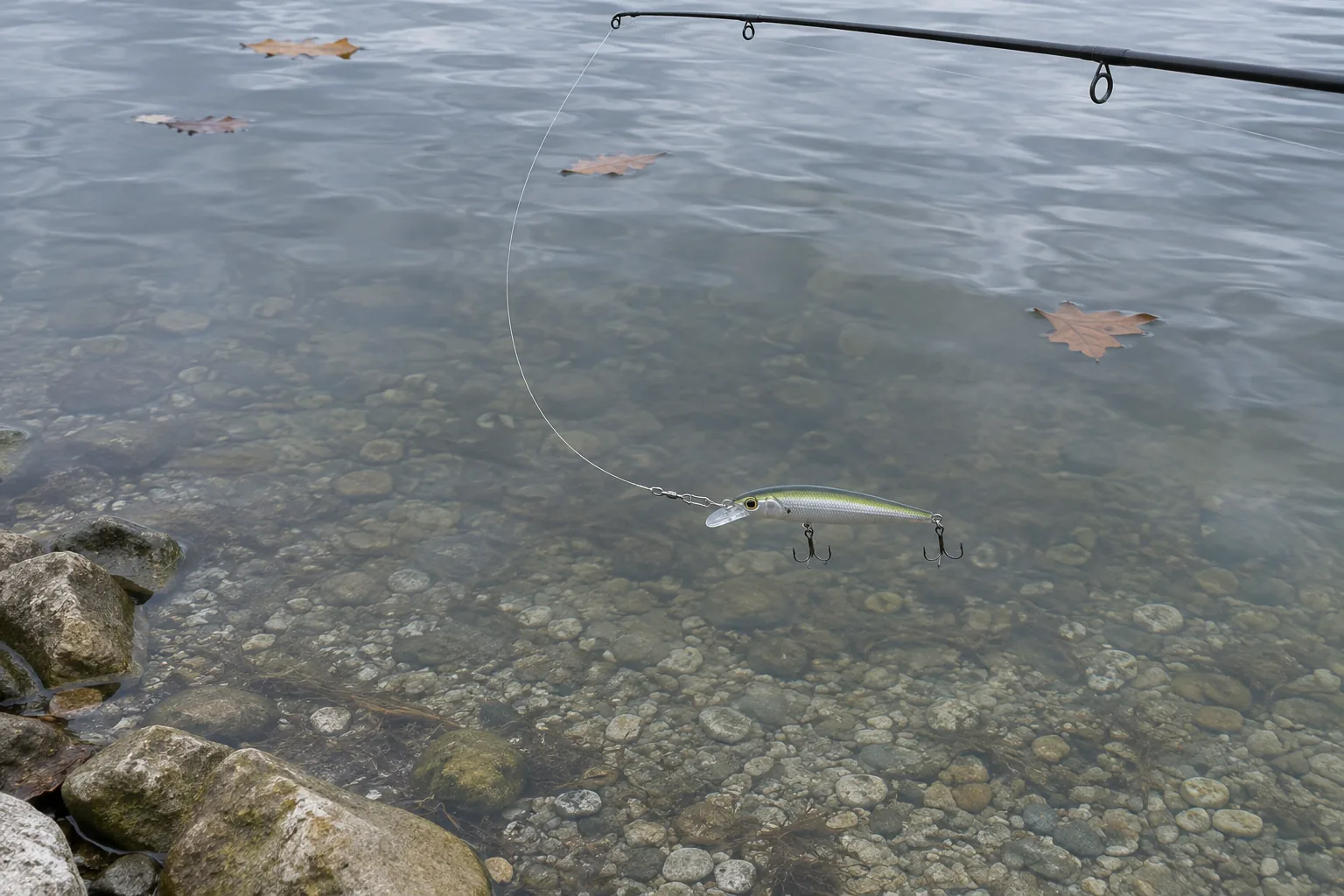
A suspender gives a hesitant pike plenty of time because it hovers on the spot during the pause, provided the snap and trace suit the lure. A heavy snap, an extra split ring or a thick trace pull the nose down, most noticeably on small models. Even so, I never do without a bite-proof trace for pike; which material is suitable is explained in Pike trace.
I check this with the complete rig in clear shallow water right at the bank, without wading in: pull the lure under water, leave the line slack, count to ten. If it sinks, I take a smaller snap, leave out the split ring or choose a lighter trace. If it rises, the snap can be one size bigger. Only then do I fish it with long pauses where a pike followed before.
 AI-generated
 AI-generated
Landing the pike at the bank with a landing net
If you get followers right up to your feet, you have to expect a take right at the edge. That is why my landing net lies open next to me before the first cast, and I land pike only with it. The Bavarian exam questions for the angling exam (Fischerprüfung) describe a good landing net as having a deep, roomy net bag of strong, knotless material and call rubberised nets especially gentle because hooks hardly penetrate them. I lead the pike in head first.
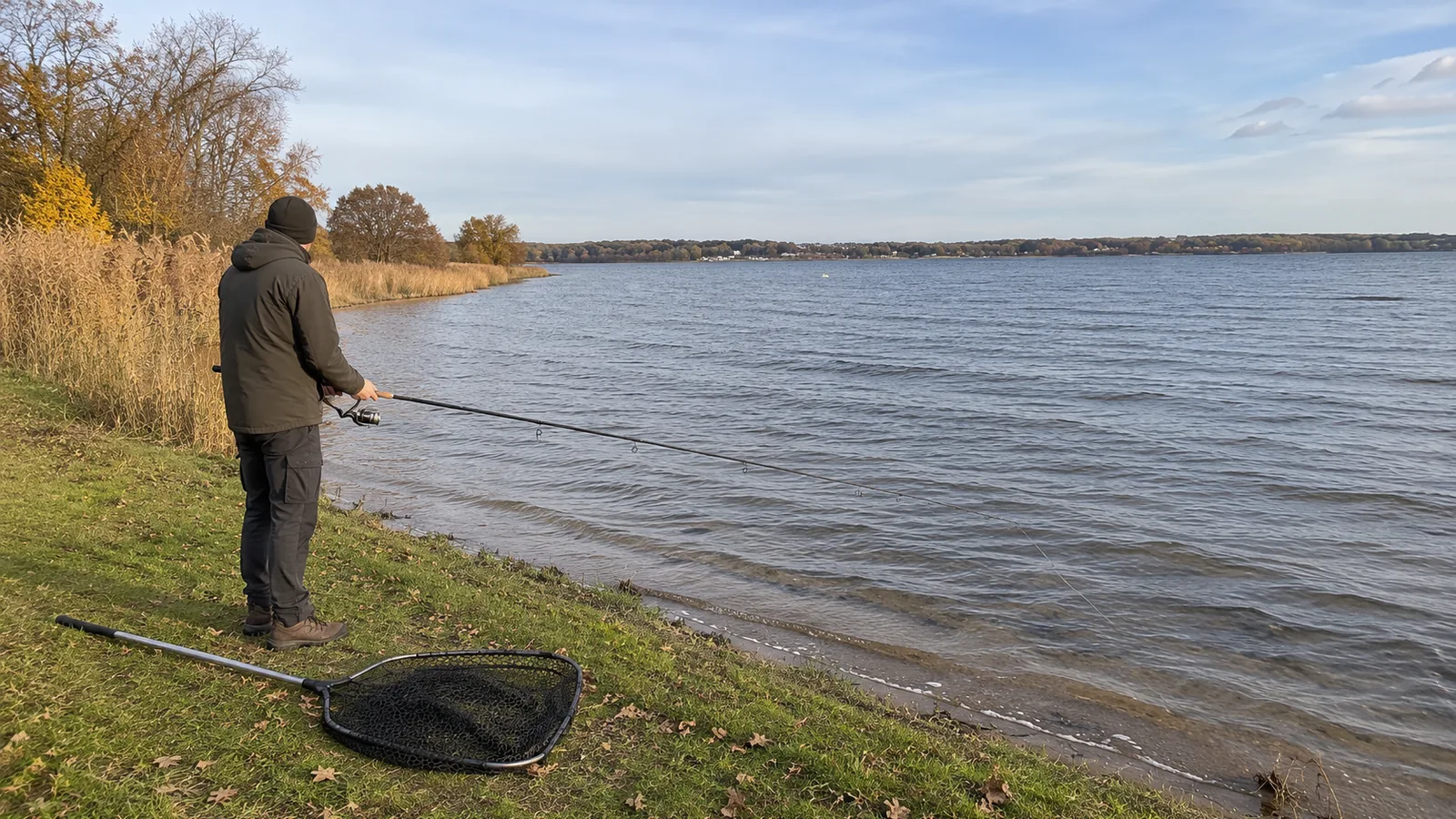
I leave out the grip behind the head. The same exam questions warn that you can reach into the gills and injure both fish and person. With the trebles of a plug close to my hand, I don’t want that, and I don’t use a jaw gripper either. How I then hold and unhook the pike is described in Landing and unhooking fish.
Followers happen throughout the open season; according to the catch calendar, the main season is October to December. Depending on the weather, pike spawn into May, according to the DAFV. When its closed season (Schonzeit) ends and which minimum size (Mindestmaß) applies is set by your federal state (Bundesland), and you also need a fishing permit (Erlaubnisschein). The basics are explained in Closed season and minimum size. The water temperature at which I leave pike alone is covered under Releasing a fish.
Frequently asked questions
Should I stop the lure in front of a following pike?
Further out, a short stop can work, as with a jerkbait, because the lure then starts moving again. In the last metre there is no room for that, so there I steer it on in an arc.
Does a garish colour help if the pike only follows?
In the tank trial from Baden-Württemberg, the pike did not attack a garish soft plastic more often than a naturally coloured one. So I only change colour once speed, depth and size have not worked.
Should I land the pike by hand at the bank?
I advise against it. When you grip behind the head, your hand can get into the gills; that injures the fish and can injure you too. A large landing net with rubberised mesh is the safe way from the bank.
Related
- Pike profile: features, spawning time and habitat
- Fishing for pike: methods, playing and landing
- Pike in autumn: holding spots and learned lure avoidance
- Fishing spots in autumn: which banks I cast at first
- Twitchbait: retrieve patterns with pauses
- Landing net: mesh, size and handle
Sources
- Lucas u. a., Fischereiforschungsstelle Baden-Württemberg: Effects of behavioral strategies on catchability, bait selectivity, and hunting behavior in northern pike (2023, PDF) (Abstände, Auslöser, Farbe, ausgespuckte Gummiköder)
- Deutscher Angelfischerverband: Fisch des Jahres 2016, Der Hecht (PDF) (Augenstellung, Laichzeit)
- Anglerverband Niedersachsen: Pike (Augenjäger)
- Bayerische Landesanstalt für Landwirtschaft: Prüfungsfragen zur Fischerprüfung 2023/2024 (PDF) (Kescher, Tauchschaufel, Griff hinter den Kopf)
- IFishMan (Humboldt-Universität zu Berlin, IGB): Waidgerecht, Pike (Ködergröße)
- Arlinghaus u. a.: Size Selectivity, Injury, Handling Time, and Determinants of Initial Hooking Mortality in Recreational Angling for Northern Pike (2008, PDF) (Hakensitz nach Ködertyp)
- Wikipedia: Wobbler (Angeln) (Einhänger, Tauchschaufel, ergänzend)
- Blinker: Laufverhalten von Wobblern (Suspender, Nachläufer)
- Blinker: Was sind eigentlich Swimbaits? (Rutenhaltung, Kraut am Haken)
- Blinker: Ratgeber zum Jig mit Metallklinge (Kopfgewicht und Lauftiefe)
- Blinker: Polarisationsbrille: Voller Durchblick (Verfolger früh sehen)
Text AI-assisted, drawing and all images in the text AI-generated, cover photo: Iwan Belokurov. Sources opened and checked in November 2026, no graphics taken from the sources.
All figures are guide values without guarantee. How a pike reacts to a lure varies from water to water and from day to day. Closed season (Schonzeit), minimum size (Mindestmaß) and permitted lures are governed by state law.