
Knowledge – safety by the water
Power lines and fishing rods
Under power lines, a carbon fibre fishing rod becomes a deadly danger: the material conducts electricity, and with high voltage it is enough to come close to the conductor. Even the minimum distances from occupational safety rules apply to supervised workers and do not tell you how close to a line you can fish.
In an emergency: 112 If a rod is caught on the line, you touch neither the tackle nor the person, stay at least 20 metres away and call 112 immediately.
Carbon fibre conducts, high voltage jumps across
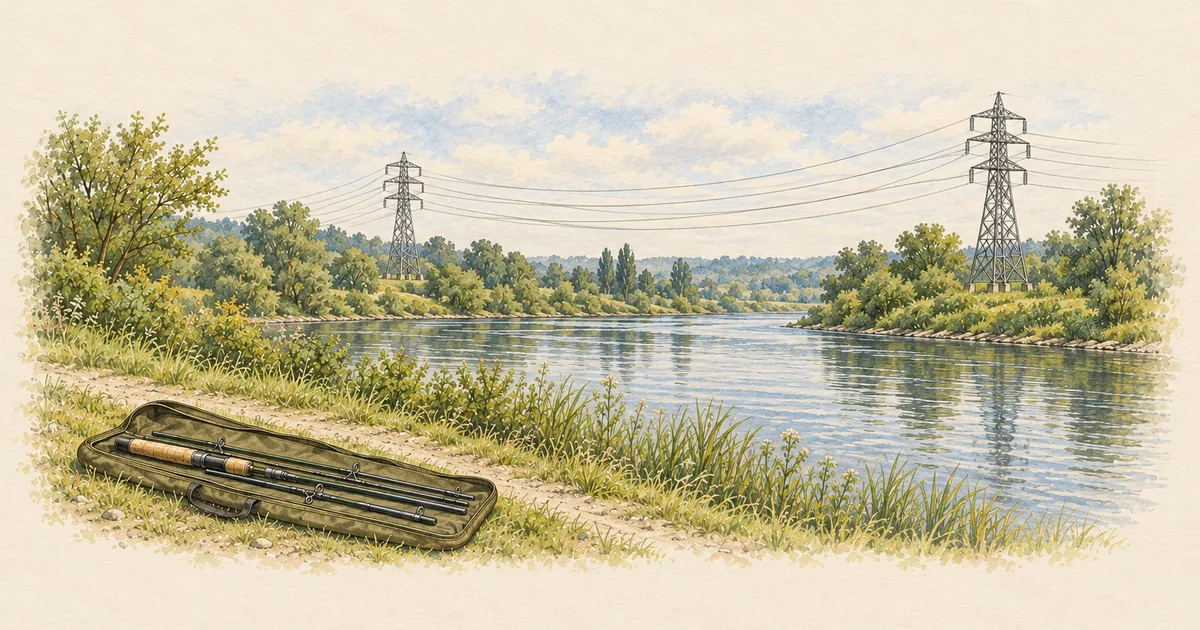
Carbon fibre is electrically conductive, warns the training material of the Landesfischereiverband Baden-Württemberg for the angling exam (Fischerprüfung). According to Blinker, every carbon fibre rod carries a warning that it is a good conductor of electricity. The Bavarian angling exam asks what to bear in mind when fishing with a carbon fibre rod. The correct answer: keep the rod away from overhead power lines and stop fishing in a thunderstorm (exam questions 2026).
Overhead lines are power lines whose conductors hang from pylons. Above 1.000 volts the rod does not even have to touch the conductor. Anyone who reaches a limit around the conductor that depends on the voltage is, under the rules of the accident insurance, in the same position as if they had touched it (DGUV Vorschrift 3). The current can jump across the air and flow through the body to the ground via an electric arc, writes the Federal Police (Bundespolizei) about the railway’s overhead contact line (leaflet).
Wet conditions make it worse. In fog or rain there is a great risk that the current jumps across without contact, warns a specialist article by the former Gartenbau-Berufsgenossenschaft, which has belonged to the SVLFG since 2013 (waldwissen.net). According to BG BAU, when it is wet a flashover can occur even on materials that otherwise conduct poorly. A line or rod that supposedly does not conduct cannot therefore be relied on.
Three kinds of line at the water
- Low and medium voltage: Up to 1.000 volts the poles are about 8 to 12 metres tall according to DGUV, at 1 to 30 kilovolts (kV) about 10 to 16 metres. Long rods reach that high. According to the training material of the Landesfischereiverband Baden-Württemberg, pole rods are available up to 15 metres; more under pole rod.
- High and extra-high voltage: At 110 kV the pylons are about 25 to 30 metres tall, at 220 and 380 kV 35 to 75 metres.
- Railway overhead contact line: It carries 15.000 volts (Deutsche Bahn). The Federal Police (Bundespolizei) warn against touching it with a stick, wire or anything similar from a bridge. The track area is off limits outside the permitted paths.
Lines on wooden poles are easily mistaken for telephone lines, warns the British network operator Electricity North West. It advises treating every line as a power line.
Which distances the specialist bodies give
The figures come from occupational safety. For work unrelated to electrical engineering, DGUV sets safe clearances, measured through the air from the unprotected live part (Table 4). The height of the pole and the insulators give a rough indication of the voltage.
| Line | Safe clearance | Pole height | Insulators |
|---|---|---|---|
| Low voltage, up to 1.000 volts | 1 m | about 8 to 12 m | about 0,10 m |
| Medium voltage, 1 to 30 kV | 3 m | about 10 to 16 m | about 0,25 m |
| High voltage, 110 kV | 3 m | about 25 to 30 m | about 1,10 m |
| Extra-high voltage, 220 and 380 kV | 4 and 5 m | about 35 to 75 m | about 2,30 and 3,50 m |
If the voltage is unknown, 5 metres apply (BG BAU, SVLFG). At the water this quickly becomes more:
- According to SVLFG the clearance also applies between equipment and overhead line. It is therefore measured from the rod tip and line, not from where you stand.
- Conductors swing out in the wind. BG BAU and DGUV require this to be taken into account.
- Estimating does not work. Against a blue or overcast sky the eye has trouble judging the distance to the thin wire, according to the former Gartenbau-Berufsgenossenschaft.
None of the German bodies consulted for this page gives a figure of its own for anglers. Electricity North West advises a horizontal distance of at least 30 metres from all overhead lines. The Luxembourg network operator Creos gives anglers at least 4 metres. The two figures are far apart, and the larger one is the more cautious. Swissgrid, the Swiss network operator, advises always keeping enough distance when in doubt, because fishing rods can get caught in the line.
For the overhead contact line, the railway and the Federal Police (Bundespolizei) give 1,5 metres, from which the current can jump across (accompanying booklet). The DGUV table requires 3 metres of clearance for work at this voltage.
Note: The values in the table are minimum distances for employees. On building sites, according to BG BAU, instruction alone is not enough; supervision must see to the distances. Nobody keeps watch at the water. The values therefore do not tell you how close to a line you can fish.
How electrical contact happens
- When casting: Line and rod tip reach further than your stand in the cast, and in wind the conductors swing out. Swissgrid therefore warns that fishing rods can get caught in the line.
- When assembling: The rod is raised in the process, often without looking up. Electricity North West therefore advises looking out for lines beforehand.
- With the end nobody is watching: The article by the former Gartenbau-Berufsgenossenschaft uses a pole saw as an example to describe how the rear end of a long tool unnoticed reaches a 20 kV overhead line. With an assembled rod it is the tip.
According to Electricity North West, such contacts are rare but can be fatal.
Look up before setting up
- At your spot, look up and to the sides first, and only then put the rod together. This order is given by Electricity North West.
- Carry the rod in pieces until the spot is settled. That way it stays away from every line on the way. In Bavaria the exam answer is to keep fishing rods away from overhead lines.
- Choose the spot so that neither rod nor line comes near a line in the cast. Electricity North West advises against estimating heights and distances from the ground. If in doubt, move further on.
- Tell children never to fish near overhead lines. They may not be able to judge the distance, the network operator explains.
- Pay attention to warning signs, which according to Electricity North West owners and tenants should put up at waters with overhead lines. If your club closes a stretch or there is a condition in the fishing permit (Erlaubnisschein), it applies.
- Do not set up a rod on a bridge over railway tracks and do not fish from railway property.
- In a thunderstorm lightning is added as a second danger, more under thunderstorms and weather.
After an electrical accident
- Do not go near, touch nothing. As long as the rod or a person is touching the line or is close to it, according to Electricity North West you move neither the tackle nor the person, and you keep others away. Any contact can be fatal, including for helpers. According to MITNETZ STROM, nobody should approach conductors lying on the ground either.
- Keep your distance. DGUV draws the limit of the danger zone for high voltage at 20 metres. MITNETZ STROM and SVLFG give the same figure for the cordon, Electricity North West gives 5 metres. 20 metres is the more cautious figure.
- Emergency number 112. In high-voltage accidents, according to the Deutsches Rotes Kreuz, the emergency call must be made immediately. MITNETZ STROM advises also informing the network operator. On the railway, you have train traffic stopped and the overhead contact line switched off via the hotline of the Federal Police (Bundespolizei), 0800 6 888 000.
- Wait. At high voltage only specialist personnel carry out the rescue, writes the DRK. After a flashover the current keeps flowing, warns the Federal Police (Bundespolizei).
Beyond the 20 metres lies step voltage. If current flows into the ground, for example through a fallen conductor, the earth around that spot is live. Anyone who takes a step there bridges part of that voltage with their feet, and the more so the closer they are to the spot.
SVLFG therefore requires drivers who have to leave their machine at a line to hop with their feet together. MITNETZ STROM speaks of shuffling steps.
Note: This page is no substitute for instruction by specialists or medical advice. According to the former Gartenbau-Berufsgenossenschaft, the effects of electrical contact often only become apparent after some time and as a rule affect the heart.
Common mistakes
- Assemble first, then look up: Electricity North West requires the reverse order. Otherwise the raised rod is already up there before you see the line.
- Distance by eye: Against the sky the distance to a thin conductor can hardly be judged. It is better to move one spot further on.
- Measured from where you stand: The safety distance applies to your tackle as well. You measure from the rod tip and the line, and a little further when casting.
- Trusting the material: When it is wet, current can jump across materials that normally conduct poorly, according to BG BAU.
- Running up to the casualty: As long as current can flow, every helper risks their own life. With high voltage, the DRK leaves the rescue to specialists.
Frequently asked questions
Is a fibreglass rod safe under power lines?
None of the sources on this page says so. According to BG BAU, when it is wet even a material that normally conducts poorly can cause a flashover. So keep your distance with every rod.
Is fishing under an overhead line allowed?
Whether a stretch is closed is stated in the fishing permit (Erlaubnisschein), in the water rules or on signs by the water. The sources on this page give no general rule. Regardless, the specialist bodies advise keeping your rod away from overhead lines.
How can you tell the voltage of a line?
The height of the pylon and the insulators give a hint: the longer the insulators, the higher the voltage. Do not rely on this; if the voltage is unknown, 5 metres applies.
Are lines on wooden poles just telephone cables?
You cannot say for sure from the bank. Power lines also hang on wooden poles, and Electricity North West warns of exactly this mix-up. So treat every line over the water as if it were live.
Related
- Thunderstorms and weather: the flash-to-bang rule and how to behave
- Float rod: how long pole, whip and Bolognese rods are
- Pole fishing: fishing with the long rod
- Fishing on a canal: sheet piling and boat traffic
- Bank and waders: a secure footing by the water
- Fishing permit and water map: where closed stretches and conditions are listed
- Safety by the water: all pages in this section
Sources
- Bayerische Landesanstalt für Landwirtschaft: Prüfungsfragen der staatlichen Fischerprüfung Bayern 2026 (Frage 4.003)
- Landesfischereiverband Baden-Württemberg: Gerätekunde, Präsentation zur Fischerprüfung (Kohlefaser leitet, Länge der Stipprute)
- DGUV Vorschrift 3, Durchführungsanweisungen (Schutzabstände, Annäherung)
- DGUV, Elektrische Gefahren an der Einsatzstelle: Aufbau Energieversorgungsnetz (Masthöhen, Isolatoren), Verhalten an der Einsatzstelle (20 Meter, Schrittspannung)
- BG BAU: Arbeiten in der Nähe elektrischer Freileitungen (Nässe, unbekannte Spannung, Aufsicht)
- SVLFG: Vorsicht bei Strom, Wasser oder Gas (Mensch und Gerät, Sprungschritte)
- MITNETZ STROM: Arbeiten im Bereich von elektrischen Anlagen (Absperrung, Notruf, Tippelschritte)
- Deutsche Bahn: Vorsicht Strom! (15.000 Volt); Bundespolizei, Achtung Bahnstrom: Faltblatt (Lichtbogen, Brücken, Hotline), Begleitheft (Mindestabstand)
- waldwissen.net: Achtung Strom! (Beitrag der früheren Gartenbau-Berufsgenossenschaft: Nässe, Stangensäge, Spätfolgen); zu deren Eingliederung in die SVLFG 2013: DGUV-Rundschreiben D 6/2013, SVLFG: 2. Nachtrag zur Satzung
- Electricity North West: Safety advice for anglers (30 Meter, Verhalten, Notfall)
- Swissgrid: Verhalten in Leitungsnähe (Abstand beim Fischen)
- Creos: Vorsicht bei elektrischen Leitungen (Abstand für Angler)
- Blinker: Angler vom Blitz getroffen (Warnhinweis)
- Deutsches Rotes Kreuz: Stromschlag (Notruf, Fachpersonal)
Text AI-assisted, drawings AI-generated. Sources opened and checked in October 2026; no graphics taken from the sources.
All figures are guide values without guarantee. They do not replace instruction by professionals or medical advice. In an emergency, call 112.