
Knowledge · Tackle
Float rod: Match, Bolognese and pole rod
The term float rod covers three designs: the match rod, the Bolognese rod and the pole. They differ in length, in the rings and in whether a reel goes with them. Which one suits depends on how far out and how deep you fish and whether the water is flowing.
Three designs at a glance
All three handle fine rigs with a float and a thin hooklength, the short length of line with the hook. The figures are guide values; individual models lie above or below.
| Design | Length | Casting weight | Intended for |
|---|---|---|---|
| Match rod | usually 3,60–4,20 m | up to about 25–30 g | waggler at distance |
| Bolognese rod | 5–8 m | depending on model, floats of 4–12 g carrying capacity | drifting float on a river |
| Pole, whip | about 3 to over 10 m, whip often 10–13 m | teaching material gives 5–20 g | fishing without a reel at close range |
Match rod: with the waggler at distance
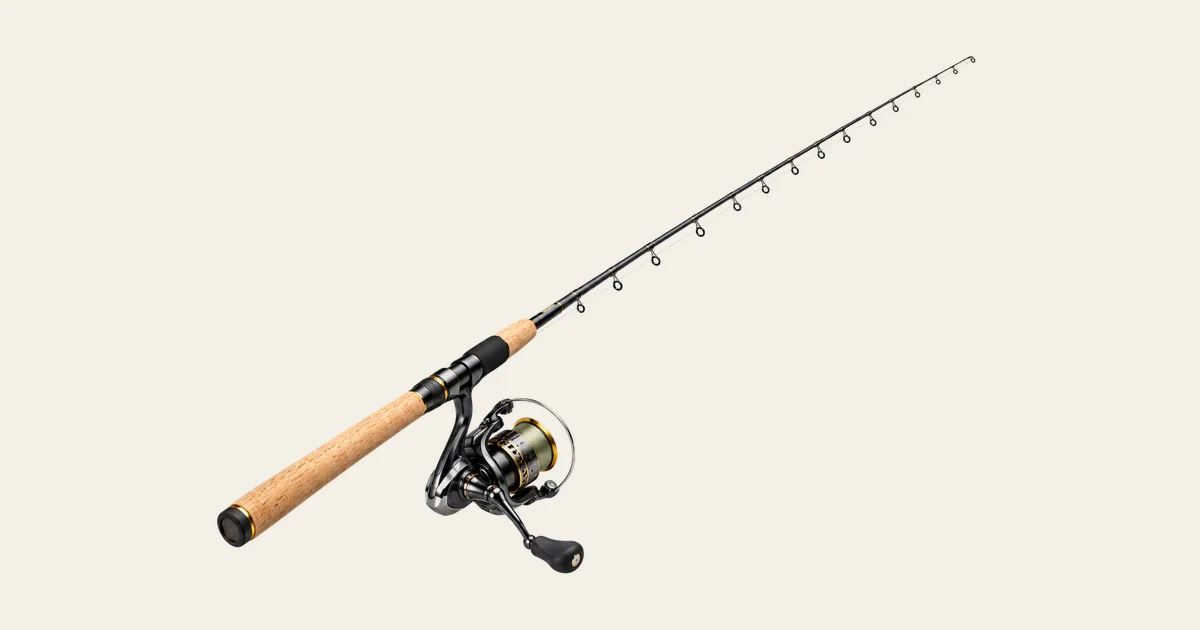
The match rod has rings and carries a small fixed-spool reel. The lengths 3,60 m, 3,90 m and 4,20 m are regarded as classic. The casting weight is low: a practical report gives up to 25 g, an encyclopaedia 10 to 30 g.
Fishing is mostly with the waggler, a float attached to the line at the bottom only, through an eye. When it stands upright, you sink the line below the surface so that the wind cannot blow a bow into it. With a suitable rig and casting technique, the trade press says 40 m and more are possible. If the swim is deeper than the rod is long, you need a sliding float, which slides on the line as far as a stop knot.
Bolognese rod: a long rod for the drifting float
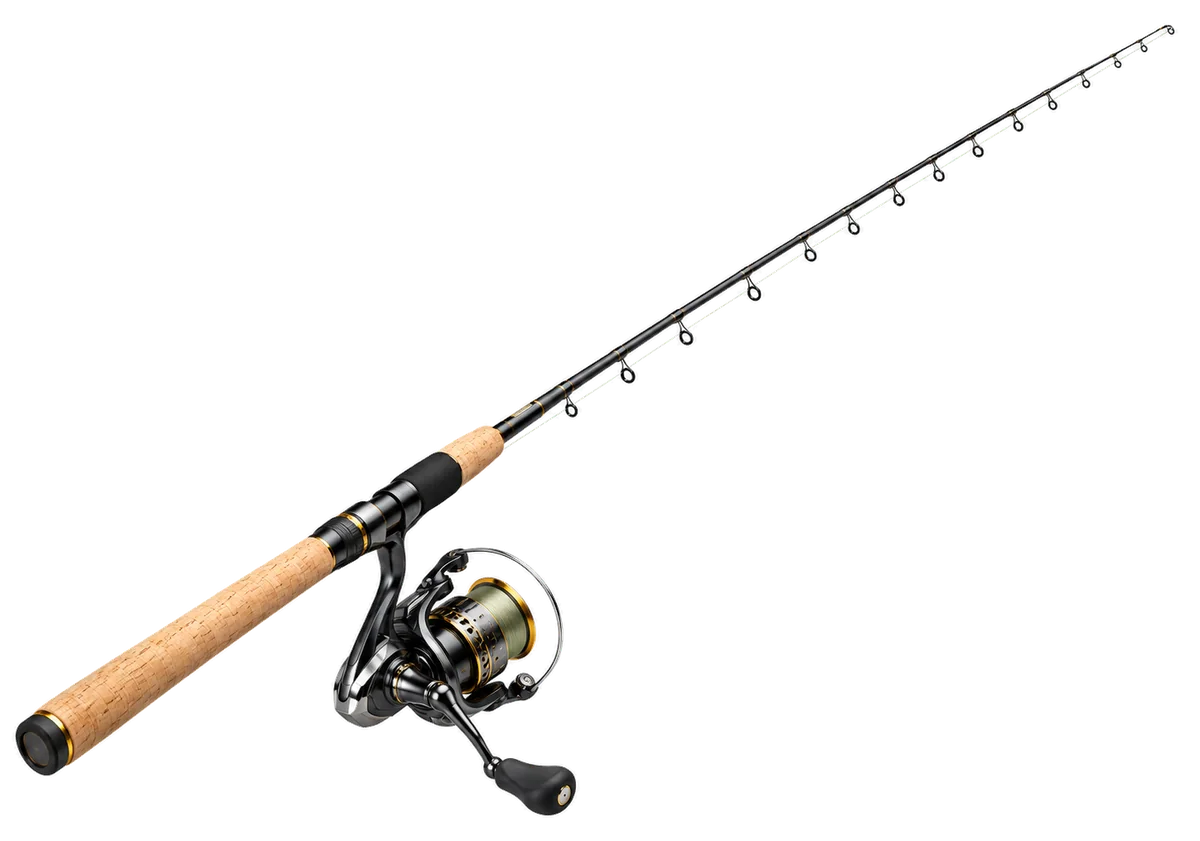
The Bolognese rod comes from Italy. Basically it is a long pole, but with widely spaced rings and a reel seat. Lengths of 5 to 8 m are quoted. For getting started, one specialist author advises 6 to 7 m, because longer rods take more practice.
Its home is the river. With the long rod you lift the line off the water and guide the float under control in the current. Even at more than 4 m deep you can still fish with a float set at a fixed depth. If a strong fish runs, the reel drag lets line go.
Pole and whip: line fixed to the tip
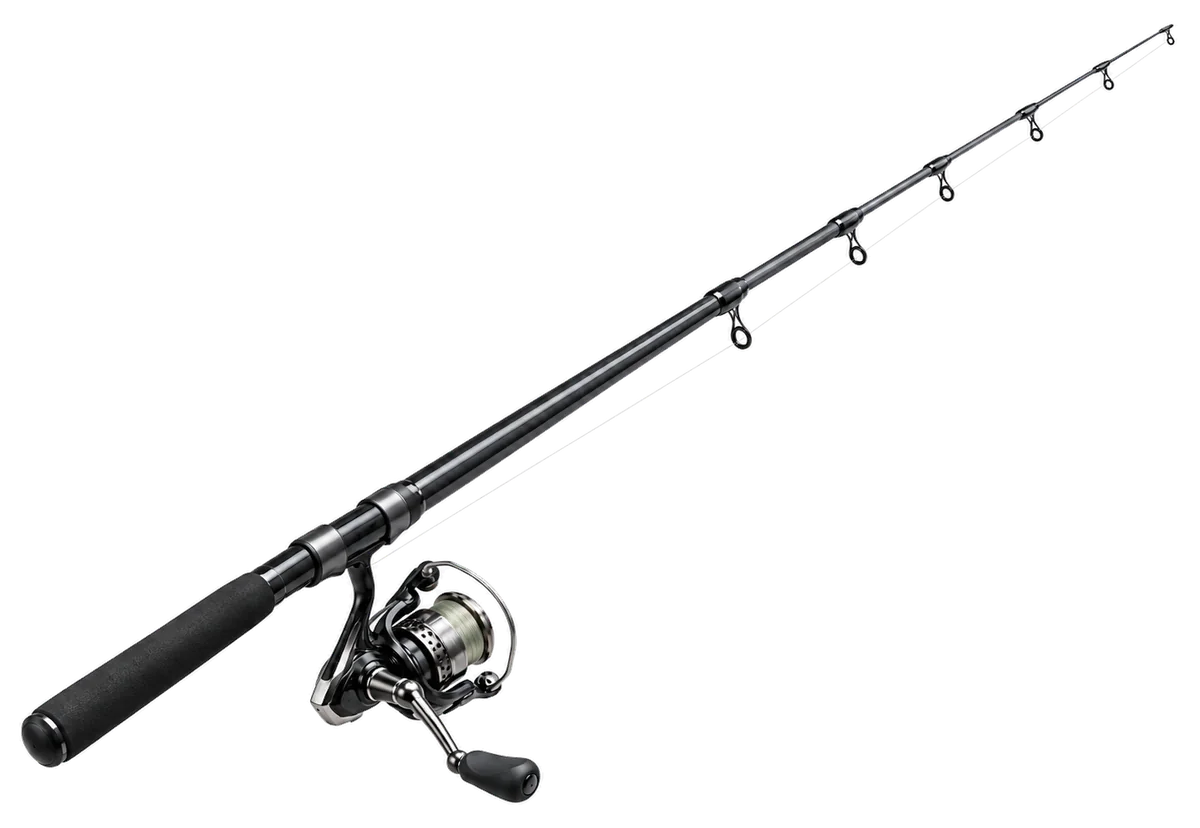
The pole has neither rings nor a reel seat. The line is tied to the rod tip. It comes as a telescopic rod that you pull out and as a push-fit one, and lengths range, according to teaching material, from about 3 to over 10 m. The long version is often called a whip; for big bream a trade magazine gives 10 to 13 m. Here the line is shorter than the rod. To land the fish you take off the rear sections until the length matches the line. The two names are not used consistently.
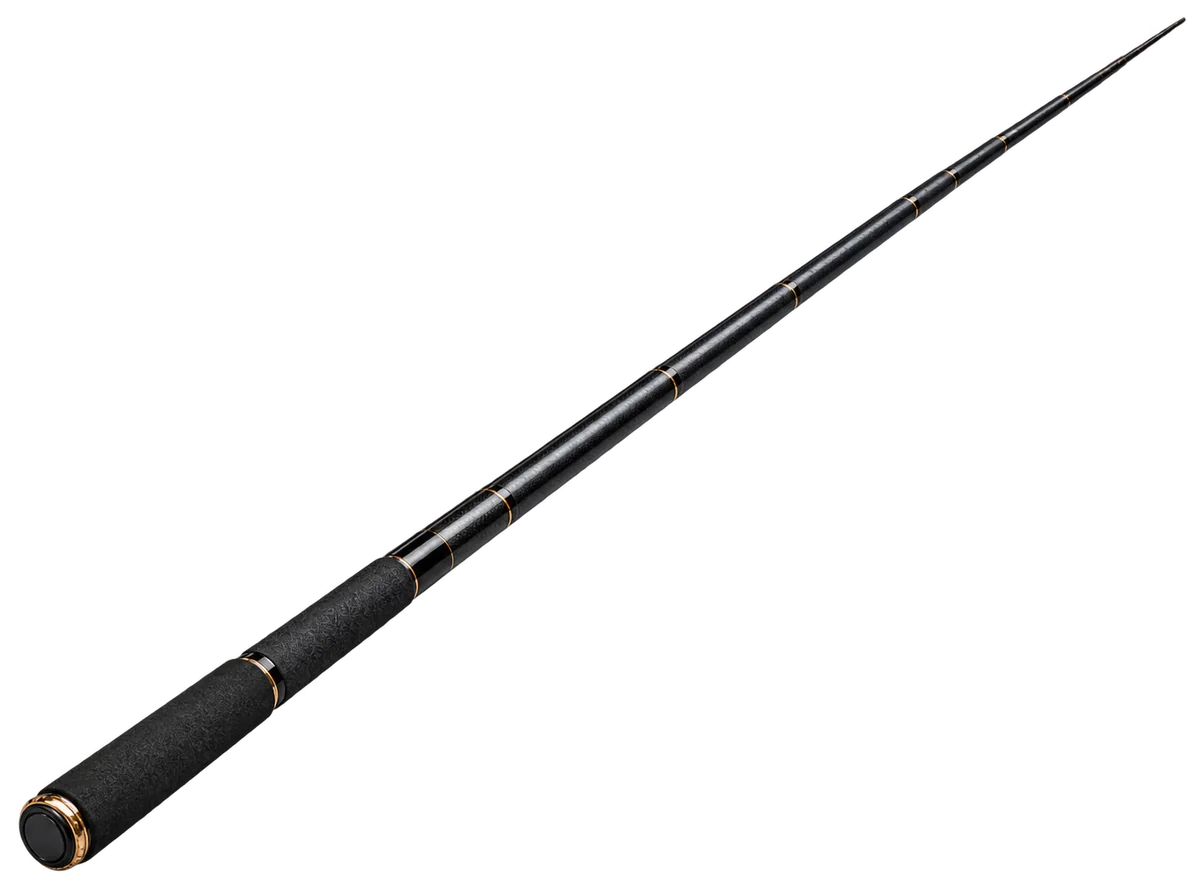
Without a reel there is no reserve of line. Elastic takes over this job: a rubber band inside the hollow top sections, to which the rig is attached. When a fish runs, it pulls the elastic out of the rod, after which it runs back in. Small fish such as the roach you land without it. For bream or tench the trade press regards it as necessary.
Action and fine line
On the Bolognese rod the rings stand well away from the blank.
The action describes how a rod bends under load. A practical report recommends a match rod with a soft action for fine rigs at distance. What matters is that the thin blank, the body of the rod, absorbs runs, because only then do fine hooklengths hold. Mainlines of 0,14 to 0,18 mm are quoted for the Bolognese rod, a 0,12 hooklength for the match rod and even 0,10 line for the whip with elastic. Use slightly thinner line for the hooklength than for the mainline. If you get snagged, only the hook then breaks off.
A small fixed-spool reel with a well-filled spool is enough. What the line still holds after the knot is shown by the line calculator. How to balance the float is explained under float rig and in the float shotting calculator.
Common mistakes
- Rod too short for the depth: A float fixed on the line can be set no deeper than the rod is long.
- Rod too powerful for the hooklength: Fine hooklengths and small hooks need a sensitive rod that absorbs runs. A hard rod gives too little for that.
- Whip without elastic for big fish: The cushion of the ringless rod is soon used up. Then the line breaks or the hook pulls out.
- Casting weight exceeded: The printed value is the upper limit for the cast.
Safety: Poles over 10 m long reach a long way up. According to teaching material for the angling exam (Fischerprüfung), carbon fibre conducts electricity, and caution is needed near pylons. More under Power lines and fishing rods.
Example: Your swim is 5 m deep, the match rod measures 3,90 m. You can no longer set a fixed float here. You either rig a sliding float with a stop or take a 6 m Bolognese rod and stay with the fixed float.
Frequently asked questions
How do the match, Bolognese and pole differ?
The match rod has rings, a small reel and usually measures 3,60–4,20 m. The Bolognese rod is longer, 5–8 m, has widely spaced rings and a reel seat. The pole has neither rings nor a reel; the line hangs fixed from the tip.
When do I need a sliding float instead of a fixed float?
A float fixed on the line can be set no deeper than the rod is long. If the swim is deeper, you need a sliding float that slides on the line as far as a stop knot, or a longer rod.
What is the elastic on the whip for?
Without a reel there is no reserve of line. The elastic in the hollow top section absorbs runs: the fish pulls it out of the rod, after which it runs back in. For small fish you can do without it; for bream or tench it is regarded as necessary.
Which line strength suits the float rod?
The trade press gives mainlines of 0,14 to 0,18 mm on the Bolognese rod, a 0,12 hooklength on the match rod and 0,10 line on the whip with elastic. The hooklength should be slightly thinner than the mainline.
Related
- Float fishing: the method at a glance
- Float rig: balancing and rigging the float
- Float shotting: working out the shot for the float
- Line calculator: what the line holds after the knot
- Setting the reel drag: drag for fine hooklengths
- Fishing rods: construction, markings and all rod types
- Power lines and fishing rods: take care with long rods
Sources
- Blinker: Informationen rund um das Thema Matchruten (klassische Längen)
- Blinker: Brassen angeln, alle Grundlagen (Matchrute bis 25 g, 40 m Distanz, Schnur absenken, feste Pose nur bis Rutenlänge, Kopfrute 10 bis 13 m)
- Fisch & Fang: Friedfisch italienisch (Bologneserute: Herkunft, Länge, feste Pose über 4 m Tiefe, Ringe, Rolle, Schnur, Posengewicht)
- Blinker: Kopfrute mit Gummizug (Aufgabe des Gummizugs, 0,10er Schnur)
- Rute & Rolle: Waggler fürs Frühjahr (4,20 m, 0,12er Vorfach)
- Fischereiverein Löningen: Zusammenfassung Gerätekunde (Lehrmaterial zur Fischerprüfung: Stipp- und Kopfrute, Aktion, Wurfgewicht)
- Fisch & Fang: Wer erfand den Waggler? (Waggler nur unten befestigt), Blinker: Forellenangeln mit der Bolorute (Bologneserute 5 bis 7 m) und Rute & Rolle: Grundkurs Stippfischen (Stipp- oder Kopfrute, Teleskop oder Steckrute)
- Wikipedia: Matchrute (Ringe, 10 bis 30 g)
All figures are guide values without guarantee. Lengths and casting weights differ from model to model. The marking on your rod applies.