
Knowledge · Tackle
Polarised sunglasses: A look beneath the water surface
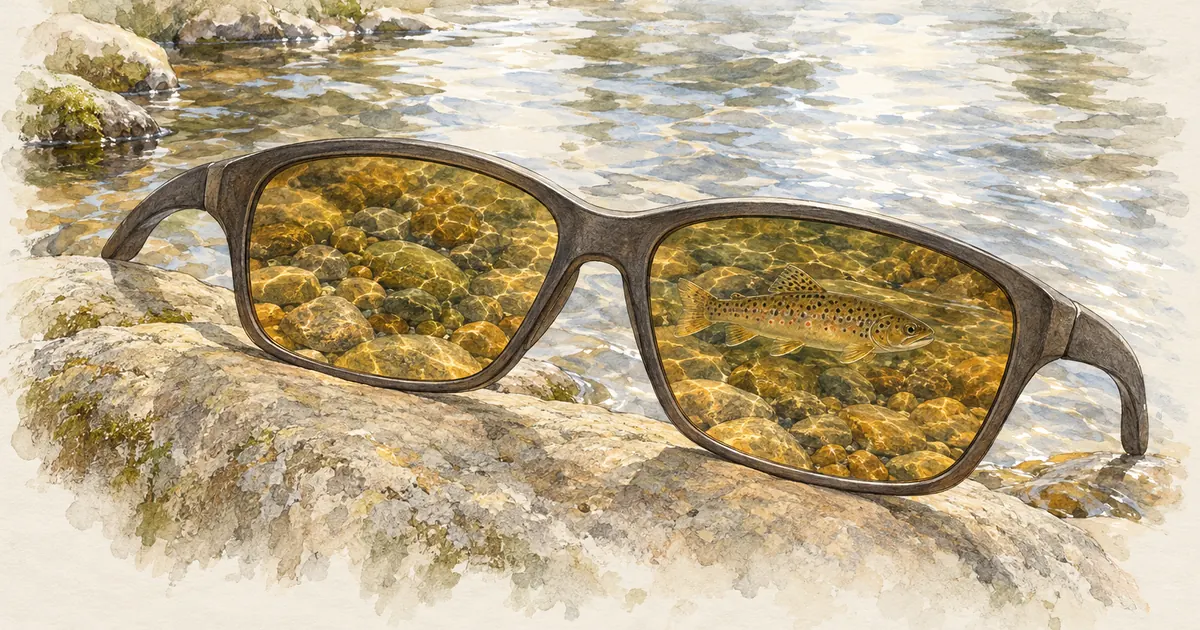
Polarised glasses take the glare off the water surface, so that you can make out fish, weed and stones below it. How far you can see depends on the position of the sun and on the water. You choose the lens colour to suit the light, and whether the lenses also protect against UV radiation is only revealed by the marking on the arm.
Why the reflection disappears
Sunlight is usually unpolarised: every wave train vibrates across its direction of travel, but in a random direction. A linear polarising filter lets through only the part that vibrates parallel to its transmission direction and absorbs the rest. Even an ideal filter halves the brightness of unpolarised light in this way (LEIFI Physik). That is why every pair of polarised glasses also darkens like ordinary sunglasses.
When light is reflected off water, that changes. The reflection is partly polarised. If the light strikes at Brewster’s angle, it is even completely polarised. For water, the Lexikon der Physik gives roughly 53 degrees, measured from the normal, the perpendicular to the water surface. The vibration then lies across the plane of incidence, that is, the plane in which the sunbeam, the normal and the reflected ray lie (LEIFI Physik). On calm water this means the reflection vibrates horizontally.
This determines how the filter has to sit in the lens: its transmission direction is vertical, at right angles to the vibration of the reflected light. LEIFI Physik describes sunglasses with a polarising filter that, when correctly aligned, filter out reflected light, for example from car windows. As long as you do not tilt your head sideways, the filter cancels the horizontally vibrating components. Light scattered beneath the surface by fish, bottom and plants, on the other hand, gets through. When photographing with a polarising filter, according to LEIFI only this light from the water remains, and the surface becomes, as it were, transparent to the camera.
Viewing angle and depth of sight
How well the glasses work depends, according to Blinker, on the direction and angle at which the sun shines onto the water. Sometimes a remnant of the reflection vanishes when you tilt your head sideways.
Even the best glasses cannot see through cloudy water. In very clear water your view reaches far, in cloudy water only a few centimetres.
Lens colours for sun, cloud and dusk
You cannot tell the polarising filter by looking at the glass, but you can see the tint. Blinker, Stiftung Warentest and the Bundesamt für Strahlenschutz classify the colours as follows:
| Lens colour | When it helps | According to |
|---|---|---|
| Grey | in any light, colours stay almost natural | angling magazine, Warentest |
| Brown | sun and glare, colours stay almost natural | angling magazine, Warentest |
| Yellow | overcast weather and dusk | angling magazine |
| Orange | strong green contrast, distorts traffic-light colours | Stiftung Warentest |
| Blue, red | reduce contrast and sharpness | BfS |
The Bundesamt für Strahlenschutz (BfS) also considers brown and grey suitable. Anyone buying only one pair is therefore right to choose these, according to all three sources.
UV protection and the marking on the arm
A polarising filter and a UV filter are two different things. You can judge the glare protection yourself, but the UV protection of sunglasses cannot be seen, according to BfS. It shows only in the marking:
- CE mark: compulsory for every pair of sunglasses sold in Germany. According to Stiftung Warentest, no testing by an independent body is required for it, and the manufacturer thereby only guarantees UV protection up to 380 nanometres.
- UV 400: the lenses filter UV radiation up to 400 nanometres. According to measurements cited by the BfS, this marking can be relied on fairly well.
- Filter category (cat or KAT): it describes the tint, that is, the glare protection, and says nothing about UV protection. Grades 0 to 4 are usual. The BfS recommends 2 or 3: grade 1 hardly protects against glare, grade 4 is too dark and not permitted in road traffic.
Because UV radiation scatters strongly, the BfS also advises good side protection from large lenses or a curved frame. More about sun protection by the water, from the UV index to headwear, can be found under Sun, heat and ticks.
Read it off when you buy: The arm or the label should show CE, UV 400 and cat 2 or cat 3, plus an explicit statement that the lenses are polarised. If the UV marking is missing, many opticians can measure the UV protection free of charge, according to Stiftung Warentest. This page does not replace advice from an eye doctor.
Protection from hooks and branches
With every cast hooks and lures whistle through the air, and Blinker reminds us that one of them can end up in your eye instead of in a fish’s mouth. The magazine therefore advises keeping the glasses on even in dull weather. Lenses made of shatterproof plastic do not splinter like glass. That also protects you in undergrowth and in hard reed.
Stiftung Warentest names three checks anyone can make in the shop: the hinges do not wobble, nothing distorts when you look through the lens, and a plastic lens does not give under light finger pressure. If a hook ends up in or beside the eye despite the glasses, follow the procedure under Hook injuries and first aid.
Seeing fish: sight fishing with polarised glasses
In fly fishing, deliberate observation before the first cast is called spotting. What matters is whether the fish takes food at the surface or just below it, whether it holds its position or moves about, and how the current shifts it. That determines where the fly lands. The exam material on tackle from the Löningen fishing club lists the glasses as an accessory for fly fishing and spinning.
At a trout lake in summer, it pays to look into the water first, early in the morning: with polarised glasses you can see where the trout gather, whether they move as a shoal or stand motionless just below the surface. More under Fishing a trout pond. On a stream, according to Rute & Rolle, the glasses are part of the minimal kit for spinning for brown trout.
In carp fishing by stalking, polarised glasses and binoculars count as aids. You look for a carp that gives itself away by jumping, rolling or rising bubbles from feeding on the bottom, and only then do you cast to it.
On the Baltic coast, Blinker counts polarised glasses as useful kit. When wading for sea trout, anglers there often look for leopard ground: seagrass or stones with weed alternating with patches of sand, where the fish find food. In a calm sea it shows up clearly through the glasses, Rute & Rolle wrote in 2016.
In spinning, predators following the lure are noticed early, and by changing the retrieve you can sometimes still tempt a follower into a bite. You can judge snaggy spots better. There is also the stronger contrast: coloured line stays easy to see even far out, which improves bite detection as an artificial lure sinks. The Line calculator works out what breaking strain your line needs.
Glasses strap, clip-on and prescription lenses
Glasses strap against loss
Polarised glasses usually get lost when wading or when the boat is moving fast: they slip off, fall into the water and sink. An ordinary glasses strap doesn’t reliably protect against this, Blinker notes, because many straps don’t float.
The remedy is a strap made of light, buoyant material. At its ends are short rubber tubes that you slide over the ends of the arms, where they hold the glasses firmly. If they still fall in, according to the magazine they stay on the surface even in strong waves, and a red or orange strap is quicker to find again. So when buying, what matters is that the strap is expressly stated to float. What else you need for wading on the coast is under Tackle for sea trout on the coast.
Clip-on and fit-over glasses for spectacle wearers
If you wear glasses, you don’t have to do without a polarising filter. Blinker names two ways of keeping your own glasses on: polarising clip-ons that attach to your prescription glasses, and fit-over glasses that sit over them. With the clip-on, your prescription glasses stay on your nose, and you don’t need a second pair with your prescription. Fit-over glasses are a separate, larger frame worn over your prescription glasses.
For both, what Blinker demands of any polarised glasses applies: they must fit closely so that no distracting light comes in from the side. Because UV radiation scatters strongly, the BfS advises good side protection anyway. Whether a clip-on or fit-over glasses seal well at the sides depends on the model and on your prescription glasses. So try them on together with your own glasses and look for gaps letting light in beside the lenses.
Sports glasses with a prescription insert work the other way round: a clip with ground lenses sits behind the lens. For looking into the water, the lens itself then has to polarise, and as with any polarised glasses this is stated explicitly in the specification. In an older sports glasses test from 2008, Stiftung Warentest found that such inserts can only be fitted with a lot of dexterity.
Prescription polarised glasses
The third solution is polarised glasses whose lenses themselves carry your prescription. Blinker mentions such made-to-measure lenses as an option for spectacle wearers and points out that they cost more than an off-the-peg pair. Nothing changes about the marking: according to Stiftung Warentest, the information on glare and UV protection applies to non-prescription lenses just as it does to prescription lenses. The BfS warns that the UV filter up to 400 nanometres must be retained when the lenses are fitted. So at the optician’s, ask for polarising lenses, filter category 2 or 3 and UV 400.
| Solution | How it sits | What to look for |
|---|---|---|
| Clip-on | clipped onto prescription glasses | check for light gaps at the side when trying on |
| Fit-over glasses | separate frame over prescription glasses | close-fitting, sealed at the sides |
| Sports glasses with prescription insert | prescription lenses behind the lens | lens must polarise, fitting takes dexterity |
| Prescription polarised glasses | polarising filter, tint and correction in one lens | more expensive, ask the optician about UV 400 |
Common mistakes
- Buying sunglasses without a polarisation marking. You cannot see the filter, so the polarisation must be stated explicitly. To test, look through the glasses at an LCD screen and turn your head: such screens usually emit polarised light, and when the two directions are at right angles the picture goes dark (LEIFI Physik).
- Confusing the polarising filter with UV protection. Without the UV 400 marking it remains unclear how much UV radiation gets through.
- Driving in category 4 glasses. Lenses that dark are not permitted in road traffic. For the drive home, keep a lighter pair in the car.
- A loose-fitting frame. If light comes in from the side it disturbs your view, so the glasses should fit snugly. When wading or in a boat, a floating glasses strap keeps them at the surface if they fall into the water.
- Leaving the glasses behind the windscreen. Great heat can, according to Stiftung Warentest, deform the coating of the lenses into a cloudy “elephant skin”.
Frequently asked questions
Are there polarised glasses for people who wear glasses?
Yes. There are clip-ons for prescription glasses, over-glasses and lenses with a prescription. With made-to-measure lenses, the BfS advises checking with the optician whether the UV filter up to 400 nanometres is retained.
Does every glasses strap float?
No. Many simple straps only hold the glasses on your head and sink with them. If you wade or fish from a boat, take a strap that is expressly stated to float.
Why does the fish finder display go dark?
Some displays emit polarised light, and polarised lenses then make it harder to read. If you tilt your head or turn the device, the brightness changes.
Are the glasses worth it under an overcast sky?
Yes, if only as protection from hooks. Yellow lenses are considered suitable for bad weather and dusk.
Related
- Sun, heat and ticks: UV index, clothing and sun cream by the water
- Hook injuries and first aid: what applies when a hook is stuck in the body
- Fly fishing: principle, fly types and target fish
- Braided line: thin, low-stretch and easy to see
- Waders: kit for going into the water
- Tackle for sea trout on the coast: wading, casting and weather on the Baltic Sea
- Spinning rod: length, casting weight and action for stalking with an artificial lure
- Line calculator: work out breaking strain and backing
Sources
- LEIFI Physik: Polarisation von Licht, Einführung (unpolarisiertes Sonnenlicht, Wirkung des Polfilters, polarisiertes Licht von LCD-Bildschirmen), Fortführung (Helligkeit halbiert, gekreuzte Filter sperren), BREWSTER-Winkel (Schwingung quer zur Einfallsebene), Reflexionsgesetz (Lot, Einfallsebene) und Polfilter beim Fotografieren (Licht aus dem Wasser bleibt übrig)
- Spektrum, Lexikon der Physik: Polarisationswinkel (vollständige Polarisation, 53 Grad bei Wasser) und Lexikon der Optik: Polarisationsfilter (teilweise polarisierte Reflexe)
- Bundesamt für Strahlenschutz: UV-Schutz für die Augen (UV 400, Tönungsstufen, Glasfarben, Seitenschutz, Gläser mit Sehstärke)
- Stiftung Warentest: Sonnenbrillen, was sicher schützt (CE-Zeichen und 380 Nanometer, Filterkategorien, Glasfarben, Proben beim Kauf, Hitze im Auto, Gläser mit eingeschliffener Stärke) und Sportbrillen, guter Schutz (Korrektureinsatz per Clip hinter der Scheibe)
- Blinker: Polarisationsbrille, voller Durchblick (Glasfarben, Kopfhaltung, Sichttiefe, Pol-Angabe, Augenschutz beim Wurf, Passform, schwimmfähiges Brillenband, Vorsatz, Überbrille und Gläser mit Sehstärke, Spinnfischen, Spotten) und Blinker: Fit für den Forellensee, im Sommer auf Forellen (Forellen am Morgen beobachten) sowie Blinker: Erfolgreich angeln an der Küste (2024) (Polbrille an der Küste, Leopardengrund)
- Rute & Rolle: Aktiv auf Karpfen (Pirsch mit Polbrille und Fernglas), Watangeln auf Meerforelle (2016) (Leopardengrund bei ruhiger See) und 5 Tipps für Bachforellen (Ausrüstung am Bach)
- Fischereiverein Löningen: Gerätekunde (PDF) (Polbrille als Zubehör beim Fliegen- und Spinnfischen) und Wikipedia: Sonnenbrille (senkrechte Filterebene, Displays, nur ergänzend)
Text AI-assisted, drawing AI-generated. Sources opened and checked in October and November 2026, no graphics taken from the sources.
All figures are guide values without guarantee. How far you can see into the water depends on light, water and viewing angle, and this page does not replace advice from an eye doctor.