
Knowledge · Fishing methods
Carp fishing
In modern carp fishing the bait hangs on a short piece of line next to the hook, and a heavy fixed lead makes the fish hook itself. How much feed is allowed is decided by the water’s manager; some associations limit the amount per fishing day.
The principle: bait on the hair, lead fixed
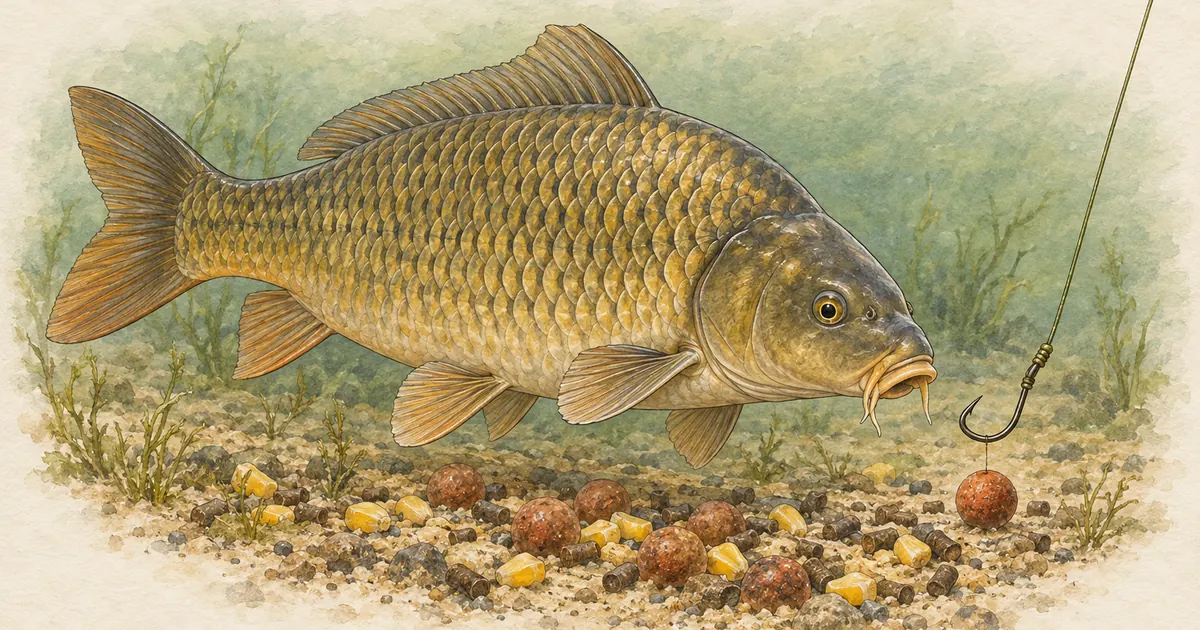
The bait does not sit on the hook. It is threaded onto a short length of line, the hair, and hangs below the hook, which stays bare. When the carp sucks in the bait, it draws the bare hook into its mouth with it. It feels the hook, panics and bolts. The fixed lead holds against it, and the hook sets (Blinker).
- Rig in place: The boilie hangs on the hair below the hook, and the hook point stays bare. The lead is fixed on the line.
- Sucking in: When the carp picks up the bait, the unbaited hook slips into its mouth along with it.
- Bolting against the lead: The fish feels the hook, panics and tries to bolt. Because the heavy lead does not give, the point goes in.
- Pick up the rod: When the bite indicator signals running line, the hook is usually already set. Pick up the rod, turn the handle to disengage the free spool and play the fish on the drag you set beforehand.
The lead must be heavy enough: in a basics article Blinker gives at least 60 grams, in the carp profile 80 to 150 grams. The hooklength is short, guide value 15 to 20 centimetres, over soft ground 25 to 30, so that the bait lies freely. Between hook and bait you initially leave a gap of about one centimetre. According to Blinker the hook is size 2 to 8; the smaller the number, the bigger the hook. The simplest way to tie the hair is with the no-knot knot.
| Feature | Running rig | Self-hooking rig |
|---|---|---|
| Weight | slides freely on the line | sits fixed, in a clip or as an inline lead |
| On the bite | Fish takes line, bail arm open | Fish runs into the lead |
| Strike | you do it yourself | does not apply |
| Leader | about 50 cm | 15 to 20 cm |
The fixed rig is also kinder to the fish. Researchers at the Leibniz-Institut für Gewässerökologie und Binnenfischerei (IGB) fished in a trial with a fixed lead, a 15-centimetre hooklength and sweetcorn on the hair. Of 88 carp landed, the hook sat almost always in the lower jaw or the corner of the mouth, in none deep. If the line breaks, the fish should be able to shed the lead. Lead holders from which it releases are made for this.
Lead and the law: The EU has adopted the restriction on lead in fishing tackle with Regulation (EU) 2026/2501, which applies from 3 December 2026 (as of November 2026). It governs sales, not recreational angling. Weights and lures containing lead up to 50 grams may no longer be sold from 3 December 2029, heavier ones up to 1 kilogram from 3 December 2031, and lead wire and drop-off leads from as early as 3 June 2027. What applies at the water is set by the water rules and the fishing permit (Erlaubnisschein).
Bait and feed
As hookbaits, boilies have become the standard; hard corn, tiger nuts and other particles and pellets also catch.
According to the IGB, carp can be got used to a spot by baiting better than any other fish species. The type of feed hardly matters: even plain hard corn gathers hungry carp after a few days. The working group’s studies found no decisive catch advantage for fishmeal boilies over hard corn or tiger nuts. Boilies are just more selective, with less bycatch.
Blinker advises feeding little at first and topping up after every bite, because the fish do not find the hookbait in too much feed. In the cold water of spring carp eat little, and in summer leftover feed can contribute to oxygen depletion.
What adds up is shown by an IGB survey from 2000 and 2001: specialist carp anglers put in an average of 215 kilograms of feed a year, which amounted to a good kilogram of phosphorus. According to a diploma thesis at the IGB, that is critical in small, shallow, nutrient-poor and clear lakes under 25 hectares with heavy angling pressure and little fish removal.
Feed and water rules: Whether and how much you may feed is decided by the water’s manager. The Landesanglerverband Brandenburg allows at most 2 kilograms of feed per fishing day on its waters and bans baiting with bait boats and drones. For individual waters it can prohibit groundbait altogether (Gewässerordnung, Ausgabe 2019).
Finding the swim
On a lake, drop-offs and plateaus are among the promising spots, because natural food lies there. According to Blinker, gaps in the weed are also made by feeding carp, and the bottom there is firm rather than silty. Spots by season are shown on the page Carp. Bank shelf and drop-off are explained under Fishing a lake.
From the bank you explore the bottom with a marker rod: braided line with a feeler lead at the end. Braid does not stretch and transmits what the lead touches. You feel hard ground as a clear tap, and in silt hardly anything. If a marker float sits above the lead, you release line until it surfaces and estimate the depth that way (Blinker). You note the distance in the line clip of the reel. Whether a boat and fish finder are allowed is stated in the water rules.
Tackle on the bank
- Rod: a carp rod, whose length and test curve are explained there.
- Reel: With a free-spool reel the fish takes line even with the bail arm closed. For the self-hooking rig you set the free spool or drag distinctly tighter than when sitting with deadbait.
- Rod support: two bank sticks per rod, which are ground spikes with a thread. On stone, concrete or a jetty you use a rod pod, a frame for several rods. If the rod points at the bait, a bite does not yank it sideways off the support.
- Bite indicators: The electronic bite alarm beeps and lights up when line runs. A swinger keeps the line under tension and also shows drop-back bites, where the fish swims towards the rod.
Bite, fight and landing
When the line runs, the fish is usually already hooked. You pick up the rod, switch off the free spool with one turn of the handle and play the fish on the drag you set beforehand (Setting the reel drag). According to the Saxon question catalogue for the angling exam (Fischerprüfung), you keep the line under tension all the time and do not play the fish for longer than necessary. The landing net should then be too big rather than too small; for carp Blinker gives at least 70 centimetres in diameter.
On land the carp goes on an unhooking mat that you wet beforehand so the slime layer stays intact. Do not hold a big fish standing over hard ground. If it slips out of your hands, the drop should be small: for a photo you crouch or kneel over the mat (Blinker). The technique is described under Landing and unhooking a fish.
Carp are robust. In experiments by the IGB, no fish died in the two months after release, not even after ten minutes in the air. But when the fish were taken out of the water again after hours in a carp sack, the lactic acid level in their blood rose sharply. The researchers advise taking a photo straight after the catch rather than keeping the fish alive first.
Season and water temperature
Warmth stimulates carp to feed: above 20 °C their food intake rises, writes the Institut für Binnenfischerei Potsdam-Sacrow. Young stocked carp can be caught in spring from as low as 8 °C (Wikipedia); the fish actively go looking for food, according to Blinker, at clearly over 10 °C. The Catch calendar rates August and September as the main season and May to July and October as good. A Blinker author, by contrast, considers spring and autumn the best times, because there is little natural food then and feed attracts more strongly.
In the warm water of summer little oxygen is dissolved, and the fish recover only slowly after the fight and being on land. More on this: Water temperature and oxygen.
What state law and water rules say
Fisheries law is state law (Bundesland), and on top come the rules of the water’s manager. Examples from Saxony and Brandenburg, as of October 2026; elsewhere something else may apply.
- Rods and supervision: In Saxony and Brandenburg you may fish with at most two hand-held rods at the same time, and rods that are set out must be supervised at all times. In Saxony it is expressly stated: electronic bite alarms do not replace supervision (SächsFischVO, § 4; BbgFischO, § 7). Whether sleeping beside the rod still counts as supervision, you clarify with the authority or the manager.
- Night fishing and tent: The water rules of the Landesanglerverband Brandenburg (LAVB, no. 6.1) allow night fishing on the angling waters, except for the salmonid waters; „the same conditions“ apply as by day. An angler’s tent or umbrella tent that protects against the weather and is not mainly used for overnight stays is, according to no. 6.3, „generally allowed provided“ it has room for at most two people, has no waterproof floor and is in muted colours. It may stand at most 12 hours in total without a break in the same place, and it is not permitted on natural stretches of brooks and rivers, small waters and similar areas. More under Night fishing.
- Returning fish: In its water rules the LAVB says it is not acceptable to deliberately target specimen fish just to record length and weight and then return them. Returning fish explains the legal position.
- Closed season (Schonzeit), minimum size (Mindestmaß), conditions: are set out in the state regulation and in your fishing permit (Erlaubnisschein), see Closed seasons and minimum sizes explained and Fishing permit and water map.
Frequently asked questions
Do you strike with a self-hooking rig?
No. The carp hooks itself against the fixed weight and you simply pick up the rod. With a running rig you do strike.
Why has the bait gone when there was no bite?
Carp learn fast. In IGB experiments with small carp in ponds and tanks, the fish kept coming to the feeding spots and fed, but took the hook less and less often or spat it out at once. After a few days they could almost only be caught at night in the tank. The researchers write that carp can remember the experience of being hooked for more than a year.
Can you fish without boilies?
Yes. Hard maize and tiger nuts also catch fish, but they must be boiled first. Boilies, on the other hand, keep small silver fish away, as they cannot crack the hard ball.
Related
- Carp: features and holding spots by season
- Carp rod: length, test curve and action
- Bottom fishing: basics of weight, hooklength and bite indication
- Grass carp and tench: also take maize and boilies
- Hair rig: bait on the hair and fixed weight, tied step by step
Sources
- Blinker: Karpfenangeln, Tipps für eine erfolgreiche Fangstrategie (Montage, Platzwahl, Jahreszeit)
- Blinker: Steckbrief Karpfen (Bleigewicht, Köder, Temperatur)
- Blinker: Karpfen-Kickstart (Rutenablage, Kescher, Futter)
- Blinker: Anfüttern beim Karpfenangeln (Futtermenge, Ausloten) und Angel-Erfolg an neuen Ufern (Lotrute, weicher Grund)
- Blinker: Fische landen (Abhakmatte, Foto, Sommer) und Bissanzeiger richtig nutzen (Einhänger)
- IGB: Praxis, Was frisst der Karpfen? (Anfüttern, Köder)
- IGB: Coupling insights from a carp angler survey (2004) (Futtermenge, Phosphor) und IGB: Einfluss von Angelfuttermitteln beim Karpfen (2003) (empfindliche Seen)
- IGB: The importance of hook size (2008) (Hakensitz) und IGB: Consequences of air exposure (2014) (Karpfensack, Foto)
- IGB: Hakvermeidung von Schuppen- und Spiegelkarpfen (2013) (Lernverhalten)
- Freistaat Sachsen: Sächsische Fischereiverordnung (§ 4) und Fragenkatalog Gerätekunde zur Fischerprüfung (Drill, Kescher, Freilaufrolle)
- Land Brandenburg: Fischereiordnung (§ 7) und Landesanglerverband Brandenburg: Gewässerordnung (Futter, Nachtangeln, Zelt, Zurücksetzen)
- Institut für Binnenfischerei Potsdam-Sacrow: Beeinflusst das Wetter den Fangerfolg? (Temperatur) und Wikipedia: Karpfen (8 °C, keine Rechtsangaben)
- EUR-Lex: Verordnung (EU) 2026/2501 der Kommission vom 12. November 2026, Blei in bestimmtem Fischereigerät und Berichtigung vom 17. November 2026 (Stichtage, Verkauf statt Verwendung)
- Deutscher Angelfischerverband: EU-Bleibeschränkung für Angelgeräte, aktueller Stand (Verkauf statt Verwendung, Stand 4. Mai 2026)
Text AI-assisted, drawing AI-generated. Sources opened and checked in October 2026; no graphics taken from the sources.
All details are guidelines and given without guarantee. For feeding, night fishing and returning fish, state law and the water rules apply.