
Knowledge · Knots
How to tie a no-knot
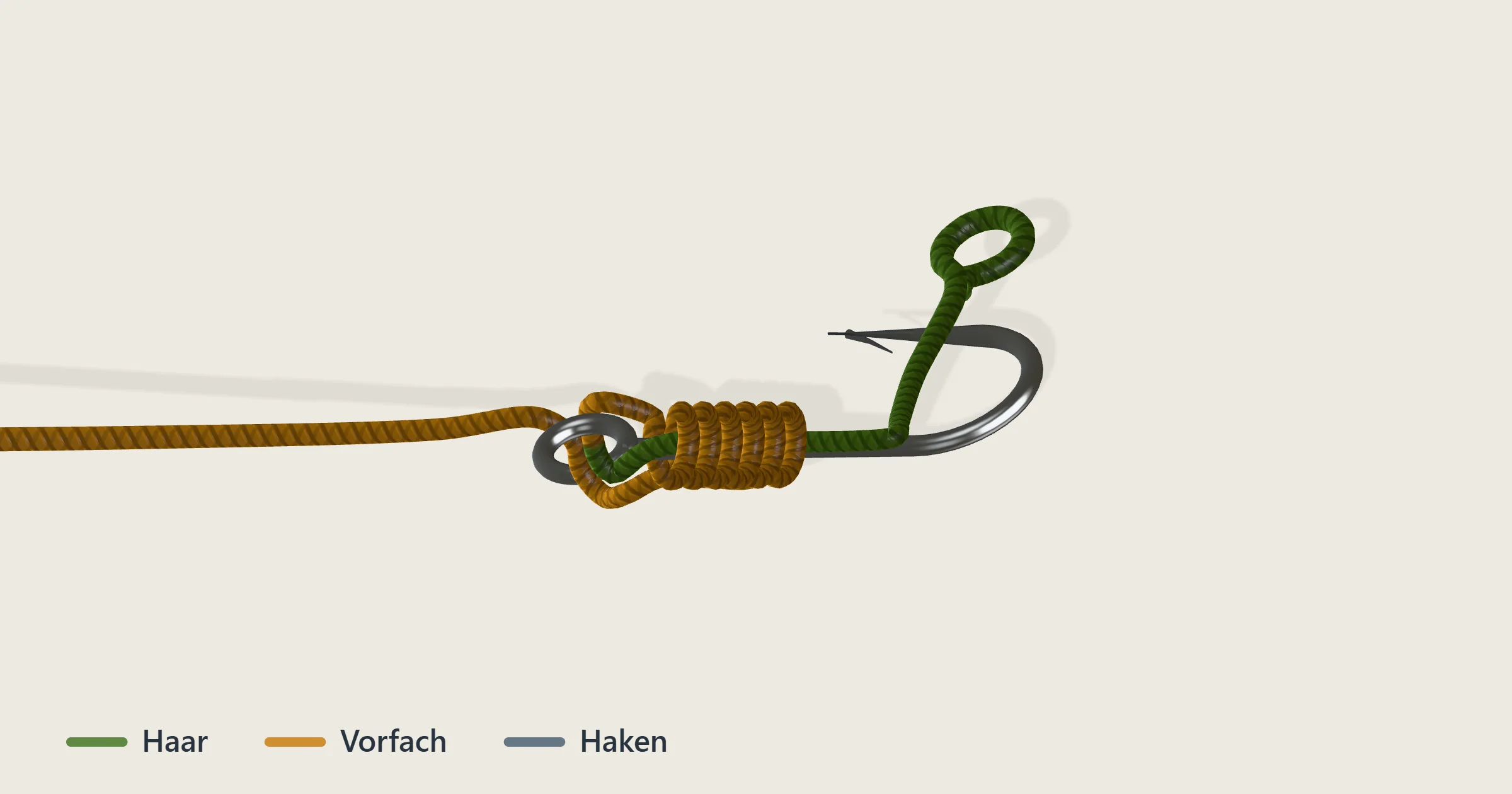
The No-knot, also called the knotless knot, ties an eyed hook using turns only and leaves one end of the line standing as a hair. The bait, for example a boilie, sits on the hair. It is widely used among carp anglers.
What is the no-knot good for?
The no-knot is tied to a hooklength, not directly to the main line. You set the hair length before you wrap.
The direction at the eye matters: Both times the hooklength runs through the eye from the back, i.e. towards the hook point.
Tying the no-knot: step by step
- Tie the hair loop. Tie a small loop at the end of the hooklength, for example as a figure-of-eight loop. The bait will hang from it later.
- Through the eye. Pass the other end of the hooklength through the eye from outside to inside, i.e. from the back towards the hook point.
- Set the hair length. Pull the hooklength through until the hair loop hangs at the distance you want below the hook.
- Wrap. Wrap the hooklength tightly around shank and hair directly behind the eye, towards the bend. NetKnots gives five to eight turns. Angling Times wraps down until the shank turns into the bend.
- Back through the eye. After the last turn, pass the hooklength through the eye again from outside to inside.
- Pull tight. Hold the hair in position, push the turns up to the eye and pull the hooklength tight.
Common mistakes
- Wrong direction at the eye: On the first pass and the second, the hooklength runs through the eye from the back towards the point.
- Untidy turns: Lay them tight and neatly side by side.
- Wrapped too short: If the wrapping ends well before the bend, the hair can flip back.
Pull test and knot strength
First check that the turns lie neatly side by side and the line is undamaged. Then pull steadily on both sides of the connection. For practice use a blunt ring; do not pull with bare fingers on an open hook or on thin line. If an end slips or the knot distorts, tie it again. A pull test does not measure breaking strength, it only shows gross tying faults.
Material, diameter and tying technique affect every connection. The line calculator gives you a rough guide using cautious knot factors of our own.
Related knots
For the hair loop, the figure-of-eight loop or the surgeon’s loop is suitable. Without a hair, the snell knot is also tied on the shank.
Used in the rig: hair rig. Also used in carp fishing.
Note: NetKnots names a drop of superglue on the turns as an option. That is a possibility, not a requirement.
Sources
- NetKnots – Knotless Knot
- Angling Times – How to tie the banded knotless knot
- Wikipedia (englisch) – Knotless knot
Sources opened and checked on 2 October 2026. Texts in our own words, sketch drawn independently; no graphics taken from the sources. You will find all knots in the overview of fishing knots.
All figures are guide values without guarantee. Follow the line manufacturer’s instructions.