
Knowledge · Rigs & setups
Hair rig
On the hair rig the bait does not sit on the hook but on a short piece of line below it, the hair. This keeps the hook point free so it can grip when the carp sucks in the bait and tries to eject it again. With a heavy fixed lead it becomes a self-hooking rig, which must release the lead if the line breaks.
What you need
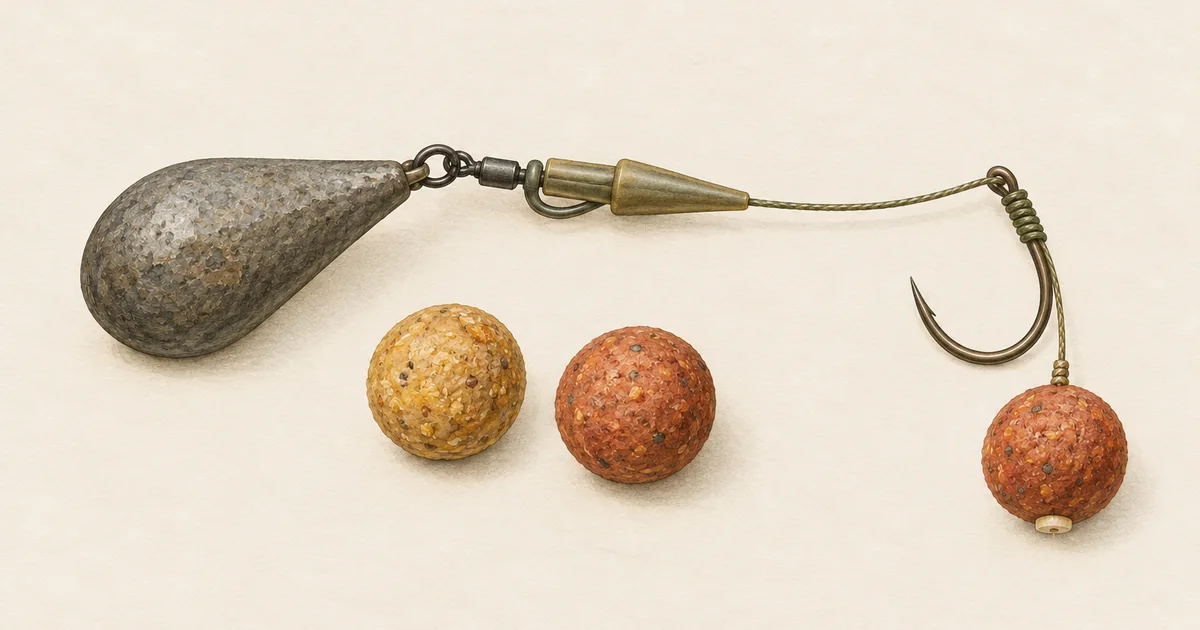
- Hooklength: soft braid for the basic form. Weighted material lies flat on the bottom, so the carp barely bump into it.
- Eyed hook, rather small, the sizes are given with the guideline figures.
- Baiting needle and bait stop: with the needle you pull the bait onto the hair, the stop holds it there.
- Barrel swivel as the link to the main line.
- Fixed lead: a lead with an eye on the safety clip with a rubber cap, or an inline lead through which the main line runs.
- Anti-tangle sleeve, a little longer than the hooklength. It sits above the lead and reduces tangles on the cast.
Baits such as boilies, cooked particles and pellets go on the hair.
Why the hook stays free
Today’s hair rig came out of a tank experiment that Fisch & Fang retells. In the winter of 1978/79, three carp anglers repeatedly caught two-pound carp in a tank on sweetcorn. Soon the fish tested every kernel by sucking it in carefully and shied away from the stiff hooklength line. One of them tied a kernel of corn to a long human hair, three centimetres from the hook. On the very first try a carp sucked in kernel and hook together and could no longer blow the hook out easily. The idea was not new: as early as 1940 an angler from Dresden described a carp rod with a „sewn-on“ bait and a free hook.
Today the hair is a thin piece of hooklength line, and no bait hides the point. Researchers at the Leibniz-Institut für Gewässerökologie und Binnenfischerei (IGB) have studied how quickly carp learn. In their experiments with carp 20 to 30 centimetres long, the fish kept feeding at the baited spot. But they increasingly left the bait with the hook lying or spat it straight out again. Rigs would therefore have to make spitting out harder, the researchers conclude.
Fixed lead and the self-hooking effect
The hair alone does not hook a fish; the weight does that. The lead is fixed. If the carp swims on with the bait in its mouth, the short hooklength tightens and the point goes in. The fish panics, bolts and drives the hook deeper, Blinker describes. If it stays put, it can suck in the bait without being hooked. With the running ledger rig the lead slides freely, the fish does not hook itself, and you strike.
- Safety clip: the clip on the main line holds the hooklength swivel. The lead is clipped on, and a rubber cap over it secures it. If the lead snags on an obstacle, the cap slips off and the clip releases it. As a drawback Blinker names the joint at the lead swivel: after the bite the carp can swim a little way to the side before the weight is pulling on the hook.
- Inline lead: the main line runs through the lead, and the swivel sits in a sleeve inside it. On the bite the weight pulls on the hook at once. Blinker sees the drawback that after a line break a carp would drag the whole rig along with it.
Tying the hair rig in eight steps
- Tie the hair loop. With a simple overhand loop knot, tie a loop at the end of the hooklength. If it turns out a bit large, that does not matter, as it is pulled into the bait later.
- Thread on the bait and secure it. Spear the bait on the needle, hook the loop in and pull it onto the hair. A stop behind it holds it in place. Because the bait goes on first, you can then set the distance to the hook as you like.
- Cut the hooklength to length. Blinker gives 15 to 25 centimetres between hook and swivel. Add at least 5 centimetres for the knots.
- Set the gap. Thread the hooklength through the eye from the outside. Pull it through until half to one centimetre is left free between the hook bend and the bait.
- Tie on the hook. For the no-knot, wrap the hooklength six to eight times around shank and hair. Then take the end back through the eye from the outside to the inside.
- Tie on the swivel. For this, Angling Times uses a grinner knot with four turns.
- Prepare the main line. Thread on the sleeve, rubber cap and safety clip, tie the main line to the hooklength swivel and pull it firmly into the clip.
- Clip on the lead. Hang the lead on the nipple, push the rubber cap on only lightly and put the sleeve into the cap.
Guide values from the sources
Three Blinker articles give guideline figures that lie close together: one on the no-knot hair rig, a basics course and one on lead rigs.
| Guide value | Blinker: no-knot hair rig | Blinker: basics course, lead rigs |
|---|---|---|
| Hooklength | 15–25 cm | 15–20 cm |
| Bait to hook bend | 0.5–1 cm | no figure given |
| Hook size | 4, 6 or 8 | 2 to 8 |
| Lead weight | from 80 g | from 60 g, better 80–100 g |
On a muddy bottom the hooklength should be longer, according to the no-knot article. In the author’s experience, smaller hooks often turn faster, grip better and come out less often in the fight, because they give less leverage. Whether your rod casts such weights is covered on the Carp rod page.
Safety for the fish
If the main line breaks in the fight, the carp is still hooked. If the lead then does not come free, it drags the rig along and, according to Blinker, can in the worst case die from it. Angling Times therefore calls it essential that the lead can slide off the rest of the rig.
- Rubber cap loose: push it only lightly onto the clip so that the lead comes free with little force. Check before casting that it releases easily, advises Angling Times.
- Hooklength weaker than the main line: Angling Times recommends this too. You can compare breaking strains in the line calculator.
Read the water rules first: which rigs, leaders and weights are allowed is governed by state law, the fishing permit (Erlaubnisschein) and the water rules. More under Fishing permit and water map.
How to land the fish gently is covered under Landing a fish and unhooking.
Common mistakes
- Wrong gap between hook and bait: according to Blinker, this happens to many people. So pull the bait onto the hair before you tie on the hook.
- Lead too light: below the minimum weights in the table, the self-hooking effect does not work reliably.
- Tinned sweetcorn on the hair: it is soft, holds badly and quickly falls victim to small coarse fish.
- Rubber cap pushed right home: then the lead no longer comes free with little force.
Frequently asked questions
Does the hair rig need a strike?
Usually not. According to Blinker, the hook is often set before you reach the rod. According to Blinker, you set the free spool or the drag distinctly tighter than when sitting it out with a baitfish for predators. Never leave the rod unattended. In Bavaria, Brandenburg and Saxony this is compulsory, and in Saxony an electronic bite alarm expressly does not count as supervision, see Bottom fishing.
Does it also work with sweetcorn?
Yes. The Blinker article on lead rigs recommends hard corn, which is boiled up and left to soak in the liquor for at least half a day. At least three kernels go on the hair, secured with a stop. Tinned sweetcorn holds badly.
Is the rig also suitable for tench and barbel?
Yes. Angling Times names the fixed-lead rig for tench and bream in still water too, and for barbel and chub in rivers.
Related
- No-knot: turns and direction at the eye in detail
- Running ledger rig: the bottom rig where you strike yourself
- Boilies and pellets: kinds and sizes of baits for the hair
- Carp fishing: the method at a glance
- Carp rod: test curve and casting weight for heavy leads
- Carp: features, holding spots and biting times
Sources
- Blinker: Die No-Knot Haarmontage und Blei-Montagen zum Karpfenangeln (Selbsthakeffekt, Material, Bindeschritte, Aufbau am Clip und mit Durchlaufblei, Richtwerte, Risiko beim Schnurbruch)
- Blinker: Karpfenangeln Grundlagen: Crash-Kurs und Angeln ohne Festblei (Haarvorfach, Vorfachmaterial, Richtwerte, Mais am Haar, Freilauf, Laufblei)
- IGB Berlin: Hakvermeidung von Schuppen- und Spiegelkarpfen (Lernen, Ausspucken des Hakens)
- Fisch & Fang: Wer erfand den Boilie? (Beckenversuch 1978/79, Karpfenangel von 1940)
- Angling Times: The safe bolt rig (Blei muss abgleiten, Gummikappe, Grinner-Knoten, Köder, Vorfach schwächer als Hauptschnur, Schleie und Barbe)
- Freistaat Bayern: Ausführungsverordnung zum Fischereigesetz, § 16 (Handangel ständig beaufsichtigen)
- Land Brandenburg: Brandenburgische Fischereiordnung, § 7 (ausgelegte Handangeln ständig und unmittelbar beaufsichtigen)
- Freistaat Sachsen: Sächsische Fischereiverordnung, § 4 (Aufsichtspflicht, Bissanzeiger ersetzt sie nicht)
Text AI-assisted, drawing AI-generated. Sources opened and checked in October 2026; no graphics taken from the sources.
All figures are guidelines without guarantee. Which rigs, leaders and leads are allowed on your water is governed by state law and the water rules.