
Knowledge · Knots
How to tie a snell knot
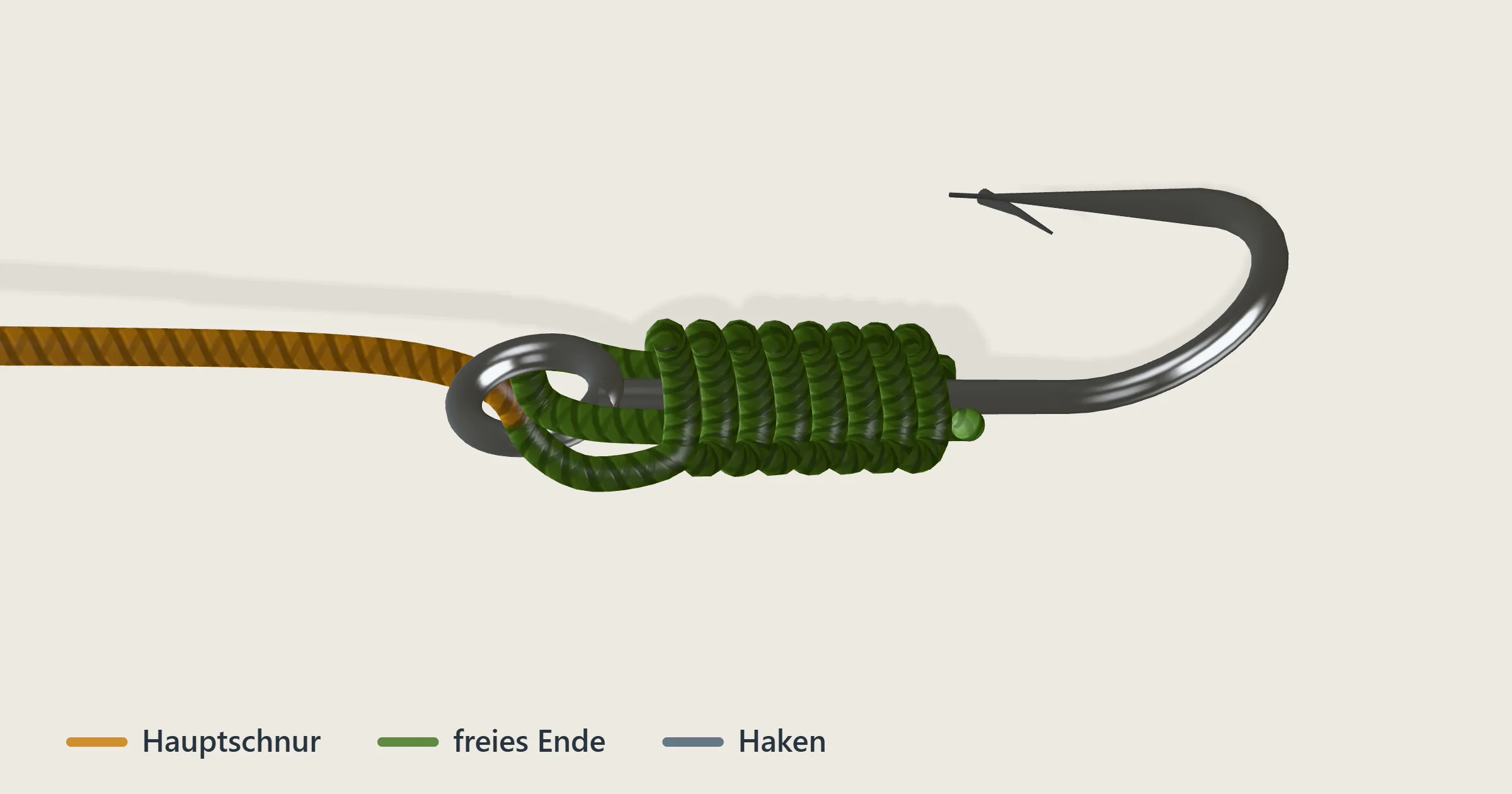
The Snell knot sits on the hook shank instead of in the eye. The line runs through the eye and pulls in a straight line along the shank. It is popular above all with sea anglers who fish strong monofilament hooklengths.
What is the snell knot good for?
The snell is one of the older fishing knots and, according to Animated Knots, was originally invented for hooks without an eye. It aligns the line with the hook shank and gives a straight pull. It is tied to a hooklength, not to the main line.
Salt Water Sportsman describes it as a firm, secure connection for sea fishing, especially when fishing natural baits and on heavy hooklengths.
Tying the snell knot: step by step
The steps follow Animated Knots: The end runs twice through the eye, then the loop is wrapped around the shank.
- Through the eye. Pass the end of the line through the eye and pull a good length through.
- Lay a large loop. Lay the end back to the eye in a curve to form a large loop, and pass it a second time through the eye in the same direction.
- Lay the end along the shank. Lay the end against the hook shank and hold the eye and both pieces of line firmly between thumb and forefinger.
- Wrap the loop. Take hold of the loop and wrap it turn next to turn around shank and the end laid alongside. Animated Knots gives seven to eight turns, Salt Water Sportsman six to seven.
- Tighten. Moisten the knot. Hold the turns and pull on the main line until the loop has disappeared. Then pull on both ends and trim the end.
Common mistakes
- Turns let go: Hold them under your fingers while tightening so that they lie neatly together.
- Loop too small: Make it generous; Salt Water Sportsman gives at least 15 cm. For every turn, it must be passed around shank and end.
- Tightened dry: Moisten the knot before tightening.
Pull test and knot strength
First check that the turns lie neatly side by side and the line is undamaged. Then pull steadily on both sides of the connection. For practice use a blunt ring; do not pull with bare fingers on an open hook or on thin line. If an end slips or the knot distorts, tie it again. A pull test does not measure breaking strength, it only shows gross tying faults.
Material, diameter and tying technique affect every connection. The line calculator gives you a rough guide using cautious knot factors of our own.
Related knots
For hooks with a spade instead of an eye there is the spade-end hook knot. Tied directly at the eye are the Palomar knot and the Uni/grinner knot.
Used in sea fishing.
Note: The sources give six to eight turns. With very thick monofilament, pliers on the hook bend help with the final tightening.
Sources
- Animated Knots – Snell Knot
- Salt Water Sportsman – How to Tie a Snell Knot (Marcus Parker)
- Salt Water Sportsman – How to Tie a Snell Knot (Dave Lear)
- Wikipedia (englisch) – Snell knot
Sources opened and checked on 2 October 2026. Texts in our own words, sketch drawn independently; no graphics taken from the sources. You will find all knots in the overview of fishing knots.
All figures are guide values without guarantee. Follow the line manufacturer’s instructions.