
Knowledge · Knots
How to tie a spade-end hook
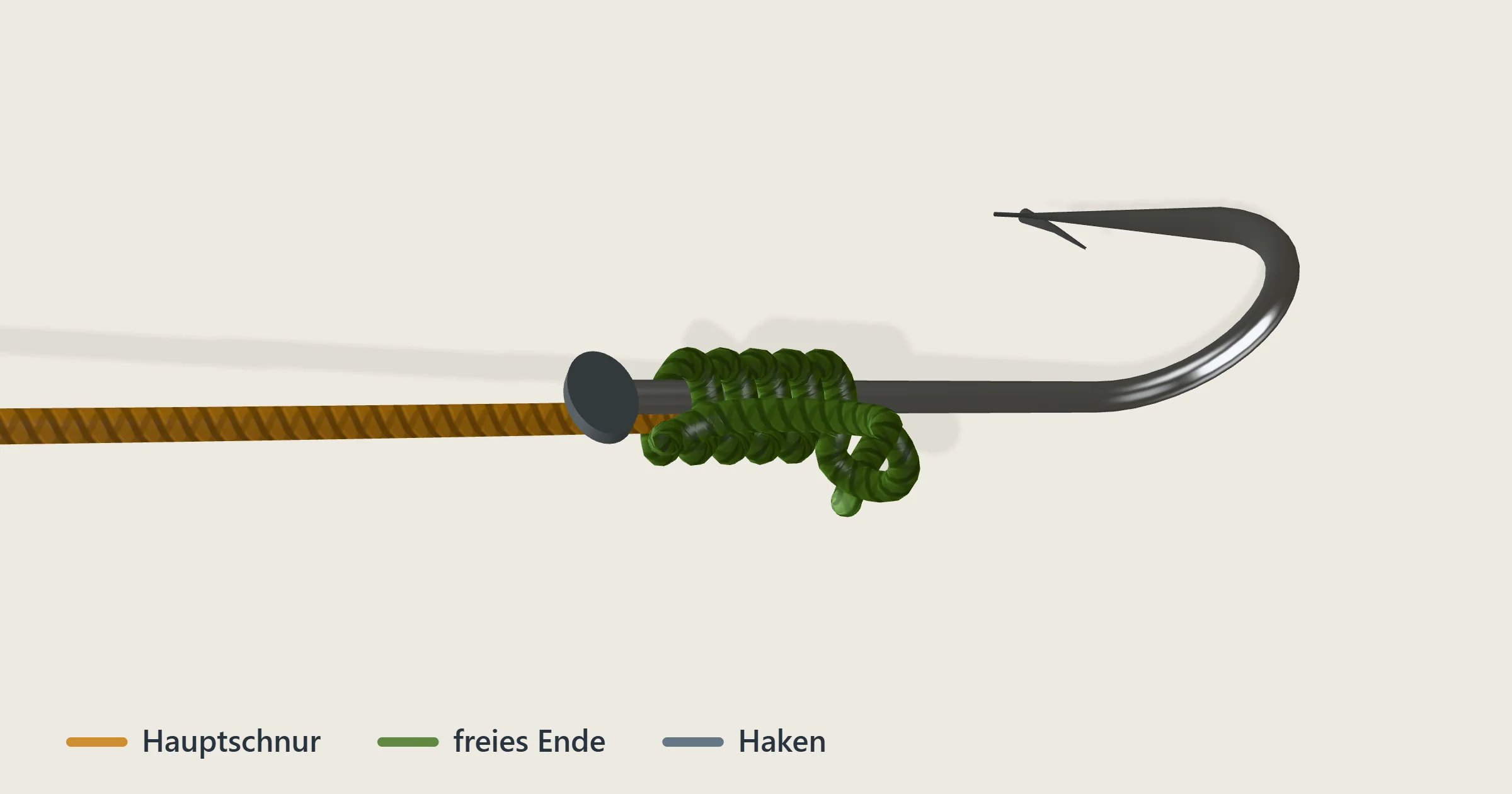
The Spade-end hook knot ties the hooklength to hooks that have a flat, widened spade instead of an eye. The line is secured on the shank with turns and pulled tight close to the spade.
What is the spade-end hook knot good for?
Pole fishing mostly uses spade-end hooks; eyed hooks are rare there. If you do not trust ready-tied hooklengths, you tie the hook to the hooklength yourself.
The widened spade holds the turns on the shank so they do not slip off. Watch the orientation: On the finished knot the spade faces away from the line.
Tying the spade-end hook knot: step by step
- Lay on a loop. Form a loop with the line and lay it on the hook shank. Hold loop and shank together firmly.
- Wrap. Wrap the free end around shank and loop, towards the spade. Blinker gives five turns, the knot booklet four or five depending on the variant.
- End through the loop. Bring the end back towards the hook point and pass it through the small loop that shows from under the turns.
- Moisten and tighten. Moisten the knot. Turn the hook so that the spade faces away from the line and pull the knot tight close to the spade.
- Trim. Cut off the protruding end short.
Common mistakes
- Spade turned towards the line: Before the final tightening, the spade must face away from the line.
- Knot too far down: It belongs close to the spade.
- Tightened dry: Moisten the knot before tightening, especially with braided line.
Pull test and knot strength
First check that the turns lie neatly side by side and the line is undamaged. Then pull steadily on both sides of the connection. For practice use a blunt ring; do not pull with bare fingers on an open hook or on thin line. If an end slips or the knot distorts, tie it again. A pull test does not measure breaking strength, it only shows gross tying faults.
Material, diameter and tying technique affect every connection. The line calculator gives you a rough guide using cautious knot factors of our own.
Related knots
On eyed hooks, the snell knot is tied on the shank in a similar way.
Used in this rig: feeder rig.
Note: The sources give four or five turns. Use a pull test on your line to see what holds.
Sources
- Blinker – Der Knoten am Plättchenhaken
- Blinker – Stippangeln: Die Sache mit den Angelhaken
- Wikipedia (englisch) – Fish hook
- Blinker-Knotenheft (PDF beim Landesfischereiverband Pfalz)
Sources opened and checked on 2 October 2026. Texts in our own words, sketch drawn independently; no graphics taken from the sources. You will find all knots in the overview of fishing knots.
All figures are guide values without guarantee. Follow the line manufacturer’s instructions.