
Knowledge · Tackle
Spinning rod: Choosing length, casting weight and action
A spinning rod is built for casting artificial lures again and again and working them actively. It stays in your hand all day, so weight and balance matter too. Which length, casting weight and action suit you depends on the lure, the target fish and the fishing spot.
What the spinning rod is built for
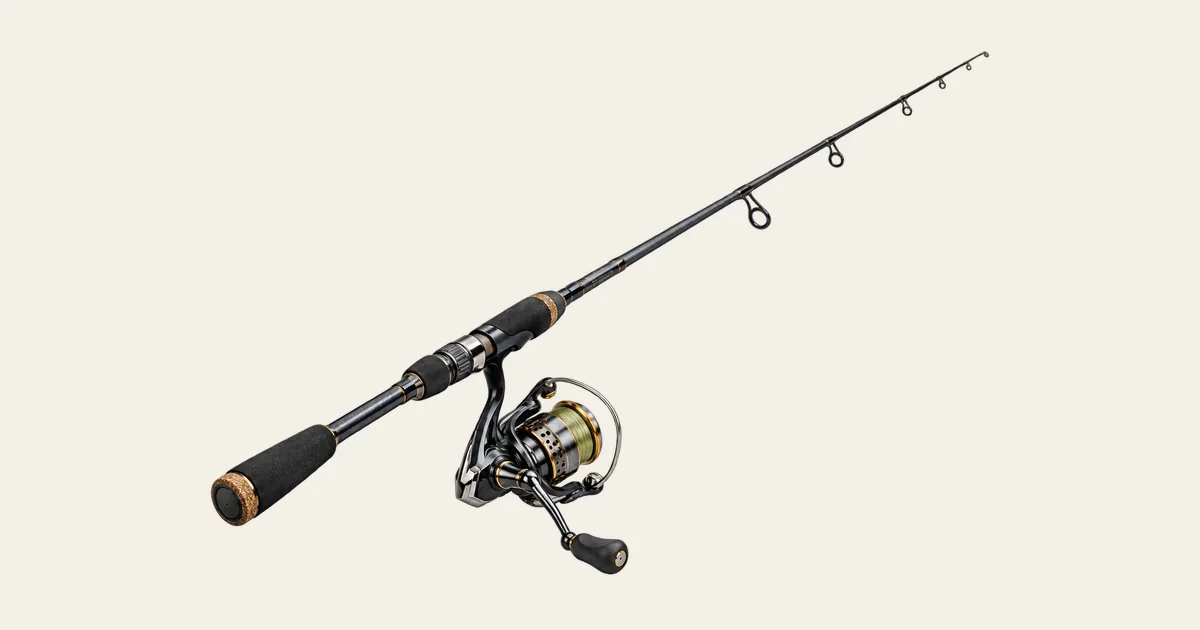
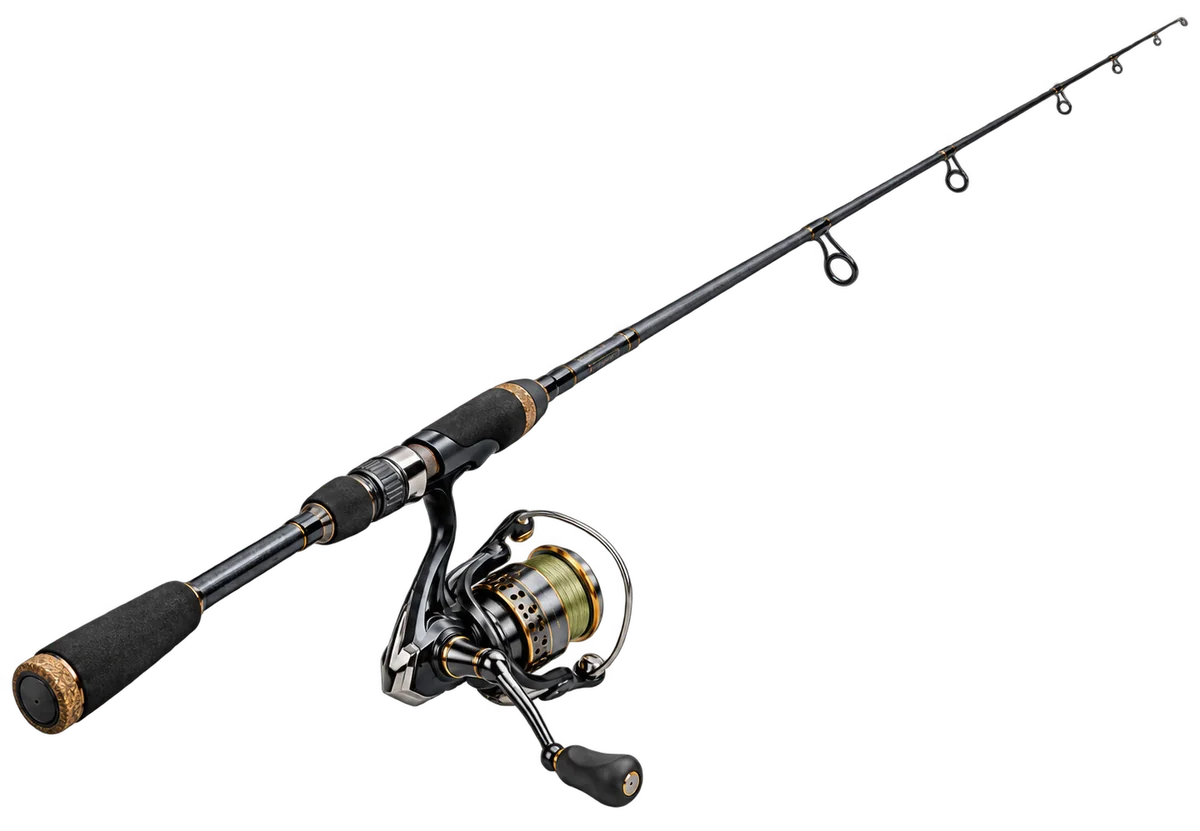
When you go spin fishing, you cast an artificial lure and retrieve it so that it imitates prey. The rod stays in your hand all day. It therefore has to be light and balanced with the reel, with the centre of gravity roughly at the reel foot. A tip-heavy rod tires your arm and shoulder, and bites come through less well. The blank, the load-bearing tube of the rod, is usually stiff. That way you feel the lure, and the strike, the jerk that sets the hook, goes through.
Length and casting weight by use
The casting weight gives the range in which the weight at the end of the line should fall. The higher it is, the harder the rod usually is. The table shows guide values from the angling press.
| Class | Target fish | Length | Casting weight |
|---|---|---|---|
| Ultralight | Trout, perch | 1,50–2,10 m | up to about 5 g, 10 g at most |
| Medium | Zander | 2,10–2,70 m | about 14–56 g, heavy models up to about 80 g |
| Heavy | Pike | 2,40–3,00 m | 20–100 g, up to 120 g for large soft plastics |
In between are perch rods of 1,80–2,40 m and 5–25 g. If the values on the blank are given in ft or oz, the unit converter will convert them.
From the bank, length helps, because a longer rod casts further. 2,70 m counts as the all-round length, and about 2,75 m at a stone-packed bank, a bank reinforced with stones. Where trees and bushes get in the way when casting, a shorter rod is handier. From a boat or from raised spots such as a sheet-pile wall, 2,40 m is enough.
Action and feedback with soft plastics and crankbaits
Action is the bending curve of the rod under load. For soft plastic lures on a jig head you need a fast rod with a stiff tip action. It bends only in the upper third, transfers the jerk from your wrist to the lure and does not bounce afterwards. When the lure touches down on the bottom, you feel it in the blank. If the rod is too soft for the weight of the lure, it swallows the jerk.
Crankbaits, hard lures with a diving lip, call for a fast rod that gives a little in the upper third. A very hard blank makes the crankbait run jerkily, a somewhat softer one passes its action on right to your hand.
Hard means it takes a lot of force to bend the blank, so the rod can take a lot of load. Fast means the blank springs back to straight quickly after bending, without swinging on for long. For perch and trout with their soft mouths, a softer tip is considered better, because fewer fish come off while being played, that is, during the fight with the hooked fish.
Handle and rings
Handles are mostly made of cork or EVA foam. Some spinning rods have a much shortened, split handle, and many have a cut-out at the reel seat. That way a finger rests directly on the blank and fine bites come through.
As for the rings, the angling press gives six to ten as usual. Fewer rings give casting distance, more rings spread the load better during the fight. Light rods carry single-foot rings with just one foot on the blank, heavy ones tend to have double-foot rings. Braided line is harder on the inserts than monofilament. A fine crack in the insert of the tip ring can cut the line.
Two designs: spinning and casting
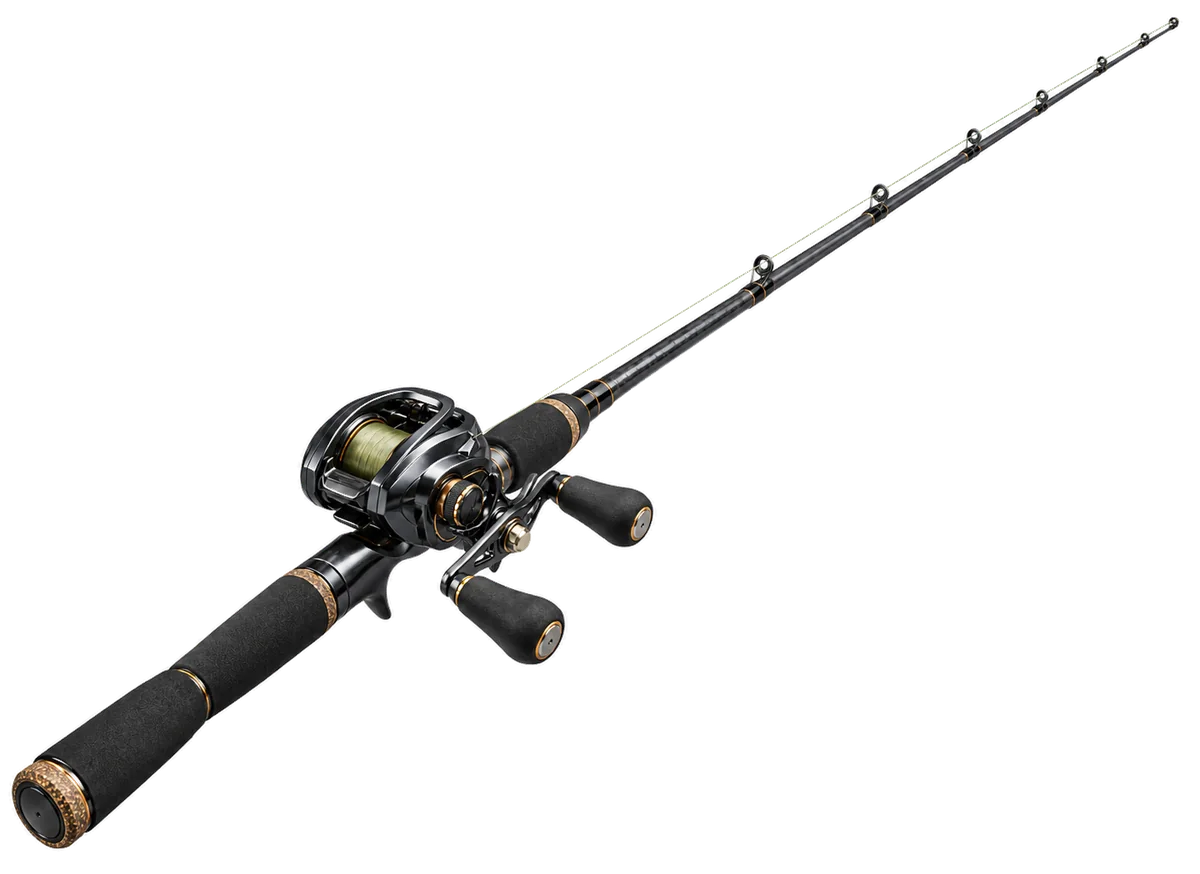
The usual spinning rod is built for the fixed-spool reel. The reel hangs below the handle and the rings face downwards. The casting rod goes with the multiplier reel, a reel with a revolving spool, which in its casting version is called a baitcaster. Here the reel and the rings sit on the top side. A spur, the trigger grip, sticks out below the handle. The rings have to match the reel, and casting with a multiplier takes practice.
The right line
Braided line is usually what goes on a spinning rod. It hardly stretches and reports lure movement and bites directly. A trade magazine gives 0,16 mm braid as the thickness for all-round spin fishing. Monofilament, by contrast, stretches and cushions sudden load peaks while playing a fish. Where pike are present, a wire trace, a bite-proof length of wire, belongs in front of the lure. More on this under Fishing lines compared.
Common mistakes when buying
- The casting weight does not suit the lure. Add up the jig head and the soft plastic. If the total is too small for the range, the blank does not load properly when casting, and distance suffers. If it is too large, the rod also casts worse and can break.
- Trusting very wide ranges. A print such as 5–30 g is rarely covered in full; according to the angling press, a rod like that works better from a good 10 g upwards.
- The length does not suit the spot. Too long in a boat and under trees, too short at a stone-packed bank.
- Not checking the balance. Screw the reel onto the rod in the shop.
- Reaching for a telescopic rod. With its many sections it is slower; for spin fishing a jointed rod is the better choice.
Worked example: A 14 g jig head and a soft plastic of an assumed 12 g make 26 g. A rod rated 14–35 g suits that. A 5 g spinner is below the range and flies correspondingly short.
Frequently asked questions
Which spinning rod suits perch?
For perch the angling press names rods of 1,80–2,40 m length and 5–25 g casting weight. With very light lures up to about 5 g, ultralight rods of 1,50–2,10 m are usual. A softer tip helps because the soft mouth tears out less.
How long should a spinning rod be?
2,70 m counts as the all-round length. A longer rod casts further, which is why about 2,75 m is usual at a stone-packed bank. From a boat or from raised spots such as a sheet-pile wall, 2,40 m is enough. Between trees and bushes a shorter rod is handier.
Is a telescopic rod good enough for spin fishing?
Usually not. Because of its many sections, a telescopic rod is slower and softer than a jointed rod and casts worse. For spin fishing the jointed rod counts as the better choice.
How do I find the right casting weight?
Add up the whole weight you cast, that is, jig head and soft plastic. The total should fall within the range printed on the blank. You should not rely on very wide ranges such as 5–30 g, because the rod only works well from a good 10 g upwards.
Related
- Fishing rods: construction, markings and all rod types
- Line calculator: working out breaking strength and knots
- Fishing lines compared: monofilament, braid and fluorocarbon
- Spin fishing: the method at a glance
- Texas rig: presenting soft plastics on the bottom
- Drop shot rig: presenting the bait above the bottom
- Metal lures: spinners, spoons and jigs
- Zander rod: the stiff rod for the soft plastic shad
Sources
- Blinker: Spinnrute: Welche Rute passt zu meinem Zweck? (Balance, Aktion nach Zielfisch, Längen und Wurfgewichte der Klassen, Härte und Wurfgewicht)
- Blinker: Raubfischrute: Wichtige Kriterien für die Auswahl (Rute für Gummiköder und für Wobbler, Länge am Ufer und von erhöhten Plätzen, Hechtrute bis 120 g, Griff)
- Fisch & Fang: Das braucht der Allrounder! (Allroundlänge 2,70 m, sechs bis zehn Ringe, 0,16 mm Geflecht, Stahlvorfach, Spitzenring)
- Blinker: Die richtige Angelrute: Darauf kommt es an (Griff, Rollenhalter, Triggergriff, Ringe und Einlagen, Beringung je nach Rolle, Rutenlänge und Wurfgewicht, schnelle Rute) und Blinker: Ruten-Kompaktklasse: Reise- oder Telerute? (Teleskoprute langsamer, Steckrute zum Spinnfischen)
- Blinker: Angeln mit der Baitcaster-Rolle: Das solltest du wissen (Werfen mit der Multirolle braucht Übung), Rute & Rolle: Die richtige Schnur: Monofile oder Geflochtene? (Geflecht ohne Dehnung) und Blinker: Monofile Angelschnur (Dehnung puffert Kraftspitzen)
- Fischereiverein Löningen: Zusammenfassung Gerätekunde (PDF) (Multirolle, Wobbler) und Wikipedia: Angelrute (Steifheit, Rückstellgeschwindigkeit, Lage der Ringe, nur ergänzend)
All figures are guide values without guarantee. Which rod suits you depends on the lure, the water, the target fish and your casting style.