
Knowledge · Tackle
Zander rod: Stiff for a soft plastic on the bottom
A zander rod is a stiff spinning rod with which you work soft plastics over the bottom in hops. It reports every landing and every short bite to your hand and drives the hook into the bony mouth. Here you will find which length and casting weight suit river, canal, lake and boat, and how to recognise the bite.
Why the rod has to be stiff
The zander usually grabs a soft plastic when it flutters back down to the bottom after being lifted. In your hand you feel the bite as a short, dry knock that anglers call a “tock”. You then have only a few tenths of a second before the fish spits the bait out again. So the rule is: strike at once and firmly, so that the hook bites into the hard bony plate of the upper jaw.
The reason lies in the mouth. The zander tears it open, the resulting vacuum pulls the lure in, and the fish does not even have to turn. If you do not strike, the zander spits the soft plastic out again. If in doubt, it is better to strike once too often.
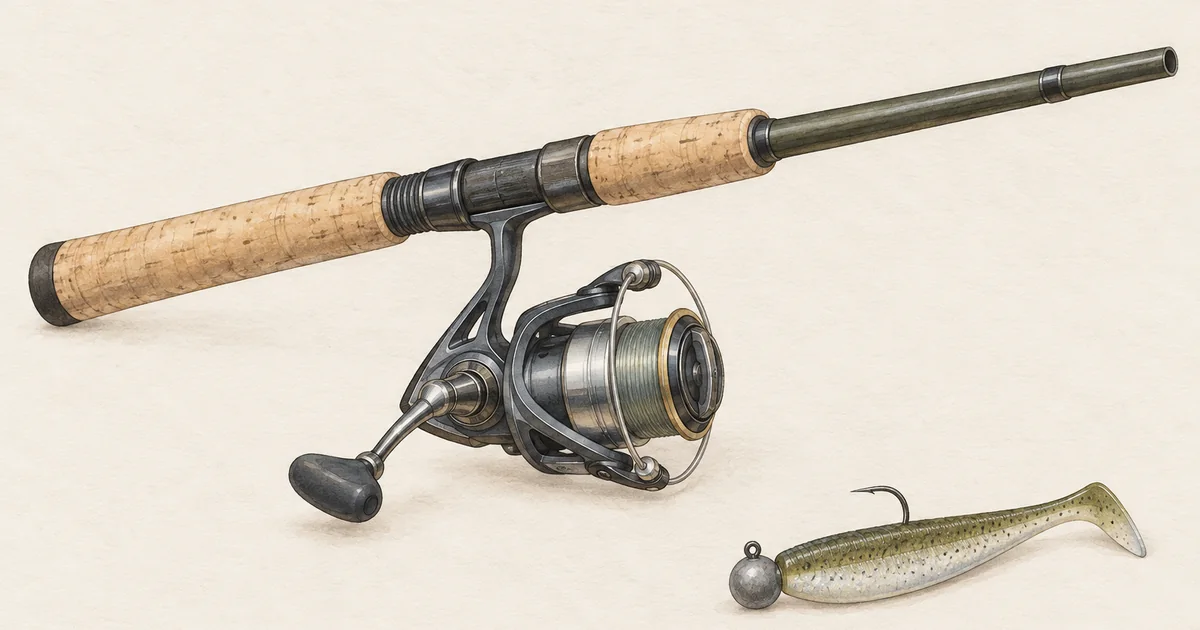
A soft rod that bends right down into the handle is out of place for zander fishing. It reacts with a delay, swallows the jerk from the wrist and dulls the strike. When jigging, the blank, the load-bearing tube of the rod, has to pass every small movement on to the bait immediately. When working the bait with turns of the reel handle, only a stiff rod lifts the bait off the bottom straight away with each turn, which keeps it out of the gaps between the stones.
Stiff does not mean rock hard
What action and tip action mean is explained in the overview Fishing rods. For the zander jig rod, a rod overview becomes more precise: the blank should be fast and very stiff, but bend a little in the upper third under load, so that the curve almost resembles an L. A floppy tip springs back at the strike. Below it lies the backbone, the strong lower part of the blank, which sets the hook and guides the fish in the fight.
In the question catalogue for the angling exam (Fischerprüfung) in Saxony-Anhalt, an “extremely hard” action is the wrong answer; the right one is to match action, casting weight and elasticity to one another. Some anglers deliberately fish a rod with a progressive action (Fig. 2): under light load the tip bends, and as the pull grows the blank works deeper. It cushions head shakes in the fight, but must not be parabolic, and calls for very sharp hooks.
Tip, line and finger: recognising the bite
When jigging, a twitch of the rod lifts the lure; in reel-lift jigging (Faulenzen), turns of the handle do it (see Spinning). The soft plastic then sinks back on a tight line. Hold the rod at about ten o’clock and watch the tip. In wind it helps to lower the tip towards the water (Rute & Rolle).
Three signals show you what is happening below (Fig. 3). On the drop the line stays tight. When the lure reaches the bottom, the tip springs back slightly and the line collapses: now you lift again. A bite often announces itself as a knock in the blank; sometimes the line suddenly shoots forward or stops.
You control the sinking phase with the head weight. As a rule of thumb it lasts about two seconds according to Blinker, while Fisch & Fang gives two to four. According to Fisch & Fang, at least 90 per cent of bites come while the soft plastic is tumbling to the bottom. In flowing water you must not wait too long before the next lift, otherwise a line bow forms and you lose control of the lure.
Two ways lead to lure control. With visual control you watch the line; with feel control you rest the index finger of your rod hand lightly on the line during the sinking phase and notice when the lure lands. The finger also works at night, when you can no longer see the line. Do not press it against the blank, otherwise you lose feel.
Through the stiff blank you also read the bottom. If the lead head knocks on stones, you clearly feel it in your hand. Over mud that is missing, and then it is worth changing spot: zander prefer sandy and stony bottoms.
Many zander anglers spool yellow, white or orange braids because they show where the lure is running. Blinker advises against this: anyone who only looks at the line cannot fish at night, and registering everything through the blank is a matter of practice. At night some anglers hold the tip just above the water so that bats flying into the line do not set off a false alarm.
Length and casting weight by fishing spot
For beginners, Fisch & Fang gives rods of 2,50 to 2,70 m from the bank and 2,10 to 2,40 m from a boat. Longer rods, it says, are heavier and slower to handle. The table shows how the length depends on the place.
| Fishing spot | Length (guide value) | Reason according to the source |
|---|---|---|
| Groyne and stone revetment | 2,70–3,00 m | bait clears the stones, snags are easier to free |
| Open bank, long casts | 3,00 m and more | more casting distance |
| Sheet piling, high bank, boat | around 2,40 m | from above a shorter rod is enough |
| Bushes, steep slope | 2,20–2,40 m | handier |
2,70 m is considered the middle course. The rod overview gives 2,10 to 2,70 m for zander rods, while for jigging from the bank 2,70 or better 3,00 m applies.
The real casting weight: add everything up
The casting weight on the blank applies to what actually flies. The exam materials describe it as the weight of the lure to be cast. With a soft plastic you therefore add the jig head, the soft plastic and the stinger treble together. For lures from 10 cm, the combination of a short jig hook and a stinger treble is considered usual, because it makes it easier for the zander to suck the lure in. How to mount the lure is covered at Jig head rig.
For heads around 20 g, Blinker mainly names rods with 30 to 50 g; less is considered too little, and many anglers fish 40 to 60 or 60 to 80 g. The rod overviews range from about 14 to 56 g for the jig rod, converted roughly ½ to 2 oz (unit converter), up to zander rods of around 80 g. The right head weight is covered under Jig heads.
According to Fisch & Fang, heads from eight to 25 g should be in the tackle box, in exceptional cases lighter or heavier ones too. Fishing too light is no solution: without regular bottom contact the lure leaves the zander’s field of view. In shipping canals and deep lakes over-weighted lures often catch better, so a test with five grams more is worthwhile.
Worked example: the blank says 14–56 g, the middle is at 35 g. A 21 g head with a soft plastic of an assumed 14 g weighs 35 g and hits the middle. With a 7 g head in still water it is 21 g, with a 30 g head in current 44 g, near the upper limit. The stinger treble comes on top.
River, canal or lake: three profiles
The same rod does not fish the same everywhere. The table summarises what the sources give for typical waters. The Rhine and canal are only examples of water types here.
| Profile | Head weight according to sources | Rod |
|---|---|---|
| Canal, rock revetment | 7 g to 20 g, often more in a shipping canal | 2,50–2,70 m, stiff |
| Lake from the bank | 5 to 15 g in still water | 2,70 m, the strike counts |
| River with current | 15 g (shallow) to 35 g (deep groyne fields) | 2,70–3,00 m |
| Boat, vertically under the boat | from 20 g, up to 50 g in current | short, 14–28 g casting weight |
River with groynes: groynes, the stone cross-dams in the river, and rock revetments, that is banks reinforced with stones, cost heads. Below 2,40 m the risk of snags rises by more than 50 per cent according to Blinker, because the lure gets between the stones at your feet. With a long rod, snags come free more easily. In current, water resistance counts: soft plastics without their own action sink faster to the bottom and need less lead.
Lake and canal: In still water less lead is enough. At a canal stone revetment, depending on the spot, a 7 g head and a 12 cm soft plastic are enough for the bait to take a long time to sink. A stiff jig rod is still considered necessary from the bank so that the strike gets through.
Boat: for casting from a boat about 2,40 m is enough, with smaller fixed-spool reels of sizes 1500 to 2500. For fishing vertically under the boat there are dedicated short rods, see Vertical rod. Posture matters there: the butt of the rod belongs against the forearm so that the strike reaches the hard mouth.
Reel, line and hooklength for the zander rod
Rod and reel should be balanced. Fixed-spool reels of sizes 3000 to 4000 are usual, and on the bank a 4000 is considered sensible because of line capacity and casting distance; the gear ratio is considered secondary. The spool should hold 100 to at most 150 m of thin braid, with a monofilament backing line underneath. See Spooling a reel correctly and Fixed-spool reel.
In reel-lift jigging you fish with braid as a matter of principle, because it hardly stretches. According to the exam materials, braided line has a considerably lower stretch than monofilament, so bottom contact, bite and strike come through without loss. A diameter of 0,10 to 0,15 mm is given. Diameter and construction are covered under braided line, and the line calculator works out the breaking strength after the knot.
Braid is sensitive to sharp stones and mussels. Between braid and lure there is therefore usually a piece of fluorocarbon as protection against abrasion, joined for example with the FG knot. There are two figures for length and strength: 30 to 50 cm at five to ten kilograms breaking strength, or a piece about 100 cm long. Fluorocarbon or hard mono keep their shape when the lure is stuck between stones. Steel kinks and curls. Further details are in the jig head rig.
Where pike occur
Zander teeth do not cut the line; pike teeth do. Ordinary monofilament as a hooklength for zander is enough only if there are no pike in the water. Where pike are a risk, steel belongs in front of the bait; in front of zander baits, thin steel with a breaking strain of 6 to 7 kg is enough. The Bavarian exam questions name a hooklength of bite-proof material such as steel for this. Whether wire makes zander shy is disputed among specialist authors: one advises fluorocarbon because of their good eyesight, another considers thin steel harmless. Materials and lengths are covered under Pike hooklength.
Carbon fibre, electricity and thunderstorms
The exam materials point out that carbon fibre rods conduct electricity very well. Take care in thunderstorms and under or beside overhead power lines. This applies especially to long rods on high banks, sheet-pile walls and harbour installations. More on this under Power lines and fishing rods and Thunderstorms and weather.
Closed season and minimum size
Zander spawn in spring, and the specialist press advises leaving them in peace then. When they are protected and from what length you may take them is set by state law. In Bavaria, closed seasons and minimum sizes follow from the annex to the implementing regulation of the Fisheries Act, which the districts can change by regulation under certain conditions (AVBayFiG § 11, version valid from 1 June 2025). Water regulations and fishing permit come on top. You can find the rules of your state under Closed seasons and minimum sizes explained and Fishing permit and water map.
Common mistakes
- Bought too soft. A parabolic rod cushions twitches and the strike, and the hook grips poorly in the hard mouth.
- Weighing only the head. If you do not count the soft plastic and stinger treble, the real casting weight is above the figure printed on the blank.
- Too short at the stone revetment. Under 2,40 m the head snags at your feet more often.
- Fishing too light. Without bottom contact the lure stays outside the zander’s field of view, and you do not recognise the bite.
- Slack line in the fight. If the tension drops, the hook easily comes free. Netting is tricky when the rod goes up too high. See Landing and unhooking a fish.
- Fluorocarbon where pike swim. A thin hooklength of monofilament or fluorocarbon does not protect against pike teeth.
Frequently asked questions
Is the zander rod also suitable for crankbaits?
Only to a limited extent. For crankbaits you are better off with a rod of its own, somewhat softer at the front, 2,40 to 2,50 m and around 36 g. According to another article, a progressive zander rod is also suitable for crankbaits at night.
Which zander rod is right for a beginner?
2,70 m and a casting weight from 30 to 50 g are considered the happy medium. For the boat and tight banks a shorter rod is handier.
Can I use the zander rod to fish for pike specifically?
Rather not: pike rods are sturdier, heavier and somewhat more parabolic than zander rods and carry 20 to 100 g of casting weight. More under Pike rod.
How heavy should the jig head be on the zander rod?
Heavy enough that the lure reaches the bottom in about two to four seconds after lifting. Heads of eight to 25 g should be in the tackle box; in current or in a canal it can be more.
Does the line on a zander rod have to be braided?
The sources recommend braid for jigging and reel-lift jigging because it hardly stretches and transmits bottom contact and bite directly. Monofilament stretches more and cushions both.
Related
- Spinning rod: all spinning rod classes at a glance
- Fishing rods: action and casting weight explained
- Jig heads: head weight by depth and current
- Zander lures: which lure when for zander
- Vertical rod: short rod for fishing beneath the boat
- Pike hooklength: bite-proof materials compared
- Line calculator: breaking strain after the knot and drag setting
- Unit converter: oz and lb to grams
Sources
- Blinker: Zanderangeln: Die 12 wichtigsten Fragen! (Aktion, Grund spüren, Drill, Vorfach, Laichzeit)
- Blinker: Das erste Mal mit Gummifisch auf Zander (Wurfgewicht, Länge, Rolle, Schnurfarbe, Abriebschutz, Tock)
- Blinker: Die 9 größten Fehler beim Zanderangeln (Zusatzdrilling, Absinkzeit, Kopfgewicht im Kanal, Schnurfarbe) und Blinker: Vertikalangeln: Erfolgreich unter der Rutenspitze (Kopfgewicht, Rute, Haltung beim Vertikalangeln)
- Blinker: Raubfischrute: Wichtige Kriterien für die Auswahl (Biegekurve, Längen und Wurfgewicht der Jigrute, Wobblerrute) und Blinker: Spinnrute: Welche Rute passt zu meinem Zweck? (Zander- und Hechtruten)
- Blinker: Jiggen: Diese 10 Fehler sollte man vermeiden (zu kurze und zu weiche Rute, Kopfgewichte) und Blinker: Zanderrute: Mehr Gefühl gleicht mehr Spaß (progressive Aktion)
- Blinker: Zeit für Zetti: 6 Tipps für Zander (Reaktionszeit, Stahl)
- Blinker: Zander vom Ufer: Mit Gummifisch zum Erfolg (Stillwasser, Nacht) und Blinker: Raubfischvorfächer im Vergleich (Vorfach bei Hechtgefahr)
- Rute & Rolle: Die Faulenzermethode (Rutenspitze, Anhieb, Wind, Geflecht), Zander: Tipps für die Steinpackung (Kopfgewicht am Kanal) und Zander vom Ufer aus (Rutenlänge am Ufer)
- Fisch & Fang: Angeltechnik auf Zander (steife Rute beim Faulenzen) und Fisch & Fang: Zander für Einsteiger (Längen, Rollen, Kopfgewichte, Absinkphase, Köderkontrolle, Vorfach)
- Bayerische Landesanstalt für Landwirtschaft: Prüfungsfragen zur Fischerprüfung 2023/2024 (PDF) (beißsicheres Vorfach) und Land Sachsen-Anhalt: Fragenkatalog zur Fischerprüfung (PDF) (Wurfgewicht, Aktion, Dehnung, Kohlefaser und Strom)
- Bayern.Recht: AVBayFiG, § 11 Fischfang, Fangbeschränkungen (Schonzeiten und Schonmaße)
Text AI-assisted, drawings AI-generated. Sources opened and checked in November 2026, no graphics taken from the sources.
All figures are guideline values without guarantee. Which zander rod suits depends on the water, current, head weight and fishing spot; your federal state (Bundesland) regulates the closed season and minimum size.