
Knowledge · Tackle
Zander baits: Which lure when for zander
A zander lure almost always belongs to one of three groups: soft bait on a jig head, slim crankbait or dead bait. Which one suits at any moment depends on light, water temperature and water. Here the three are sorted accordingly; rigging and presentation are on the linked specialist pages.
Three lure groups and their sizes
The zander hunts small, slim fish. Its mouth is small compared with the pike, so overly large lures are discouraged. The sizes are rough guides from Blinker and Fisch & Fang.
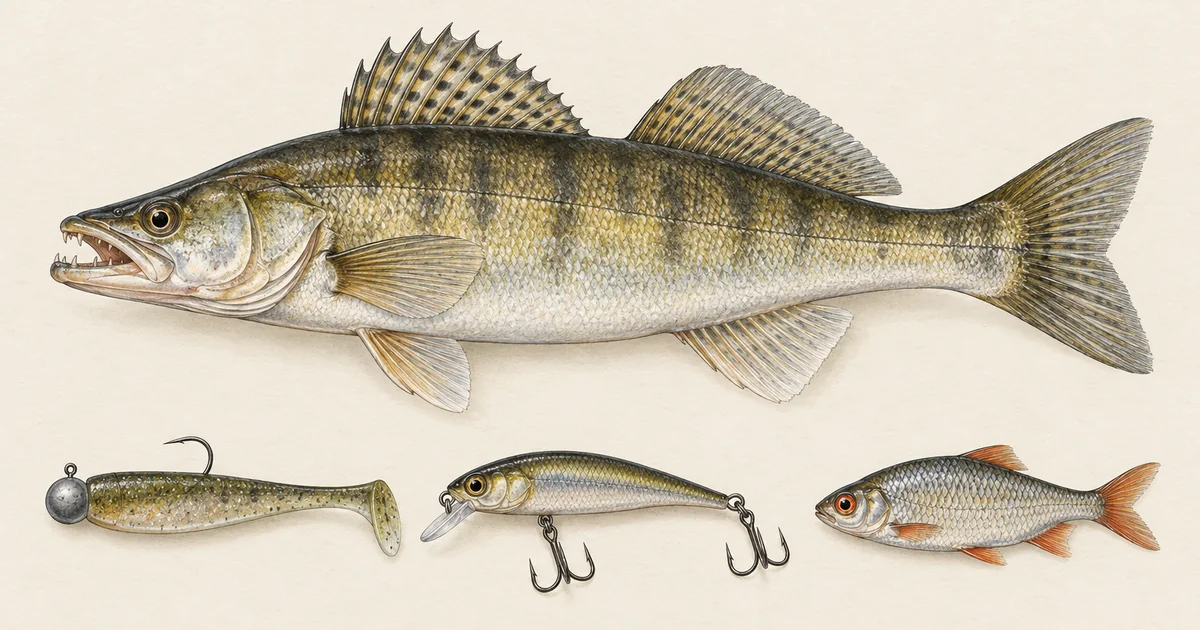
| Baits and lures | Size (rough guide) | When and where | Rig |
|---|---|---|---|
| Soft plastic (shad) with a paddle tail | 10–17 cm | by day on the bottom, in rivers, in warm water | Jig head |
| No-action shad | around 12 cm | winter, still water, cautious bites | jig head, drop shot |
| shallow-running crankbait | 10–12 cm | dusk and night in the shallows | hooklength with a clip |
| dead baitfish | roach up to 12 cm | bank fishing, winter, heavily fished waters | Baitfish rig |
No-action shads are soft baits with a narrow tail that hardly moves by itself. On sizes the angling press is not agreed. One article recommends slim soft baits of 8 to 14 cm and, in winter, lures up to 25 cm for big zander, another considers length irrelevant. A further source gives 8 to 20 cm for all zander lures.
Soft plastic is clearly in front today. In a Blinker analysis of catch reports from December to February, 87 per cent of zander took soft baits, 7 took crankbaits and 4 took baitfish. The editors note that more fishing is simply done with artificial lures.
Light, time of day and turbidity
According to the Anglerverband Niedersachsen, the zander prefers firm ground and murky water and takes its prey mainly at night in open water.
- Clear water, bright day: in clear waters zander shift their feeding to the night. By day they almost always stand on the bottom, and a soft bait in mid-water goes unnoticed. Work it in short hops close above the bottom.
- Murky water, cloud: in permanently murky water, overcast skies or a rising river, zander also bite by day. At low water the river is clearer, and bites then come more at dusk and at night.
- Dusk: it is considered the best phase, on into the dark. With baitfish it is advisable to be at the water before sunrise or to use the first hours after dark falls.
- Night: the zander move into the shallows, often to a metre deep and less. One angler then switches to a crankbait of 10 to 12 cm that runs 0,5 to 1 m deep and hangs in the water on the pause (suspender). He retrieves it slowly and evenly, with stops of two to three seconds, and avoids jerky twitching.
This angler leaves soft baits in the box at night, another reports bites in the dark on light soft baits worked parallel to the bank. Over the stone revetment, though, he too advises a slim crankbait that runs only about a metre deep. You recognise it by the small, almost vertical diving lip.
On colour, opinions differ: some fish loud at night, others dark, one catches on both and considers the steady action more important. Black is also named for its strongest contrast. You do not shine the torch on the water, as that scares off the predators, while lit harbours and bridges attract small fish. Whether you may fish at night is covered under Night fishing.
Season: from spawning to winter
- Spring: according to the Anglerverband Niedersachsen, the zander spawns from April to June, and the male guards the nest. Spring is therefore considered a delicate time; whether zander are protected is regulated by your federal state (Bundesland).
- Summer: algae cloud many waters, so zander also take the hook by day. In warm water the lure can be livelier, and soft baits with a strong paddle tail are then a good choice. Reel-lift jigging (Faulenzen), lifting the bait off the bottom with just turns of the handle, catches only moderately now.
- Autumn: when the water in the rivers clears, the chances rise at night. In lakes zander at first stand shallower and move into the deep as water temperature falls.
- Winter: the fish mostly stay in the deepest spots, and time of day takes a back seat. Below about 10 °C reel-lift jigging (Faulenzen) is a fit, and no-action shads with a V-tail are often the better choice. Smaller zander often stand deeper than ten metres in mid-winter according to Fisch & Fang, barely reachable from the bank.
In February and March big zander already head for the spawning grounds according to Fisch & Fang and then stand unusually shallow. For bank fishing with dead bait the magazine names small roach up to 12 cm, depending on the water also ruffe or gobies.
Closed season and lure bans: when the zander is protected is set by your federal state (Bundesland), and water rules and the fishing permit (Erlaubnisschein) come on top. Some states also regulate lures: in Saxony fishing with lures suited to catching predators is banned from 1 February to 30 April (§ 4 para. 5 SächsFischVO, version of 22 April 2022). How to find the rules of your state is covered under Closed season and minimum size explained.
River, lake and canal
In a river the lure’s own movement counts. A soft bait with a broad paddle tail wiggles just by standing in the current or sinking to the bottom, and most bites come precisely as it tumbles back. How heavy the head must be is covered under Jig heads.
In a lake zander often bite very cautiously. One angler catches almost only on no-action shads there, which he works slowly along the bottom, drags or leaves lying, even on 12 cm soft baits with an extra treble (stinger). In winter another searches the steep edges at deep holes and plateaus. From the boat, Dutch vertical anglers work mainly no- and low-action shads, see Vertical rod.
In a canal and harbour the lit spots are worth fishing at night. Where many artificial lures pass through the water every day, people rely on baitfish.
Rig, hooklength and pike bycatch
You thread the soft bait onto a jig head, explained in the Jig head rig. On the stinger two articles contradict each other: one fits every soft bait over 12 cm with it, the other only after missed bites, because every extra hook brings more snags. You present the dead bait on the bottom or under a float, see Deadbait rig. Many federal states expressly ban live baitfish, such as Bavaria, Hesse and North Rhine-Westphalia; in Brandenburg the fisheries authority (Fischereibehörde) can allow an exception in individual cases.
Zander teeth do not cut line, pike teeth do. Where both species live, a thin wire hooklength is considered appropriate for reasons of good angling practice, and the zander does not mind it. When bank fishing with baitfish, wire is always used. Another angler prefers fluorocarbon because of the zander’s good eyesight. If pike bites threaten, a wire leader is advisable. Materials are covered under Pike trace, and what main line and hooklength still hold after the knot is shown by the Line calculator.
Common mistakes
- The soft bait runs too high by day. By day zander almost always stand on the bottom.
- Hops too big in cold water. One angler never lifts the rod above the eleven o’clock position in winter, so that the soft bait stays on the bottom.
- Baitfish that are too big or deep-bodied. The mouth is small, and zander often reject deep-bodied fish such as bream.
- No bite-proof hooklength where pike swim. Without wire, bite-offs threaten.
- Not reading up on closed season and lure rules. In spring zander may be protected and predator lures banned.
Frequently asked questions
Which zander lure suits a beginner?
A soft plastic (shad) on a jig head worked by reel-lift jigging (Faulenzen). Reel-lift jigging is considered a universal method, easy to learn and good for beginners. The rod for it is described under Zander rod.
May I fish with live baitfish?
Not in many federal states. Brandenburg, for example, allows the fisheries authority (Fischereibehörde) in § 6 para. 1 BbgFischO to exempt individual waters or parts of waters if there is a sound reason. What otherwise applies to baitfish is regulated by your federal state.
Will a piece of sea fish also catch zander?
The sources contradict each other. According to one, zander take almost only freshwater fish, with smelt the exception. One angler caught well in his lake with pieces of sardine. Where baitfish may come from is regulated by the state: in Brandenburg they belong in the water they came from, deep-frozen baitfish and dead sea fish are exempt (§ 6 para. 2 BbgFischO, as at August 2026).
Related
- Zander: features, haunts and spawning
- Soft plastic (shad): build, presentation and choice of colour
- Jig head rig: threading the soft bait, stinger and hooklength
- Deadbait rig: float and bottom, law in the states
- Zander rod: length and casting weight for the soft plastic (shad)
- Jig heads: head weight by depth and current
- Pike trace: bite-proof materials for mixed waters
- Night fishing: light at the swim and rules in the states
Sources
- Blinker: Zanderangeln: Die 12 wichtigsten Fragen! (Licht, Trübung, Jahreszeiten, Stinger, Größe, Vorfach)
- Blinker: Zanderangeln mit Gummifisch (Grundnähe, Aktion, Größen) und Blinker: Steckbrief Zander (10 bis 17 cm, Stahl bei Hechtgefahr)
- Blinker: Zanderangeln bei Nacht (Flachwasser, Wobbler, Führung, Farbe, Licht) und Blinker: Im Winter geht’s in der Dunkelheit auf Zander! (Gummi im Dunkeln, Tauchschaufel)
- Blinker: Wackelschwanz oder Gabelschwanz? (See und Fluss) und Blinker: Zeit für Zetti (Dämmerung, Stahl, Stinger)
- Blinker: Zanderangeln mit Köderfisch (Maul, Tageszeit, Herbst, Sardine), Blinker: Winterzander (Kanten, Rutenhaltung) und Blinker: Der Nr. 1 Köder für Zander im Winter (Auswertung der Fangmeldungen)
- Fisch & Fang: Mit Köderfisch auf Winter-Zander (Winter, Köderfische, Stahl), Fisch & Fang: Angeltechnik auf Zander (Faulenzen) und Fisch & Fang: Vertikalangeln (Köder unter dem Boot)
- Anglerverband Niedersachsen: Zander (Lebensraum, Nahrung, Laichzeit)
- Freistaat Sachsen: Fischereiverordnung (§ 4 Abs. 5, Raubfischköder) und Land Brandenburg: Fischereiordnung (§ 6, Köderfische)
- IGB: Boddenhecht, Bericht 33/2023 (PDF) (Verbot lebender Köderfische) und Wikipedia: Zander (Ködergröße, Farbe, Köderfische, nur ergänzend)
Text AI-assisted, drawing AI-generated. Sources opened and checked in October 2026; no graphics taken from the sources.
All figures are rough guides without guarantee. Which zander lure catches depends on the water, light and water temperature, and what is allowed is regulated by state law, water rules and the fishing permit (Erlaubnisschein).