
Knowledge · Rigs & setups
Baitfish rig
A baitfish rig offers predators a dead baitfish: under a float in mid-water or just above the bottom, or with a running lead directly on the bottom. Between the main line and the bait sits a bite-proof trace, and the fish carries a single hook or one to two trebles. Here you find the rules, the construction in steps and guide values from the sources.
Law: dead baitfish only
Many federal states explicitly ban live baitfish as bait. The Leibniz-Institut für Gewässerökologie und Binnenfischerei (IGB) states that it is prohibited for anglers on animal welfare grounds. The Animal Welfare Act (Tierschutzgesetz) prohibits causing an animal pain, suffering or harm without a reasonable cause. The ban is set out explicitly in the states‘ fisheries law, for example:
- Bavaria: “Fishing with live baitfish” is prohibited (§ 15 AVBayFiG).
- Saxony: It is prohibited “to use live fish and other vertebrates as bait” (§ 24 SächsFischG). Baitfish must be killed in a proper, sportsmanlike way before baiting (§ 6 SächsFischVO).
- North Rhine-Westphalia: Live baitfish may neither be carried nor used (§ 6 LFischVO).
- Brandenburg: Live fish are banned as bait; exceptions can be allowed only by the fisheries authority (Fischereibehörde) in individual cases (§ 6 BbgFischO).
Origin and species are also regulated by the state. In Brandenburg and North Rhine-Westphalia the baitfish must belong to the water it comes from or to one connected to it. Brandenburg makes an exception for deep-frozen baitfish and dead sea fish and bans fish in closed season or under the minimum size as bait. In Saxony anglers with a fishing permit may use self-caught baitfish only in the water where they were caught. See Closed season and minimum size explained.
As of October 2026: The examples come from four federal states; other states, water regulations and fishing permits may ban more. Where to find the rules is explained under Fishing permit and water map.
What you need
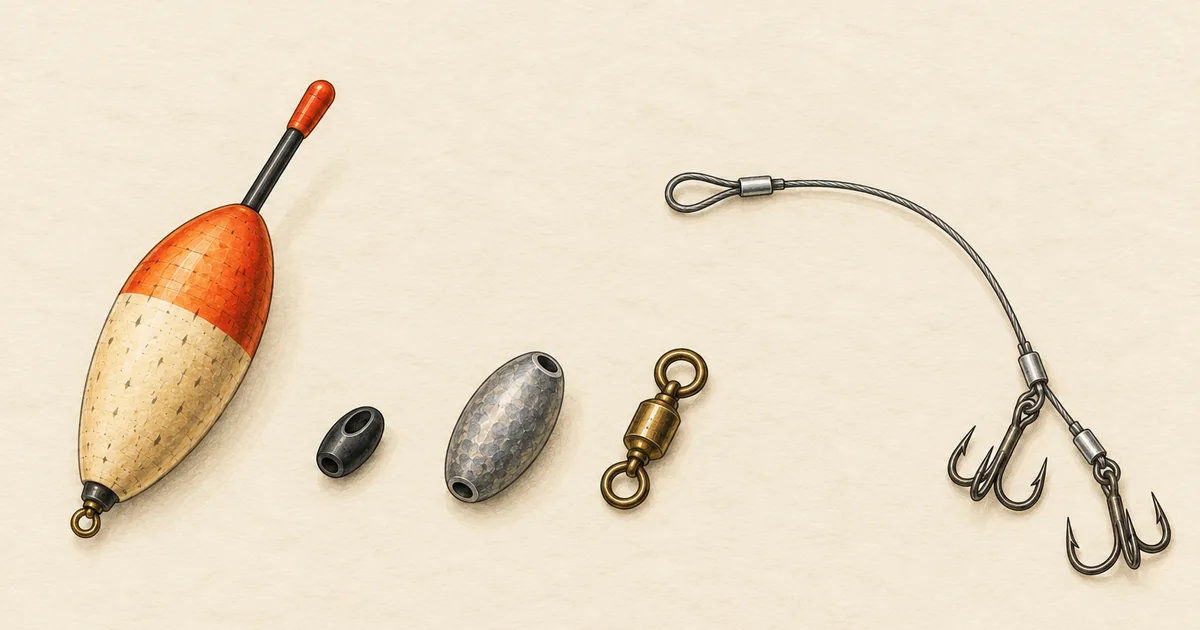
- a predator float with a buoyancy that suits the bait, plus a stopper and a small bead
- an olive weight for the float or a running lead for fishing on the bottom
- a large rubber bead and a sturdy snap swivel
- a trace of steel or titanium wherever pike occur
- a single hook or one to two trebles, that is hooks with three bends and three points
- a baiting needle, pliers and a mouth gag for unhooking
Which fish are suitable as bait and how to mount them is explained under Baitfish.
Construction under a float and on the bottom
Under a float in seven steps
Under the float the baitfish hangs at a fixed depth, in mid-water or above the weed. The order comes from a pike guide in Blinker; Fig. 1 shows it.
- Slide on the stopper. It sets the depth, for example as a stopper knot.
- Thread on a small bead and the float. The float runs on the line, the stopper and bead limit it from above.
- Slide on the olive weight. It runs freely and brings the bait down to depth.
- Slide on the large rubber bead. It protects the knot at the swivel from the weight.
- Tie on the snap swivel, for example with the clinch knot.
- Clip on the steel trace. Blinker uses 50 centimetres with a treble in size 6 or 8.
- Mount the baitfish and balance the float. If it is to hover above the bottom, the hook sits in the back at the height of the dorsal fin or in the lip. The right weight is calculated by the float weighting.
On the bottom with a running lead
On the bottom the predator should feel hardly any resistance when it bites, otherwise the zander, for example, spits the bait out. A zander rig in Blinker runs 20 to 60 grams of lead on an anti-tangle tube, a tube against tangles when casting. Behind it follow a plastic bead, a snap swivel and about 70 centimetres of trace. The bail arm stays open, and the line sits loosely under a rubber band on the rod handle. The principle is explained by the running ledger rig.
Over weed or foul ground a stick of balsa wood in the baitfish lifts the bait. The length of the trace then decides how high it floats; the guide in Blinker uses 30 to 50 centimetres of steel and 50 to 70 grams of lead. On weight, two Blinker authors contradict each other. One uses the lightest lead on soft lake bottoms, because a heavy one sinks in; the other tends to choose it too heavy so that the fish does not move it.
Trace and hook
Where pike occur, a bite-proof trace, for example of steel, belongs between bait and main line, according to the exam catalogue of the Bayerische Landesanstalt für Landwirtschaft. Titanium is likewise considered pike-proof in Blinker and does not kink, but after longer use it can break without warning.
On length, the Prüfungskatalog Sachsen-Anhalt gives at least about 30 centimetres for pike fishing. Blinker uses 50 centimetres with 8 to 15 kilograms breaking strain, and 60 to 70 centimetres on zander bottom rigs.
Blinker guides use trebles in size 6 or 8, the Prüfungskatalog Sachsen-Anhalt gives sizes 1 to 3 for pike fishing. The points face in the direction of the strike. With two trebles the rear one absorbs the force of the cast, and the front one sits loosely in the fish. A treble in the head holds on long casts in the solid skull. Predators usually swallow prey head first. A pike angler in Blinker therefore does not place the hook right at the front; that way it takes hold at the front of the mouth rather than deep in the throat.
Strike early
According to the IGB report, more pike die on the hook with natural baits than with artificial lures, especially when the bait is swallowed deeply and the fish bleeds heavily. Pike often take small baits deeper. The Fachgebiet für Integratives Fischereimanagement (Humboldt-Universität zu Berlin) advises striking at once with a natural bait and tending to use larger baits. A beginner’s guide in Blinker, by contrast, gives the pike 5 to 10 seconds on the bottom.
Keep an eye on every float: an unnoticed pike can swallow the hooks so deeply that they cannot be removed without fatal injury, warns Blinker. If the hook sits deep, the IGB report advises cutting the trace as short as possible in front of the bait. Brandenburg prescribes this for undersized and protected fish: the line is cut at the level of the tip of the head. More under Landing and unhooking a fish.
Use and target fish
For pike, Blinker recommends bottom fishing with a deadbait, mainly in autumn and winter, when pike move into deeper water. The catch calendar shows the seasons. Saxony bans fishing with baits suitable for catching predatory fish from 1 February to 30 April.
- Pike: under a float over weed or on the bottom. Above a water temperature of 22 degrees, the specialist department at Humboldt University advises against catching pike and says to release them.
- Zander: its mouth is relatively small. Blinker names baitfish of 8 to 12 centimetres and floats with a carrying capacity of 4 to 8 grams.
- Eel: according to Blinker, finger-length dead baitfish or strips raise the chance of a big eel; the Bavarian exam catalogue also names the dead baitfish for large eels.
- Wels catfish: Blinker also offers it baitfish weighing around half a kilo, does without steel and uses a mono hooklength of 0.50 to 0.80 millimetres, single hooks from 5/0 to 10/0 and floats with a carrying capacity of 60 to 120 grams.
- Burbot: according to Blinker, a small dead baitfish or strips are second choice after the worm, on the bottom or a few centimetres above it.
A piece catches too: a zander angler in Blinker presents the back fillet of a larger roach under a float with 3 grams of carrying capacity. The page Fish strips describes strips for the sea.
Common mistakes
- Striking too late: the hook sits deep in the throat.
- Mono without steel where pike live: pike bite through ordinary line with their sharp teeth.
- Float too small: it is pulled under water. The carrying capacity depends on the bait size; for a baitfish that should dance on the waves, a pike angler in Blinker uses 50 grams.
- Kinked steel trace: kinks weaken the material, says Blinker; according to the exam catalogue for Saxony-Anhalt it must not have any kinks.
Frequently asked questions
Are there exceptions to the ban?
The regulations quoted from Bavaria, Saxony and North Rhine-Westphalia name none for live baitfish. In Brandenburg the fisheries authority (Fischereibehörde) can allow an exception for specific waters in individual cases if there is a sound reason.
Does zander need a steel trace?
Only where pike are present, writes Blinker; otherwise mono of about 0.30 to 0.40 millimetres is enough. When sitting it out on the bank, Fisch & Fang always uses steel anyway, because the risk from pike is higher there.
How many treble hooks are allowed?
The federal state decides. Bavaria allows a maximum of five biting points per hand rod, with a treble counting as one. Brandenburg allows a maximum of three hooks on a predator rod. In Saxony a hand rod has only one biting point; whether a rig with two trebles is permitted there, you can clear up with your fishing permit (Erlaubnisschein) or the fisheries authority.
Related
- Baitfish: suitable species and baiting up
- Fish strips: strips of herring and mackerel for the sea
- Float rig: carrying capacity, shotting and depth
- Running ledger rig: why the weight runs freely
- Releasing a fish: when and how
- Bottom rod: length and casting weight for sitting it out on the bottom
Sources
- Bundesrecht: Tierschutzgesetz, § 1 (Schmerzen, Leiden, Schäden)
- Freistaat Bayern: Ausführungsverordnung zum Fischereigesetz (§ 15 Verbot, § 16 Anbissstellen)
- Freistaat Sachsen: Fischereigesetz (§ 24 Verbot) und Fischereiverordnung (§§ 4, 6, 12)
- Land Brandenburg: Fischereiordnung (§§ 2, 3, 6, 7)
- Land Nordrhein-Westfalen: Landesfischereiverordnung (§ 6 Köderfische)
- Bayerische Landesanstalt für Landwirtschaft: Prüfungsfragen 2023/2024 (Vorfach beim Hecht, Drilling, Aal)
- Land Sachsen-Anhalt: Fragenkatalog zur Fischerprüfung (Stahlvorfach, Drillingsgröße)
- IGB: Boddenhecht, Bericht 33/2023 (Verbot, Naturköder, tiefer Haken)
- Humboldt-Universität zu Berlin, Fischereimanagement: Empfehlungen Hecht (Anhieb, Ködergröße, Wassertemperatur)
- Blinker, Hecht: Montage in 5 Schritten, Hechtpose, Einsteiger-Guide, Deadbaiting, Drillinge, Vorfächer (Aufbau, Vorfach, Haken, Tragkraft)
- Blinker, Zander und Grund: Zanderangeln mit Köderfisch, Grundmontage, Posenmontage, Seitenarm, Auftrieb (Blei, Vorfach, Haken, Fetzen)
- Zielfische: Blinker Eel, Wels catfish, Quappe; Fisch & Fang: Winter-Zander (Köder, Vorfach und Haken je Art)
Text AI-assisted, drawing AI-generated. Sources opened and checked in October 2026; no graphics taken from the sources.
All figures are guidelines without guarantee. What applies on your water for baitfish, hooks and closed seasons is determined by the law of your federal state, the fishing permit and the water rules.