

Knowledge · Tackle
Bottom rod: Length, casting weight and bite indication
A bottom rod is built for sitting and waiting: the bait lies on the bed of the water with a lead, the rod rests on a rod rest, and the bite shows on the tip or on the line. Which length and which casting weight you need depends on whether you fish a lake or a current and how far you have to cast.
What the bottom rod is built for
In bottom fishing a lead replaces the float. It keeps the bait where many fish feed: on the bottom. Typical target fish are eel, bream and carp. Sitting and waiting for zander with a deadbait also belongs to its uses; the rules that apply are set by your federal state (Bundesland), more under Law. The rod has to cast lead and bait and have enough backbone in the fight.
Length and casting weight by water
The casting weight is the highest load in grams that a rod is designed for in the cast. Lead and bait together should stay below it. For an all-round bottom rod the trade press gives 3,00–3,60 m in length and 60–80 g casting weight, for sitting out for eel 3,00–3,30 m and 50–80 g. Teaching material for the angling exam (Fischerprüfung) takes a wider view of the rod type: up to over 4 m in length and up to 100 g. How heavy the lead must be is determined by the water.
| Water | Lead (guide value) | Consequence for the rod (derived) |
|---|---|---|
| Still water | 20–50 g | 60–80 g casting weight is enough |
| Canal, slow-flowing river | 50–80 g | Plan for a casting weight up to 100 g |
| Strong current | 100–200 g | too much for the all-round bottom rod, more a case for the heavy feeder rod |
A longer rod casts further. If trees or bushes are in the way, a shorter one is easier to handle.
Action, push-fit rod or telescopic rod
The action describes how the rod bends under load. Teaching material assigns bottom rods to the semi-parabolic action: the bend reaches from the tip to about the middle. A hard backbone is recommended for sitting out for eel.
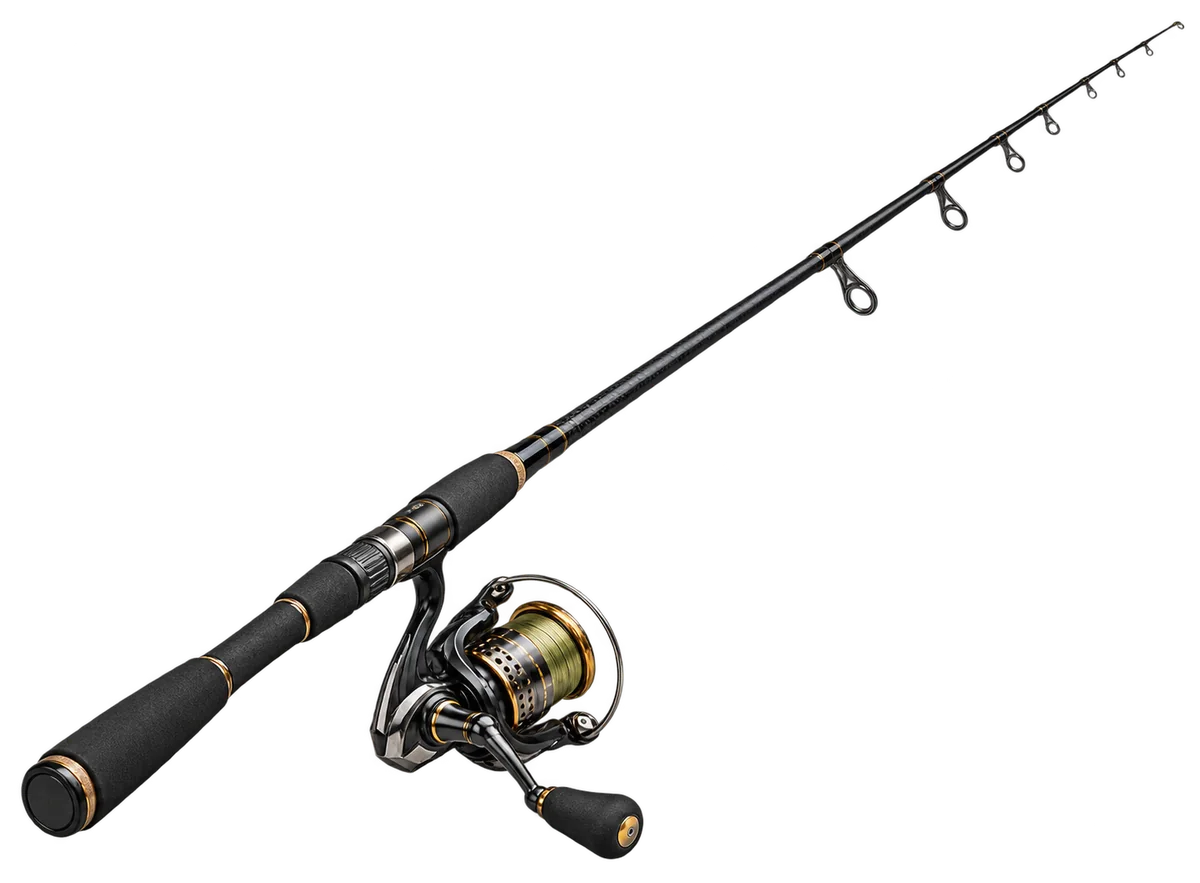
Push-fit rods usually consist of two sections. They are regarded as sturdier and cast better, but are bulkier to transport. Telescopic rods you push into one another and can carry ready assembled. In return their action is softer and slower, and they take less load. For modest casting distances a telescopic rod is enough; for long casts and heavy leads the push-fit rod is the better choice.
Bite indication and rod rest
- Rod tip: Set the rod up steeply so that roughly a right angle forms between line and tip, and tighten the line slightly. In a current this is often the best solution.
- Bell: is clipped to the tip and rings when it jerks. The fish quickly feels resistance, though, and cannot take line.
- Swinger: a light body, such as a plastic ring, hanging in the line between two rod rings. If the fish takes line, it rises. If the fish swims towards you, it drops. The rod lies flat and points at the rig.
- Electronic bite alarm: doubles as the front rest. If the fish pulls line off, it runs over a trigger on the device, which signals the bite with sound and light.
With swingers and electronic devices the fish must be able to take line: bail arm open, drag loosened or freespool switched on. On a river the rod stands high so that little line lies in the current. On a lake it lies flat on two bank sticks. On jetties, stone banks or hard ground a tripod or a rod pod, a frame with its own feet, helps.
Example: On a gravel pit a 40 g running lead with a worm lies on the bottom. A rod of 3,30 m and 60–80 g casting weight is enough for that. On a river with an 80 g lead plus bait the same rod is already over its casting weight.
Reel and line
A robust fixed-spool reel with a sturdy gearbox and a strong drag is enough; a basic course for beginners gives sizes 35 to 50. A freespool reel releases line on request even though the bail arm is closed and the drag is set. One turn of the handle switches the freespool off again before the strike, more on this under setting the reel drag. Monofilament around 0,30 mm is usual as mainline; for carp teaching material gives 0,30–0,40 mm. What your line still holds after the knot is shown by the line calculator.
How it differs from the feeder rod and carp rod
The feeder rod is a bottom rod with a fine interchangeable tip. It casts a feeder instead of a lead and shows bites much more finely. The carp rod is built for long casts with a heavy fixed lead. Its strength is usually not printed in grams on the blank but as a test curve in imperial pounds (lb, 1 lb is about 454 g): the weight that bends the blank to a right angle. 2–4 lb is usual, often at 12 ft long, that is just over 3,60 m. The unit converter translates such markings.
Common mistakes
- Lead and bait weigh more than the casting weight. The rod should never be loaded beyond it.
- The lead is too light and wanders. Then the rig snags, or the hook collects dirt. A few grams more do no harm to the bite indication.
- Bail arm closed and drag tight although a swinger is used. The fish cannot take line.
- The rod points at the rig although the tip is meant to show the bite. Without an angle to the line the tip hardly moves.
Frequently asked questions
What length is a bottom rod?
For an all-round bottom rod the trade press gives 3,00–3,60 m and 60–80 g casting weight, for sitting out for eel 3,00–3,30 m and 50–80 g. Teaching material for the angling exam (Fischerprüfung) takes a wider view of the rod type: up to over 4 m in length and up to 100 g.
How heavy may the lead be?
Lead and bait together should stay below the casting weight of the rod. As a guide value, 20–50 g is enough on still water, 50–80 g on a canal or slow river, 100–200 g in a hard current. For the all-round bottom rod that is usually too much.
How does the bottom rod differ from the feeder rod?
The feeder rod is a bottom rod with a fine interchangeable tip. It casts a feeder instead of a lead and shows bites much more finely.
How do I indicate bites on the bottom rod?
Possible are the rod tip itself, a bell on the tip, a swinger in the line or an electronic bite alarm. With swingers and electronic devices the fish must be able to take line: bail arm open, drag loosened or freespool switched on.
Related
- Running lead rig: the classic rig for this rod
- Bottom fishing: the method at a glance
- Fishing rods: construction, markings and all rod types
- Feeder rod: bottom rod with a feeder and interchangeable tip
- Carp rod: test curve and long casts
- Line calculator: what the line holds after the knot
- Fishing lines compared: the right mainline
- Setting the reel drag: using drag and freespool properly
Sources
- Blinker: Grundangeln, dein Weg zum Fangerfolg (Länge und Wurfgewicht der Allround-Grundrute, Rolle, Schnur, Bissanzeiger)
- Rute & Rolle: Grundangeln, so gelingt der Einstieg (Bleigewichte nach Gewässer, Rutenspitze, Glocke, Einhänger) und Rute & Rolle: Rutenhalter, welche gibt es und wofür? (Rute hoch am Fluss, flach am See, Dreibein und Rod Pod)
- Fischereiverein Löningen: Gerätekunde (Aktion, Wurfgewicht, Freilauf, Bissanzeiger, elektronischer Bissanzeiger) und Fischereiverein Löningen: Zusammenfassung Gerätekunde (Grundrute bis über 4 m und bis 100 g, Schnur für Karpfen)
- Blinker: Die richtige Angelrute, darauf kommt es an (Steck- und Teleskoprute, Feederrute) und Blinker: Aalangeln, mit diesen Tipps klappt’s (Rute für den Aalansitz)
- Blinker: Bissanzeiger richtig nutzen (Kletteraffe, Einhänge-Ring, Aalglocke)
- Blinker: Karpfen, welche Rute für welchen Zweck (Testkurve in lb, Länge in Fuß), Rute & Rolle: Angel-Basics, die Bremse (Freilauf) und Blinker: Köderfischmontage zum Grundangeln (Zander am Grund)
All figures are guide values without guarantee. Length, casting weight and line depend on water, current, rig and target fish.