
Knowledge · Fish welfare and practice
Live bait and animal welfare
A live baitfish is a vertebrate, and for vertebrates the Animal Welfare Act (Tierschutzgesetz) sets tighter limits than for a worm or maggot. Several federal states expressly ban it on the hook. Different rules apply to worms, maggots and baitfish killed before hooking, and these also vary from state to state.
Vertebrates and invertebrates in the Animal Welfare Act
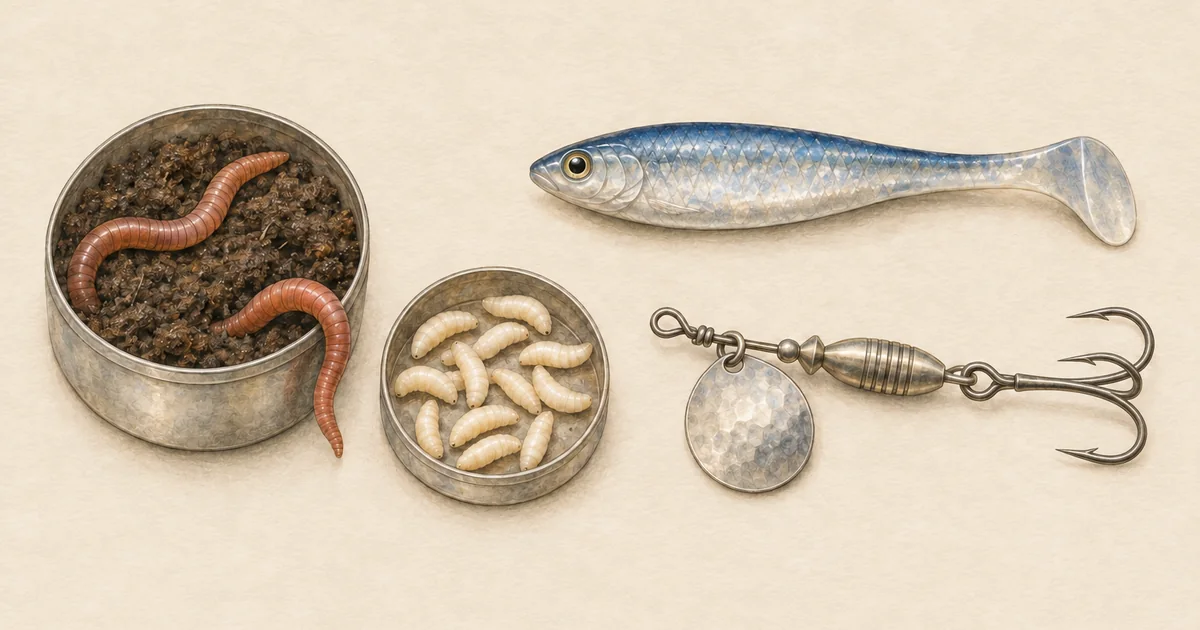
§ 1 of the Animal Welfare Act (Tierschutzgesetz) lays down the principle for every animal: no one may cause it pain, suffering or harm without a sound reason. Several provisions, however, apply only to vertebrates, i.e. animals with a backbone such as fish, frogs or birds. Under § 4, a vertebrate may only be killed after being stunned, and only by someone with the necessary knowledge and skills. The penal provision in § 17 also refers expressly to vertebrates.
For lobworms, maggots or midge larvae, the principle from § 1 remains. On top of that comes § 18 paragraph 2: under it, causing any animal significant pain, suffering or harm without reason is an administrative offence. The duty to stun under § 4, on the other hand, applies by its wording only to vertebrates.
Live baitfish in state law
Fisheries law is state law. Five examples with references:
| State | Source | Rule |
|---|---|---|
| Bavaria | § 15 Abs. 1 Nr. 3 AVBayFiG | Fishing with live baitfish banned |
| Saxony | § 24 Abs. 1 Nr. 2 SächsFischG | no live fish or other vertebrates as bait |
| Brandenburg | § 6 Abs. 1 BbgFischO | as in Saxony; exceptions only by the fisheries authority in individual cases |
| North Rhine-Westphalia | § 6 Abs. 2 LFischVO | neither carry nor use live baitfish |
| Schleswig-Holstein | Ministry leaflet, 2026 | live baitfish banned |
Saxony and Brandenburg frame the ban more broadly than just fish: a live frog, as a vertebrate, would also be ruled out there. The angling exam (Fischerprüfung) covers the topic. In the Bavarian exam questions, fishing with live baitfish is the prohibited method, with worms and maggots among the wrong answers. The question catalogue from Saxony-Anhalt answers no to the question of whether predator fishing with a live baitfish is allowed. For the other states, you will find the regulations via Closed season and minimum size explained.
Why experts reject it
In 2004 Joachim Nilz gave a straightforward reason for the ban in the conference proceedings “Tierschutz in der Fischerei” of the Landesfischereiverband Baden-Württemberg: on the hook, the fish can no longer move freely, and the way it is attached injures it. That alone, he argued, makes the ban follow from the Animal Welfare Act. The reasoning rests on movement and injury, not on the question of whether fish feel pain. The 2003 animal welfare report cited in the same volume considered that question unresolved, but stress and harm from improper handling undisputed.
The Leibniz-Institut für Gewässerökologie und Binnenfischerei (IGB) describes live baitfish as banned for anglers on animal welfare grounds (Boddenhecht report, p. 427). The public backs this too: in a survey by the IGB and Humboldt-Universität, the majority rejected live baitfish (IGB, 2014). Brandenburg expressly ties its exception to a sound reason, i.e. to the standard from § 1 of the Animal Welfare Act.
Obtaining and killing baitfish
Catching your own
Brandenburg expressly prohibits using fish as bait if they are under a catch ban, in their closed season or below the minimum size (Section 6(1) with Section 2 BbgFischO), and Schleswig-Holstein points to the minimum sizes. In the Bavarian exam questions, you may not take the spined loach, a small bottom-dwelling fish, from a trout stream at the end of April to use as a bait fish.
The dip net (Senke), a square lift net, is not permitted everywhere. Saxony allows up to 150 centimetres side length and bans it from 1 February to 30 April (§ 6 Abs. 2 SächsFischVO). Other states are listed under Baitfish dip net.
Buying
North Rhine-Westphalia prohibits offering or supplying protected species as baitfish and allows other species to be caught only for your own use (§ 5 LFischVO). Schleswig-Holstein points to preserved or frozen baitfish from tackle shops. In open inland waters there, only native species are permitted that come from the water system or were produced in an aquaculture facility. Brandenburg ties baitfish to the water where they were caught and exempts frozen, chemically preserved and dead sea fish. Why origin matters is explained in Not spreading species and diseases.
Kill before hooking
Saxony requires in § 6 Abs. 1 of its fisheries regulation that the baitfish is killed humanely before it goes on the hook. Nationwide, the Tierschutz-Schlachtverordnung applies: anyone who kills a fish must stun it immediately beforehand (§ 12 Abs. 10). It names exceptions only for flatfish and eels, none for small fish. Blow, check and gill cut are explained in Stunning and killing fish, and mounting the bait afterwards in Baitfish rig.
You may not keep baitfish alive everywhere. Schleswig-Holstein considers keeping them alive in any form impermissible under animal welfare law. Brandenburg regulates keeping live fish in general in § 11 BbgFischO: roomy containers, enough oxygen and water, as briefly as possible. What a bucket with a pump can do is explained under Aerator pump.
Note, as of November 2026: the references come from five federal states. Other states, water rules and fishing permits may contain further rules, for example on dip nets or keeping fish. Before you catch baitfish for the first time, read the state regulation and your fishing permit, see Fishing permit (Erlaubnisschein) and water map.
Worms, maggots and other invertebrates
The state regulations cited contain no ban on worms and maggots like the one on baitfish. In both exam catalogues, lobworms and maggots are among the wrong answers to the question about prohibited bait. The principle from § 1 still applies to them. How to keep worms and maggots cool and fresh is explained under Maggot box, hooking them under Worms and Maggots and larvae.
Leftover bait does not belong in the water. The Sea Grant programme of the University of Maryland asks anglers to put unused bait worms, together with the seaweed they are shipped in, in the rubbish, because non-native species can travel in it. Too much also does harm as feed: according to the Bavarian exam questions, excessive groundbaiting increases nitrogen and phosphorus and degrades the water. How much you may groundbait is set by the water rules.
Artificial lures as an alternative
Without an animal on the hook, you fish with artificial lures, such as a soft plastic (shad), a crankbait from the Hardbaits or a spinner. Here too, how deep the hook sits matters. In an IGB-led study on pike (Arlinghaus and others, 2008), the hook lodged in the gullet in 15,4 per cent of catches with dead baitfish, in 10,5 per cent with soft plastics and jigs, and in none with crankbaits. The authors suspect that soft plastics resemble real prey and are therefore more likely to be swallowed. More baits are shown in the Bait overview.
Differences and points of dispute
- Commercial fishing: On the Bodden lagoons of the Baltic coast, commercial fishermen with a longline licence may use live baitfish. According to the IGB report, this adds to a feeling of unequal treatment among some anglers (p. 427), and many consider the use of live baitfish on longlines unethical (p. 430).
- Switzerland: The Swiss Animal Welfare Ordinance (Tierschutzverordnung) prohibits live baitfish (Art. 23). However, the cantons may allow exceptions for anglers with proof of competence where predatory fish can hardly be caught otherwise; the baitfish is then attached only by the mouth (Art. 5b VBGF). The Canton of Bern rules it out (Reglement über die Fischerei 2026, Art. 18 FiDV).
Frequently asked questions
May I carry baitfish alive in a bucket?
That is up to your state. North Rhine-Westphalia even bans carrying live baitfish, and Schleswig-Holstein considers keeping them alive impermissible. Where keeping them is allowed, there are requirements on container, oxygen and duration.
Do I have to stun a small baitfish too?
Yes. The Tierschutz-Schlachtverordnung requires stunning immediately before killing and contains no exception for small fish. The only exceptions are flatfish and eels, with the cut or stab described there.
May I bring baitfish from another water?
Several states tie them to the water where they were caught. In Saxony this applies to holders of a fishing permit (§ 12 Abs. 3 SächsFischVO), North Rhine-Westphalia also permits connected waters (§ 6 Abs. 1 LFischVO), and Brandenburg the water system. Brandenburg exempts frozen baitfish from this.
Related
- Stunning and killing fish: blow, check and gill cut step by step
- Baitfish: suitable species and how to present them
- Baitfish rig: hooklength, hook and float
- Baitfish dip net: design and the states‘ dip-net rules
- Aerator pump: oxygen in the bucket and rules on keeping fish
- Maggot box: storing maggots and worms properly
- Not spreading species and diseases: bait, water and tackle between waters
Sources
- Bundesministerium der Justiz: Tierschutzgesetz § 1, § 4, § 17 und § 18 (Grundsatz, Wirbeltiere, Ordnungswidrigkeit)
- Bundesministerium der Justiz: Tierschutz-Schlachtverordnung § 12 (Betäubung vor dem Töten, Ausnahmen für Plattfische und Aale)
- Freistaat Bayern: Verordnung zur Ausführung des Bayerischen Fischereigesetzes (§ 15 Verbot des lebenden Köderfischs)
- Freistaat Sachsen: Sächsisches Fischereigesetz (§ 24 lebende Wirbeltiere als Köder) und Sächsische Fischereiverordnung (§ 6 Töten und Senke, § 12 Fanggewässer)
- Land Brandenburg: Fischereiordnung (§ 2 Schonzeit und Mindestmaß, § 6 Köder und Herkunft, § 11 Hältern)
- Land Nordrhein-Westfalen: Landesfischereiverordnung (§ 5 Fang und Abgabe, § 6 Verwendung von Köderfischen)
- Landwirtschaftsministerium Schleswig-Holstein: Merkblatt zum Urlauberfischereischein, Stand 2026 (PDF) (Verbot, Handel, Hältern, Herkunft)
- Bayerische Landesanstalt für Landwirtschaft: Prüfungsfragen 2023/2024 (PDF) (Fragen 5.135, 5.173, 4.110) und Land Sachsen-Anhalt: Fragenkatalog zur Fischerprüfung (PDF) (lebender Köderfisch, verbotene Naturköder)
- Landesfischereiverband Baden-Württemberg: Tagungsband Tierschutz in der Fischerei, 2004 (PDF) (Begründung nach Nilz, S. 13; Schmerzfrage, S. 29)
- IGB: Boddenhecht, Bericht 33/2023 (PDF) (Verbot aus Tierschutzgründen, Berufsfischerei, Sicht der Angler) und IGB über idw: Bevölkerungsbefragung zum Angeln, 2014 (Ablehnung lebender Köderfische)
- Arlinghaus und andere: Hooking mortality in recreational angling for northern pike, 2008 (PDF) (Hakensitz nach Ködertyp)
- Maryland Sea Grant, University of Maryland: Bait Worm Study (übrige Köderwürmer in den Müll)
- Kanton Bern: Reglement über die Fischerei 2026 (PDF) (Art. 23 TSchV, Art. 5b VBGF, Art. 18 FiDV)
Text AI-assisted, drawing AI-generated. Sources opened and checked in November 2026; no graphics taken from the sources.
All information is indicative, without guarantee, and does not replace legal advice. Whether and how you may catch, keep and use baitfish is determined by the fisheries law of your federal state in its current version, the water rules and your fishing permit.