
Knowledge – Fish
Spined loach: Features, spine and protection
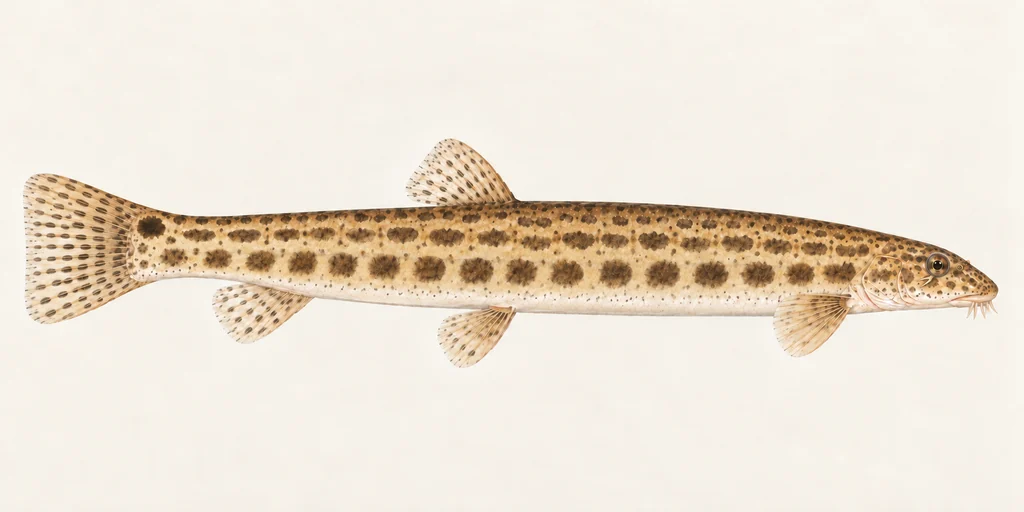
The spined loach (Cobitis taenia) is a small bottom-dwelling fish of the true loach family that spends the day buried in the sand. Below each eye it has a spine it can raise, and it sifts its food out of the sediment. As a species listed in Annex II of the EU Habitats Directive (FFH-Richtlinie) it is protected and not a target fish.
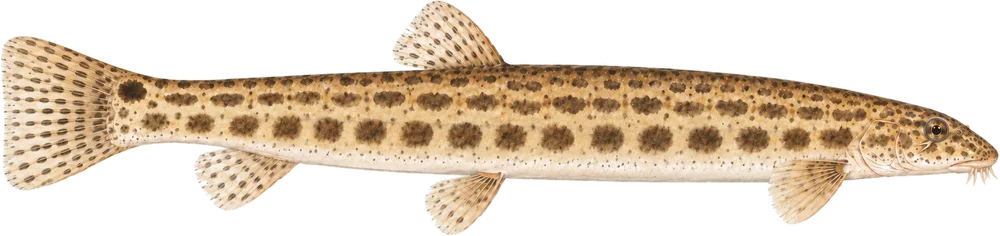
In short: FFH species with a spine below the eye, protected all year round in Bavaria; do not confuse it with the Atlantic wolffish, which is also called “Steinbeißer” in German. Not a target species; release any bycatch gently straight away.
- Two-pointed spine below each eye that can be raised
- Small underslung mouth with six short barbels on the upper jaw
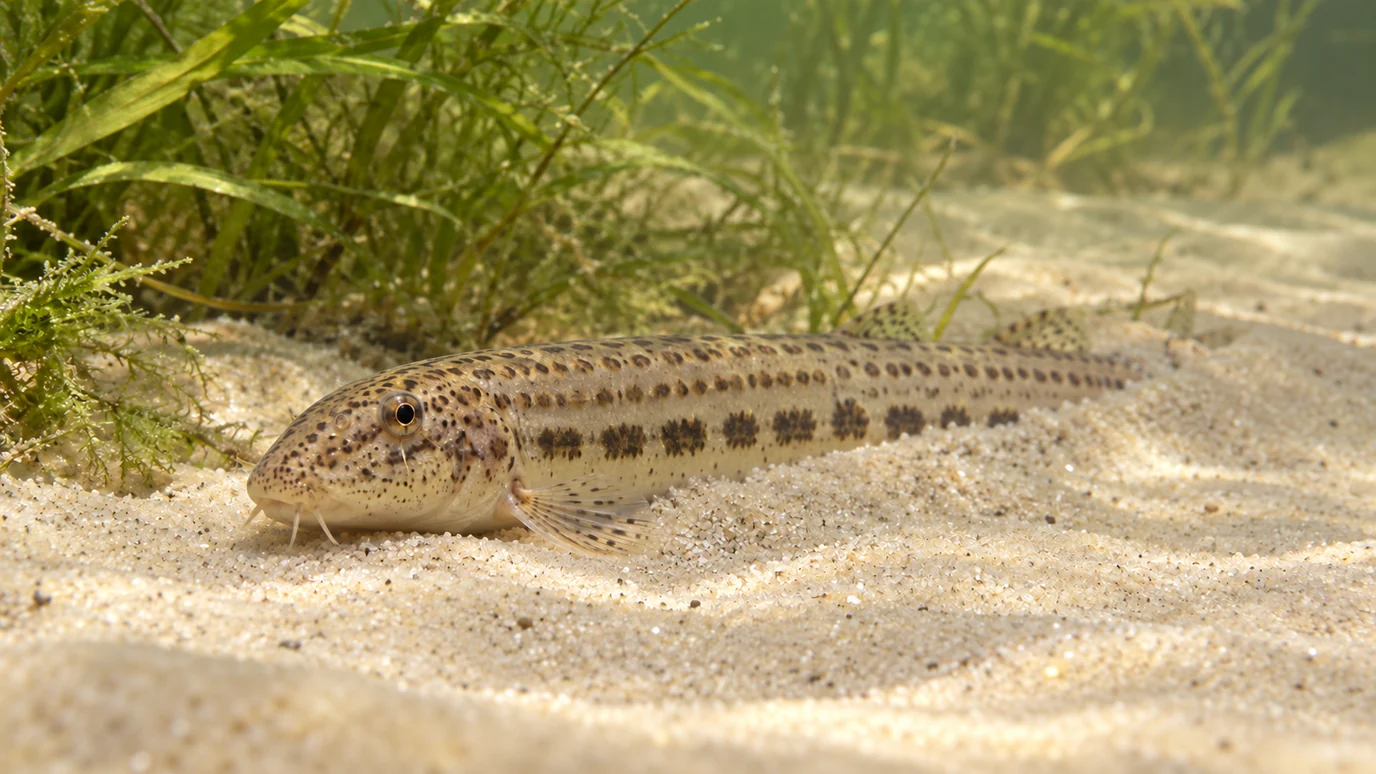
- Lengthwise rows of dark spots on a pale yellow background, a row of larger spots below the lateral line, a small dark spot at the top of the tail root
Catch chances through the year
- Hardly any chance
- Possible
- Good
- Peak season
- Spawning (observe the closed season)
Editorial assessment for waters in Germany, not a measured value and no guarantee. Spawning time is not the same as the legal closed season.
Species profile and sources in the catch calendarAll species compared month by monthThe rules of your federal state
How to recognise it
The spined loach is slender, elongated and strongly compressed from the sides. It usually measures 5 to 10 centimetres. The Landesfischereiverband Bayern gives 12 centimetres as the maximum, FishBase 13,5 centimetres and the Lower Saxony state office LAVES up to 14 centimetres.
Its surest identifying feature is on the head: below each eye there is a two-pointed spine that the fish can raise. The small mouth is underslung, that is on the underside of the head, and six short barbels sit on the upper jaw. The scales are tiny, and the lateral line does not run the full length of the body.
On a pale yellow background there are dark dots and several lengthwise rows of spots. Most striking is a row of large spots below the lateral line. FishBase also mentions a small spot at the top of the tail root. You can recognise males by the thickened second ray of the pectoral fin.
In German the name “Steinbeißer” is used for two fish. The Atlantic wolffish (Anarhichas lupus), a sea fish of the North Atlantic, also goes by this name. According to the Thünen-Institut, the name covers several species. You will find its profile under Atlantic wolffish.
In fresh water the closest look-alike is the stone loach. It also has six barbels, but it is cylindrical, darkly marbled without clear rows of spots and has no eye spine. It lives over stony, gravelly ground, which according to LAVES the spined loach avoids. The weatherfish grows much larger and has ten barbels, the gudgeon only two and noticeably larger scales.
Things get tricky within the genus: according to the Rote-Liste-Zentrum, all spined loaches examined more closely from the German Danube region are Danube spined loaches (Cobitis elongatoides). In the southern Upper Rhine the Italian spined loach (Cobitis bilineata) is spreading; it was first recorded near Freiburg in 2019. On top of that, the species interbreed, and in Saxony, according to the state, they can only be told apart genetically.
Side by side
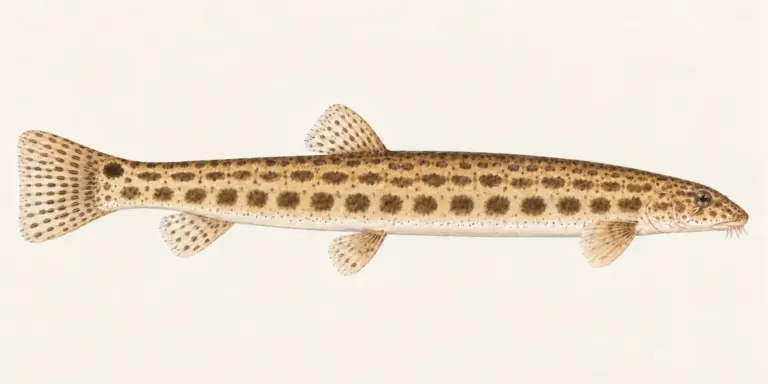

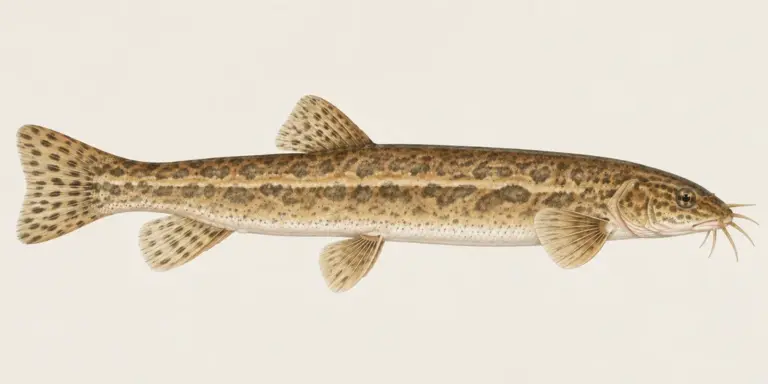
AI-generated illustrations.
Where it lives
According to the Bundesamt für Naturschutz (BfN), the range extends from France to Russia. In Germany the species lives mainly in the North German Plain, and also in parts of the Rhine valley.
It inhabits slow-flowing and still waters of the lowlands, such as streams, smaller rivers, oxbows, ponds, lakes and ditches. More important than the type of water is the bottom: fine, loose sand, preferably with some organic content, and mud as well. For spawning it needs dense cushions of submerged plants or algae nearby. According to LAVES it can even tolerate less than 3 milligrams of oxygen per litre for short periods.
It is threatened by the loss of floodplain waters, by inputs that silt up the sand and by the clearing of ditches. According to the Hessian state office, the fish, which move little, end up directly on land with the excavated material. The BfN also names excessive stocking with eel.
Holding spots in the picture
Choose a season and time of day: the picture shows where the species sits then. Tap a fish or a spot in the list to bring it closer. The picture is schematic and AI-generated, every water is different.
Active time It spends the daylight hours buried and only searches the sandy bottom at dusk and after dark.
No main time It spends the daylight hours buried and only searches the sandy bottom at dusk and after dark.
Active time It spends the daylight hours buried and only searches the sandy bottom at dusk and after dark.
Active time It spends the daylight hours buried and only searches the sandy bottom at dusk and after dark.
In the lake
Water lilies and weed bed
Spined loach are found here all year round.
In lakes, ponds and oxbows it lives in shallow water over fine, loose sand, preferably right next to submerged plants.
Spring: The spawning season falls in this period, observe the closed seasons. Between April and July the females attach their sticky eggs to water plants.
Summer: The spawning season falls in this period; observe the closed seasons (Schonzeiten).
In the river
Calm bay with aquatic plants
Spined loach are found here all year round.
In lowland streams and small rivers you will find it in calm, sandy stretches, because it is not a good swimmer.
Spring: The spawning season falls in this period, observe the closed seasons. Spawning takes place from April to July on cushions of plants near the sandy bottom.
Summer: The spawning season falls in this period; observe the closed seasons (Schonzeiten).
Size comparison: AI-generated drawing, schematic.
How it lives and spawns in the sand
By day the spined loach is hidden in the sand, often with only its head poking out. Only at dusk and at night does it slowly push its way across the bottom. According to the Hessian state office, it is one of the weakest swimmers among the native fish.
When feeding it sucks sand into its mouth, chews it through and expels the indigestible part through its gills. What remains are rotifers, small crustaceans, small worms and decaying organic matter.
According to the BfN and the Landesfischereiverband Bayern, spawning takes place from April to July; in Hesse and Saxony the state agencies give April to June. The females prefer to attach their sticky eggs to submerged plants, up to 300 of them according to figures from Saxony.
According to LAVES and the Hessian state office, males often mature at just one year, females at two; the BfN gives one year more in each case. According to the BfN, females live to about five years, males two and a half to three. FishBase describes a peculiarity: some females have a triple set of chromosomes, and their eggs develop without fertilisation but need contact with sperm as a starting signal.
Is there a season?
The spined loach has no fishing season. It is not fished for deliberately, and in Bavaria it is protected all year round.
The time of year matters when ditches are maintained. An assessment framework printed by LAVES rates weed cutting before mid-September as a threat to the population. Clearing by hand, mowing above the bed and clearing sections alternately are considered gentle.
You will find the monthly overview of all species and the water temperature check in the catch calendar.
What to do with a bycatch
The spined loach is not fished for, so there is no rig or bait. It is protected; you do not take it.
If one does end up in your landing net, a lift net or on your hook, release it straight away. Handle it only with wet hands and let it go over a shallow, sandy bottom in the same stretch of water.
Do not move spined loaches to other waters. LAVES generally does not consider stocking sensible, partly in order to preserve regional genetic forms.
Look below the eye: six barbels, a body that is flatter from the sides and spotted in rows, a spine below the eye: that is a spined loach and not a stone loach.
Maintain ditches in sections: clear only parts or one bank at a time, and run the mower above the bed.
Suitable lures
We deliberately show no baits for this species.
FFH species, protected all year round in Bavaria: do not target it, return any bycatch gently at once.
What you need to observe
The spined loach is one of the species in Annex II of the EU Habitats Directive (FFH-Richtlinie). The Red List of freshwater fish of Germany, in its 2023 edition, classes it as not threatened, while its population is considered rare. The regional picture differs: in Saxony Cobitis taenia is considered critically endangered.
How it is handled when angling is up to each federal state (Bundesland). Bavaria protects the spined loach all year round under the Ausführungsverordnung zum Bayerischen Fischereigesetz. Anyone there who catches a viable fish during the closed season (Schonzeit) must return it immediately and with the necessary care to the same stretch of water.
Closed seasons (Schonzeit), minimum sizes (Mindestmaß) and fishing bans are set by each federal state (Bundesland), often differently for individual waters. We give figures only with a date and source. What is binding is your state’s fisheries regulation and your fishing permit (Erlaubnisschein); the official sources are linked in the catch calendar.
What closed season, minimum size and harvest slot mean and where to find them is explained on the page Closed season and minimum size explained.
Frequently asked questions (FAQ)
Is it the same fish as the sea fish called “Steinbeißer”?
No. The Atlantic wolffish, a sea fish, is also called “Steinbeißer” in German. The spined loach is a small bottom-dwelling freshwater fish of the true loach family.
How does it survive water that is low in oxygen?
When the oxygen level falls, it gulps air at the surface and takes up the oxygen through its gut.
May I take a spined loach home?
Not in Bavaria, where it is protected all year round. What applies in other states is set out in your state’s fisheries regulation. As it is an FFH species, it is best to put it straight back everywhere.
Sources
The rating of catch chances is an editorial assessment. The facts come from these sources, and the text is worded in our own words. The illustration is an original design by Angel Momente in the style of a natural history plate (AI-generated, see the AI notice).
- Landesfischereiverband Bayern: Fischlexikon – Steinbeißer (Dorngrundel), Bachschmerle, Schlammpeitzger, Gründling
- Bundesamt für Naturschutz: Artenporträt Cobitis taenia (FFH-Anhang II, Verbreitung, Biologie, Gefährdung)
- Rote-Liste-Zentrum: Steinbeißer, Cobitis taenia (Rote Liste der Süßwasserfische Deutschlands 2023: ungefährdet)
- Rote-Liste-Zentrum: Donau-Steinbeißer, Cobitis elongatoides (Rote Liste 2023: Gefährdung unbekannten Ausmaßes)
- Rote-Liste-Zentrum: Italienischer Steinbeißer, Cobitis bilineata (Neobiota)
- FishBase: Cobitis taenia, Spined loach (Größe, Alter, Lebensraum, Fortpflanzung)
- LAVES Niedersachsen: Vollzugshinweise zum Schutz von Fischarten – Steinbeißer, Dorngrundel (Stand November 2011)
- Hessisches Landesamt für Naturschutz, Umwelt und Geologie: Artensteckbrief Steinbeißer (Stand 2020)
- Freistaat Sachsen, Natura 2000: Steinbeißer (Cobitis spec.), FFH-Art 1149
- Thünen-Institut, Fischbestände online: Steinbeißer, Katfisch, Seewolf (Anarhichas lupus, A. minor)
- Bayern.Recht: Verordnung zur Ausführung des Bayerischen Fischereigesetzes (AVBayFiG) mit Anlage Schonzeiten
Created with AI support from the sources listed. Figures only appear in the text if a source gives them. Last updated: 8 November 2026. Found a mistake? Write to us. Who is behind this site: About me.
More in the lexicon
- All fish species at a glance
- Catch calendar – month, water temperature and profile for 93 species
- Line calculator – breaking strain after the knot, drag guideline, backing
- Angling methods