
Knowledge – Fish
Weatherfish: Features, gut breathing and protection
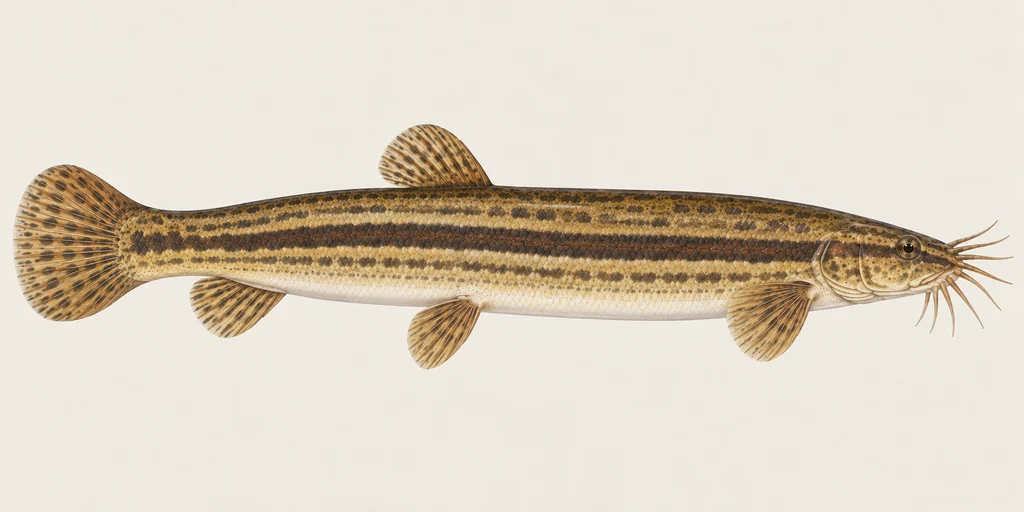
The weatherfish (Misgurnus fossilis) is an eel-like bottom-dweller with ten barbels that lives in the mud of still waters. Because it can gulp air and breathe through its gut, it survives oxygen shortage and even the drying up of its water. The species is threatened in Germany, is listed in Annex II of the Habitats Directive (FFH Directive) and is not a target fish.
In brief: FFH species, threatened in Germany and protected all year round (Schonzeit) in Bavaria. Not a target fish; return any bycatch gently at once.
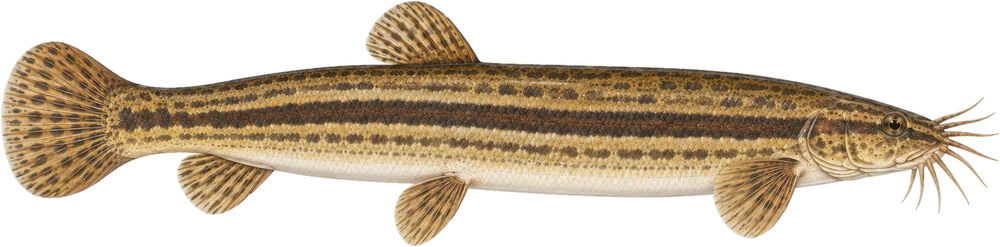
- Small, inferior mouth with ten barbels, six longer ones on the upper jaw
- Broad dark band from the eye to the base of the tail, narrower stripes above and below
- Rounded tail fin on a body that is flattened from the sides towards the rear
Catch chances through the year
- Hardly any chance
- Possible
- Good
- Peak season
- Spawning (observe the closed season)
Editorial assessment for waters in Germany, not a measured value and no guarantee. Spawning time is not the same as the legal closed season.
Species profile and sources in the catch calendarAll species compared month by monthThe rules of your federal state
How to recognise it
The weatherfish is long and slim like a small eel. At the front the body is cylindrical, towards the rear it becomes flatter from the sides. The scales are very small and barely visible under a thick layer of mucus. It usually measures 15 to 30 centimetres. FishBase lists a female from the Netherlands at 30,7 centimetres.
The small mouth is on the underside and surrounded by ten barbels: six longer ones on the upper jaw and four shorter ones on the lower jaw. The front nostrils are drawn out into small tubes. It does not have the erectile spine under the eye that many loaches carry. The tail fin is rounded.
The base colour is yellow-brown. A broad dark band runs from the eye to the base of the tail, with narrower stripes above and below it and many small dark spots. The belly is ochre-yellow to orange. You can recognise males by their longer, pointed pectoral fins.
The spined loach (Steinbeißer, Dorngrundel) and the stone loach look similar. Both stay much smaller and have only six barbels. The spined loach also has a movable, two-pointed spine under the eye, which the weatherfish lacks. The stone loach lives in clear running water with a stony or gravelly bed, not in mud.
Introduced Asian weatherfish occur in some waters. The Rote-Liste-Zentrum (Red List Centre) lists the Chinese weatherfish as a non-native species whose numbers are clearly increasing. A find outside the known populations is therefore not automatically the native weatherfish.
Side by side

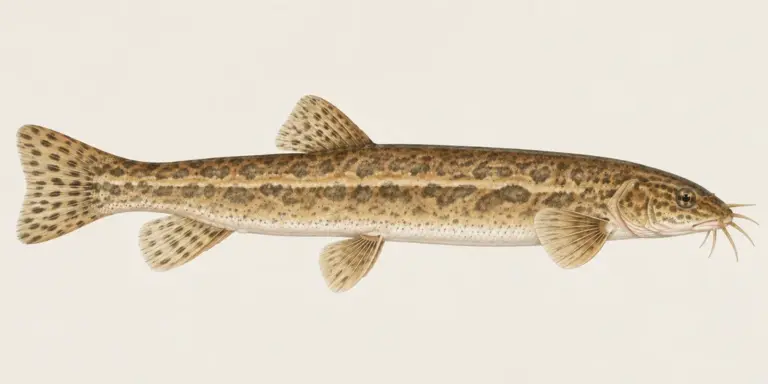
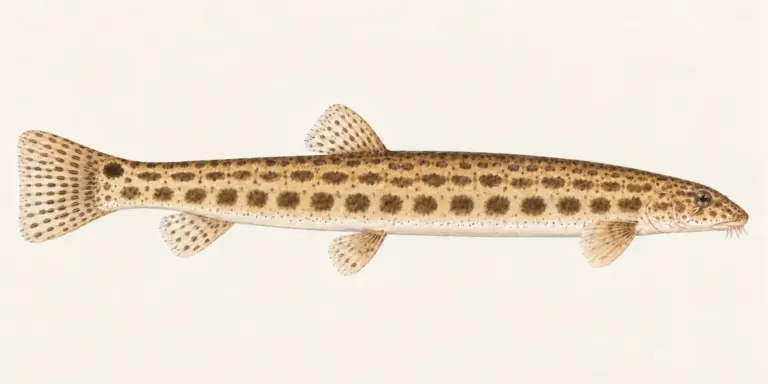
AI-generated illustrations.
Where it lives
The weatherfish lives in shallow, still or slow-flowing waters with a loose muddy bed: oxbow lakes, floodplain waters, ponds, pools and ditches. Its range runs from the Meuse basin to the mouth of the Volga, north of the Alps. In Germany it lives mainly in the lowlands.
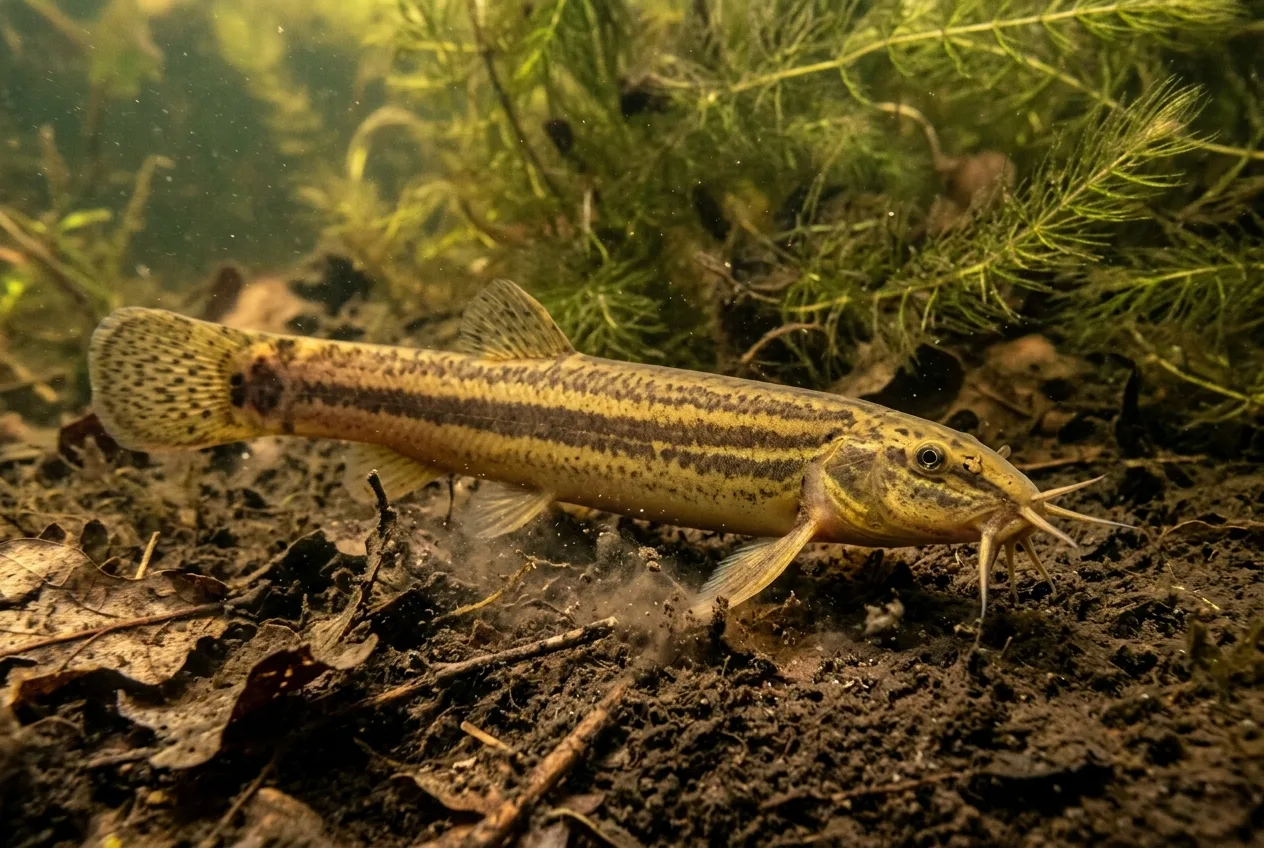
It is very sedentary. The BfN points out that it therefore needs a network of connected habitats. If its water is destroyed, it often cannot move away because of weirs and other barriers across the river.
It is threatened by the silting up of oxbow lakes, the draining of marshes, drainage and the clearing of ditch beds. The Landesfischereiverband Bayern also names eel stocking as a threat.
Holding spots in the picture
Choose a season and time of day: the picture shows where the species sits then. Tap a fish or a spot in the list to bring it closer. The picture is schematic and AI-generated, every water is different.
Active time It spends the day hidden in the soft bed or in dense plants and is on the move at dusk and at night.
No main time It spends the day hidden in the soft bed or in dense plants and is on the move at dusk and at night.
Active time It spends the day hidden in the soft bed or in dense plants and is on the move at dusk and at night.
Active time It spends the day hidden in the soft bed or in dense plants and is on the move at dusk and at night.
In the lake
reed edge
The weatherfish is found here all year round.
Water lilies and weed bed
The weatherfish is found here all year round.
The weatherfish lives on the bottom of shallow, still waters with loose mud, for example in oxbows, pools, ponds and ditches. It stays among water plants and copes with warm, low-oxygen water. It hardly ever leaves its water.
Spring: This is the spawning period, so observe the closed seasons (Schonzeit). It spawns from April into July; the eggs stick to plants or lie loose on the bottom.
Summer: The spawning season falls in this period; observe the closed seasons (Schonzeiten).
Winter: When the water turns cold, it burrows into the mud and rests there.
Depth: In cold or drought it usually burrows 20 to 30 centimetres into the mud, in severe drought up to 70 centimetres.
Size comparison: AI-generated drawing, schematic.
How it survives in the mud
During the day the weatherfish stays among water plants or in the soft bed. It becomes active at dusk and at night. It then searches the bottom for small snails, mussels, crustaceans, worms and insect larvae.
Its special trait is gut breathing. It swims to the surface, gulps air, takes up oxygen through the richly supplied lining of the gut and releases the used air through the vent. Together with breathing through the skin, this allows it to live in warm, oxygen-poor water with foul mud.
If its water dries up or turns cold, it burrows in. According to FishBase usually 20 to 30 centimetres deep, up to 70 centimetres in dry conditions. The Landesfischereiverband Bayern writes that it can survive in this dormant state for up to a year.
During rapid changes in air pressure, for example before thunderstorms, it becomes restless even by day and often rises to the surface. That is where the German name Wetterfisch, or weather fish, comes from. It spawns from April to June, according to the BfN until July. A female releases between 12.600 and 170.000 eggs, which stick to plants or lie freely on the bottom. The larvae at first carry thread-like external gills. The animals reach sexual maturity at about two years.
Is there a season?
There is no angling season for the weatherfish. It is not a target fish and is protected all year round in Bavaria.
What matters is the yearly cycle in managing its waters. The BfN recommends not mowing water plants before the end of September, working only on parts of the water and removing underwater plants only above the sediment. A club that maintains ditches and ponds thereby protects eggs, larvae and buried fish.
You will find the monthly overview of all species and the water temperature check in the catch calendar.
From the blog: Freshwater fish in Germany: which species you catch where · Roach or rudd, bream or silver bream: how to tell these silver fish apart reliably
What to do with a bycatch
The weatherfish is not fished for. According to FishBase it only rarely takes a hook.
If one does end up on the hook, unhook it in the water or with wet hands and return it at once. Do not leave it thrashing on the bank, but work quickly.
If weatherfish turn up during work on ditches or when a pond is drained, put them back into suitable water of the same water body and inform the holder of the fishing rights (Fischereiberechtigter).
Count the barbels: Ten barbels point to the weatherfish, six to the spined loach or stone loach.
Water management in autumn: Mow and clear ditches only from the end of September and only in sections: that way part of the habitat is preserved.
Suitable lures
We deliberately show no baits for this species.
FFH species, threatened in Germany and protected all year round in Bavaria: do not target it, return any bycatch gently at once.
What you need to observe
The weatherfish is listed in Annex II of the Habitats Directive (FFH Directive). In the 2023 Red List of Germany’s freshwater fish it is classed as threatened. Compared with the previous list, in which it was considered endangered, the rating has improved, but its population has fallen sharply in the long term.
How it should be treated when angling is regulated by the federal states. In Bavaria the weatherfish is protected all year round under the Ausführungsverordnung zum Bayerischen Fischereigesetz. Viable fish caught during the closed season must be returned promptly and carefully to the same stretch of water there.
Closed seasons (Schonzeit), minimum sizes (Mindestmaß) and fishing bans are set by the federal states (Bundesland). They differ by state and water. We give figures only with a date and a source; what counts is always the fisheries regulation of your federal state and your fishing permit (Erlaubnisschein). You will find a list of links to the official sources in the Fishing calendar.
What closed season, minimum size and harvest slot mean and where to find them is explained on the page Closed season and minimum size explained.
What state law says about the closed season (Schonzeit) and minimum size (Mindestmaß) for this species is in the “At a glance” box on the state page for Bavaria. Our overview does not list this species for the other states; the state fisheries regulation applies there.
Frequently asked questions (FAQ)
Why is the weatherfish called the weather fish (Wetterfisch)?
During rapid changes in air pressure, for example before thunderstorms, it becomes restless even by day and often rises to the surface to gulp air.
How many barbels does the weatherfish have?
Ten: six longer ones on the upper jaw and four shorter ones on the lower jaw. The spined loach and stone loach have only six.
May I keep a weatherfish?
No. The species is an FFH species, threatened in Germany and, for example, protected all year round in Bavaria. You return any bycatch gently at once.
Sources
The rating of catch chances is an editorial assessment. The facts come from these sources, and the text is worded in our own words. The illustration is an original design by Angel Momente in the style of a natural history plate (AI-generated, see the AI notice).
- Landesfischereiverband Bayern: Fischlexikon – Schlammpeitzger (Kennzeichen, Darmatmung, Lebensweise)
- Bundesamt für Naturschutz: Artenporträt Misgurnus fossilis (FFH-Anhang II, Verbreitung, Biologie, Schutz)
- Rote-Liste-Zentrum: Schlammpeitzger (Rote Liste der Süßwasserfische Deutschlands 2023: gefährdet)
- Rote-Liste-Zentrum: Chinesischer Schlammpeitzger (Neobiota, Bestandstrend)
- FishBase: Misgurnus fossilis, Weatherfish (Größe, Lebensweise, Eingraben)
- Wikipedia: Europäischer Schlammpeitzger
- Bayern.Recht: Verordnung zur Ausführung des Bayerischen Fischereigesetzes (AVBayFiG) mit Anlage Schonzeiten
Created with AI support from the sources listed. Figures only appear in the text if a source gives them. Last updated: 8 November 2026. Found a mistake? Write to us. Who is behind this site: About me.
More in the lexicon
- All fish species at a glance
- Catch calendar – month, water temperature and profile for 93 species
- Line calculator – breaking strain after the knot, drag guideline, backing
- Angling methods