
Knowledge – Fish
Atlantic wolffish: Features, teeth and catching
The Atlantic wolffish, known in the trade as Steinbeißer or Katfisch, is zoologically Anarhichas lupus. It lives on the seabed, in good spots often in small groups, and cracks mussels, sea urchins and crabs with its teeth. It has nothing to do with the freshwater fish of the same German name, a finger-length loach.
In short: You catch the Atlantic wolffish best from April to June. Good spots on the coast: wreck, reef. Proven baits: pirk or lead head with mussel or fish strips, tapped along the bottom. The Swedish Red List classes the wolffish as endangered. It matures late, so keep only a few fish and put the rest back gently. Step by step: wolffish fishing.
- Powerful dentition: long fangs curving backwards at the front, broad grinding teeth behind them
- Long dorsal fin from the nape to just before the tail fin, not fused with it
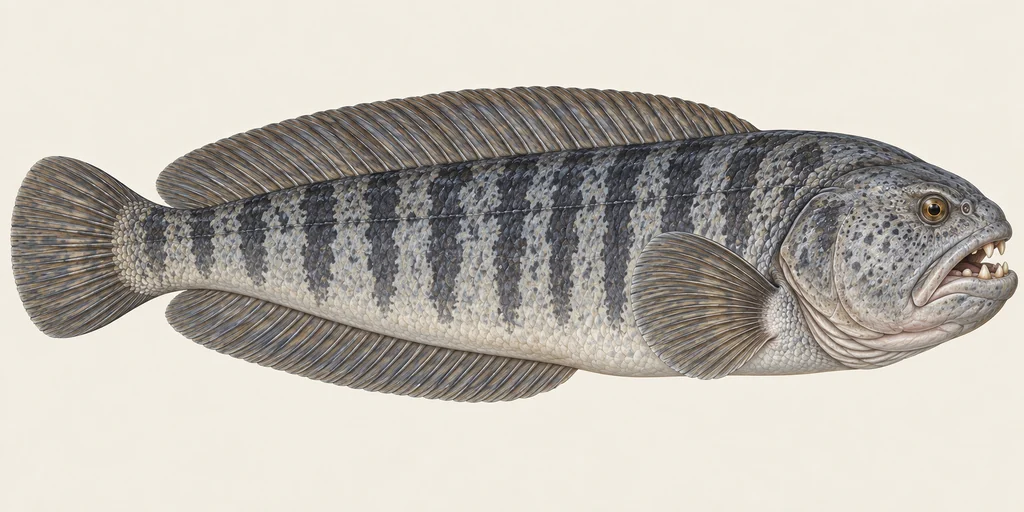
- Skin with tiny, deeply embedded scales and 10 to 15 dark crossbands on a mostly grey-green ground
Catch chances through the year
- Hardly any chance
- Possible
- Good
- Peak season
- Spawning (observe the closed season)
Editorial assessment for waters in Germany, not a measured value and no guarantee. Spawning time is not the same as the legal closed season.
Species profile and sources in the catch calendarAll species compared month by monthThe rules of your federal state
How to recognise it
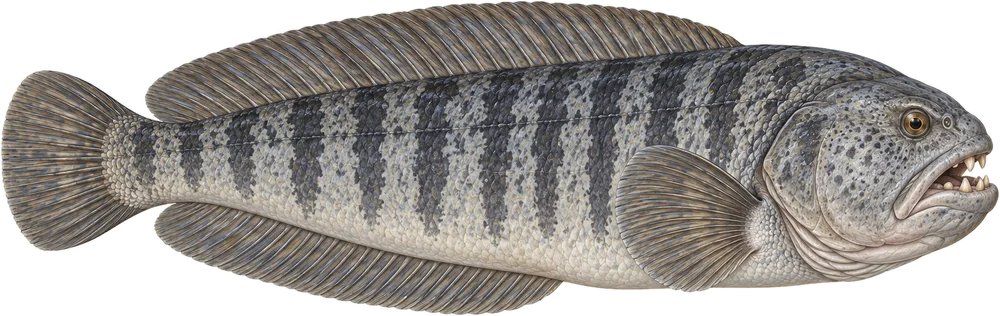
The body is elongated, the head large with a broad, rounded mouth. The dorsal and anal fins are long but not fused with the tail fin. The tiny scales lie deep in the skin, and no lateral line is visible.
The ground colour is usually grey-green, sometimes reddish-brown or almost black. Across the body run 10 to 15 dark cross-bands that extend into the dorsal fin. In the mouth there are long, backward-curved canine teeth at the front, with thick grinding teeth behind them.
According to the Norwegian Institute of Marine Research, the Atlantic wolffish grows to 125 centimetres in length, 20 kilograms in weight and 20 to 25 years of age. FishBase gives 150 centimetres and 23.6 kilograms as the maximum, the Swedish authority up to 26 kilograms. It matures late, at about six years.
Direct comparison: Atlantic or spotted wolffish?
| Feature | Atlantic wolffish (Steinbeißer) | Spotted wolffish |
|---|---|---|
| Markings | 10 to 15 dark cross-bands that extend into the dorsal fin | many distinct dark spots on the body and dorsal fin |
| Ground colour | usually grey-green, also almost black or reddish-brown | grey-brown |
| Habitat | rocky ground, from 1 to 500 m depth | further out over soft ground, usually 100 to 400 m deep |
| Size according to FishBase | up to 150 cm | up to 180 cm, usually around 120 cm |
The spotted wolffish (Anarhichas minor) is spotted rather than striped, lives further north in deeper water and grows larger. The northern wolffish (Anarhichas denticulatus) mostly stays at depths that anglers cannot reach. In the trade, several species are sold under the names Steinbeißer and Katfisch.
The spined loach (Cobitis taenia), also known in German as Dorngrundel, belongs to the loaches and reaches only five to ten centimetres. It has nothing in common with the wolffish except its German name.
Where it holds
The Atlantic wolffish occurs in the north-east Atlantic from Svalbard and the White Sea along the Scandinavian coast to the North Sea, around Great Britain and Iceland, and also in the north-west Atlantic. Reports from the Baltic Sea are considered doubtful. Anyone who wants to target it travels far to the north of Norway or to Iceland.
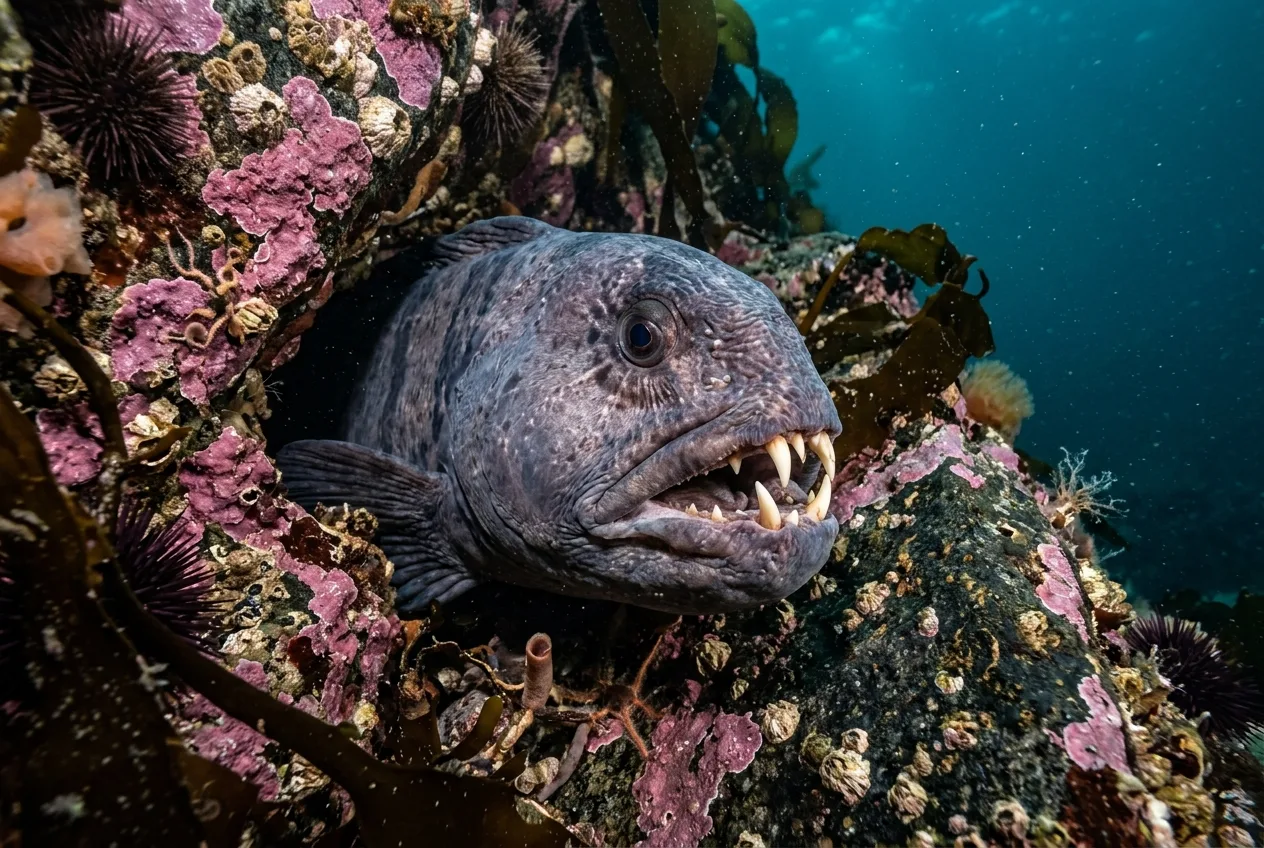
It prefers rocky, often kelp-covered ground, but is also found over sand or mud, according to FishBase from a few metres to 500 metres, usually at 18 to 110 metres. Of the three Norwegian wolffish species it is the most site-faithful, the one closest to the coast and the one that lives in the shallowest water. In summer it stands on the coast at 20 to 60 metres, in winter it migrates into deeper water down to about 400 metres. In spring anglers often find it at mussel beds already between 5 and 25 metres.
The Thünen Institute and FishBase describe it as a loner. Blinker, by contrast, describes small packs: at one spot there are often several fish, mostly at underwater rocks and over mussel beds. In the North Sea, Skagerrak and Kattegat catches have fallen sharply: international landings dropped from 2,000 to 4,000 tonnes in the 1970s and 1980s to around 500 tonnes.
Holding spots in the picture
Choose a season and time of day: the picture shows where the species sits then. Tap a fish or a spot in the list to bring it closer. The picture is schematic and AI-generated, every water is different.
Catch chance in springPeak season
Catch chance in summergood
Catch chance in autumnpossiblespawning, observe closed seasons
Catch chances in winterpossiblespawning season, observe the closed seasons
- J
- F
- M
- A
- M
- J
- J
- A
- S
- O
- N
- D
Spawning season
Time of day Tagged wolffish off Newfoundland were on the move by day and by night in spring and summer, and only a few hours a day in autumn and winter, often at dawn and dusk.
On the coast
Wreck, reef
Atlantic wolffish are found here all year round.
The Atlantic wolffish always lives on the bottom, never in mid-water. It stays mainly over rocky ground overgrown with kelp, less often over sand or mud. It is faithful to its spot and stays close to the coast. At good spots several fish often sit in small groups.
Spring: catch chances according to the catch calendar good in March, peak season in April and May. The angling press names spring, with April and May, as the favourable time. The fish then sit at mussel beds, often already at 5 to 25 metres, the big ones usually shallower than the small ones.
Summer: catch chances according to the catch calendar peak season in June, good in July, possible in August. In late summer Atlantic wolffish on the Norwegian coast also come into shallow bays with a soft bottom.
Autumn: catch chances according to the catch calendar: possible. Spawning falls in this period, so observe the closed seasons (Schonzeit).
Winter: catch chances according to the catch calendar: possible. Spawning falls in this period, so observe the closed seasons (Schonzeit). In the winter half-year wolffish change their teeth and then temporarily do not feed. They move into deeper water in autumn to spawn.
Depth: The Atlantic wolffish lives from a few metres down to about 500 metres, mostly between 18 and 110 metres according to FishBase. In spring the fish sit at mussel beds, often already at 5 to 25 metres. It sits closer to the coast and shallower than the other wolffish species.
Size comparison: AI-generated drawing, schematic.
How it hunts and spawns
Wolffish eat hard-shelled mussels and snails, crabs, sea cucumbers and sea urchins, which they break open with their strong teeth. The teeth wear down in the process and grow back. The tooth change stretches over the winter half-year, and according to Norwegian sources the fish stop feeding during this time. Larger fish also take fish.
The sources give the spawning season as October to January or November to February, depending on the area at 40 to 200 metres, in Norway near the coast in fjords and bays at 50 to 150 metres. The female sticks a clump of eggs to the rocky bottom, and the male guards it until hatching and hardly feeds during this time. The eggs only hatch after nine to ten months.
Late maturity makes the species vulnerable: the Thünen Institute rates its resilience as low, and the minimum time for the stock to double is 4.5 to 14 years.
When it bites
The angling press names spring, with April and May, as the best time. Experienced Atlantic wolffish anglers fish from April into July. In spring the fish move into shallower areas to the mussel beds, in autumn they migrate into deeper water to spawn.
Anglers report that the biggest fish often stand shallower than the small ones, down to about 25 metres: they defend the best feeding grounds over the mussel beds, while weaker fish give way to deeper water. In late summer wolffish on the Norwegian coast sometimes move into shallow bays with soft ground. Such catches are rare.
Today’s catch index needs JavaScript. Season and spawning time are in the catch calendar.
You will find the monthly overview of all species and the water temperature check in the catch calendar.
From the blog: Roach or rudd, bream or silver bream: how to tell these silver fish apart reliably
What you catch it with
Step by step: Atlantic wolffish fishing: tips on bait, rig and tackle – season, spots, bait, tackle and rules on one page.
You fish with natural baits on the bottom; the wolffish does not stand in mid-water. Mussel meat, crabs and shrimps, squid and fish strips of herring or mackerel are usual. Soft mussel meat holds better if you pack it into a fine mesh bag.
The rig stays simple: a paternoster, a side arm or a running rig, plus a bottom weight of 200 to 500 grams depending on wind and current. The bait hovers just above the bottom. Norwegian anglers also use a heavy pirk without a treble, with a short trace and one large baited single hook, which they only pluck lightly along the bottom. You need a sturdy boat rod, a multiplier reel and braided line.
The bite is often barely noticeable. Give the fish time to suck in the bait, then strike hard and twice. The mouth is hard and bony, so the hook must be needle-sharp. In the fight the fish can at first often be pumped up like a wet sack, but at the boat it goes wild. Big wolffish fight hard, and some fish are lost in the fight or while landing.
Keep clear of the mouth: A wolffish still bites around itself on board and wriggles across the planks. Never reach into the mouth. Remove the hook only once the fish is stunned.
Leave the bait on the bottom: Wolffish do not stay in mid-water. The bait belongs just above or on the bottom.
Remember the spot: Where an Atlantic wolffish has bitten, there are often more. Mark the spot and keep fishing it after looking after the fish.
Suitable lures
Pirk or lead head with mussel or fish strips, tapped along the bottom.
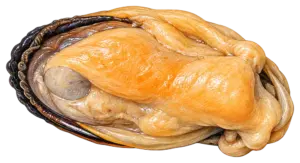
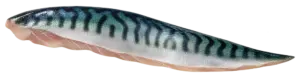
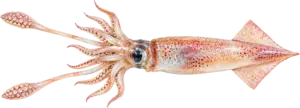

AI-generated illustrations. A click opens the lure’s page.
Rigs for these baits: natural bait rig for the sea.
What the Atlantic wolffish tastes like and what you can do with it
The flesh is pale and fairly firm, suitable for steaming, frying, grilling, deep-frying and braising. The angling press calls it tasty. In the trade the wolffish mostly comes onto the market without head and skinned, fresh or frozen, filleted or in slices.
How to skin and fillet fish is covered in the encyclopaedia. Beforehand the fish must be stunned and killed.
What you need to observe
Closed seasons, minimum sizes and harvest slots are set by the federal states (Bundesländer) and by the fisheries authorities of the neighbouring countries on the coast (Denmark, Norway, Poland). They vary by type of water, stretch of coast and time of year. We only give figures together with the date and source; the fisheries regulation of your federal state and your fishing permit (Erlaubnisschein) are always what is binding. You will find a list of links to the official sources in the catch calendar.
A fish of legal size that you want to keep you stun and kill at once, in line with animal welfare rules. Protected, undersized fish or fish too large under a harvest slot you unhook, if possible still in the water and with wet hands, and release gently. What exactly applies is regulated by state law and your fishing permit (Erlaubnisschein).
Norway has its own rules for sea anglers on minimum sizes (Mindestmaß) and export; the authority responsible is the Fiskeridirektoratet. Its simplified overview does not list the Atlantic wolffish among the protected species. For Europe the IUCN rates the data as insufficient, and the Swedish Red List classes the species in Swedish waters as endangered.
What closed season, minimum size and harvest slot mean and where to find them is explained on the page Closed season and minimum size explained.
Frequently asked questions (FAQ)
Are Steinbeißer, sea wolf and Katfisch the same fish?
Zoologically the species is called Atlantic wolffish. Steinbeißer and Katfisch are trade names under which the spotted wolffish is also sold. The freshwater Steinbeißer is a small loach.
How dangerous are the teeth?
The jaws crack mussels and sea urchins, and a bite can injure seriously. Even a landed fish keeps biting around itself. Never reach into the mouth, and remove the hook only after stunning.
When and where do I catch it best?
In spring, above all in April and May, into July. You look for rocky ground and mussel beds, often in less than 25 metres of water.
Sources
The rating of catch chances is an editorial assessment. The facts come from these sources, and the text is worded in our own words. The illustration is an original design by Angel Momente in the style of a natural history plate (AI-generated, see the AI notice).
- FishBase: Anarhichas lupus
- Thünen-Institut, Fischbestände online: Steinbeißer, Katfisch, Seewolf
- Havforskningsinstituttet: Steinbit (Seewölfe)
- Havs- och vattenmyndigheten: Havskatt (Laichzeit, Laichtiefe)
- Blinker: Steckbrief Steinbeißer (Seewolf, Katfisch)
- Blinker: Angeln auf Steinbeißer
- Fiskeridirektoratet: Sea angling in Norway, regulations (geschonte Arten, Ausfuhrquote)
- Landesfischereiverband Bayern: Fischlexikon (Laichzeit, Lebensraum, Nahrung, Aktivität)
- FishBase: Anarhichas minor (Gefleckter Seewolf, zur Unterscheidung)
- Wikipedia: Gestreifter Seewolf
- Fisheries and Oceans Canada, CSAS Research Document 2014/033: Habitat Use and Movement Patterns of Wolffish (Anarhichas spp.) in Coastal Newfoundland Waters (Simpson et al., PDF)
Created with AI support from the sources listed. Figures only appear in the text if a source gives them. Last updated: 8 November 2026. Found a mistake? Write to us. Who is behind this site: About me.
More in the lexicon
- All fish species at a glance
- Catch calendar – month, water temperature and profile for 93 species
- Line calculator – breaking strain after the knot, drag guideline, backing
- Angling methods