
Knowledge · Tackle
Pike rod: Strong for big baits
A pike rod is a strong spinning or casting rod for big artificial lures: jerkbaits, long soft plastic shads and swimbaits that sometimes weigh well over 100 g. This page covers which weight class suits which lure size, when a baitcaster is worthwhile and what belongs between line and lure.
The lure size decides the rod
There is no single all-purpose rod for pike. A Blinker article divides pike spinning rods into three classes by lure weight. Even a light rod of around 30 g has enough power for a pike, it says, as long as the lures stay small.
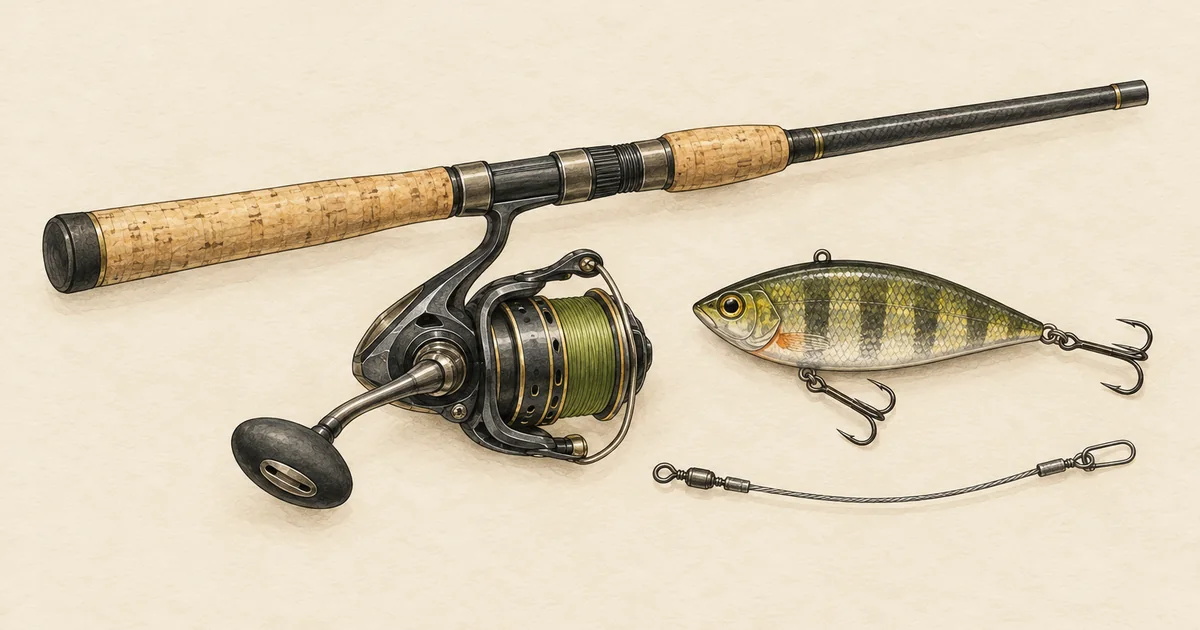
| Class | Typical lures | Casting weight | Reel and line |
|---|---|---|---|
| Light | Crankbaits 10–12 cm, spinners, small soft plastics | around 30 g | Size 2000–2500, braid 0.12 mm |
| Medium | Lures 10–18 cm, swim jerks, larger crankbaits | 60–80 g | Size 3000–4000, line around 10 kg |
| Heavy | big soft plastic shads, swimbaits, large crankbaits | from 100 g, specialist rods 150 to over 200 g | Braid around 0.25 mm |
Guide values from the source, the line strength of the heavy class from a second article in the magazine. The page Spinning rod gives 2.40 to 3.00 m and 20 to 100 g for pike; the heavy class starts above that. The big bait is not firmly defined; one author counts everything from 25 cm.
Big lures have a measurable reason. In a study of 415 pike from a German and a Canadian lake, lures from 150 mm caught larger fish and fewer undersized ones. The smaller the lure, the more often the hook sat deep, see Disgorger. For capital pike, artificial lures of 20 to 40 cm are quoted.
Length: short for jerking, longer for big baits
A jerkbait is a plug without a diving lip; it only works when you jerk it with the rod. According to Rute & Rolle the classic jerk rod is short: 1.80 to 2.00 m, about 6 to 6.5 ft. Classic jerkbaits there often weigh more than 80 g and call for a strong baitcaster rod. The tip should be fine enough for gentle twitches, the backbone, the strong lower part of the blank, stiff enough for the strike in the hard pike mouth. It is mostly worked downward, most easily from a boat or a raised position.
The jerk rod no longer has to be rock-hard: according to Rute & Rolle the lures have become finer in twenty years and need much gentler strokes. Small jerkbaits can even be fished on the pike spinning rod. An author of the magazine fishes them on 2.70 m with about 80 g and estimates that he casts at least a third further that way.
For big baits, two articles name rods from 2.40 m, nearly 8 ft. With soft plastic shads on a jig head, one author fishes 2.70 m up to 120 g from the bank and the boat. The unit converter translates figures given in feet.
Action: stiff for jigging, softer for big soft plastics
On the action, the bending curve under load (see Fishing rods), opinions differ depending on the lure. For soft plastic shads that hop across the bottom, one author wants a very stiff tip action in which only the front 40 cm or so gives way. A soft rod would swallow the jerk and the strike. According to another article a pike hooks itself better on a harder rod, and a rod overview says heavy big-bait rods are often particularly stiff.
The big-bait author in Blinker sees it differently. He fishes big lures on semi- or fully parabolic rods. Big soft plastic shads fly further on them because the rod loads in the cast without a jerk. A very stiff backbone, low-stretch line and big trebles, on the other hand, tear the mouth of a small pike that is only lightly hooked.
Fixed-spool reel or baitcaster
Big lures can also be cast with the fixed-spool reel. Many big-bait anglers still take the baitcaster, a small multiplier with a spool that turns. It gives more control, and the lure does not flip over in the cast. Multipliers are also considered robust enough to take heavy lures in the long run. Drags and thumbing technique are explained under Baitcaster and multiplier reel. Because the baitcaster needs a casting rod with the rings on top, the choice of reel follows the rod.
Line and trace: bite-proof all the way to the lure
A heavy lure loads the line more than the number on the spool suggests. According to the big-bait author, breaking strain values are determined under slow, steady pull, whereas a jerk in the cast or on the strike acts suddenly. He therefore uses braid of about 0.25 mm. The Bavarian exam questions also call for braided line for big pike in snaggy water, because it does not stretch and carries a lot.
In front of the lure, pike fishing needs a trace that the teeth cannot cut through. The Bavarian exam questions name bite-proof material of suitable strength, for example steel. According to Blinker only metal is completely bite-proof. Fluorocarbon is considered pike-proof there only from about 0.90 mm; the big-bait author uses 0.80 mm. A thin fluorocarbon leader therefore does not replace a steel trace. Materials and lengths are compared under Pike trace.
Two rods, two lures: An article advises taking a light and a medium rod ready-rigged and offering both lures at the same spot. Whether that is allowed is decided by the state. In the question catalogue for the angling exam (Fischerprüfung) in Saxony-Anhalt, the correct answer to the question of how many rods may be used when spinning and fly fishing is: „one“. What applies to you is in the state regulation and the fishing permit (Erlaubnisschein).
Landing big pike and unhooking them
A strong rod helps the fish too. One author keeps a big pike under control in the fight with his 120 g rod and leads it away from snags. The Swiss fisheries advisory service FIBER lists choosing tackle so that the fight stays short among the measures against needless mortality.
One article advises always landing specimen pike with a large landing net rather than by hand, because fish that are almost caught often still thrash free. The Bavarian exam questions warn that if you grip behind the head you can get into the gills and injure both fish and angler. The net head size for pike is covered under Landing net, the mat under Unhooking mat, and the procedure under Landing and unhooking a fish.
Whether you may take a pike home is decided by the closed season (Schonzeit) and minimum size (Mindestmaß) set by the state. The Bavarian angling exam (Fischerprüfung) asks about the closed season, for example, based on the implementing regulation to the Bavarian fisheries act (AVBayFiG). The figures are in the state regulation and the fishing permit (Erlaubnisschein); the terms are explained under Closed season and minimum size explained.
Jerk rod and soft-plastic rod compared
Jerk rod: short, stiff, with a baitcaster
The jerk rod is usually a casting rod: reel and rings sit on top, and the trigger grip sticks out under the handle (construction under Spinning rod). In a basic pike outfit, Rute & Rolle describes a 1,90 m jerk rod with a casting weight of 100 to 120 g, fitted with a baitcaster. The author also casts larger plugs with it.
A Blinker report on jerkbait fishing in winter gives two reasons for the short, stiff build. What the angler puts in with the wrist reaches the lure through the stiff blank without loss. On the strike, the stiff rod pulls the lure a little further while it is still in the pike’s mouth, so that the trebles take hold. To keep the lure running at the same depth, the boat angler in the report lowered the rod tip the closer the jerkbait came, until it almost touched the water just before the boat. Over very shallow ground the same report advises jerking upwards, otherwise the lure collects weed. The report dates from 2014. That today’s jerkbaits work with gentler strokes and the tip should not be too stiff is covered above in the section on length.
Casting with a baitcaster is different from casting with a fixed-spool reel. According to Blinker the rod must load evenly during the cast. A jerky flick accelerates the spool more than the lure can pull off line, and a bird’s nest, a tangle of loose line, forms on the reel.
Short is not a fixed rule. For large jerkbaits in winter, a 2024 Blinker article names baitcasting rods of 2,30 to 2,70 m rated 100 to 200 g. For smaller jerkbaits the same article recommends rods of the same length with a fixed-spool reel and 50 to 100 g.
Soft-plastic pike rod: longer, with a firm backbone
For soft plastics on a jig head the rod looks different. In the same Rute & Rolle basic outfit, the all-rounder is a 2,70 m spinning rod rated 80 g with a firm backbone and a moderate tip, paired with a size 4000 fixed-spool reel. With it the author fishes small soft plastics as well as 23 cm shads. If you only fish from a boat, the article says 2,20 to 2,40 m will do; anglers who fish only from the bank choose 3 to 3,30 m.
A Blinker article on jigging from the bank, written with zander as the example, explains why length matters. Only a long rod lifts the lure high enough for it to sink for a long time, and a snag between stones or branches comes free more easily with it. For bank anglers the article names 2,70 or 3,00 m. Here the movement is upwards: a sharp lift raises the rod from about 10 to 12 o’clock, then the soft plastic sinks to the bottom on a tight line. This rod must not be as floppy as a “lamb’s tail”; it should respond to even a small movement of the hand. The rig is shown under Jig head rig.
| Feature | Jerk rod | Soft-plastic rod |
|---|---|---|
| Length | 1,80–2,00 m, also up to 2,70 m | 2,70 m, from the bank up to 3,30 m |
| Casting weight | 100–120 g, large jerkbaits up to 200 g | around 80 g, large soft plastics up to 120 g |
| Reel | Baitcaster | Fixed-spool reel, size 4000 |
| Movement | Strokes, mostly downwards | Lift, lure sinks to the bottom |
Guide values from the Blinker and Rute & Rolle articles mentioned. A rod for both remains a compromise. The Rute & Rolle basic outfit gets by with two combinations: the spinning rod for soft plastics and plugs, and the short jerk rod with a baitcaster. Whether you may use two rods at the same time is regulated by your federal state (Bundesland); see the note on two rods above.
Common mistakes
- Big bait on a rod that is too light. Then the strike will not come through cleanly, and the rod may even break on the cast. Allow for the belly weight of big soft plastics.
- One broomstick for everything. A stiff rod suits jigging, but with big soft plastics an overly stiff blank harms small pike that are only lightly hooked. A jerk rod also needs a tip that is not too stiff.
- Choosing the line by its printed rating. With a heavy bait even a 60 cm pike can break the line. What your line still holds after the knot is worked out by the Line calculator.
- Big baits on a small pond. On small lakes and tightly confined spots, big baits scare the fish off, writes the big-bait author.
Frequently asked questions
Is my zander rod enough for pike?
For small pike baits often yes, with a bite-proof hooklength. Rods around 30 g are already considered strong enough. For jerkbaits and big soft plastics it usually lacks the casting weight: a zander jig rod is around 14 to 56 g, more under Zander rod.
Do I need a baitcaster for jerking?
Not for small models, which go on a spinning rod with a fixed-spool reel. Classic jerkbaits over 80 g need short, strong rods with a multiplier reel.
Can I fish all pike baits with one rod?
Only with compromises, because the choice is always a trade-off between bait control and the fight. The mid-range class of 60 to 80 g covers baits from 10 to 18 cm. For all big baits on one rod, the big-bait author recommends a semi-parabolic one.
Why is a jerk rod so short?
A short, stiff rod passes every movement of the wrist straight to the lure and drives the trebles into the hard pike’s mouth on the strike. The strokes mostly go downwards towards the water. For large winter jerkbaits, however, a Blinker article also names baitcasting rods of up to 2,70 m.
Related
- Spinning rod: spinning and casting rod compared
- Pike trace: wire, titanium and fluorocarbon compared
- Baitcaster and multiplier reel: setting the brakes, avoiding bird’s nests
- Jerkbait: gliders, divers and how to work them
- Unhooking forceps: removing trebles safely from a pike’s mouth
- Pike: holding spots and feeding times
- Jig heads: weight and shape for the soft plastic
- Line calculator: breaking strain after the knot
Sources
- Blinker: Die richtige Spinnrute auf Hecht, 3 Klassen (Gewichtsklassen, Big-Bait-Ruten, Baitcaster, zwei Ruten)
- Blinker: Angeln mit Big Baits, großer Köder, großer Hecht (Big Bait ab 25 cm, Schnur, Fluorocarbon ab 0,80 mm, Aktion)
- Blinker: Raubfischrute, wichtige Kriterien für die Auswahl (2,70 m bis 120 g, straffe Aktion, Zander-Jigrute) und Blinker: Spinnrute, welche Rute passt zu meinem Zweck? (schwere Spinnruten)
- Blinker: Die 10 größten Fehler beim Hechtangeln (Ködergröße, Kescher)
- Blinker: Fluorocarbon-Vorfach für Hecht (Fluorocarbon ab 0,90 mm) und Blinker: Bissfeste Mono-Vorfächer (nur Metall völlig bissfest)
- Rute & Rolle: Grundkurs Jerken (Jerkrute, Multirolle), Rute & Rolle: Jerken mit der Spinnrute (kleine Jerks an der Spinnrute) und Rute & Rolle: Jerken heute (feinere Köder)
- Rute & Rolle: Hecht, die Basisausstattung (Jerkrute 1,90 m mit Baitcaster, Spinnrute 2,70 m für Gummifische, Längen für Boot und Ufer)
- Blinker: Winterjerken auf Hechte (kurze, harte Ruten, Schlagrichtung) und Blinker: Jerken im Winter mit Winter-Jerks (Baitcastruten 2,30 bis 2,70 m)
- Blinker: Angeln mit der Baitcaster-Rolle (gleichmäßiger Wurf) und Blinker: Jiggen, diese 10 Fehler sollte man vermeiden (Rutenlänge und Aktion beim Jiggen)
- Carleton University (Fish Ecology and Conservation Physiology Lab) mit IGB Berlin: Size Selectivity, Injury, Handling Time, and Determinants of Initial Hooking Mortality in Recreational Angling for Northern Pike (North American Journal of Fisheries Management 2008, PDF) (Ködergröße, Fischgröße und Hakensitz)
- FIBER, Schweizerische Fischereiberatungsstelle: Schonende Methoden (kurzer Drill)
- Bayerische Landesanstalt für Landwirtschaft: Prüfungsfragen zur Fischerprüfung 2023/2024 (PDF) (Vorfach, Schnur, Griff hinter den Kopf, Schonzeit)
- Land Sachsen-Anhalt: Fragenkatalog zur Fischerprüfung (PDF) (Rutenzahl beim Spinnangeln)
Text AI-assisted, drawing AI-generated. Sources opened and checked in October and November 2026, no graphics taken from the sources.
All figures are guideline values without guarantee. Which rod suits depends on bait weight, water and casting style; state law and your fishing permit are what count for the number of rods, closed season and minimum size.