
Knowledge · Tackle
Disgorger and artery clamp: Removing a hook from deep in the mouth
Forceps take the hook out where fingers have no business: from the toothy mouth of a pike or zander, or deep from the throat. Here is which design suits what, how you apply it and when it is better for the fish not to remove the hook at all.
When you need long forceps
For roach or bream a classic disgorger with an eye is usually enough. With toothy predators the angler also risks injury. Blinker advises pike anglers to use the extra-long version so that the hand does not end up between the teeth when the bait has been sucked in deep.
The British Pike Anglers‘ Club (PAC) gives a length in its code of conduct: clamp or long-nosed pliers at least 10 inches, so a good 25 cm, plus side cutters with a long neck.
How often the hook sits deep depends strongly on the bait. A pike study from 2008 evaluated 415 pike. With natural bait the hook sat in the throat in 15.4% of the fish. Gills and throat were hit more often with natural bait, soft plastic, jig and spoon than with spinner and plug, and small baits under 75 mm hooked in the gills more often. Unhooking fish hooked in the gills took longest. For pike and zander on deadbait, a deeply swallowed treble sits fast in the throat, and removing it is like an operation the fish often does not survive.
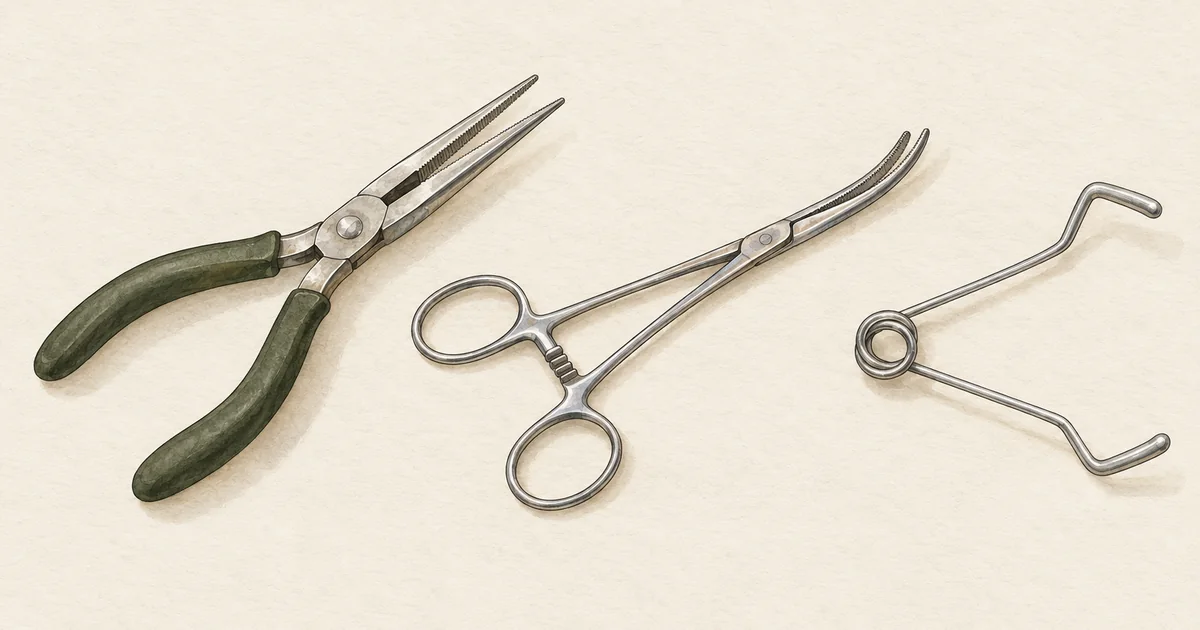
Three designs compared
Long forceps
Basically long-nosed pliers with long, slender jaws. Many angling pliers also have cutting jaws, a split-ring opener or a fitting for crimps, as the pike trace requires. Dedicated predator forceps are considered very practical but bulky in the pocket.
Artery clamp
The artery clamp comes from surgery. It is held like scissors but has two cross-ribbed jaws instead of blades and a ratchet, a lock that keeps it closed. There are straight and curved shapes. Once locked, the clamp does not slip off the hook. Curved jaws are usual for the predator’s mouth, and for pike the extra-long version.
Gag
According to the Saxony-Anhalt exam questions, the gag holds a predator’s mouth open for unhooking. The equipment guide of the Löningen angling club recommends it for larger predators, though in the section on fish that are kept and only unhooked after being killed.
For a live pike that is going back into the water, pike anglers take a critical view. The PAC says never to use a gag when unhooking and relies on forceps and the hand grip. A guide by the Deutscher Hechtangler-Club (DHC) published in Blinker argues along the same lines: with the gill cover grip, the pike usually opens its mouth by itself, so a gag is unnecessary. In the pike study, on the other hand, the researchers used gags to cut off deeply lodged hooks. None of the sources evaluated here gives figures on injuries caused by the gag itself. What helps instead of the gag is explained below under Jaw spreaders and the alternatives.
Removing the hook with forceps or a clamp
Landing net, wet hands and unhooking mat are described in Landing and unhooking a fish.
- Secure the head. In the gill-cover grip according to the DHC, you slide index and middle finger under the gill cover, feel your way towards the tip of the mouth and hold against it from outside with your thumb. According to Blinker, the hand belongs only between the gill cover and the first gill arch. The PAC lays the pike on its back for this and holds the lower jaw through the gill cover, without touching the gill rakers.
- Do not reach into the gills. The Bavarian exam questions warn that when you grip behind the head your hand can get into the gills, and then fish and person are injured.
- Take hold of the hook and lock. Close the artery clamp to the ratchet so that it does not slip off the hook. A large single hook can be gripped far better than a treble.
- Cut off dangerous points. If a hook point sits near the eye or in the gills, the DHC strongly advises snipping it off.
- Protect your hands. If you are unsure of your grip, keep a landing glove ready. The researchers of the pike study expressly used long side cutters to protect their hands.
Deeply swallowed: remove or cut
In the pike study from 2008, deeply hooked fish bled more often, and bleeding raised mortality shortly after capture. The researchers did not even try to pull deep-sitting hooks out through the mouth with the long forceps. They snipped the hook shank through with long side cutters, and the part with the barb stayed in the fish. Their advice: do not operate on deeply swallowed hooks in pike, and strike quickly when fishing with natural bait.
How much the position of the hook matters is shown by a field trial by the Thünen Institute with Baltic flatfish, which stayed in net cages for 6 to 7 days after capture.
| Hook position | Plaice died | Dab died |
|---|---|---|
| Lip or front of mouth | around 1% | around 3% |
| deeply swallowed | around 42% | around 71% |
The anglers taking part most often removed deep-sitting hooks with pliers or an artery clamp. With these, around 71% of deeply hooked flatfish died, and with a flatfish disgorger, around whose rod the fish is turned, around 55%. Because of too few cases, the authors speak only of a tendency. Some hooks broke off during removal and stayed in the fish. Cutting the hooklength just before the mouth could lower mortality, write the Thünen researchers, pointing to recommendations for other species.
A WWF angling guide for Mecklenburg-Western Pomerania, advised on the science by the Leibniz-Institut IGB and the state office LALLF, puts it more plainly: cutting the line and leaving the hook in the fish usually results in lower mortality. For steel traces and thick hook shanks there are dedicated cutters, because many cutting tools reach their limits on steel.
Mind the law: Research recommends cutting more widely than some exam materials permit. The Saxony-Anhalt question catalogue allows briefly cutting the line only for undersized eels with a deeply swallowed hook. For an undersized fish that is bleeding heavily and no longer trying to escape, the Bavarian exam questions provide for stunning and a gill cut, with trace and hook left in the throat as proof. What applies at your water is set by state law and the fishing permit (Erlaubnisschein).
Crushing the barb with pliers
The pliers have a second job before the first cast: with them you crush the barb of an ordinary hook. The PAC prefers hooks with a half or crushed barb in sizes 4 to 6 and stresses that this is no licence to let the pike swallow the bait. According to the WWF guide, barbless hooks injure less and can be removed faster, often still in the water. In return more fish are lost if contact breaks during the fight. More on gentle hooks and circle hooks is under Fish hook.
Jaw spreaders and the alternatives
A jaw spreader holds a predator’s mouth open while you remove the hook. In the exam questions it is called Rachensperre (Bavaria) or Rachensperrer (Saxony-Anhalt); in English it is a gag or jaw spreader. A review of gentle catch and release in the journal Fisheries Research lists spreaders alongside pliers among the tools for unhooking. It considers pliers and purpose-built unhooking tools useful above all for species with sharp teeth and where the hook sits deep in the mouth.
For a live fish that is going back, the spreader remains controversial: PAC and DHC manage without it, as described above under gag. The guide of the English anglers‘ body Angling Trust lists long pliers, forceps and good side cutters for pike; a spreader does not appear on the list. According to the guide, anyone fishing for pike and zander needs special unhooking tools and the skill to use them.
None of the sources evaluated here provides injury data on the spreader itself. A different tool used on the jaw has been studied: in a study on bonefish (a marine species), mechanical fish grips caused considerable damage to the mouth, up to and including broken jaws, the same review reports. More on this under Fish grips. Whether this applies to the spreader is not examined by any of these sources.
Without a spreader, the sources name these options:
- Gill cover grip. Two fingers between the gill cover and the first gill arch, with the thumb pressing against the outside. Applied correctly, the pike usually opens its mouth by itself, according to the DHC (Fig. 2).
- Reach instead of a gag. Forceps or long-nose pliers of at least a good 25 cm according to the PAC, plus side cutters with which, according to the Angling Trust, you can cut through a hook if necessary.
- Unhook in the water where possible. The review names unhooking in the water as a way of sparing the fish the stress of being in the air.
Common mistakes
- Pliers too short for pike. The fingers get close to the teeth; the PAC sets a good 25 cm.
- Operating on a deeply swallowed hook. In the Thünen trial such fish stayed in the air longer, and some hooks broke off.
- Going to the water without side cutters. The authors of the pike study consider it possible that inexperienced pike anglers in particular lack side cutters and pliers. Then all that is left is pulling.
- The gag as standard on a live pike. The PAC rejects it, the DHC considers it unnecessary.
- Waiting before striking. With deadbait the pike study and the PAC advise a quick strike. The PAC would rather miss a pike than hook it deeply.
Frequently asked questions
Is an ordinary pair of angling pliers enough?
Usually yes: ordinary angling pliers or a multitool do the job in most situations. On pike and with baits sucked in deep they lack reach, and there you take the extra-long forceps or clamp.
Straight or curved artery clamp?
Both shapes exist. Curved jaws are usual for the predator’s mouth. As soon as teeth are involved, though, length counts first.
Does a jaw spreader harm the pike?
None of the sources evaluated here contains measurements on this. The PAC rejects the spreader for unhooking, and the DHC considers it unnecessary. Both rely on the gill cover grip and long forceps.
What happens to the hook that stays in the fish?
According to the 2008 pike study, this had not yet been investigated in pike. How pike coped after a line break with the bait in the mouth is described under Pike trace. X-ray trials on eels with a cut line are described on the page Fish hook.
Do I have to carry an unhooking tool?
The exam materials see it this way: Saxony-Anhalt counts the disgorger among the accessories you absolutely need, Bavaria among what belongs with you for reasons of sporting conduct. Whether your state prescribes it is in state law, see Law & licence.
Related
- Landing and unhooking a fish: landing net, mat and wet hands before unhooking
- Disgorger: the tool for small hooks and coarse fish
- Pike: mouth, teeth and lies in profile
- Releasing a fish: obligation, grey area and survival rates
- Hook injuries and first aid: when the hook is stuck in your own hand
- Fish grips: design and what studies show about mouth injuries
- Multitool and fishing pliers: which tool helps at the water
- Line calculator: breaking strain of main line and hooklength after the knot
Sources
- American Fisheries Society: Size Selectivity, Injury, Handling Time, and Determinants of Initial Hooking Mortality in Recreational Angling for Northern Pike (2008, PDF) (Hakensitz, Blutungen, Abkneifen, Anhieb)
- Thünen-Institut: Überlebensraten nach dem Zurücksetzen in der Angelfischerei auf Plattfische (2025, PDF) (Sterblichkeit nach Hakensitz und Lösemethode, Abschneiden)
- Pike Anglers‘ Club of Great Britain: Recommended code of conduct (2024, PDF) (Länge, Rachensperre, Griff, Widerhaken, Anhieb)
- Fisheries Research: Best practices for catch-and-release recreational fisheries, angling tools and tactics (2017, PDF) (Spreizer als Abhakwerkzeug, Zangen bei bezahnten Arten, Abhaken im Wasser, Kieferschäden durch Fischgreifer)
- Angling Trust: Best Practice Guide for Freshwater Angling (2025, PDF) (Werkzeug für Hecht, Spezialausrüstung für Hecht und Zander)
- WWF mit IGB und LALLF MV: Fische angeln und wieder zurücksetzen (2024, PDF) (Schnur kappen, Haken ohne Widerhaken)
- Blinker: Angler-Werkzeug (extralange Zange, Arterienklemme, Angelzangen, Schneiden von Stahl)
- Blinker: Drillingshaken und ihr Nachteil (tief geschluckter Drilling, gebogene Klemme, Einzelhaken)
- Blinker: DHC-Tipps zum schonenden Zurücksetzen (Kiemendeckelgriff ohne Rachensperre, Spitzen abkneifen)
- Blinker: Handlandung (Griff am ersten Kiemenbogen, Handschuh)
- Blinker: Aal zurücksetzen (Widerhaken mit der Zange andrücken)
- LfL Bayern: Prüfungsfragen zur Fischerprüfung 2023/2024 (PDF) (Hakenlöser, Griff hinter den Kopf, tief gehakter Fisch)
- Land Sachsen-Anhalt: Fragenkatalog zur Fischerprüfung (PDF) (Rachensperrer, Hakenlöser, Abschneiden nur beim Aal)
- Fischereiverein Löningen: Gerätekunde (PDF) (Arterienklemme, Rachensperre bei entnommenen Fischen)
- Wikipedia: Arterienklemme (Aufbau, Formen, nur ergänzend)
Text AI-assisted, drawing AI-generated. Sources opened and checked in October and November 2026, no graphics taken from the sources.
All figures are guide values without guarantee. Whether you may remove or cut a deep-sitting hook is set by state law and fishing permit; the text replaces neither legal nor medical advice.