
Knowledge · Tackle
Multitool and angling pliers: Which tool helps at the water
A pair of angling pliers removes hooks, opens split rings and cuts monofilament or wire trace. For unhooking, according to Blinker, a multitool with pliers usually does the job too. For braid, pike and the crimp on a home-made trace, however, you need dedicated tools.
What the pliers do at the water
Their most important job is unhooking. A review of fish release in the journal Fisheries Research describes pliers and purpose-built unhooking tools as often indispensable for removing a hook from the tissue quickly and with little damage. That shortens the time the fish spends in your hand. This applies especially to species with sharp teeth or a bony mouth and to deeply set hooks.
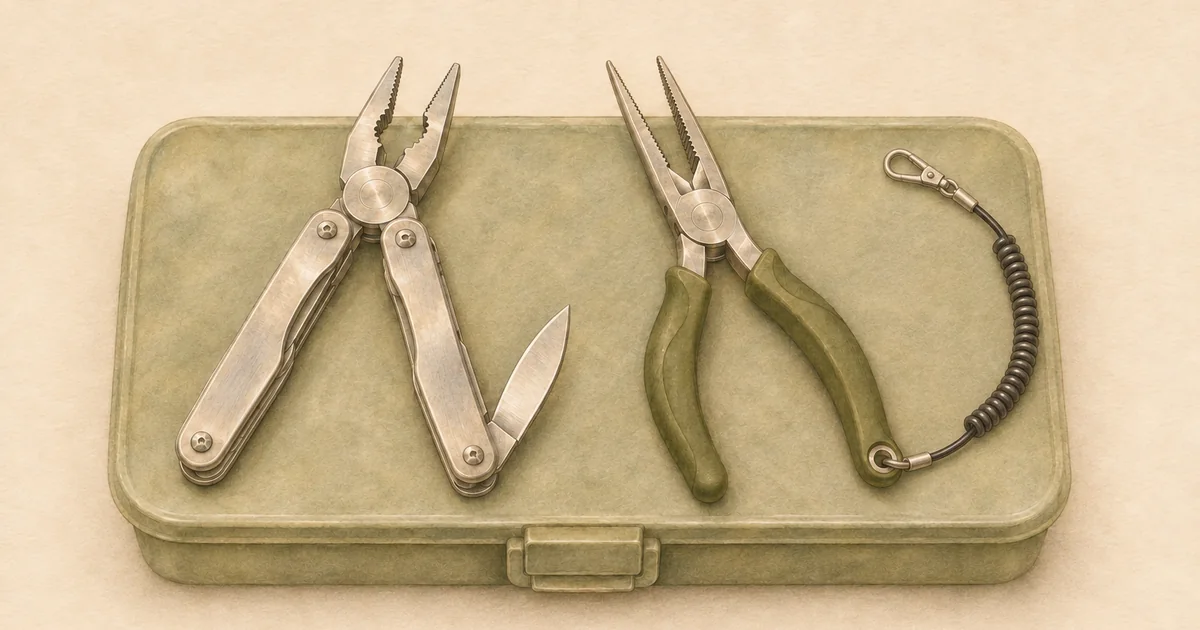
According to Blinker, an ordinary pair of angling pliers or a multitool with pliers is enough in most cases. For small hooks in coarse fish, a disgorger with an eye is often handier. With pike you reach for extra-long pliers or forceps. The British Pike Anglers‘ Club sets at least 10 inches for this, a good 25 cm. How to use them in the mouth is explained under Disgorger pliers and artery forceps.
Besides that, the pliers take care of a range of small jobs:
- Flatten the barb. If you want to release fish, flatten a pronounced barb with the pliers beforehand. That is Blinker’s advice in an article on releasing eels gently.
- Open split rings. Many combination pliers have a small tooth at the front as a split-ring opener (Fig. 1). The procedure for changing trebles is shown on the Split-ring pliers page.
- Tighten knots. Pliers hold the hook more securely while you pull the knot tight than your fingers, between which it easily slips. Hooks never go between your teeth. What the knot will still hold afterwards is worked out by the Line calculator.
- Bend open eyes. With the tip you open the eye of a lead clip or metal boom to hook in a swivel.
- Cut. The cutting jaws of many angling pliers are designed for wire and usually cope with monofilament too. Braid, on the other hand, they often fray; that is what line scissors are for.
With crimp sleeves, the small metal tubes that clamp wire or thick fluorocarbon leaders into a loop, combination pliers reach their limit. Their crimping groove is often simply made and only presses at a few points, so the connection holds less well. If you build such leaders yourself, get a dedicated pair of crimping pliers. These close the sleeve without crushing it. A sleeve crimped too hard damages the line inside it. More on crimping under Pike leader.
| If you … | then take … | and watch out for … |
|---|---|---|
| remove small hooks from coarse fish | disgorger or forceps | keep the fish in your hand only briefly |
| unhook a pike | extra-long pliers or forceps | at least 10 inches (PAC) |
| cut braid | Scissors with a serrated edge | plier cutters fray it |
| cut monofilament or wire trace | the pliers’ cutting jaws | wire blunts scissors |
| have to snip through a hook shank | sturdy side cutters | not every cutter can handle hook steel |
| crimp sleeves | crimping pliers | combination pliers press at only a few points |
Angling pliers, multitool and side cutters
Angling pliers
Essentially a pair of needle-nose pliers with long, slender jaws, often with cutting jaws, a split-ring opener and a groove for crimp sleeves. Alongside these there are artery forceps from surgery, which can be locked. For unhooking predators, both are covered under Disgorger pliers.
Multitool
On a multitool the pliers sit between two handle shells that hold further tools. The plier head is a pair of needle-nose or combination pliers, sometimes with a wire cutter. Blades, metal files, awls, saws, screwdrivers or bit holders fold out. On some models the folded-out tools lock in place. Blinker counts multitools among the most versatile tools at the water, but considers some of the extra tools more or less useful.
The file in the handle is a tool for metal. How to rework a blunt hook point and why a finer stone follows the file is explained under Hook sharpener. As for using the screwdriver on a reel: only open the housing with the exploded diagram for your model, see Cleaning a fishing reel. Screw a handle that goes directly into the drive gear back in cleanly. Otherwise dirt in the thread can damage it.
Side cutters and cutters
A dedicated pair of side cutters is the tool for the heavy work. Strong versions cut stainless steel wire, robust cutters even hook shanks. You need this when a hook cannot be removed from the fish and has to be snipped off. The British angling body Angling Trust therefore advises pike anglers to carry a good pair of side cutters in addition to long pliers and forceps. When snipping is better than removing is explained under Disgorger pliers. A Blinker packing list for sea fishing in Norway even includes a bolt cutter alongside the split-ring pliers.
Stainless steel, salt water and care
Sea Angler recommends stainless steel multitools because they resist corrosion even when left in the tackle box. Cheap chrome-plated clippers, on the other hand, tend to rust and go blunt, according to Sea Angler. But stainless does not mean saltproof. According to the Lexikon der Chemie (Spektrum), pinhole-like holes can form on chromium-nickel steels in the presence of chloride, known as pitting corrosion. Aluminium, copper and nickel can also be affected. Seawater supplies the chloride. The Lexikon counts titanium among the resistant materials and points out that protective coatings only last for a limited time and must be renewed.
Sea Angler calls salt the main enemy: even expensive tackle corrodes if it is left salty and wet in humid air. This gives you the care routine after a day on the coast:
- Rinse. Rinse pliers and multitool with fresh water at home, as the angling press also recommends for hooks and artificial lures used in salt water.
- Dry. Open the tool out and let it dry. The Lexikon der Chemie names drying and removing chloride as a way to slow down corrosion.
- Protect it for the break. For storage and periods of non-use, the same Lexikon describes temporary protective coatings of mineral oils and waxes. A thin film of oil on the joint and spring follows this idea.
- Don’t forget the pouch. Pouches hold on to salt and moisture if they are not washed regularly. A clean tool does not belong back in a salty sheath.
- Check small parts. According to Blinker, light surface rust on hooks and split rings is still acceptable; with heavy rust, both should be replaced.
How the rest of your tackle gets through the winter is explained under Storing fishing tackle for winter.
The blade on a multitool and § 42a WaffG
Many multitools have a blade, and that means the Weapons Act (Waffengesetz) applies. Under § 42a paragraph 1 it is prohibited “to carry knives with a blade that can be locked with one hand (one-handed knives) or fixed-blade knives with a blade length over 12 cm”. Under paragraph 2 this does not apply to transport in a locked container, nor where there is a legitimate interest. According to paragraph 3, such an interest exists in particular if carrying the knife is connected with practising a profession or “serves the preservation of customs, sport or a generally recognised purpose”.
A pointer, not legal advice: The section does not mention multitools or angling. Whether the blade of your tool can be locked with one hand and what counts as a legitimate interest is decided, in case of doubt, by the responsible weapons or public order authority. The current wording of the law is what counts. Further bans, for example at events, are explained on the Angling knife page.
Carrying and packing within reach
A multitool is made to be carried in your trouser pocket or on your belt. To stop anything ending up in the water, there are two solutions: lanyards on which tools hang around your neck or are attached to the angler, and retractable zingers that keep a single tool within reach without it getting lost. A coiled lanyard as in Fig. 1 is one form of this safeguard. When wading, pliers and forceps can be attached to your wading vest.
The Bavarian exam questions for the angling exam (Fischerprüfung) name disgorger pliers, priest and knife as useful tools for trout fishing. That is exam material, not a regulation. What your federal state (Bundesland) actually requires is explained under Mandatory equipment.
Checklist for the tool pouch
Compiled from the sources on this page, to tick off before your fishing day:
- Angling pliers or a multitool with pliers
- for pike, extra-long pliers or forceps as well
- Disgorger for small hooks
- Side cutters, strong enough for wire and hook shanks
- Scissors with a serrated edge or nail clippers for braid
- Split-ring pliers if your pliers have no opener
- fine hook sharpener
- Knife, see Angling knife, and fish priest if you are taking fish home
- Tape for quick repairs and superglue
- small head torch
- Bag for line scraps and rubbish
- First aid pouch, see First aid kit
- at home at the tying bench: crimping pliers for crimp sleeves
Hook in your own skin: The principle of first aid organisations applies here: according to the Deutsches Rotes Kreuz (German Red Cross), foreign bodies are only removed by a doctor. What to do until then is explained under Hook injuries and first aid. This note does not replace medical advice.
Common mistakes
- Cutting braid with pliers. The cutting jaws are designed for wire and monofilament; braid frays at the cut.
- Closing crimp sleeves in the groove of combination pliers. A few pressure points hold less well, and if you press too hard you damage the line in the sleeve.
- Going at a pike with short pliers. Your fingers get close to the teeth; the PAC sets at least 10 inches.
- Packing the tool away salty. Even stainless steel can suffer pitting from chloride; rinsing and drying are part of every day at the sea.
- Holding hooks with your teeth. Sea Angler expressly warns against tightening knots this way. That is what the pliers are for.
Frequently asked questions
Is a multitool enough instead of angling pliers?
For unhooking, usually yes; a multitool with pliers does the job in most situations. For pike it lacks the length. For braid use scissors, for crimp sleeves a dedicated pair of crimping pliers.
Are stainless steel pliers saltwater-proof?
Not without care. Stainless chromium-nickel steels can suffer pitting in the presence of chloride, and aluminium can be affected too. After every day in salt water, rinse the tool with fresh water and let it dry.
Can I take a multitool with a blade fishing?
§ 42a WaffG prohibits carrying one-handed knives and fixed-blade knives with a blade over 12 cm; exceptions are transport in a locked container and a legitimate interest. Whether angling counts and whether your blade can be locked with one hand is not stated in the text of the law. If in doubt, ask the responsible public order authority.
Do I need dedicated pliers for crimp sleeves?
If you build wire or thick fluorocarbon leaders yourself, yes. The grooves in combination pliers only press at a few points and hold less well than crimping pliers.
Related
- Disgorger pliers and artery forceps: removing or snipping hooks deep in the mouth
- Split-ring pliers: changing trebles on artificial lures step by step
- Line scissors: cutting braid cleanly, disposing of offcuts properly
- Angling knife: blade shapes and the Weapons Act in detail
- Hook sharpener: recognising blunt points and filing them
- Pike leader: wire, crimp sleeve and crimping pliers
- Hook injuries and first aid: when a hook is stuck in the skin
- Line calculator: working out the strength of line and knot
Sources
- Blinker: Angler-Werkzeug, was muss noch mit ans Wasser? (2025) (Angelzange oder Multitool reicht meist, extralange Zange am Hecht, Hakenlöser, Klemmvorrichtung und Klemmhülsenzange, Sprengringöffner, Multitools, Cutter für Hakenschenkel, Hakenschleifer, Stirnlampe, Tüte, Sekundenkleber)
- Blinker: Immer gut abschneiden (2025) (Schneidbacken für Stahl und Monofil, robuste Cutter, Haken im Fisch abkneifen, Schere mit gezackter Schneide) und Blinker: Immer in der Tacklebox (2026) (Zangen-Cutter fransen Geflecht aus)
- Blinker: Angelausrüstung für Norwegen (2025) (Werkzeugliste mit Sprengringzange, Bolzenschneider und Klebeband, Flugrost), Blinker: Rollenpflege (2024) (Kurbelgewinde), Blinker: Angeln am Mittelmeer (mit Süßwasser abspülen) und Blinker: Aal zurücksetzen (Widerhaken mit der Zange andrücken)
- Sea Angler: Basic Rig Making Tools (Klemmhülsenzange, Knoten mit der Zange festziehen, Ösen öffnen, Seitenschneider für Edelstahldraht, Multitool aus Edelstahl, verchromte Clipper) und Sea Angler: Look after your tackle (Salzkorrosion, Taschen)
- Fisheries Research: Best practices for catch-and-release recreational fisheries, angling tools and tactics (2016, PDF) (Zangen und Lösewerkzeuge, kürzere Handhabung)
- Pike Anglers‘ Club of Great Britain: Recommended code of conduct (2024, PDF) (Mindestlänge der Zange) und Angling Trust: Best Practice Guide for Freshwater Angling (2025, PDF) (Seitenschneider am Hecht)
- Spektrum Lexikon der Chemie: Lochfraßkorrosion (Chlorid, Chrom-Nickel-Stahl, Aluminium) und Spektrum Lexikon der Chemie: Korrosionsschutz (Titan, Schutzschichten, Trocknen, Öle und Wachse)
- Bundesministerium der Justiz: Waffengesetz § 42a (Führverbot und Ausnahmen, Wortlaut, abgerufen am 07.11.2026)
- LfL Bayern: Prüfungsfragen zur Fischerprüfung 2023/2024 (PDF) (sinnvolle Werkzeuge beim Forellenfischen)
- Deutsches Rotes Kreuz: Wundversorgung und Verbände (Fremdkörper nur vom Arzt entfernen)
- Wikipedia: Multifunktionswerkzeug (Aufbau, Zusatzwerkzeuge, Tragen am Gürtel, nur ergänzend) und Wikipedia: Fly fishing tackle (Umhängebänder und Aufroller, nur ergänzend)
Text AI-assisted, drawing AI-generated. Sources opened and checked in November 2026; no graphics taken from the sources.
All figures are guide values without guarantee. Which tool suits depends on target fish, line and water; whether you may carry a blade is governed by the current version of the Weapons Act (Waffengesetz), and in the case of injuries this text does not replace medical advice.